
The Best Fluffy Pancakes recipe you will fall in love with. Full of tips and tricks to help you make the best pancakes.



Green winter nails can feel wonderfully different depending on what you pair with them. A deep emerald base and a silver moon have a quiet, evening mood; soft sage with a white fern looks lighter and more delicate. Add ivory, a little gold or a sheer blush base, and the same color family opens up into an entire winter manicure wardrobe. This collection brings those moods together in 17 designs, from tiny snowflakes to flowing marble and miniature mountain scenes.
The palette is the thread that connects them: forest green, emerald and sage, balanced with creamy white and small metallic details. Some ideas lean into Christmas with holly or a decorated evergreen. Others, such as the Art Deco fan, constellation pattern and malachite marble, can work well beyond the holidays. You do not have to choose a festive motif to enjoy a rich green manicure in winter.
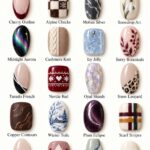
Below, the ideas follow the reference board from left to right, one row at a time. Each close-up shows how the single nail design can become a coordinated manicure, with simpler supporting nails where the main artwork needs room. Use the pictures to choose a mood, then read the salon notes to decide what matters most: the exact shade, the placement of the pattern or the contrast between glossy color and metallic detail. A good reference gives your nail artist a clear starting point while leaving room to adapt the design to your own nail length.
Find Your Favorite Shade of Green
Deep emerald gives white snowflakes and silver stars a crisp backdrop. Forest green feels a little quieter, especially beside ivory or gold. Sage is the softer option when you want a lighter manicure that still belongs to the collection. Compare each shade beside your everyday coat or favorite sweater; the color you enjoy wearing is a more useful starting point than a rigid seasonal rule.
- Soft and delicate: Frosted Sage Fern, Evergreen Sprig on Ivory and Sage Snowflake French.
- Dark and luminous: Moonlit Emerald, Silver Constellations on Emerald and Golden Art Deco Fan.
- Festive: Snowy Evergreen on Blush, Silver Tartan on Forest Green and Holly Leaves and Red Berries.
- Statement artwork: Malachite Marble with Gold Veins, Snowy Mountains under a Green Sky and Evergreen Forest Moon.
1. Emerald Snowflake

A large white snowflake looks especially clear against this deep emerald base. The smaller dots and stars give it a snowy setting, but the main snowflake should still be the first thing you notice. I would keep most of the hand glossy green so the detailed accent has a little space around it. The result feels seasonal without needing several different holiday motifs.
What to ask for: Ask for one clean, six-armed snowflake with fine branching strokes. On shorter nails, simplify the branches and keep a clear green border around the design.
2. Evergreen Sprig on Ivory

This is one of the quieter designs in the collection, and that is its appeal. The little green needles have enough contrast to stay visible on ivory, while the fine brown stem keeps the branch from looking like a flat green stripe. I like it with cream knitwear or a soft camel coat, where the tiny botanical detail can become the main point of interest.
What to ask for: Request a thin, slightly curved stem with small needle-like strokes on both sides. Keep the needles varied in length, and use only a few white snow dots.
3. Moonlit Emerald

A silver crescent gives dark green a cool, luminous focal point. The empty space inside the moon is just as important as the silver itself: it keeps the shape elegant and easy to read. I would scatter only a few stars around the crescent rather than cover every finger in sparkle. This is a lovely choice if you want a winter mood that continues comfortably beyond Christmas.
What to ask for: Keep the crescent flat, with a fine metallic or shimmering finish. Place a few tiny stars at different distances so the composition does not look like a repeated dot pattern.
4. Silver-Edged Emerald Side French
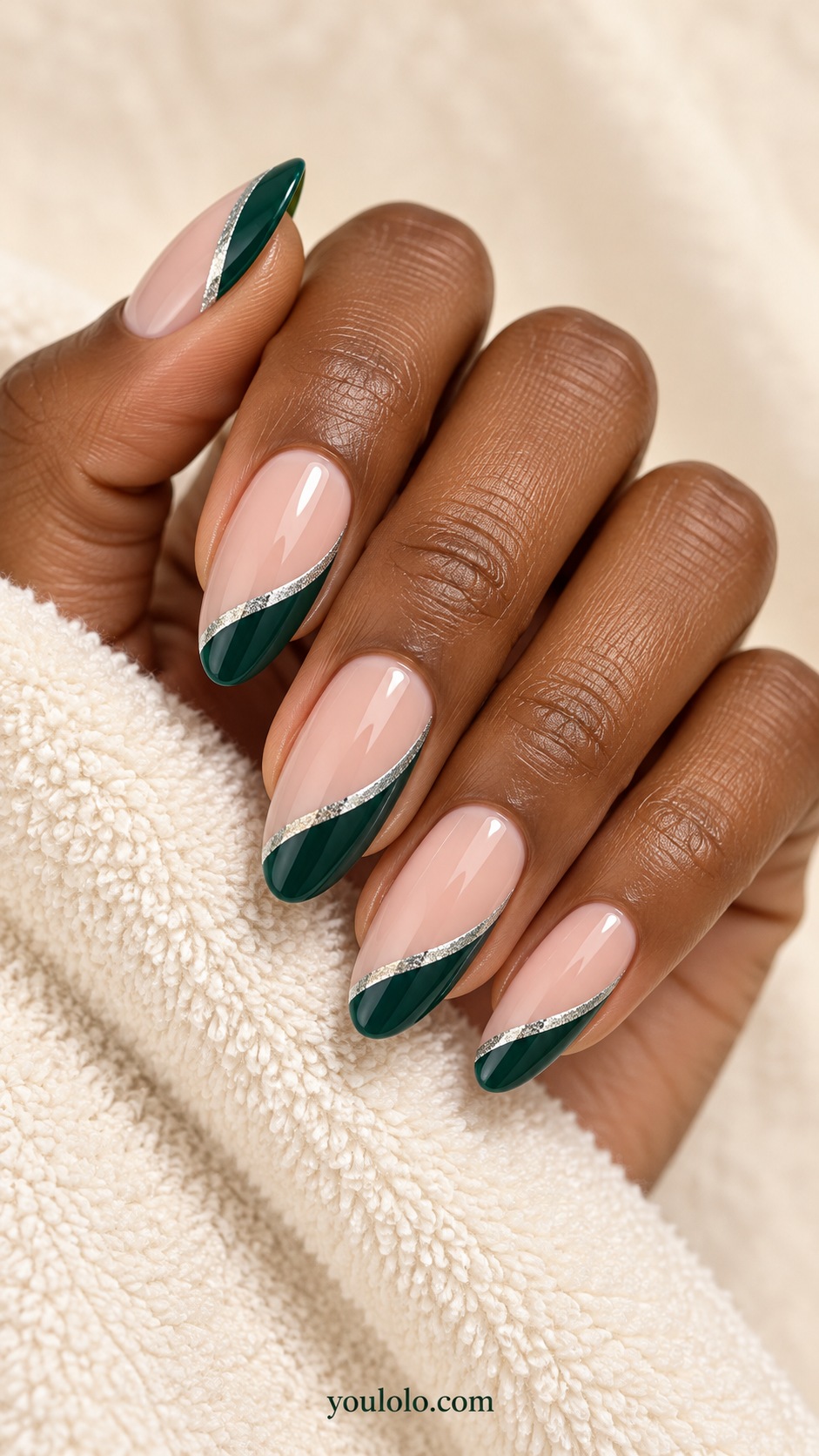
The sheer blush center gives this green manicure a lighter feel. Instead of a straight or evenly rounded French edge, the emerald sweeps up one side of the nail. Silver makes that curve more defined without taking over the design. I would keep the silver line narrow and the base translucent, especially if you want the manicure to feel polished rather than heavily decorated.
What to ask for: Show the artist the diagonal curve, not just the colors. Ask for a sheer blush base, a smooth emerald side tip and one fine silver line along the boundary.
5. Frosted Sage Fern
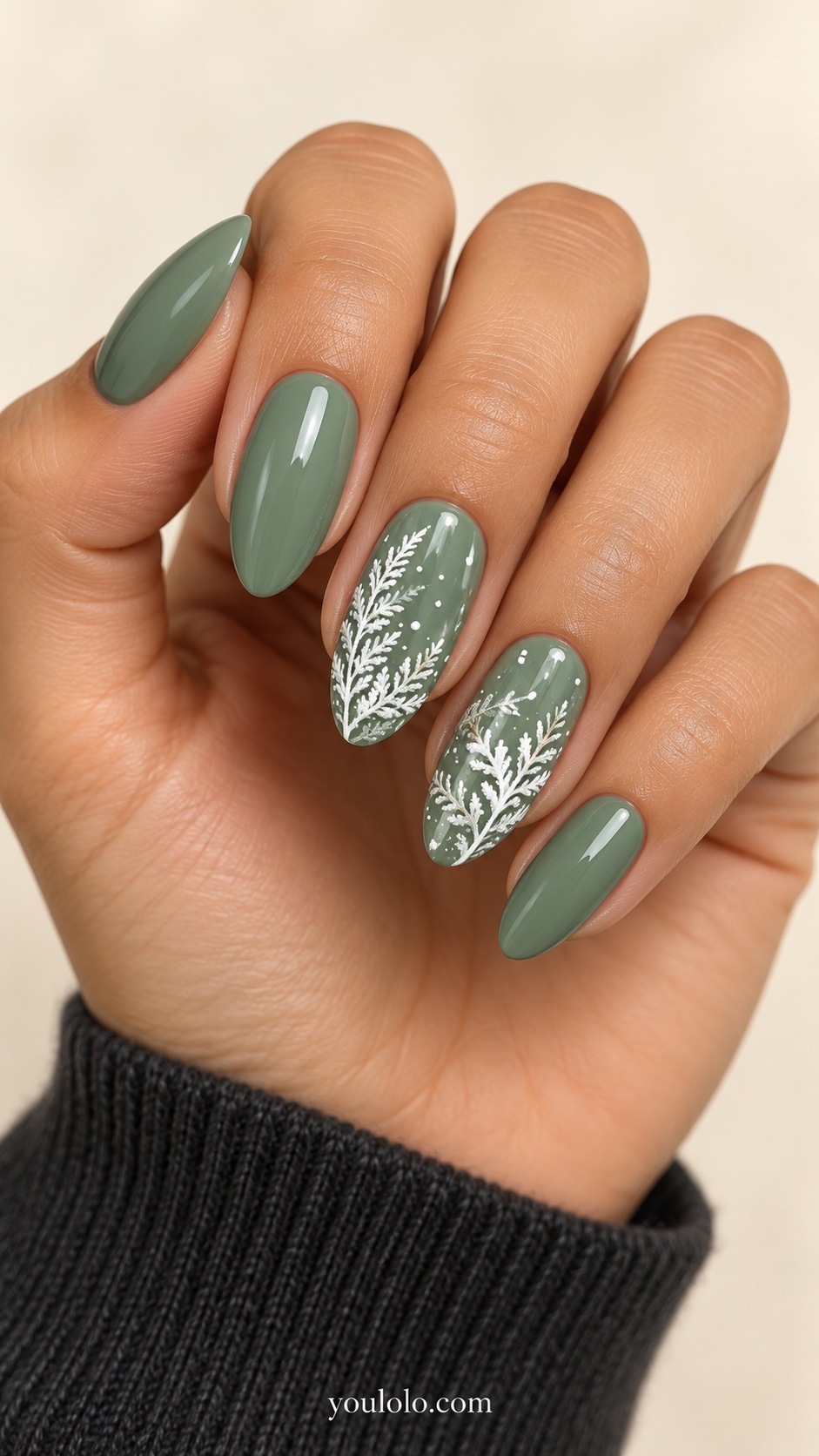
Sage gives the white fern a much softer background than emerald or navy. The little branches spread like frost on a window, which makes the design feel wintry without a conventional snowflake in the center. I would let the fern follow one side of the nail and leave some sage visible. That open area helps the fine white strokes stay airy instead of becoming a dense white patch.
What to ask for: Ask for one main white stem with smaller branching strokes. Keep the drawing delicate, and simplify the fern to fewer branches if your nails are short.
6. Golden Art Deco Fan
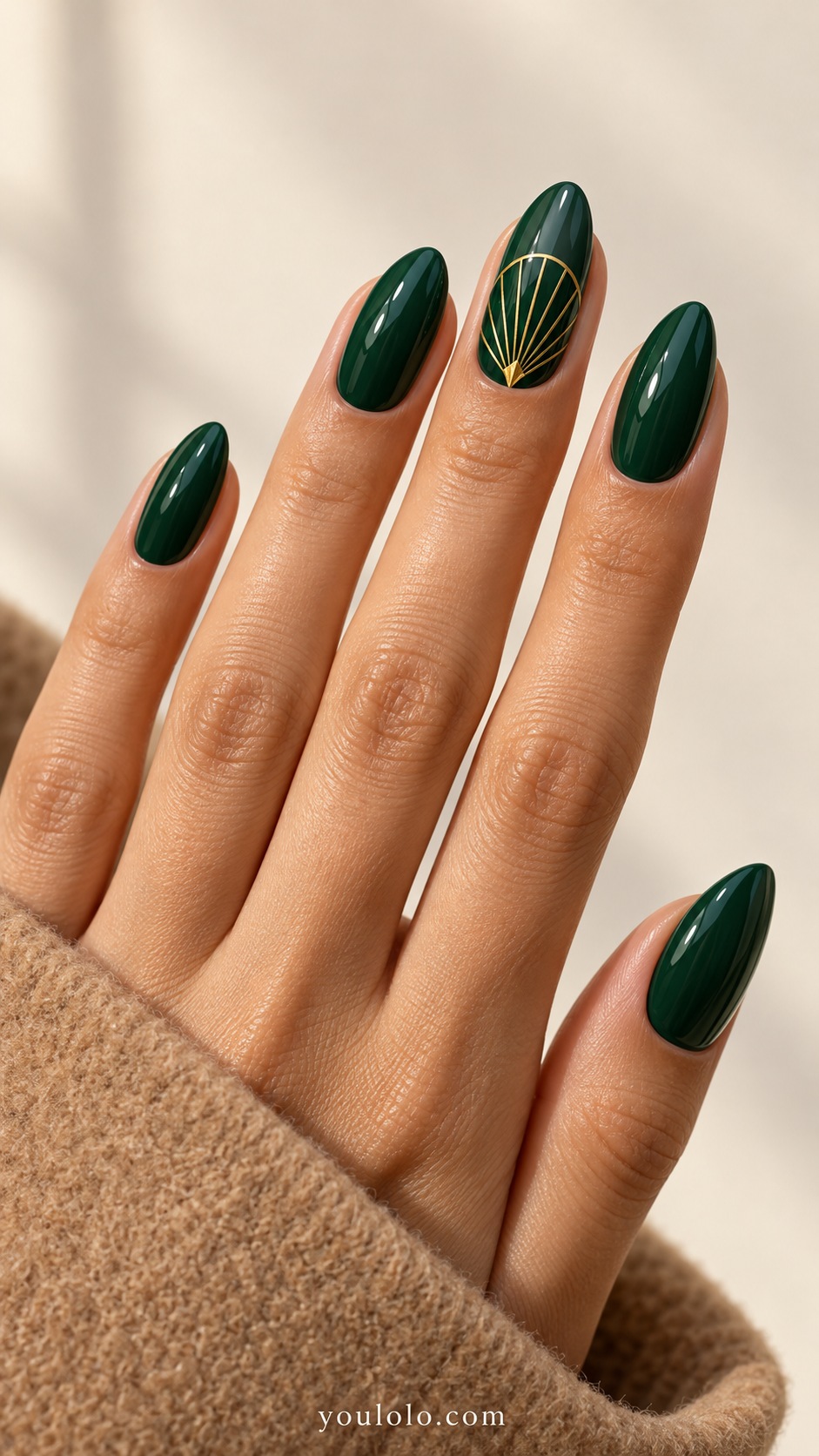
The fan gives forest green a more architectural character. Its long gold lines follow the nail shape and create a clear point of focus near the base. I like that the design can feel dressed up without glitter, gems or a painted scene. A smooth, deep green background is enough to make the fine gold work visible, so there is no need to add a second metallic color.
What to ask for: Use a small number of fine gold rays and a clean curved outer line. Keep the fan centered and the spaces between the rays open.
7. Emerald and Ivory Mosaic

This mosaic has a sharper, more graphic mood than the botanical designs. The ivory panels stop the emerald from becoming too heavy, while silver defines the irregular shapes. I would use a few larger pieces rather than a dense network of tiny triangles. That keeps the pattern readable and gives each color enough room to contribute to the design.
What to ask for: Ask for flat geometric panels with fine silver divisions. On shorter nails, reduce the number of panels and keep at least one broad ivory area.
8. Malachite Marble with Gold Veins

The mixture of green and ivory gives this marble its depth. Some areas are dark and concentrated, while others open into softer pale bands. Gold works best as a few broken veins following the flow, rather than a neat outline around every color. I would let each marbled nail differ slightly, keeping the same palette so the whole hand still feels connected.
What to ask for: Request irregular green-and-ivory marble with sparse, fine gold veins. Keep the finish smooth and glossy, and avoid making every nail carry the same repeated swirl.
9. Snowy Evergreen on Blush

The blush base gives this little tree a warm, gentle background. Snow on the branches provides the detail, and the gold star adds a clear finishing point at the top. This is the most obviously festive option in the set. I would keep the surrounding nails simple so the tree feels like one small illustration rather than part of an overloaded Christmas manicure.
What to ask for: Choose one accent nail for the tree. Build a clear green silhouette first, then add restrained white snow and a small gold star, keeping the surface mostly flat.

10. Silver Tartan on Forest Green

Silver tartan brings a textile-like pattern into the green palette. The different line widths are what make it feel like a check rather than a simple grid. I would keep some intersections quieter than others and let the green remain visible between the stripes. It pairs naturally with plain winter layers, where the pattern on the nails can stand on its own.
What to ask for: Use a few broader pale lines mixed with finer silver ones. Keep the intersections clean and reduce the number of stripes on shorter nails.
11. Holly Leaves and Red Berries
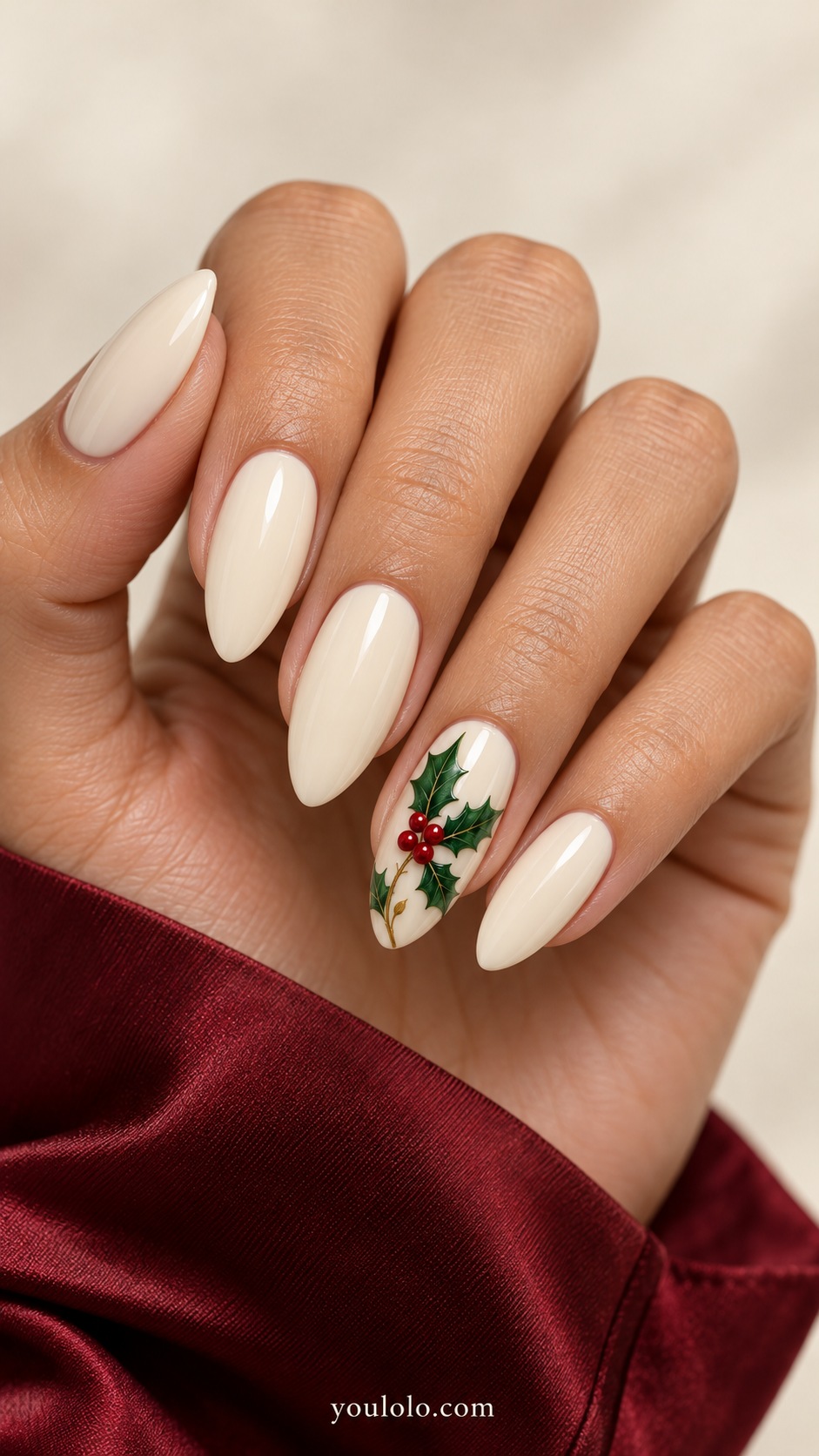
The red berries give this ivory manicure a small burst of color. Their rounded shapes contrast with the sharp points of the holly leaves, which is what makes the motif recognizable. I would keep the leaves in a deep green and use a fine stem so the little cluster does not become too heavy. The ivory around it is part of the appeal.
What to ask for: Ask for a compact holly cluster with a few pointed leaves and three small berries. Use painted highlights on the berries instead of large raised decorations.
12. Snowy Mountains under a Green Sky
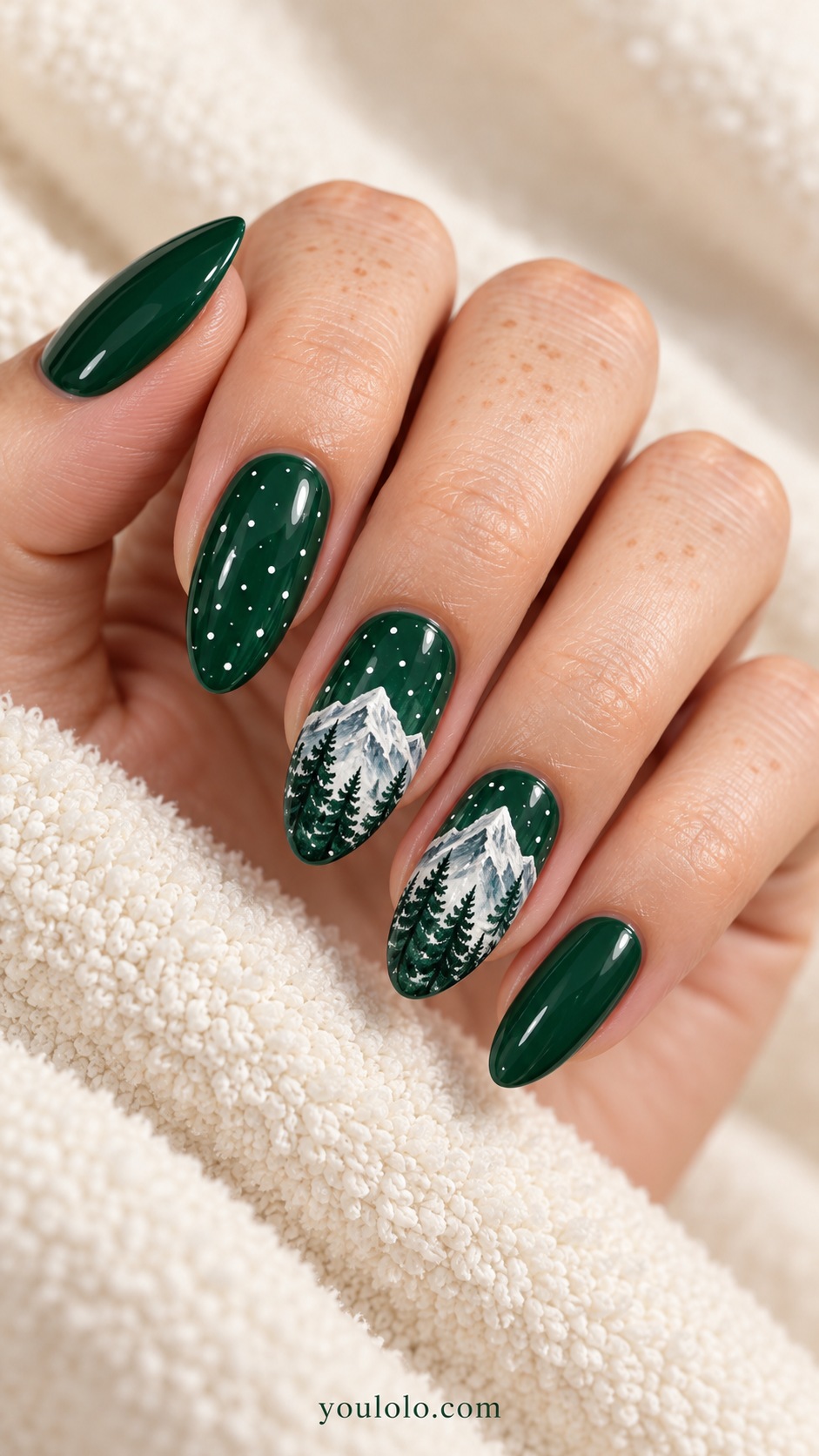
A green night sky gives the mountain scene a different mood from the more familiar blue version. The pale peaks supply the strongest contrast, while the trees anchor the lower edge of the design. I would keep the mountain layers simple and reserve the smallest detail for a few foreground trees. That helps the scene remain clear when you look at your hand from a normal distance.
What to ask for: Use one main snowy peak and a few smaller ridges, with fine tree silhouettes below. For a shorter nail, reduce the landscape to one peak and one or two trees.
13. Sage Snowflake French

This design combines the openness of a French manicure with one soft winter detail. The snowflake crosses the boundary between blush and sage, so it feels connected to the whole nail rather than placed inside a separate colored box. I like the muted green because it keeps the contrast gentle. A few small white dots are enough to finish the tip.
What to ask for: Keep the sage tip fairly shallow and the silver border fine. Place the snowflake across the smile line on one accent, leaving the other tips simpler.
14. Silver Constellations on Emerald

A constellation creates a little path for the eye to follow across the green. The stars should vary slightly in size, with the connecting lines almost disappearing between them. I would keep the arrangement asymmetrical and leave generous dark space around it. The design feels more delicate when it suggests a small map of the sky rather than filling every gap with another star.
What to ask for: Choose a simple constellation arrangement that fits the nail. Use flat metallic stars or fine painted points, and keep the connecting lines much thinner than the stars.
15. Emerald and Silver Ribbon

The broad green ribbon gives this manicure a sense of movement. Its gentle marbling adds depth inside the curve, while the silver edges separate it from the ivory base. I would keep the ribbon as one continuous shape rather than splitting it into several narrow waves. That gives the design a calmer rhythm and lets the green remain the main feature.
What to ask for: Ask for one flowing emerald band with a little tonal variation inside it. Trace the edges with fine silver and keep the supporting nails simple.
16. Evergreen Forest Moon

The pale curved area acts like a small window onto the forest. Dark tree silhouettes stand out against ivory, while the green upper half keeps the overall manicure rich and moody. I like this design because it tells a little story with only a few shapes. The curve, the tree line and a handful of snow dots are enough; extra scenery would make it harder to read.
What to ask for: Keep the pale curve broad and the tree silhouettes varied in height. Use only a few fine snow dots in the dark area, leaving the ivory section mostly clear.
17. Golden Winter Botanical

The pale leaves brighten emerald without using a solid white panel. Gold connects the small shapes and adds warmth, while the tiny white berries make the branch feel more delicate. I would keep the stem slightly curved and the leaves unevenly spaced. That natural arrangement gives the botanical more character than a perfectly mirrored pattern, especially on a softly tapered nail.
What to ask for: Ask for a fine gold stem with a few pale leaves and tiny white berry accents. Keep the details flat and leave enough green visible between the leaves.
How to Adapt Green Winter Nails to Your Length
On short nails, simplify the drawing. One white snowflake, a single holly sprig or two fine constellation lines can say enough. For tartan, keep just a few crossing stripes. For mountain artwork, use one clear peak and a small group of trees. Leaving space around the motif makes it easier to see than shrinking every detail from a long reference nail.
Match the direction to the shape. A narrow branch or flowing ribbon can follow the length of an oval nail. A diagonal French tip works nicely when you want the color concentrated at one edge. On a softly squared nail, a small centered snowflake or clean geometric panel can make good use of the broader tip. Ask your artist to sketch the placement before adding the fine details.
Choose where the shimmer goes. Silver pairs beautifully with snowflakes, stars and frosty white; gold gives botanical and marble designs a warmer feeling. Keep the metallic lines narrow if you want the green to remain the main color. Discuss whether you prefer a smooth metallic line or a fine glitter edge, because they catch the light differently.
Use an accent nail to control the amount of art. A mountain scene or ornate gold botanical can be the focus of the whole hand. Plain green supporting nails make that choice feel intentional. If you prefer more detail, repeat a smaller element, such as a star, leaf or thin silver curve, instead of adding a completely new motif to every nail.
What to Bring to Your Manicure Appointment
Save the overview together with your favorite close-up. Tell your artist which details you want to preserve and which can change. For example: “I like the sage tip, sheer blush base and one white snowflake, but I want it on short oval nails.” Agree on the number of accent nails and the level of detail before the painting starts. Intricate landscapes and fine tartan lines need a different approach from a simple side French.
For technique inspiration, browse OPI’s nail art tutorials and essie’s snowflake nail art. These offer useful ways to discuss pattern and placement; you can still choose the green shade and finish that suit your own version.
The Green Winter Designs I Would Save First
For a quiet everyday option, I would start with the ivory fir sprig: the pale base gives the little needles room to show. Golden Art Deco Fan would be my choice for a dressier evening manicure, while Sage Snowflake French feels like a lovely middle ground between a classic tip and winter artwork. If you want the most dramatic focal point, save the snowy mountain design and keep its supporting nails simple.
Green Winter Nails FAQ
Which green shades work for winter nails?
Emerald, forest green and sage all appear in this collection. Emerald creates strong contrast with white and silver; forest green looks rich beside gold or ivory; sage gives a softer result. Choose a shade you enjoy with your everyday wardrobe.
Can I wear green winter nails after Christmas?
Yes. Snowflakes, fern patterns, marble, celestial art and geometric designs do not depend on Christmas. If you want a less festive look, skip the holly and decorated tree and choose a simple botanical or metallic accent.
Do these designs work on short nails?
Yes, with less detail where needed. A single star, small snowflake, narrow French tip or short sprig can fit comfortably. Simplify the mountain and tartan patterns so their main shapes remain clear.
Does gold or silver look better with green nails?
Both work. Silver makes white snowflakes and celestial designs feel crisp; gold adds warmth to emerald, marble and botanical patterns. Pick the finish you like best, or use the metallic detail already shown in your chosen reference.
Should every nail have winter artwork?
No. One or two detailed nails can carry the design, with plain green or ivory on the others. Repeating a small motif gives a more decorated set without making every nail equally busy.
What should I ask my nail artist for?
Show the specific image and name the shade, motif, placement and finish you like. Mention your preferred nail length and shape, then agree on any simplifications. Ask how the metallic lines will be made if a smooth finish matters to you.

[…] For another direction to compare, take a look at our green winter nail ideas. […]