
The Best Fluffy Pancakes recipe you will fall in love with. Full of tips and tricks to help you make the best pancakes.


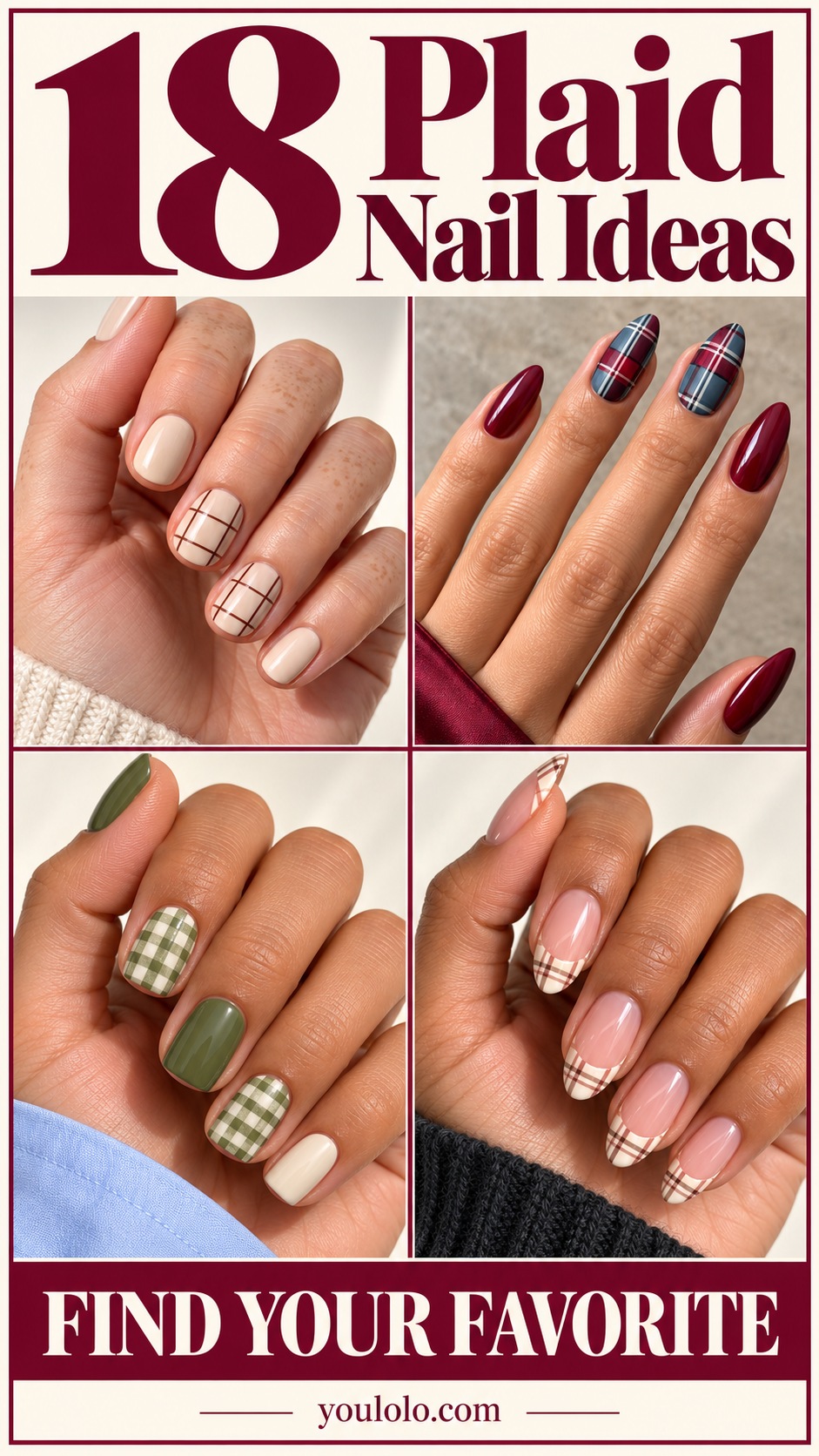
Plaid nail ideas can look completely different depending on three small choices: the width of the lines, the space between them and the colors underneath. An open brown grid over cream feels quiet. Cranberry bands crossing dusty blue look more playful. A checked French tip gives you just a little pattern, while a full tartan accent becomes the detail you notice first. That range is what makes plaid such a satisfying design to save for a manicure appointment.
I like a plaid set best when the pattern is easy to read without being identical on every finger. A few solid nails can repeat the main color, or a sheer base can leave space beside a narrow panel of checks. The design does not need a bow, crystals and glitter to feel finished. A well-placed intersection or an unexpected color pairing can be enough.
This collection brings together 18 versions, with short rounded nails, soft squares, ovals and almond shapes throughout. There are warm neutrals, deeper shades and a few lighter combinations for anyone who prefers a softer manicure. Each idea includes a specific note for your nail artist, because asking for plaid alone leaves a lot open to interpretation. Pick the palette you love, then look at the scale of the pattern and how much of the nail it covers. Those details will help you turn a saved picture into a set that suits your own hands.
Choose Your Plaid Nail Style
Start with the amount of pattern you want to see. An open grid leaves the base color in charge. Layered bands create a fuller, more fabric-like effect. A checked tip or side panel gives you a smaller area of artwork. You can keep the same colors and change the entire mood simply by moving the pattern.
- For short nails: Oat Milk and Espresso Windowpane, Black Cherry Micro Plaid and Cream and Cocoa Half-Nail Plaid.
- For unexpected color: Cranberry and Dusty Blue Tartan, Toffee and Slate Scarf Check and Deep Teal and Apricot Tartan.
- For less coverage: Sheer Rose Plaid French and Forest Green Plaid Side Panels.
- For a little shine: Ink Blue and Copper Crosshatch or Mushroom and Silver Pinstripe Plaid.
1. Oat Milk and Espresso Windowpane

This is the set I would start with if a full tartan manicure feels like too much. The brown lines are fine enough to leave the creamy base visible, and two patterned nails give the hand a clear focal point. What makes it work is the open spacing: you can see the little rectangles without having to look closely. Keep the plain nails in the same oat shade rather than introducing another beige.
What to ask for: Ask for one vertical line and two horizontal lines on each accent nail, with no metallic outline.
2. Cranberry and Dusty Blue Tartan

Dusty blue takes cranberry in a different direction from the usual holiday pairing. The blue accent nails lighten the set, while the cranberry bands connect them to the plain nails. A few ivory lines keep the overlapping colors readable. I would let the wider bands sit slightly off-center so the pattern feels like a small piece of fabric rather than a perfectly centered emblem.
What to ask for: Use cranberry as the main color and reserve the blue ground for two accent nails; keep the ivory lines much thinner than the colored bands.
3. Olive and Buttercream Mini Check

Small olive checks look lovely beside a warm pale yellow. This is a softer kind of contrast than black and white, but it still has a clear graphic shape. Keeping the check to two nails prevents the little squares from taking over the hand. On a very short nail, I would increase the square size slightly instead of adding another row to fit more pattern in.
What to ask for: Choose a simple even check, with darker olive intersections and enough light squares to preserve the buttercream base.
4. Ink Blue and Copper Crosshatch

Copper gives ink blue a warm point of contrast without making the whole manicure bright. The doubled lines add detail, but the spaces between them stay large. A satin base makes the smooth metallic strokes easy to notice. This is the version I would choose when I wanted a dark manicure with something more precise than a glitter accent.
What to ask for: Keep the copper lines close together in pairs and leave broad blue spaces between each pair; skip studs and crystals.
5. Sheer Rose Plaid French

Putting the pattern at the edge changes how much plaid you see. The sheer base stays open, and the little checked tips become the main detail. Cocoa keeps the lines softer than stark black, while a muted rose stripe brings the base color into the pattern. The tips need enough depth to show at least one clear intersection, so avoid making them extremely narrow.
What to ask for: Ask for a modestly deep curved French tip with a sparse grid, and keep every plaid stroke inside the ivory section.
6. Charcoal and Lilac Offset Plaid
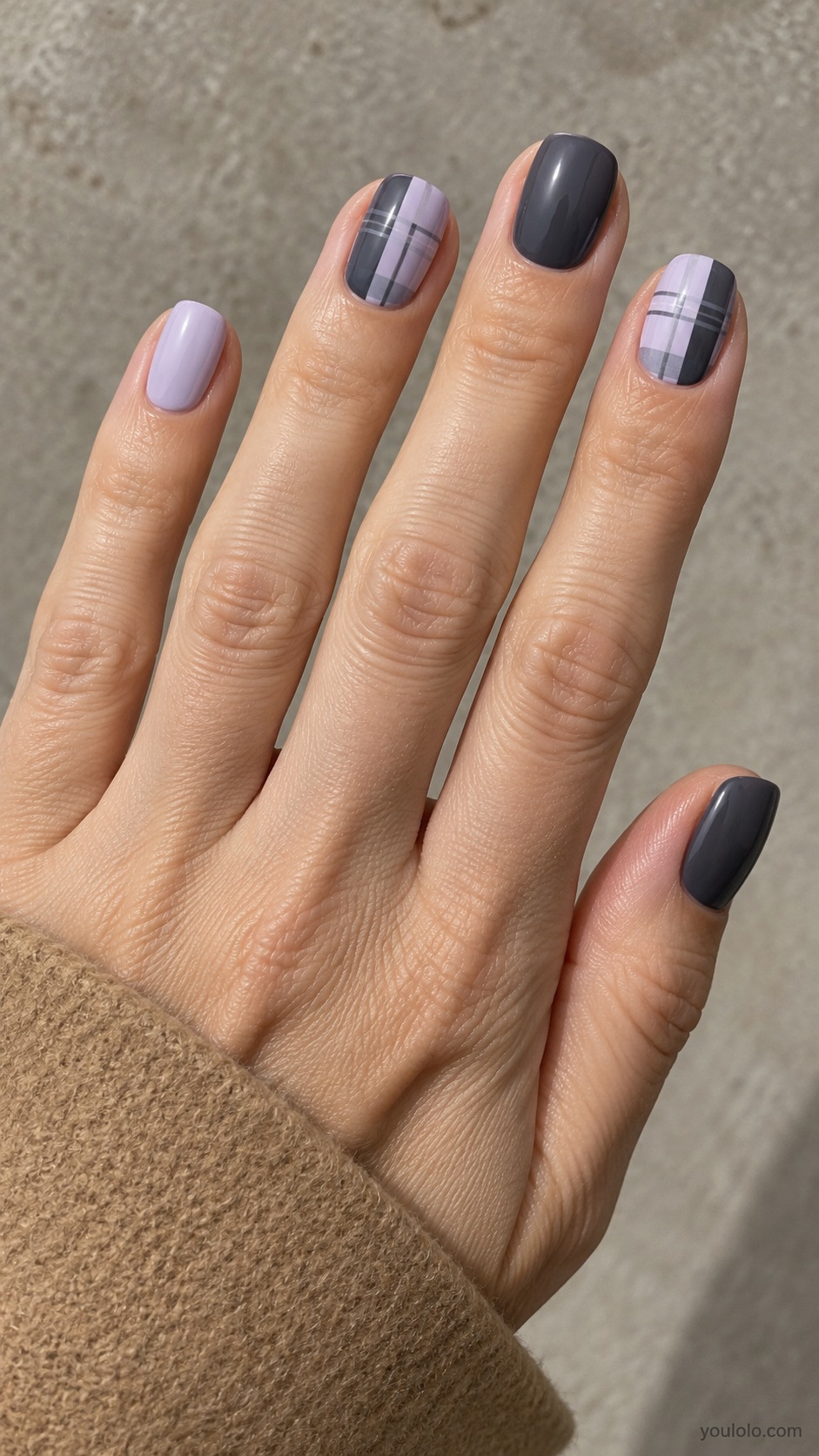
The off-center stripe makes this feel more graphic than a traditional all-over check. Pale lilac supplies the lighter space, and charcoal gives the design a strong edge without using a completely black base. I would keep one nail plain charcoal to repeat the darker color. The asymmetry is deliberate, so the intersections do not need to sit in the middle of every accent.
What to ask for: Place one wider charcoal stripe near a sidewall, then add two finer crossing lines with generous spacing.
7. Rust and Peach Blanket Check

This palette has warmth without relying on brown. Broad rust bands over peach create a gentle fabric-like overlap, and the cream strokes keep the larger shapes from becoming muddy. It is a good choice if you like a fuller pattern but want a softer contrast. Keep the surface smooth; the cozy feeling can come from the colors and line arrangement alone.
What to ask for: Use broad muted bands with only a few narrow cream lines, and keep two supporting nails solid rust.
8. Black Cherry Micro Plaid

A single lighter nail makes the small check easy to see. The rest of the hand stays deep cherry, so this reads as a dark manicure first and a patterned one second. Dusty mauve is close enough to the main color to keep the contrast gentle. I would avoid filling the accent with too many intersecting stripes; a short nail still needs open areas.
What to ask for: Choose one accent nail with a restrained grid, then match its darkest lines to the solid cherry polish.
9. Denim and Cream Pocket Plaid

The slightly muted blue gives this set a relaxed mood. Cream sections brighten it, while gray adds a quieter line inside the pattern. This works particularly well when the bands have different widths: one broader blue stroke gives the smaller gray lines a reason to be there. Keep the finish consistent across the hand so the color changes do not also compete with different textures.
What to ask for: Ask for one broad denim band crossing a pair of narrow lines, leaving cream visible around the intersections.

10. Forest Green Plaid Side Panels
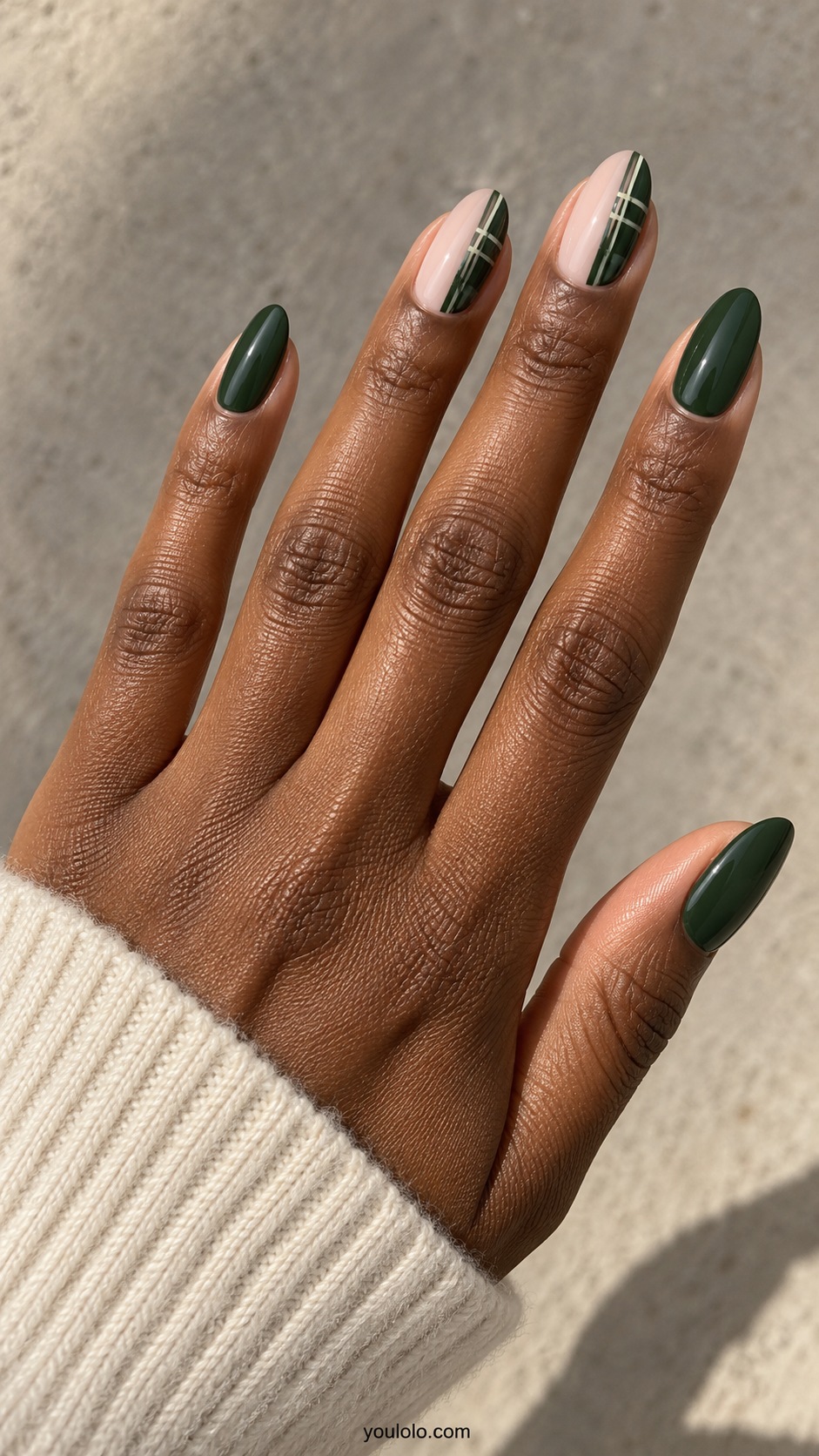
A side panel offers a different way to wear a dark plaid without covering the whole nail. The sheer portion makes the pattern feel lighter, while the green nails elsewhere give it enough weight to belong to the set. Pale sage lines provide contrast inside the panel without introducing a metallic finish. The boundary should follow the nail smoothly, with no heavy border.
What to ask for: Keep the plaid confined to one curved side panel and use fewer crossings toward the narrow tip.
11. Toffee and Slate Scarf Check

Toffee and slate have a lovely warm-cool balance. The caramel ties the patterned nails to the plain ones, while the darker brown marks the smaller intersections. I would keep the slate slightly gray rather than bright blue; that quieter ground lets the toffee stay rich. This is a useful option if you like brown nails but want a more unexpected accent color.
What to ask for: Use slate as the accent background, caramel for the main bands and dark brown only for the narrowest strokes.
12. Ivory Plaid with a Painted Ribbon

A small ribbon gives the straight lines a softer companion. Keeping both details in the same berry shade makes them feel related, while the ivory ground gives the set plenty of light. The ribbon should remain small; it is a second detail, not a larger decoration competing with the plaid. I would leave the thumb and middle finger completely plain.
What to ask for: Ask for a flat painted ribbon and two simple plaid accents, all using the same muted berry color.
13. Mushroom and Silver Pinstripe Plaid

Mushroom taupe sits between warm and cool, which makes it an interesting ground for silver. The off-white strokes give the grid a visible shape even when the metallic lines are not catching the light. Keep those two kinds of line distinct rather than stacking them directly on top of each other. The result should look delicate at arm's length, with the finer detail appearing up close.
What to ask for: Use off-white for the main open grid and add a few narrower silver strokes beside it; avoid an all-over glitter base.
14. Deep Teal and Apricot Tartan

Apricot gives deep teal a warmer companion than white. A very fine plum line adds another layer without becoming a third main color. The proportions matter here: teal should dominate the hand, apricot should give the pattern breathing room, and plum should remain a small detail. I would keep the band arrangement simple enough that all three colors are still easy to identify.
What to ask for: Reserve apricot for two accent nails, with broad teal bands and only one or two plum pinstripes per nail.
15. Smoky Plum Diagonal Plaid

Turning the grid changes the whole rhythm of the manicure. The diamond shapes follow the curved nail differently from upright checks, and the pale background keeps their edges clear. A small amount of silver can trace one direction without outlining every diamond. I would leave the surrounding nails smoky plum so the angled pattern remains the distinctive feature.
What to ask for: Rotate the grid diagonally while keeping the crossing bands perpendicular, and use silver sparingly along one set of lines.
16. Cream and Cocoa Half-Nail Plaid

A straight half-nail boundary gives this version a slightly more graphic feel than a curved French tip. The cream area has room for a simple grid, while the sheer base keeps the hand from looking heavily painted. This can work on short square nails as long as the cream section is not crowded with tiny boxes. Two clear intersections are enough to explain the pattern.
What to ask for: Place the cream panel across the upper half of each accent nail and use an open cocoa grid with no thick outline.
17. Wine and Steel Gray Check

Steel gray makes wine feel cooler and more tailored. The satin finish suits the quiet palette, but the linework still needs contrast so it does not disappear into the base. Broad wine bands establish the check, and charcoal supplies the smaller details. I would keep this set free of metallic accents; the color pairing already gives it enough character.
What to ask for: Use a lighter steel gray behind the wine pattern and keep the charcoal lines thin enough to remain separate.
18. Mixed Neutrals with One Shared Grid

If you like a different shade on every nail, a repeated grid can connect the colors. This set uses three related neutrals rather than a full rainbow, so the changing bases feel gentle. Keep the line spacing and direction consistent across all five nails. That repetition is the point: the eye notices the palette first, then the shared pattern that brings the manicure together.
What to ask for: Choose three clearly different neutral base shades and repeat one simple espresso grid at the same scale across the hand.
How to Make Plaid Work on Short Nails
Remove lines before making them smaller. A shorter nail does not need a miniature copy of a large tartan. Keep the main crossing band and one or two fine lines, then leave the remaining base visible. If the intersections blend together when you look at your hand normally, the grid is probably too dense for the effect you want.
Choose one clear contrast. Cream against espresso or dusty blue against cranberry makes the pattern readable without several extra colors. A third shade can be useful for a narrow stripe, but it does not need equal space. Try deciding which color should be noticed first, then give that color the largest area.
Use placement to change the balance. One full accent nail can show more pattern than several very narrow tips. A half-nail panel can work well on a short square shape, while an open grid can sit comfortably on a rounded nail. Pick the layout that gives the lines enough room rather than choosing a shape only because it appears in a photo.
A Simple Plaid Nail Art Practice Plan
For a first attempt, practice an open windowpane on a nail tip or nail wheel. Choose a base and one contrasting color before trying a layered tartan. Follow the drying or curing directions for the products you are using, and keep each stage neat before adding another layer.
- Apply your chosen base color and let it set as directed.
- Using a fine liner brush, paint one vertical stripe slightly away from the center.
- Add two horizontal stripes, leaving enough space to see the base between them.
- Check the design at normal hand distance. If it already reads clearly, stop there; extra lines are optional.
- For a more detailed version, add one finer parallel stripe in a second shade, then finish according to the product instructions.
For more technique examples, explore OPI’s nail art tutorials and essie’s nail art library. Use them to compare tools and approaches while keeping the palette and pattern placement you chose.
What to Decide Before Your Salon Appointment
Bring the individual design image and explain which part matters most. “The toffee and slate colors, with two checked accents and the rest plain” is a clearer starting point than asking for the entire mood of a collage. Decide on nail length and shape first, then agree on how the artist will simplify the pattern if necessary.
Also discuss the finish. A satin base makes a set feel different from high gloss, and a smooth painted metallic line is different from a raised decoration. If you prefer a completely smooth surface, say so when choosing the artwork. For a very detailed pattern, ask whether hand painting, stamping or another method would give the clearest result at your chosen scale.
The Plaid Designs I Would Save First
Oat Milk and Espresso Windowpane would be my quiet everyday pick. For a stronger color combination, I would save Deep Teal and Apricot Tartan: the warm pale ground gives the teal bands a beautiful place to stand out. Sheer Rose Plaid French is the one I would choose when I wanted pattern without a fully painted base. Each has a different amount of detail, so the choice comes down to how much artwork you want to see.
Plaid Nail Ideas FAQ
Can plaid nails work on short natural nails?
Yes. An open grid, one checked accent or a small half-nail panel can suit short nails. Reduce the number of lines rather than making the whole pattern extremely tiny. The main intersections should stay visible at normal hand distance.
What is the easiest plaid nail design to start with?
A simple windowpane is a useful starting point: one base color with a few fine crossing lines. Practice the spacing on a nail tip before adding several colors or doubled stripes. A single accent nail is enough for a finished look.
Should every nail have the same plaid pattern?
No. Plain nails can repeat the main shade while one or two accents carry the pattern. If you do want checks on every nail, keeping the line spacing consistent helps different base colors feel connected.
Can I combine plaid with French tips?
Yes. Put the grid inside a light-colored tip and leave the base sheer. The tip needs enough room for a clear intersection; if it is very narrow, use fewer lines or move the plaid onto one full accent nail instead.
Are plaid nails only for fall and winter?
No. The pattern can work with many palettes. Rich shades and warm neutrals suit a cozy mood, while lighter combinations make the same geometry feel softer. Choose the colors you want to wear rather than treating the pattern as limited to one season.
How do I keep plaid nail art from looking too busy?
Give the pattern some quiet space. Use fewer accent nails, leave more of the base visible, or limit the design to two main colors. If you add a metallic stripe or ribbon, keep it smaller than the main checked area.

[…] more checks and color combinations, our plaid nail ideas offer another place to start when choosing your next patterned […]