
The Best Fluffy Pancakes recipe you will fall in love with. Full of tips and tricks to help you make the best pancakes.



Gray nails can be much more expressive than the color name suggests. A deep glossy graphite feels crisp and defined; a milky dove gray looks softer; silver shimmer changes the whole surface when it catches the light. Add a thin contour or one white snowflake and the same family of shades becomes something quite different. These 18 winter gray nail ideas explore those small changes in color, finish and placement.
What I like about this palette is how easily a quiet manicure can become a little more detailed. You do not have to cover every nail in winter artwork. A fine metallic edge, a single patterned accent or two neighboring shades of gray can be enough. For a bolder set, there are reflective finishes and darker outlines that make the shape of the nail part of the design.
The collection moves from solid shades to delicate patterns, then into silver details and lighter French-style options. Each idea includes two short notes about the design and a clear request you can take to your nail artist. Use the images to choose the detail you enjoy, then adapt the length and shape to suit you. If you are deciding between two sets, compare how much of each nail is plain: that often tells you more about how the manicure will feel day to day than the color alone.
Start with the Kind of Gray You Enjoy
Before choosing the artwork, look at the base color. Cool grays can lean blue; warmer mushroom shades can lean taupe. Pale gray gives white and silver a delicate contrast, while charcoal makes small bright details more visible. None of these is a rule about what you should wear—compare the shades together and choose the one you like beside your everyday clothes.
- Clean and simple: Glossy Graphite, Dark Smoke or the Cool Gray Tonal Set.
- Soft winter detail: a white snowflake, pale knit pattern or cloud-gray waves.
- A little shine: silver micro tips, polished silver curves or small gold foil accents.
- More reflective: fine silver shimmer, icy cat-eye or silver chrome.
Solid Shades and Soft Winter Patterns
1. Glossy Graphite on Short Squares

A deep gray manicure does not need a second color to feel considered. Here, the short square edges give the dark polish a clear shape, while the glossy finish creates the only bright detail.
I would keep the length consistent and the corners softly rounded. That little bit of softness balances the graphic color. If you want the gray to remain visible in indoor light, choose a graphite that is clearly lighter than black.
For your nail artist: Ask for a solid deep graphite with high gloss and short soft-square tips; compare the shade in ordinary room light.
2. Pearl Gray with Flowing Silver Lines

The flowing lines give this pale manicure movement without turning it into a dense pattern. Pearl-white supporting nails bring a softer surface beside the cooler gray.
Keep the silver strokes narrow and let them wander at different angles. I would leave broad areas of gray visible rather than outlining every curve twice. The effect comes from the contrast between the plain base and a few reflective lines.
For your nail artist: Request smooth, flat metallic waves on two accent nails and alternate them with plain pearl white or gray.
3. Frosted Gray with White Knit Details

This set combines several winter details, but the pale palette keeps them related. The snowflake has a clear center, while the knitted pattern uses repetition instead of a single focal point.
I would separate those two patterns onto different nails. A plain gray nail between them gives the hand some breathing room. The cable can be painted as a flat illusion if you prefer a smooth surface rather than raised texture.
For your nail artist: Choose one snowflake, one simple cable accent and one restrained shimmer nail, keeping the remaining nails plain.
4. Fine Silver Shimmer on Tapered Squares
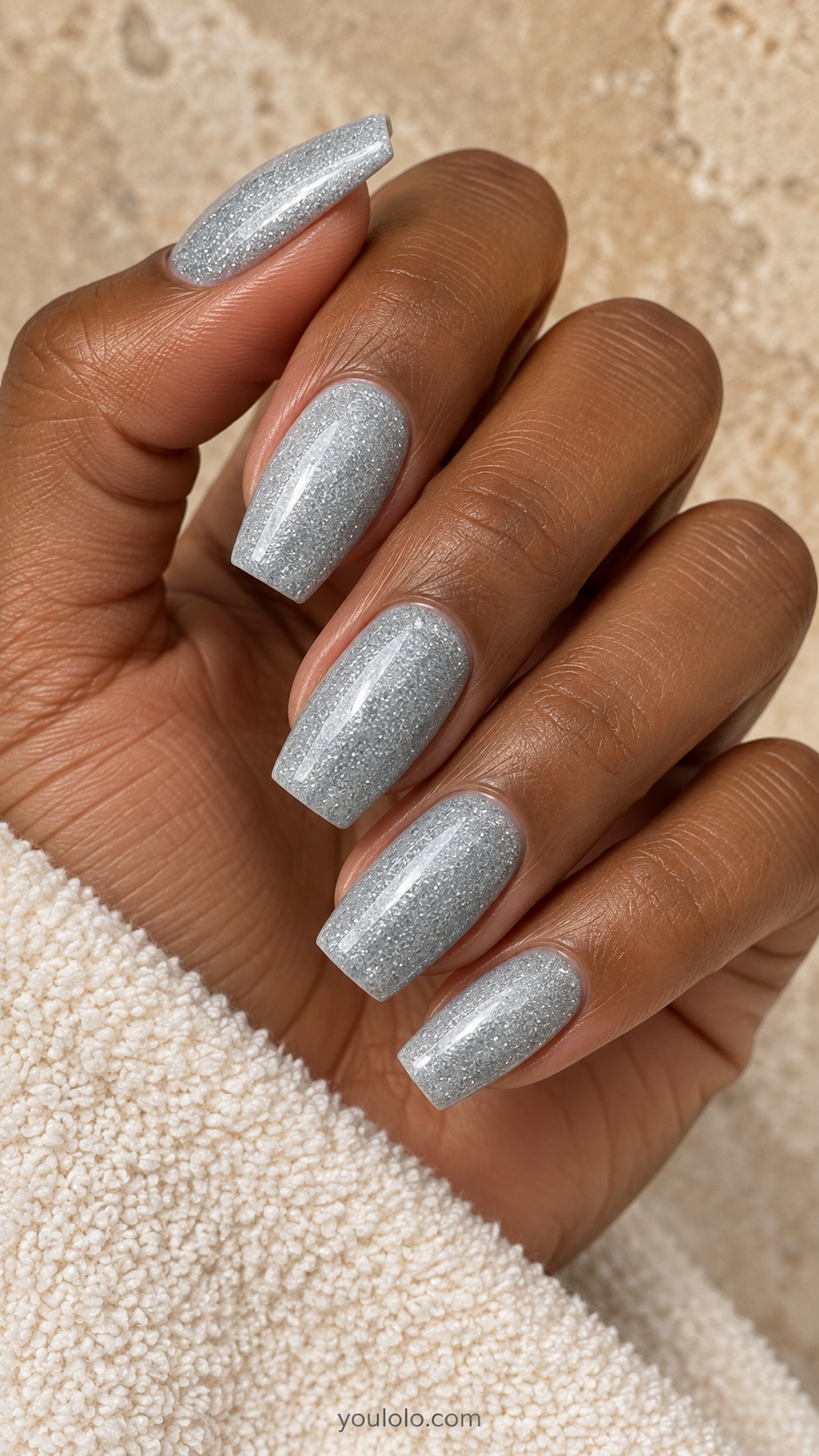
The finish supplies all the detail in this manicure. Fine silver particles make the gray look lighter when the hand moves, while the underlying color keeps it from becoming a completely white sparkle.
A medium tapered square gives the shimmer a broad surface without needing extra length. I would avoid large scattered pieces here; the appeal is an even, soft-looking reflective finish across all five nails.
For your nail artist: Ask for fine silver-gray shimmer with a smooth sealed surface, not large confetti glitter.
5. A Cool Gray Tonal Set

Changing the shade on each finger adds variety without introducing artwork. The colors work best when they share a cool undertone, so the hand still reads as one gray palette.
Place the lightest and darkest shades where you enjoy the contrast rather than treating the order as a rule. I would check the colors together before painting; two grays that seem different in a bottle may look almost identical on the nail.
For your nail artist: Choose clearly separated cool grays and keep the finish and nail shape consistent across the hand.
A Small Check Before Choosing Silver
Think about whether you want the silver to be visible all the time or mainly when it catches the light. A solid metallic line has a different effect from scattered glitter, and fine shimmer looks different again. Show your artist the kind of reflection you like, rather than asking only for a silver finish.
Silver Details, Curves and Small Accents
6. Silver Tips and a Single Snowflake
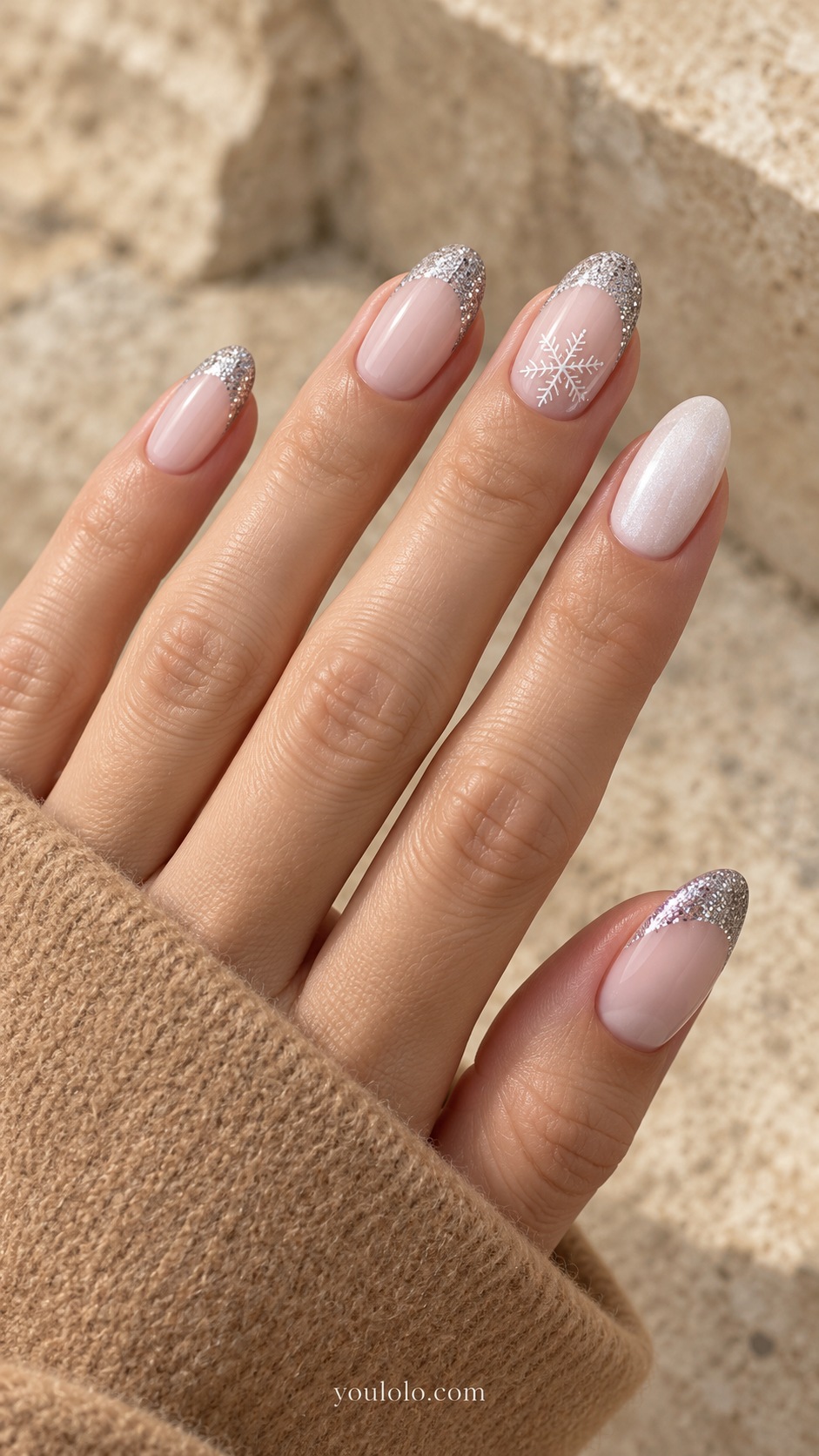
The glitter sits at the edge, leaving the milky base open for one small snowflake. That placement gives the two details different jobs: sparkle defines the tip, and the white drawing supplies the winter motif.
I would keep the snowflake above the silver area so its branches remain easy to see. A deeper tip can hold more glitter, but it should not crowd the artwork or cover most of the pale base.
For your nail artist: Request silver glitter tips with one separate fine white snowflake and plenty of clear space between the two.
7. Slate Satin with Polished Silver Curves
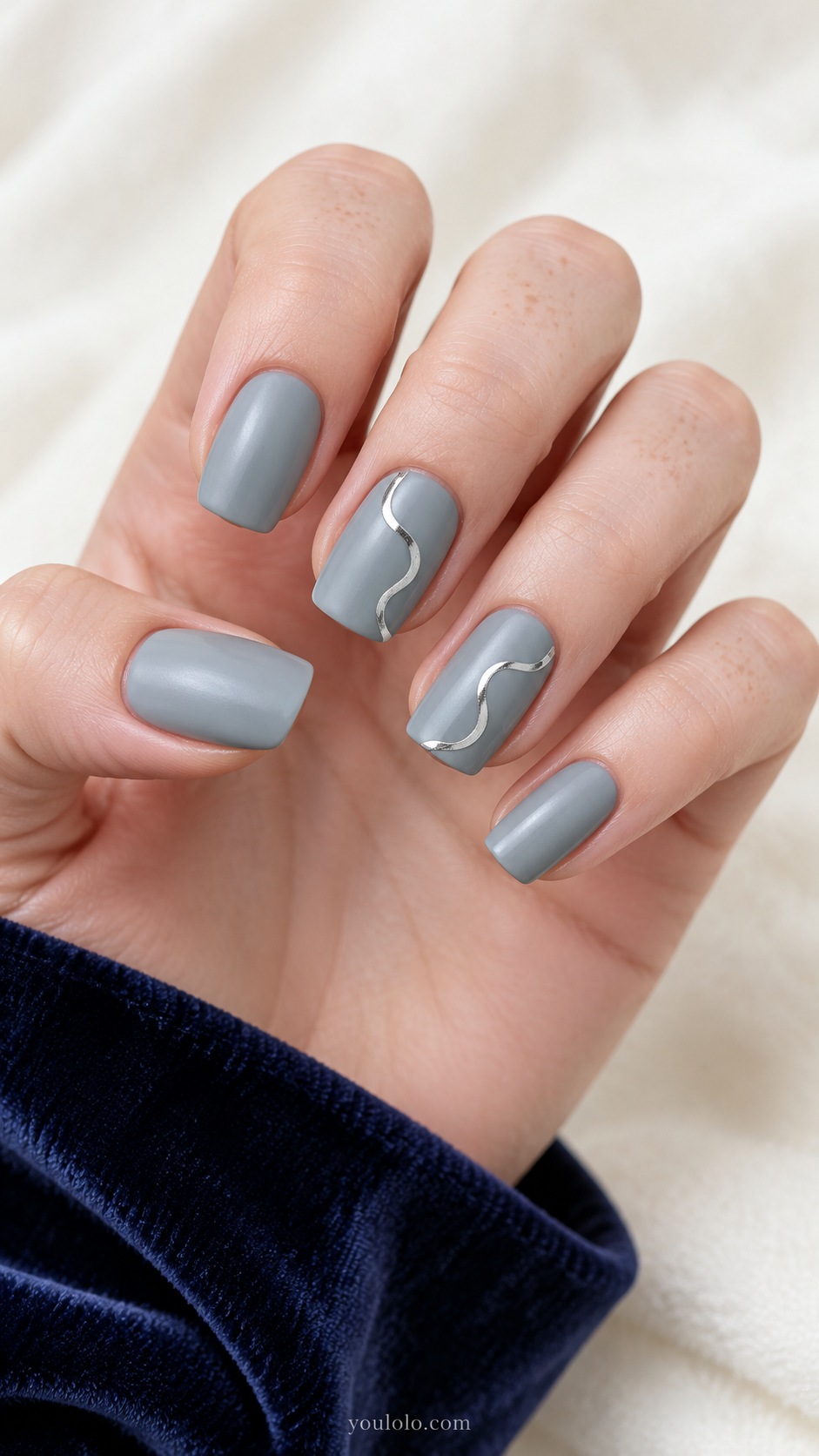
The contrast between satin gray and polished silver makes the small curves noticeable. You do not need a complicated shape; a gentle bend across an accent nail is enough.
Keep the line slightly away from the sidewalls so it looks like a deliberate stroke rather than an accidental outline. I would use only two decorated nails and let the remaining satin finish provide the quieter part of the set.
For your nail artist: Ask for flat silver curves over a satin slate base, with broad areas of undecorated gray.
8. Dove Gray with a Tiny Crystal Trio

Three tiny crystals give this pale gray manicure a small focal point. The narrow pearly strip behind them creates a direction for the detail without filling the whole nail.
Scale matters more than the number of decorations. I would keep the crystals small enough that you can still see the gray around the strip. If you want an entirely smooth version, use three painted silver dots in the same position.
For your nail artist: Choose one accent with a narrow pearly stripe and a tiny crystal trio, or replace the crystals with flat metallic dots.
9. Charcoal and Pewter with Gold Flecks
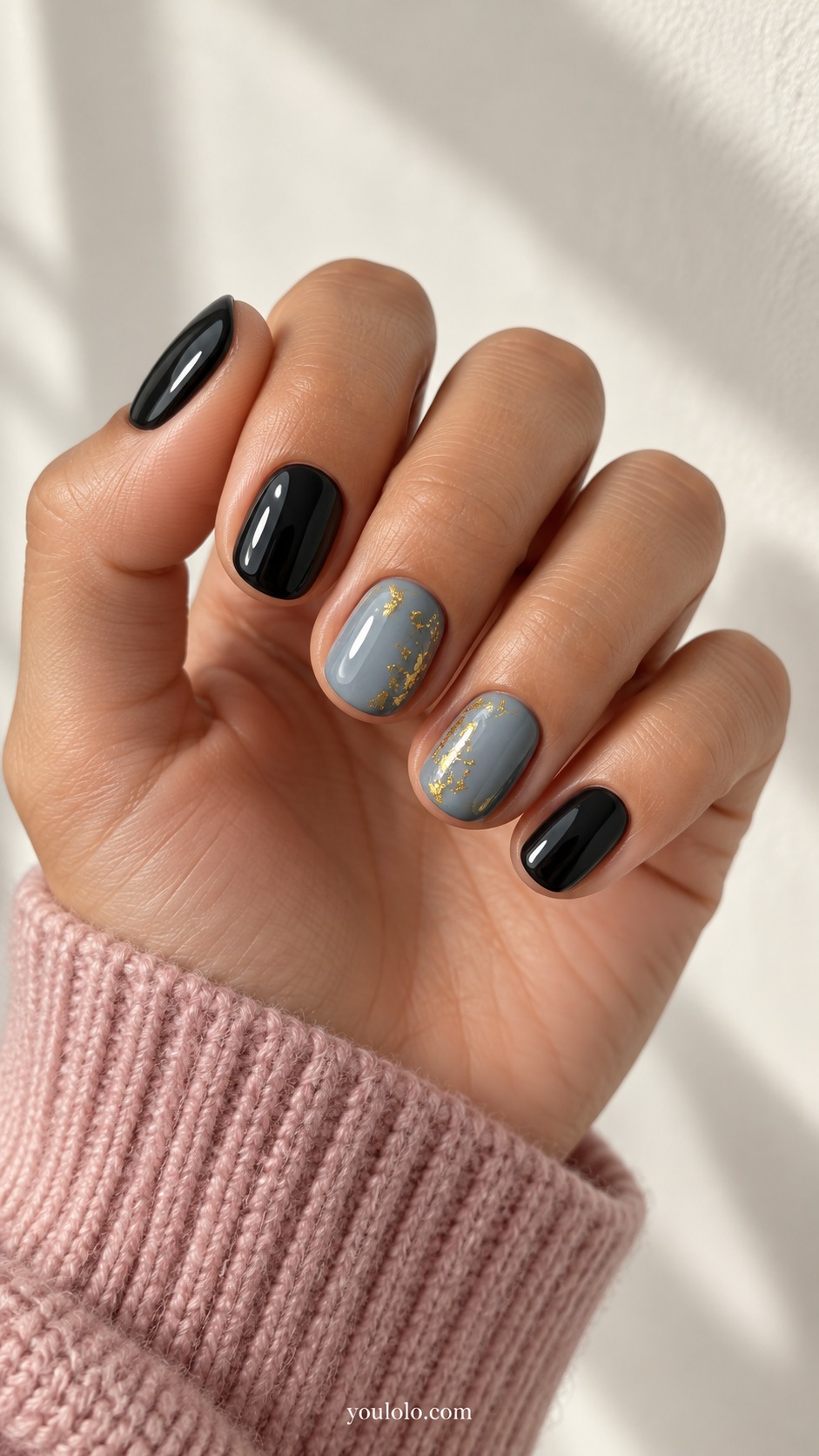
A little gold changes the temperature of a gray manicure. The warmer flecks stand out on pewter, while the charcoal supporting nails give the lighter accents more contrast.
I would keep the foil irregular and sparse. A solid gold patch would become the main color, but a few separate pieces let the gray stay dominant. Repeat the same pewter shade on both accents to make the arrangement feel connected.
For your nail artist: Ask for small gold foil fragments sealed smoothly on two pewter nails, with plain charcoal elsewhere.

10. Winter Neutrals with One Slate Nail

Gray can also act as the link between several quieter colors. Here, slate sits comfortably beside taupe, ivory and a dark muted teal rather than carrying the whole manicure alone.
The set feels coordinated because the colors are subdued and the finish stays the same. I would keep the teal deep and the brown softly gray-toned so neither becomes much brighter or warmer than the other nails.
For your nail artist: Choose five muted shades with slate as the central color, and keep every nail plain and glossy.
Icy Finishes and Modern Gray Tips
11. Icy Gray Cat-Eye with White Stars

A soft magnetic sheen gives this gray a moving highlight. The white stars add a sharper detail beside the blurred shimmer, which makes the two finishes feel different even within a pale palette.
I would use the artwork on only two nails so you can still appreciate the light across the others. Ask your artist to show the shimmer angle before adding the white details; it can look different as the hand turns.
For your nail artist: Request an icy gray magnetic finish with sparse white star accents, keeping the reflective band soft.
12. Gray Side Tips on a Blush Base

The blush base makes the gray feel lighter than a full-color manicure. An angled side tip gives the almond shape a clear direction, and the solid gray nails repeat the color more strongly.
Keep the gray area narrow near the base and a little fuller toward the tip. I would avoid adding a separate outline because the clean boundary between blush and gray already explains the shape.
For your nail artist: Ask for asymmetric gray side tips on sheer blush, balanced with two plain nails in the same gray.
13. Dark Smoke on Rounded Ovals

This is the softer-shaped counterpart to the graphite squares. The rounded edges change the silhouette even though the palette stays dark and simple.
A smoky gray with a little visible softness can feel different from an almost-black charcoal. I would choose the shade beside the glossy topcoat effect you want, since strong reflections can make a dark polish seem lighter in photographs.
For your nail artist: Request a short rounded oval with solid smoky gray polish and a consistent glossy finish.
14. Silver Chrome with a Gold Base Line

Silver chrome gives this set its strongest feature. The small gold line is a second detail, visible mainly near the base rather than spread across the reflective surface.
The two metals work best when their proportions are unequal. I would keep silver on almost the entire nail and use gold sparingly. A thicker gold border would change the manicure into a much more graphic design.
For your nail artist: Choose a smooth silver chrome finish with hair-thin gold base arcs on two nails, leaving a neat margin beside the skin.
15. Mushroom Gray with a Charcoal Outline

The darker border makes the soft gray center feel more defined. It is an interesting option if you like the precision of a French tip but want the line to travel farther around the nail.
Keep the charcoal outline thin and consistent. I would leave the center completely plain so you can appreciate the shape of the border. On very short nails, a line around just the tip and upper sides can preserve the idea.
For your nail artist: Ask for a warm gray center with a fine charcoal border; simplify the border on smaller nails if needed.
Three Delicate Ways to Keep the Palette Light
16. Pearl Gray with an Off-Center Snowflake

Moving the snowflake away from the middle gives a familiar motif a different balance. Some branches can approach the edge while the opposite side stays mostly open gray.
I would keep the silver dots smaller than the snowflake center so they do not compete with it. One accent is enough for this quiet version, especially if the base has a subtle pearl finish of its own.
For your nail artist: Choose one off-center fine white snowflake with sparse silver dots and plain pearl-gray supporting nails.
17. A Thin Silver Edge on Soft Gray

A narrow silver edge gives pale gray just a little extra definition. From a distance, the manicure stays simple; up close, the line catches the light along the shape of the tip.
This is the option I would save when I wanted the reference palette with very little artwork. Keep the metallic band thin enough that the gray remains the main color, and match its width across the hand.
For your nail artist: Ask for pale gray polish with a clean silver micro French edge, using a smooth metallic finish rather than glitter.
18. Cloud Gray with Two Quiet Waves

Ivory and silver create two slightly different kinds of light against cloud gray. The ivory stroke stays visible in softer lighting, while the silver line changes as the hand moves.
I would keep the waves separate instead of tracing one directly over the other. A small gap between them makes both finishes readable. Plain gray supporting nails give those few curves enough space to feel intentional.
For your nail artist: Use one ivory wave and one finer silver wave on two nails, leaving the remaining nails plain cloud gray.
How to Adapt the Detail to Short Nails
Keep the important shape. A small snowflake still needs a clear center and separate branches. If space is limited, remove surrounding dots or use fewer secondary strokes. A simple visible motif usually works better than a very dense miniature of a longer reference nail.
Choose where the contrast sits. A silver micro tip can define the free edge without covering the base. A dark outline can make a pale center look more graphic. A single lighter accent can hold detail that would be harder to see on a dark nail. These are different ways to use the same small amount of space.
Let plain nails connect the set. Repeat the gray from the artwork on the supporting nails. You can vary the finish or shade, but keeping one element consistent gives the hand a clear relationship between its detailed and quieter parts.
Glossy, Satin, Shimmer or Chrome?
Choose the finish before adding decoration. Gloss makes a plain gray surface look smooth and reflective. Satin gives the color a softer appearance. Fine shimmer adds many small points of light, while chrome creates a more continuous reflective surface. A magnetic finish adds a moving band or glow within the polish rather than a painted line on top.
These finishes can change how visible the artwork feels. A fine white snowflake may look subtle on a bright shimmering base but clearer on a darker plain gray. If the motif matters most, give it enough contrast. If the finish is what you love, use fewer painted details so it stays easy to appreciate.
What to Bring to Your Appointment
Save one close-up and point out three things: the base shade, the finish and the detail you want to keep. For example, “I like the pale gray and thin silver edge, but I want short rounded nails.” That is a more useful brief than asking for gray winter nails in general.
Discuss the surface as well as the appearance. A crystal accent feels different from a painted silver dot, and a raised knit pattern feels different from a flat cable illustration. Tell your artist if you prefer a smooth finish. The same visual idea can often be simplified while preserving its colors and placement.
For additional technique examples, explore OPI’s nail art tutorials and essie’s nail art library. Use them to compare approaches while keeping the palette and amount of detail you chose here.
Winter Gray Nail Ideas FAQ
What colors can I pair with gray winter nails?
White, ivory, blush, silver and charcoal all appear in this collection. Small gold details give gray a warmer contrast. You can also include a muted teal or taupe if you want a broader neutral palette.
Can gray nail art work on very short nails?
Yes. A plain glossy shade, a thin silver tip, one small snowflake or a single metallic curve can fit a short nail. Keep the linework open and simplify the number of details to suit the space.
How do I choose between warm and cool gray?
Compare a blue-leaning gray with a taupe-leaning one beside your hand and everyday clothing. Choose the effect you enjoy. There is no need to follow a fixed rule about which undertone you should wear.
Are snowflakes necessary for a winter gray manicure?
No. Dark graphite, silver shimmer, soft gray tips and small foil accents can give you the palette without illustrated winter art. Choose a snowflake only if that is the detail you want.
Can I replace rhinestones with a smooth detail?
Yes. A painted silver dot or small sealed foil piece can suggest a similar point of light with less surface texture. Tell your artist that a smooth finish matters to you before choosing the embellishment.
What should I ask for if I want subtle gray nails?
Start with a plain gray you like and add only one small detail, such as a fine silver edge or a single curved line. Keep most of the nail undecorated and choose a softer contrast between the colors.
The Gray Designs I Would Save First
For a quiet set, I would start with the thin silver edge on soft gray. For more detail, the cloud-gray waves offer a lovely balance of plain color and movement. And if the finish is the main attraction, the fine silver shimmer makes a strong choice without needing extra artwork. Save the one detail you keep coming back to, then build the rest of the manicure around it.

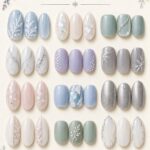


[…] For another look at shape and color, browse our blue almond nail ideas and winter gray nail ideas. […]