The Best Fluffy Pancakes recipe you will fall in love with. Full of tips and tricks to help you make the best pancakes.


Short abstract nail art ideas do not need much space to make an impression. A curved block of color, one loose line or a well-placed dot can change the whole manicure. The challenge is deciding what to leave out. On a short nail, a few clear shapes usually communicate the idea better than several tiny details squeezed together.
This collection has 20 different palettes and layouts, including warm terracotta arches, cobalt brushstrokes, sage squiggles and small rose-toned mosaics. Some designs use the same mark on every nail; others keep the art to two fingers. There are soft neutrals as well as brighter combinations, so abstract does not have to mean loud.
Think of each nail as a small composition rather than a miniature copy of a painting. The empty area, the direction of a line and the size of a color block all matter. After the gallery, you will find a simple planning guide, a two-color practice design and ways to fix a layout that feels crowded. These notes can help with a home polish attempt or make your salon reference more precise, especially when you want to adapt a longer-nail idea to your own short shape.
Planning Short Abstract Nail Art Ideas Without Crowding
Start by choosing a base and one contrast color. Add a third color only when it has a clear job, such as separating two blocks or repeating a tiny dot. A limited palette lets the shape of the art stay visible, even when the placement changes from nail to nail.
Choose one main gesture: a wave, an arch, a corner block or a dot-and-line pair. You can vary its size and direction across the hand. Using several unrelated motifs on every finger can make the set feel disconnected unless the palette is especially restrained.
Leave a visible area of base around the artwork. On very short nails, that might mean moving a shape toward one side rather than centering it. The open area is not unfinished space; it helps the color and line stand out.
1. Terracotta Cream Arches

Warm arches give the short shape a clear focal point. Keep the black dots small enough to act as punctuation rather than a second pattern.
2. Cobalt Nude Brushstroke

A single stroke can show texture without filling the surface. Change its direction across the hand while keeping the same blue throughout.
3. Olive Peach Color Blocks

Curved blocks feel less rigid than a checker pattern. Use the ivory line only where the two colors meet so the layout stays simple.
4. Black Cream Fine Waves

Two narrow waves are enough to create movement. Leave a generous cream area between them so the lines stay separate on short nails.
5. Lilac Orange Half Moons

The warm half moon makes the cooler base feel lively. Keep it shallow so the lilac still occupies most of the nail.
For more small-scale art and playful accents, browse our short artsy nail ideas.
6. Chocolate Blue Side Shapes

The open center prevents two colors from overwhelming a small nail. Repeat the same palette but let the shapes change from finger to finger.
7. Sage Pink Minimal Squiggle
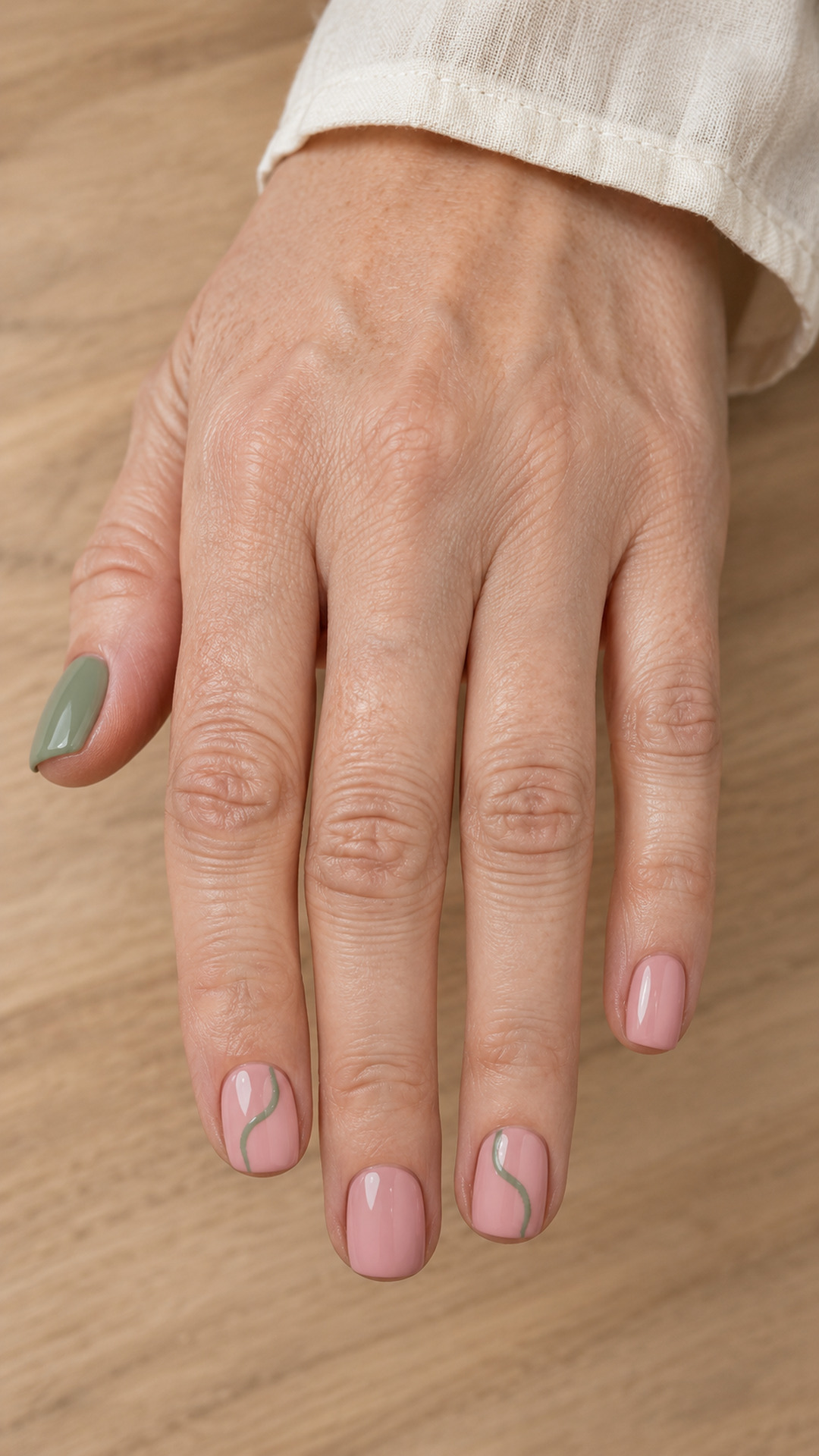
One solid nail anchors the finer lines. Keep the squiggles sparse so the dusty pink remains a visible part of the design.
8. Red Ivory Dot and Line
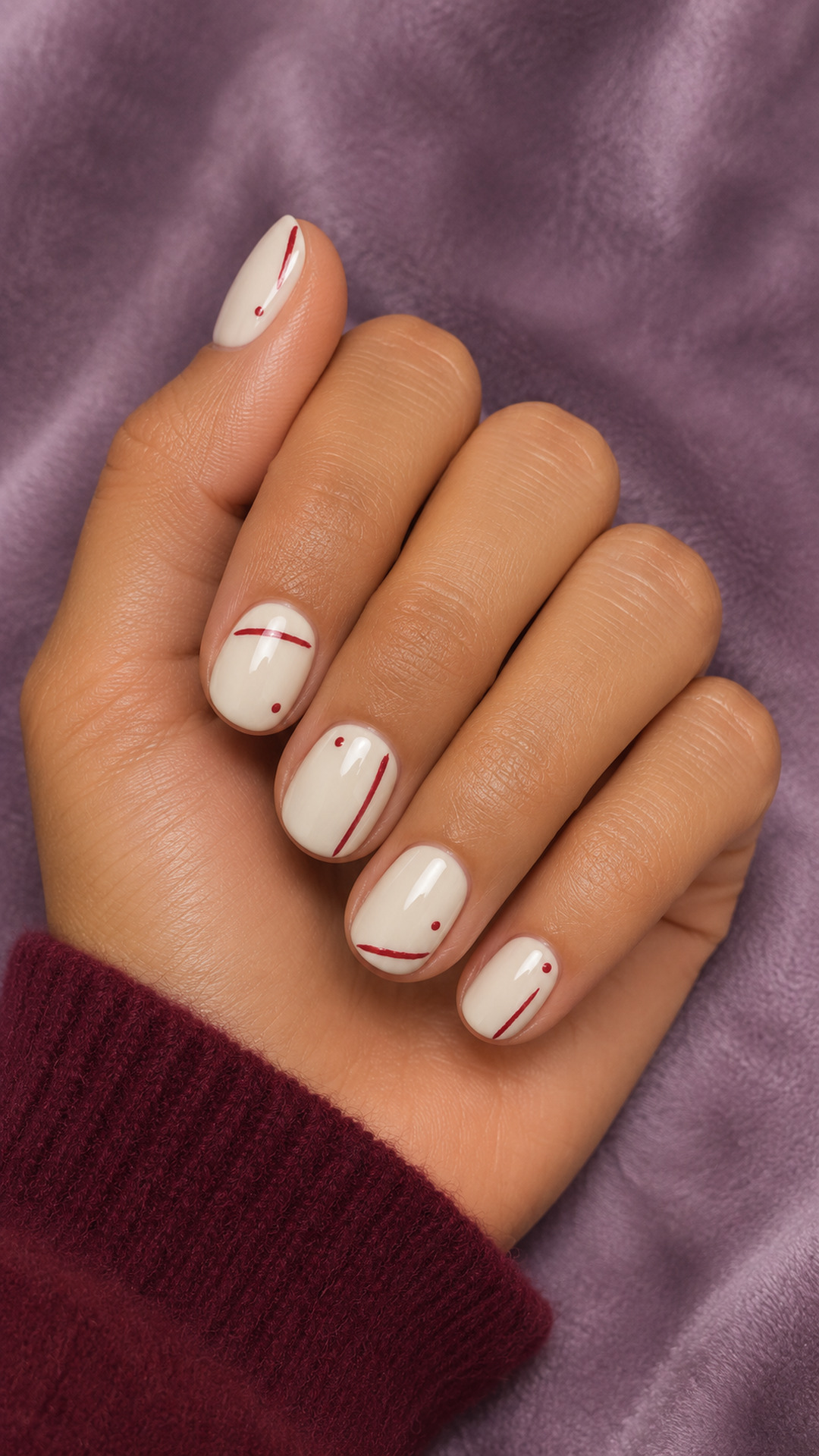
A dot-and-line pairing makes a compact graphic design. Vary the placement rather than the size to keep the manicure connected.
9. Navy Sand Cutout
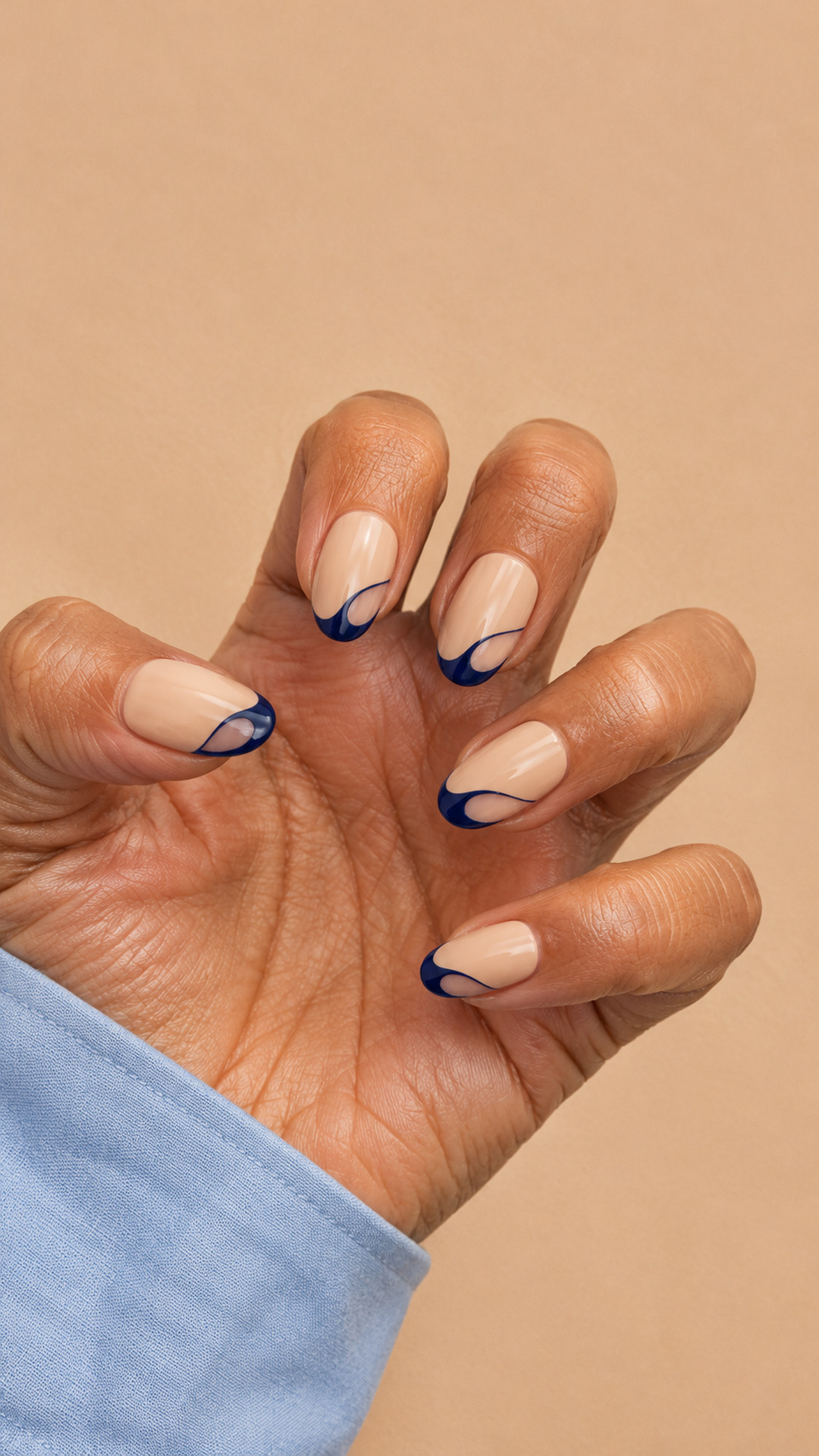
The navy shapes give the light palette definition. Leave the windows broad enough to read as intentional negative space.
10. Apricot Teal Swirl

The cool teal stands out against apricot, so it can stay narrow. A cream swoosh gives the two stronger colors a little separation.
Mini Guide: A Two-Color Wave on Short Nails
Gather a light base color, one contrasting polish, a fine brush, a practice tip and compatible base and top coats. Choose colors that remain distinct when placed next to each other. A muted base with a stronger line is easier to judge than two nearly identical shades.
- Paint the base and let it dry according to the instructions. Decide where the wave begins and ends before touching the brush to the nail. A shallow curve from one side toward the tip is a useful starting point.
- Draw one thin line with a relaxed bend. Keep it inside the nail boundary and leave a margin around the skin. If the line is too thick, begin again on a practice tip with less polish on the brush instead of adding a second heavy line.
- Add a second curve only if there is enough base visible between them. Let the curves move in the same general direction without becoming exact parallel stripes. A small difference in spacing gives the layout a more freehand feel.
- Repeat the idea on another nail with the curve reversed or moved toward a different side. Keep the line width similar so the set still feels connected. A plain nail in the contrast color can anchor the design.
- Allow the artwork to dry and finish with the compatible top coat. Check the result at arm’s length as well as close up. If the lines disappear into a dark patch from farther away, simplify the next version.
For another two-color example using a fine nail brush, see ANNY’s abstract-lines tutorial.

11. Plum Blush Geometric Corners

Corner accents preserve a large clear center. Use one triangle per nail and keep the gold dots small to avoid turning the design into a dense pattern.
12. Butter Yellow Charcoal Lines

The pale yellow gives dark lines a warm background. Choose one relaxed loop per accent nail rather than crossing several lines together.
13. Rust Cream Dry Brush

The broken brush texture is the detail here. Leave visible nude gaps between marks so the finish feels painterly rather than patchy.
14. Blue Gray Silver Curve

A metallic curve adds a small flash beside the muted base. Keep the navy dot separate from the curve so both elements stay legible.
15. Mauve Cream Wavy French

An uneven wave changes the French outline without needing extra length. Keep the band shallow enough that the nude center remains the largest area.
16. Emerald Beige Open Frame

An incomplete frame gives the border a lighter feeling. Place the gaps in different corners while keeping a consistent line width.
17. Coral Burgundy Organic Dots

Two related reds give the spots depth without requiring precise circles. Keep them separated and leave several nails with only one small shape.
18. Lavender Mint Split Curve

A curved division softens the square nail shape. Use a narrow white separator so the two pastel areas remain the main feature.
19. Espresso Ivory Scribble

A loose ivory loop creates contrast against the dark base. Keep the drawing open so it looks intentional rather than like a filled-in tangle.
20. Rose Taupe Modern Mosaic

Three small blocks can suggest a mosaic without covering the entire nail. Keep thin nude spaces between them so each shape has a clear edge.
Mini Guide: Build a Small Color-Block Accent
For a block design, choose two colors and a neutral base. Sketch the layout on paper or a practice tip first: one larger curved shape near the side and one smaller shape near the opposite corner. Avoid dividing every nail into equal halves unless you specifically want a geometric look.
Paint the first shape on a dry base with a small brush. Let it dry before adding the second color beside it. Leaving a thin strip of the base between the shapes is often easier than trying to make their edges meet perfectly.
If you want a separating line, add it only after both blocks are dry. Keep it narrow so it does not become the largest feature. A cream or nude line can soften the boundary, while black gives a stronger graphic effect.
Use the same two colors on the other hand, but change the placement slightly. You can keep most nails plain and repeat the blocks on two accents. This is a useful way to try a brighter palette without making every finger equally detailed.
How to Edit a Design That Feels Too Busy
Remove one type of mark first. If a nail has a wave, two blocks, dots and a metallic line, decide which element is the real focus. Keep that and move one supporting detail to another nail. Reducing the number of motifs often helps more than changing all the colors.
Check the size of the smallest gap. When two shapes nearly touch, the remaining sliver can look accidental. Either give them a clearer separation or let them meet deliberately. This is especially useful for mosaics and split-color curves.
Use different levels of detail across the hand. A detailed accent beside two simple nails has more impact than five equally busy nails. You can repeat one tiny dot or one color on the simpler nails to keep the set coherent.
For a salon appointment, show the palette and explain the parts you want to keep: short shape, open center, fine lines or two accent nails. Abstract art leaves room for interpretation, so a few concrete preferences are more useful than asking for an exact copy of every brushstroke.
If you prefer a straight free edge, compare the layouts in our short square nail designs.
Frequently Asked Questions
Can abstract nail art work on very short nails?
Yes. A single dot, a shallow curve or one corner block can fit a small surface. Reduce the number of elements before reducing every element to a size that is hard to see.
How many colors should I choose?
Two colors plus a neutral base are a manageable starting point. A third accent can work, but give it a small role so the palette does not compete with the shapes.
Do all the nails need the same pattern?
No. Repeat the palette and line weight while changing placement. A few plain nails can connect the set and give the detailed nails more room to stand out.
What is the easiest abstract design to practice?
A dot-and-line pair or one curved stroke is a useful first attempt. It teaches placement and scale without requiring several layers of shapes. Practice on a tip before adding more detail.
Can I use a long-nail reference?
Yes, but borrow its palette and main gesture rather than every detail. Move the art to one side, shorten the curve or keep only one block to suit the shorter surface.
How do I keep the manicure wearable for everyday outfits?
Choose a neutral base and use the brighter color as a small accent. Terracotta with cream, navy with sand or plum with blush can give you contrast without covering every nail in a bold pattern.