
The Best Fluffy Pancakes recipe you will fall in love with. Full of tips and tricks to help you make the best pancakes.


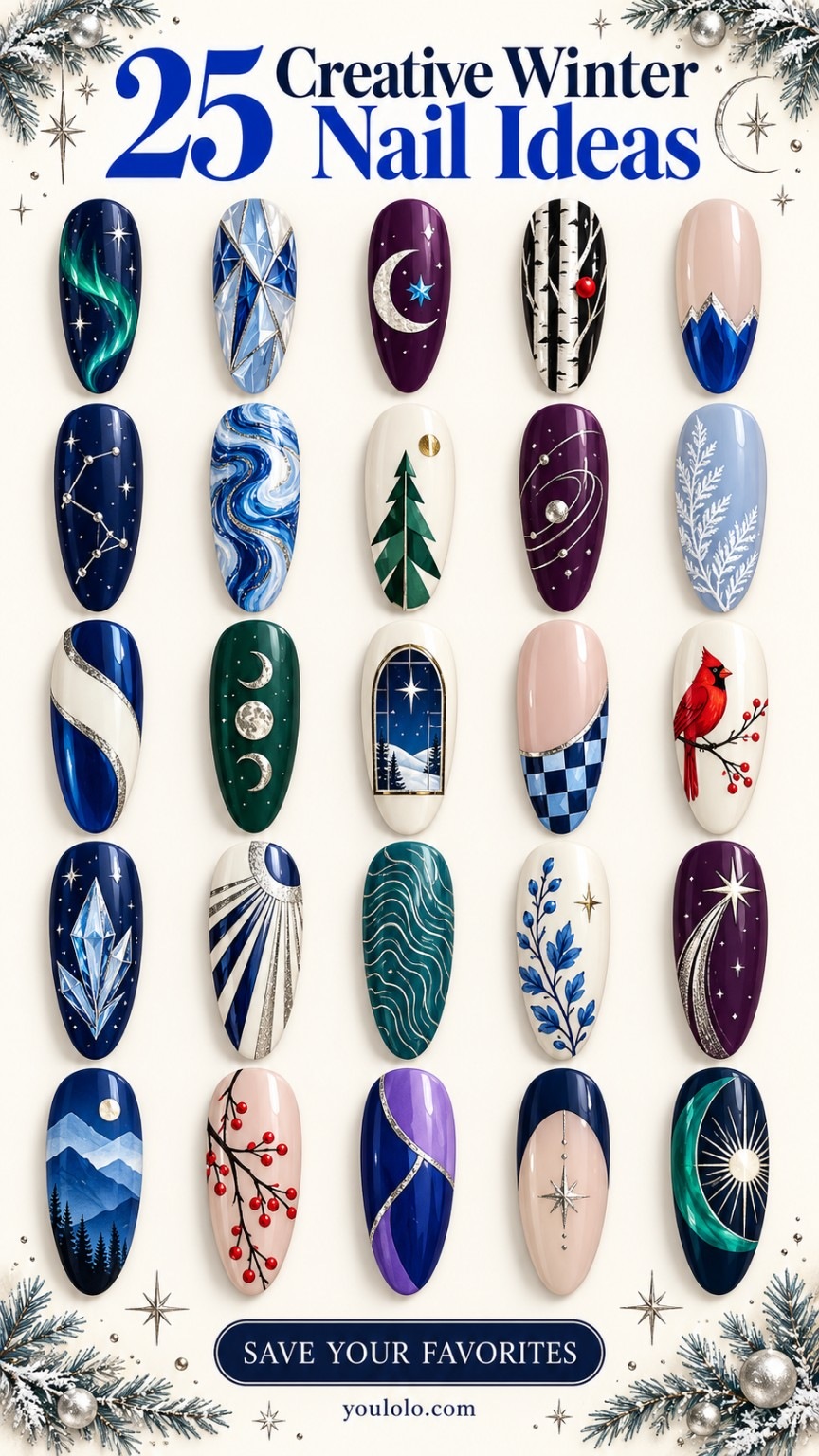
Some winter manicures are all about a beautiful shade. Others make you stop scrolling because there is a tiny world painted on one nail: a red cardinal on an ivory branch, a star above snowy mountains, or a green ribbon of northern lights crossing a midnight sky. These 25 creative winter nail ideas belong to that second group. The details give you something specific to fall in love with, whether you prefer a bold full-color set or a sheer base with one small accent.
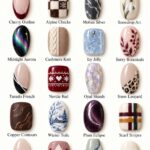
The collection stays close to a winter palette of cobalt, navy, evergreen, plum, ivory and silver, with a few red berries and warm gold details. That shared palette makes very different designs feel related. A checkerboard French tip can sit beside a miniature landscape without either losing its own character. There are graphic options, delicate botanicals and celestial designs with enough variety to choose by mood as well as color.
The close-ups follow the overview from left to right, one row at a time. Each turns a single design into a full manicure, using quieter supporting nails where an accent needs room to stand out. Save the idea that catches your eye, then notice what you actually want to keep: the color combination, the main motif or the finish. You can adapt the scale to your own nails while preserving the detail that made you choose it.
Choose Your Winter Nail Art Mood
Start with the kind of detail you enjoy looking at. Celestial designs give dark colors a delicate focal point; landscapes turn one nail into a miniature painting. Graphic patterns are a good choice when you want something striking without a recognizable scene. For a lighter manicure, keep the blush or ivory base and let one blue, green or red accent supply the color.
- For a night-sky mood: Aurora Across a Midnight Sky, Plum Moon and Blue Star, Silver Constellation Map and Emerald Crescent and Silver Sun.
- For crisp, graphic detail: Faceted Blue Ice, Blue Checkerboard French and Art Deco Winter Sunburst.
- For winter nature: Birch Trees and a Red Berry, Frosted White Fern, Red Cardinal on an Ivory Branch and Winter Berry Branches.
- For a tiny painted scene: A Window onto Winter and Moonlit Mountain Layers.
1. Aurora Across a Midnight Sky

The green ribbon is what makes this design feel alive. It curves through the navy rather than sitting in a straight stripe, while the small stars give the eye a few quiet points to land on. I would keep the other nails dark and glossy so the northern-lights accent stays the focus.
What to ask for: Ask for a flowing, translucent-looking green ribbon over navy, with a few fine stars. On shorter nails, use one broad curve and fewer stars.
2. Faceted Blue Ice
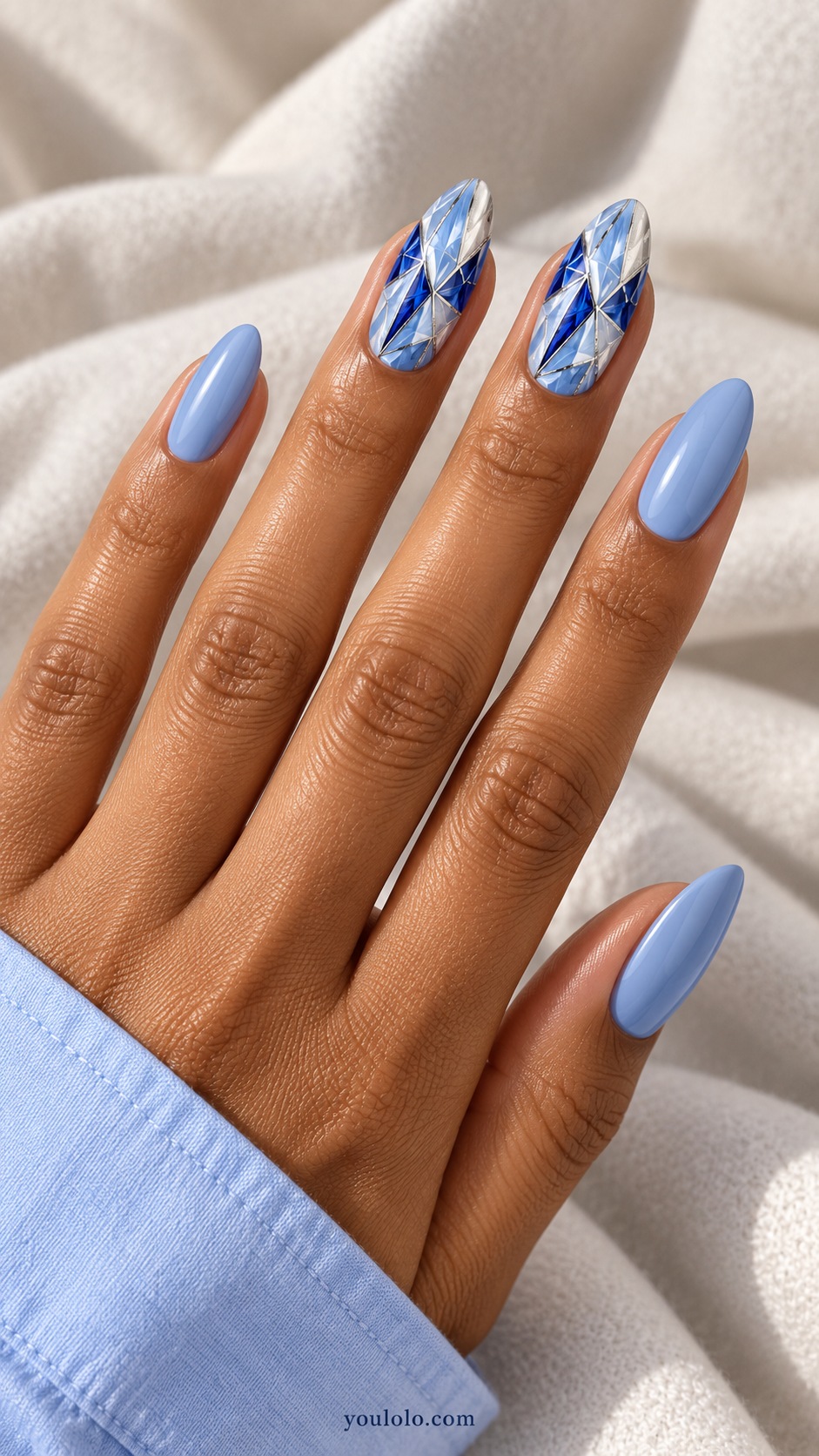
Sharp blue facets bring a completely different mood from soft snowflakes. The mix of light and dark panels creates an icy, jewel-like effect, but the artwork can remain smooth and flat. I like the silver divisions kept very fine; thick outlines would take attention away from the different blues.
What to ask for: Show the artist the angular panels and ask for a flat painted finish. Reduce the number of facets on a shorter nail rather than making every triangle tiny.
3. Plum Moon and Blue Star

The bright blue star is a small but important detail here. It makes the silver crescent feel more unusual than a standard moon-and-stars manicure, especially against the rich plum background. I would choose this with a simple dark outfit and let the cool metallic accent supply the contrast.
What to ask for: Keep the crescent and blue star on one roomy accent nail. Use fine silver shimmer or a flat metallic finish rather than a bulky moon charm.
4. Birch Trees and a Red Berry

The red berry interrupts a very graphic black-and-white scene. That single warm point is enough to make the birch trunks feel seasonal without adding glitter or a full landscape. The irregular bark markings matter: perfectly even stripes would lose the natural character of the trees.
What to ask for: Ask for thin birch trunks with broken black bark marks, a few fine branches and one red berry. Keep the background clean so the trunks remain distinct.
5. Cobalt Mountain French

This is a French manicure with a much more interesting horizon. The blue peaks rise unevenly from the tips, while the sheer blush base gives them space. A narrow silver ridge suggests snow without filling the entire manicure with white. I like the contrast between the soft base and the sharp mountain outline.
What to ask for: Keep the mountain peaks within the tip area and vary their height slightly. On shorter nails, use two broad peaks instead of several narrow points.
6. Silver Constellation Map
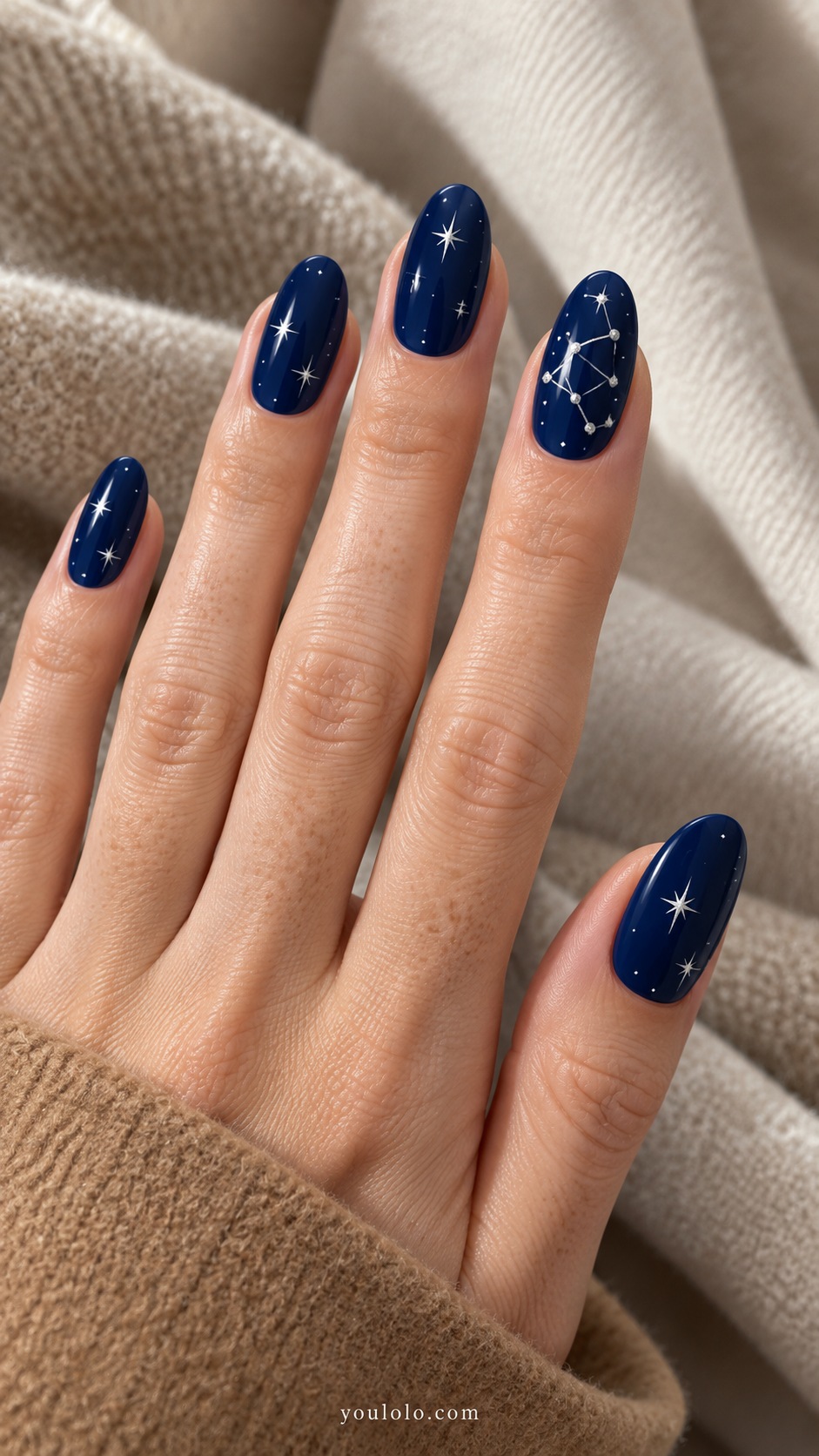
A constellation gives a dark manicure a little structure without making it rigid. The connected points form a clear path across the nail, and the scattered stars keep the background from feeling empty. I would avoid adding several competing constellations to one finger; a single readable arrangement has more presence.
What to ask for: Use small flat silver dots and very fine connecting lines. Choose a simple constellation layout that fits the nail, leaving dark space around it.
7. Blue Winter Swirl

These swirling blues have the movement of water and the palette of ice. The white curves separate the darker colors, so the effect does not turn into one muddy blue surface. I would let the pattern vary from nail to nail while repeating the same limited palette across the hand.
What to ask for: Ask for clear, flowing bands of blue and white with only a little silver. Keep some wider areas of color between the narrow lines.
8. Geometric Evergreen and Gold Moon

The tree is built from crisp triangular pieces rather than fine painted needles. That makes it feel graphic and almost like folded paper, even though the nail surface stays flat. The small gold moon warms the ivory background. I would keep the supporting nails plain so the silhouette remains easy to recognize.
What to ask for: Build the tree from a few clean green triangles and place the gold moon above it. For a smaller nail, simplify the tree to three main tiers.
9. Silver Orbits on Plum
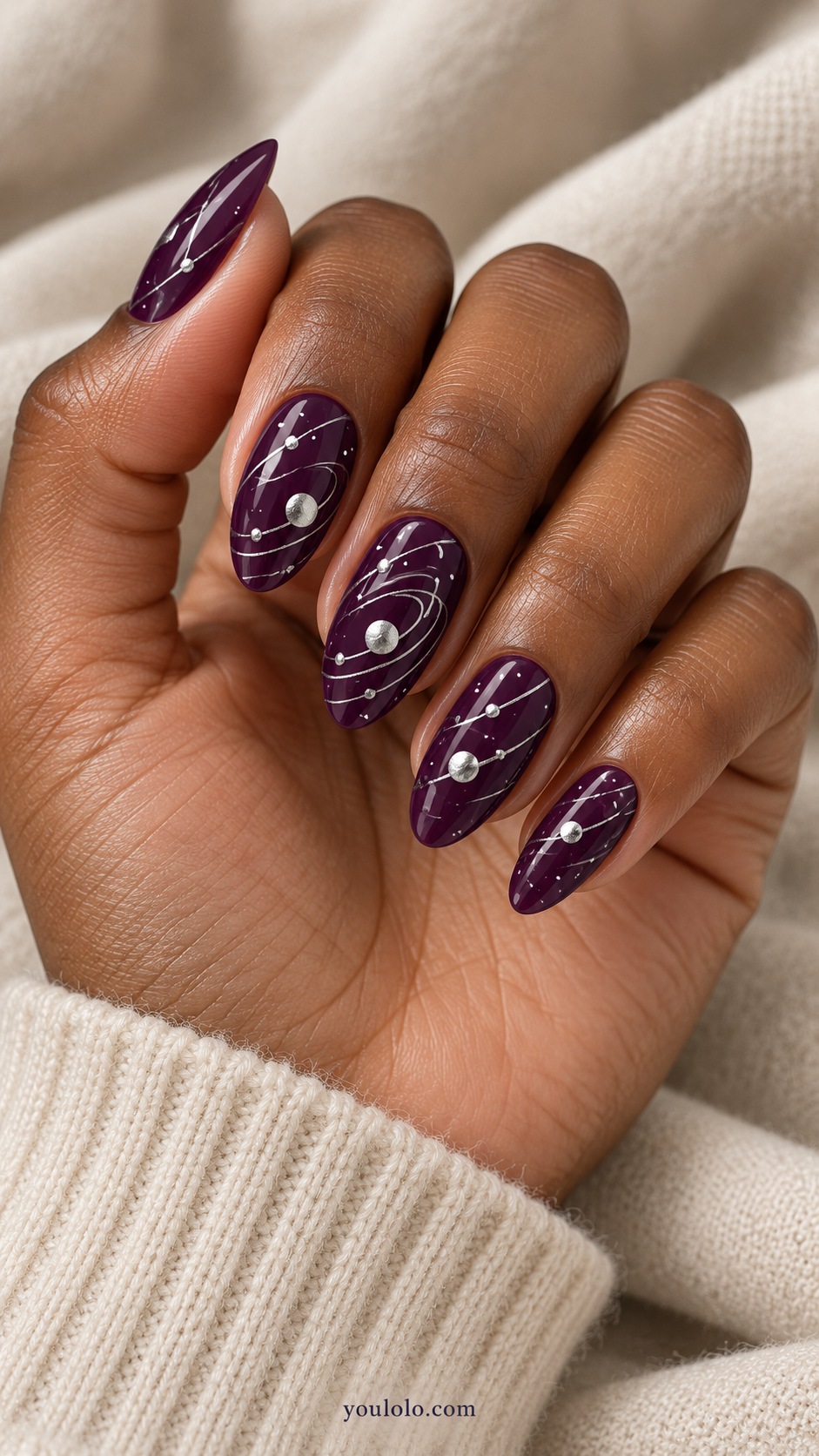
The curved orbits create movement without needing a full night-sky scene. Plum gives the silver a rich background, while the little planets provide different-sized focal points. I like this as a more abstract celestial manicure: it reads as a design first, with the space theme appearing when you look closer.
What to ask for: Keep the orbit lines fine and let them cross with plenty of space between them. Use flat metallic circles instead of tall stones for the planets.
10. Frosted White Fern

A white fern-like frost pattern feels softer than a geometric snowflake. The little branches spread gradually across the blue, giving the artwork a light, feathery quality. I would choose a muted periwinkle rather than a very bright blue so the white drawing stays gentle but visible.
What to ask for: Use a fine white central stem with smaller branching strokes. On shorter nails, keep a single fern along one side instead of filling the entire surface.
11. Cobalt and Ivory Ribbon

The broad ivory ribbon gives this set a confident, graphic shape. Silver defines its edges, but the real contrast comes from the creamy white against cobalt. It is a useful option when you want a winter manicure with impact but do not want miniature scenery, flowers or stars.
What to ask for: Ask for one smooth ivory curve with a fine silver border. Keep the ribbon broad enough to read clearly and avoid adding extra thin waves around it.
12. Moon Phases in Evergreen

Evergreen changes the mood of a moon-phase design completely. The silver feels cool against the green, while the vertical arrangement makes good use of an almond nail. I would keep the full moon softly textured rather than perfectly mirror-like, so the three phases have a little visual depth.
What to ask for: Place the three phases in a vertical line with visible gaps. If space is tight, use one full moon and one crescent instead of shrinking all three.

13. A Window onto Winter

This is the miniature painting of the collection. The arched frame makes the snowy scene feel like a view through a window, with the bright star drawing the eye upward. I would leave the rest of the manicure creamy and quiet. The small landscape already contains enough detail to carry the whole set.
What to ask for: Reserve the window scene for one nail and agree on its scale before painting. A simplified version can keep only the arch, one snowy slope and a star.
14. Blue Checkerboard French

The checkerboard turns a familiar French tip into a small piece of pattern. Using several blues gives the squares depth without introducing unrelated colors. I like the sheer base kept clean because it balances the busy edge. This is one of the more graphic choices in the reference.
What to ask for: Use a curved tip with large enough squares to stay readable. Keep the silver smile line narrow, and reduce the number of checks on smaller nails.
15. Red Cardinal on an Ivory Branch
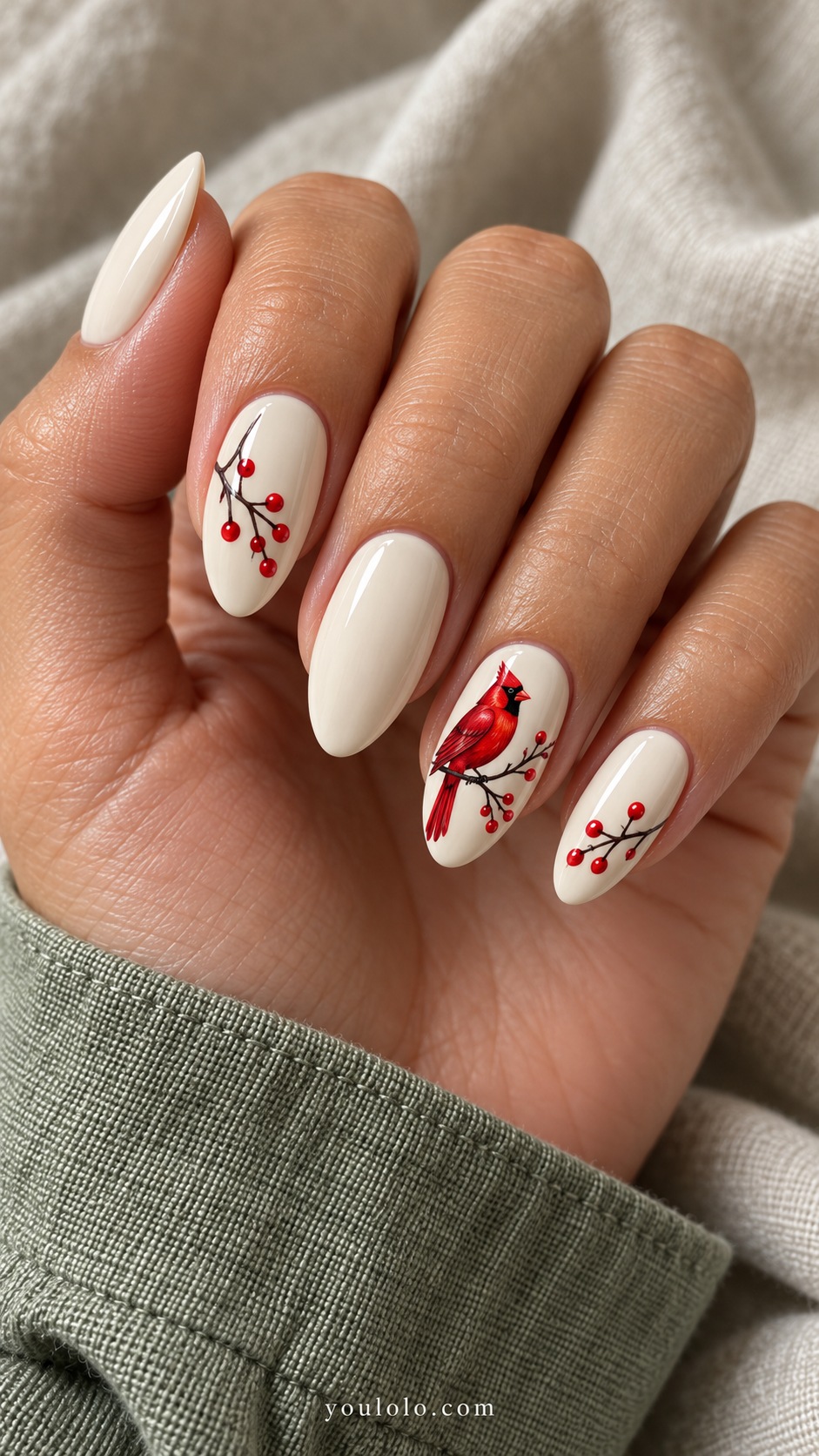
The cardinal brings the strongest warm color into the collection. Its red feathers stand out against ivory, while the branch gives the bird a natural place to sit. I would keep the bird on one accent and use only a small berry detail elsewhere, so the manicure still feels light.
What to ask for: Show the artist the cardinal's crest, dark face detail and long red tail. Keep the branch thin and use a simplified bird silhouette if the nail is short.
16. Crystal Shards under the Stars

The crystal shapes look striking because they are long and angular against a dark sky. Pale blue highlights help the facets read as crystal rather than simple triangles. I would keep this artwork flat; the painted illusion gives plenty of depth without needing a raised sculptural decoration.
What to ask for: Ask for one main faceted crystal and a smaller companion shard. Use a few clear light-and-dark planes, with only a handful of stars around them.
17. Art Deco Winter Sunburst

The rays give this design an Art Deco feeling, with a clear focal point and a controlled fan of lines. Ivory keeps the negative space bright, while navy makes the pattern feel wintry. I would keep the silver rays slim so they complement the blue instead of overwhelming it.
What to ask for: Choose one point for the rays to fan from, then alternate broad navy bands with fine silver lines. Use fewer rays on a shorter nail.
18. Silver Contours on Teal

The contour lines are quiet compared with the landscapes and celestial details, but they have their own rhythm. Their uneven spacing is what makes the pattern interesting. I like deep teal here because it gives silver definition while feeling a little softer than navy or black.
What to ask for: Ask for thin, irregular flowing lines with changing gaps. Keep the artwork flat and avoid making every curve perfectly parallel or mechanically repeated.
19. Blue Winter Botanical

Blue botanical art has a porcelain-like quality against ivory. The small gold star gives the branch a seasonal companion without turning it into a Christmas motif. I would keep the leaves varied in size and leave some cream showing between them, so the drawing feels airy rather than densely printed.
What to ask for: Use one curved stem with a few blue leaves and one small gold star. Place the branch along the side of the nail to preserve an open center.
20. A Silver Comet on Plum

The curved tail is the detail that gives the silver star its movement. It sweeps through the plum like a ribbon rather than dropping in a straight line. I would make one star clearly dominant and keep the smaller background stars sparse, so the composition has an obvious focal point.
What to ask for: Start with one well-defined star, then add two or three slender curved trails. Keep the tail flat and leave plum visible between the silver strokes.
21. Moonlit Mountain Layers
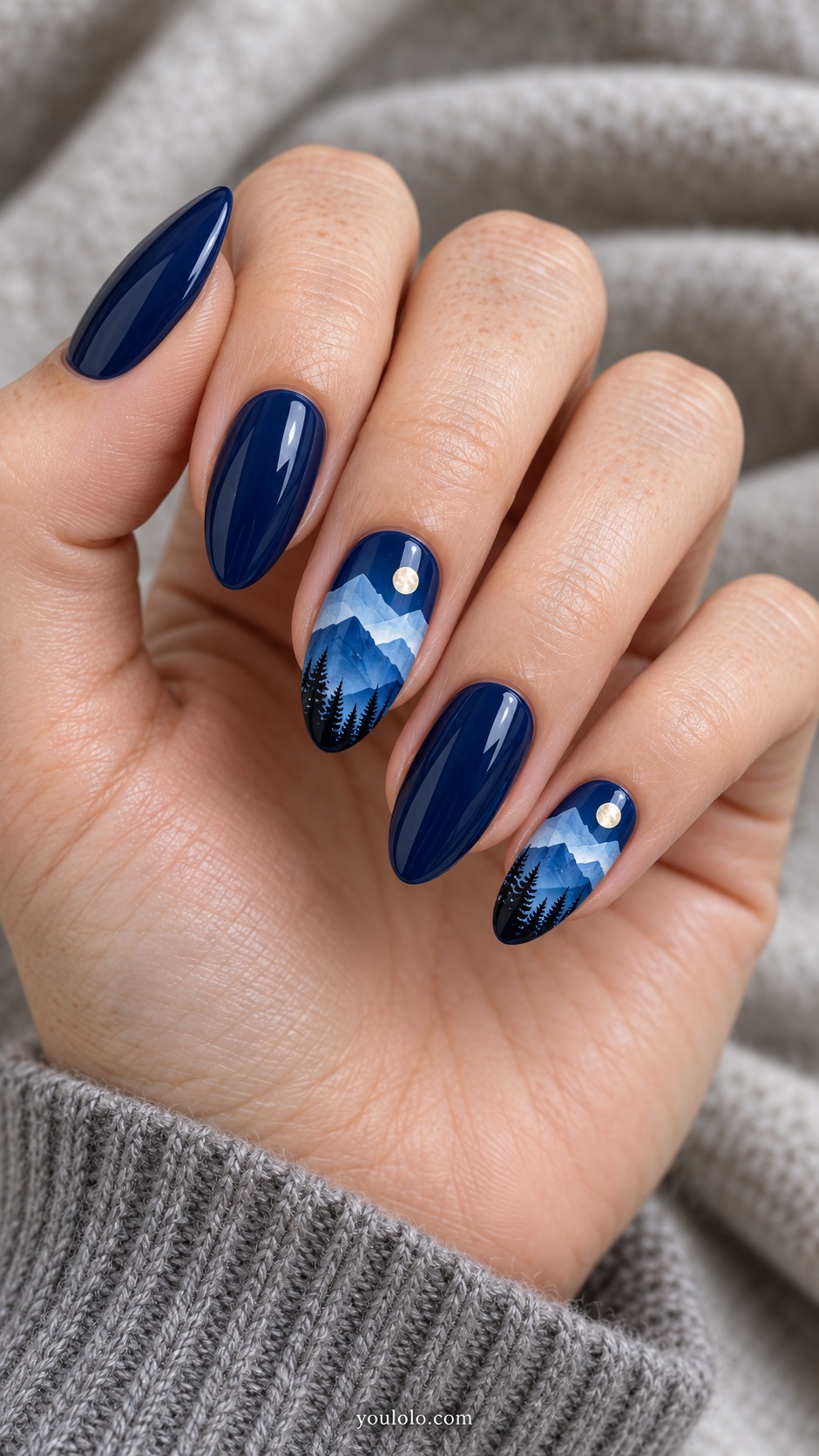
Layered mountain ridges create depth with a small number of colors. The pale moon gives the sky a focal point, while the dark trees anchor the bottom of the scene. I like the distant ridges lighter and simpler, with the strongest detail reserved for the foreground.
What to ask for: Use three or four mountain layers in related blues and a few fine tree silhouettes at the base. On shorter nails, keep only two ridges and one tree.
22. Winter Berry Branches

Red berries against a blush base feel lighter than a full red manicure. The branches create a natural path across the nail, and the uneven berry clusters keep the pattern from looking like polka dots. I would use a glossy finish so the red stays crisp and bright.
What to ask for: Paint fine dark twigs first, then place small berries in uneven clusters. Keep the berries flat with tiny painted highlights rather than large raised beads.
23. Cobalt and Violet Silver Waves

This design uses color blocking rather than a winter illustration. Cobalt and violet share the nail in broad curves, with silver defining the transitions. I like it for someone who wants a more colorful set but still prefers a controlled palette. The smooth wave shapes keep it from feeling busy.
What to ask for: Use two broad color areas and one or two fine silver boundaries. Keep the colors opaque and the dividing lines consistent in thickness.
24. Hanging Silver Star French

The dark tip frames the nail while the hanging star brings the detail into the sheer center. That change in placement is what makes this French manicure feel different from a star painted directly on the tip. I would keep the chain very fine so the central star remains the focus.
What to ask for: Use a slim silver line with tiny dots and one flat star on an accent nail. Keep the supporting nails as a simple navy French.
25. Emerald Crescent and Silver Sun

The emerald crescent wraps around the silver sun, making this the boldest celestial composition in the group. The green needs to remain a clear shape against navy, while the rays should be thin enough to leave dark space between them. I would keep this as a single statement accent.
What to ask for: Place the silver sun slightly off-center and curve the green crescent around it. Simplify the number of rays for a smaller nail rather than thickening them.
How to Turn a Saved Design into a Wearable Manicure
Choose one hero detail. A window scene, cardinal or crystal arrangement can carry the whole set. Keep the supporting nails in one of the colors already present in the artwork. This gives the detailed nail a clear place in the manicure rather than making it compete with four unrelated patterns.
Scale the pattern to the nail. For shorter nails, remove a mountain layer, reduce the number of checkerboard squares or use a single moon. Keeping the important shapes clear usually works better than shrinking every element equally. A fine detail that looks beautiful in an enlarged picture still needs to make sense at normal hand distance.
Decide how the shine should work. These references often combine glossy color with silver or gold detail. Ask whether the metallic parts will be painted, foiled or created with another flat finish. The same motif can look quite different when the silver is a solid mirror surface instead of a fine shimmer.
Bring a focused reference. Show the overview and the individual manicure together, then explain which part matters most. For example: “I want the cobalt mountain tip and the narrow silver ridge, with a sheer blush base.” That gives your artist a clearer starting point than asking for every winter detail in one set.
My Favorite Creative Winter Nail Ideas from This Collection
A Window onto Winter would be my first choice for a statement accent: the little arch gives the scene a beautiful frame. For something lighter, I would choose the Blue Winter Botanical, with plenty of ivory around the branch. Cobalt Mountain French is the option I would save when I wanted a clean base and a stronger tip. They have very different moods, but each has one detail you can recognize immediately.
For additional technique references, browse OPI’s nail art tutorials or essie’s midnight-blue celestial nail art. Use them to discuss approaches and finishes rather than expecting one product shade to match every reference exactly.
Creative Winter Nail Ideas FAQ
What nail colors work well for creative winter nail art?
This collection uses navy, cobalt, evergreen, plum, ivory and blush as its main colors. Silver gives them a cooler contrast, while small gold or red details add warmth. Choose the palette you enjoy against your skin and everyday clothing.
Can these winter nail designs work on short nails?
Yes, with a simpler composition. Use fewer mountain layers, one moon instead of three, a smaller branch or a narrower patterned tip. Keep the main motif recognizable and leave space around it.
Do I need long almond nails for detailed winter art?
No. The references use elongated shapes because they offer room for the artwork, but the motifs can be adapted to oval, rounded or softly squared nails. The amount of detail should follow the space available.
Should every nail have the same detailed design?
It does not need to. A single statement nail with coordinated plain nails can make a small scene easier to appreciate. Repeating a simpler element, such as a berry or star, can connect the rest of the set.
Can I wear these designs after Christmas?
Many of them are easy to keep wearing through winter. Auroras, moons, mountains, birch trees and blue geometric patterns do not depend on a specific holiday. Choose a quieter evergreen or berry detail if you prefer a less festive look.
What should I show my nail artist?
Bring both the overview and your favorite close-up. Point out the color, motif and finish you want to keep, then discuss how the design will fit your nail length. Ask which details should be simplified before the artwork begins.
[…] For another direction to compare, take a look at our more creative winter nail ideas. […]