The Best Fluffy Pancakes recipe you will fall in love with. Full of tips and tricks to help you make the best pancakes.


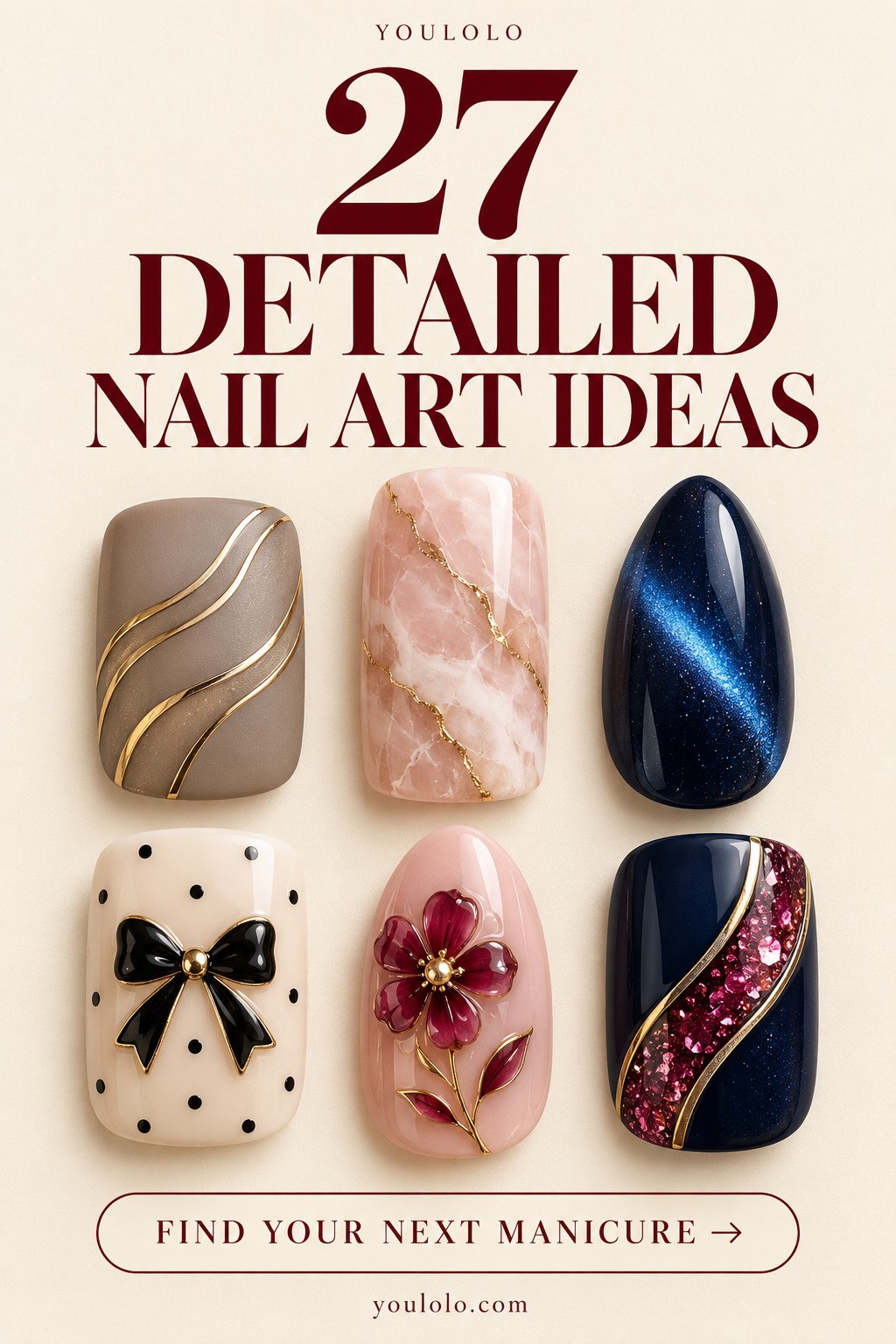
A beautiful manicure often comes down to one small decision: a gold line left deliberately thin, a flower placed where it has room to breathe, or a pearl chain balanced by plain nails. These detailed nail art ideas explore those finishing touches through 27 complete manicure combinations. The collection moves from soft pink and ivory to olive, burgundy and midnight blue, with square, almond and oval shapes throughout.
Some looks are quietly decorative, such as a tiny gold bow or a silver starburst. Others make more of a statement with rose-quartz marble, jewel-colored petals or glitter ribbons. The designs are grouped by the way they feel and the details they share, so you can compare related options before choosing one.
Each look includes a short salon brief and a way to adapt it to less nail length. You do not need to put every element on every finger. In many of the sets, one or two accent nails carry the artwork while the others repeat a background color. That balance makes the fine details easier to see and gives your nail artist a clear starting point.
Choose the kind of detail you love
- Jewelry-inspired: gold bows, heart frames, pearl chains, crystals and pendants.
- Soft and romantic: tulips, daisies, lavender ribbons, pink marble and tiny hearts.
- Graphic and polished: black bows, windowpane checks, tortoiseshell and framed French tips.
- Rich and reflective: ruby petals, glitter rivers, sapphire waves and deep blue cat-eye.
- Quiet contrast: matte taupe with fine gold curves.
1. Gold Bows on Rose and Olive
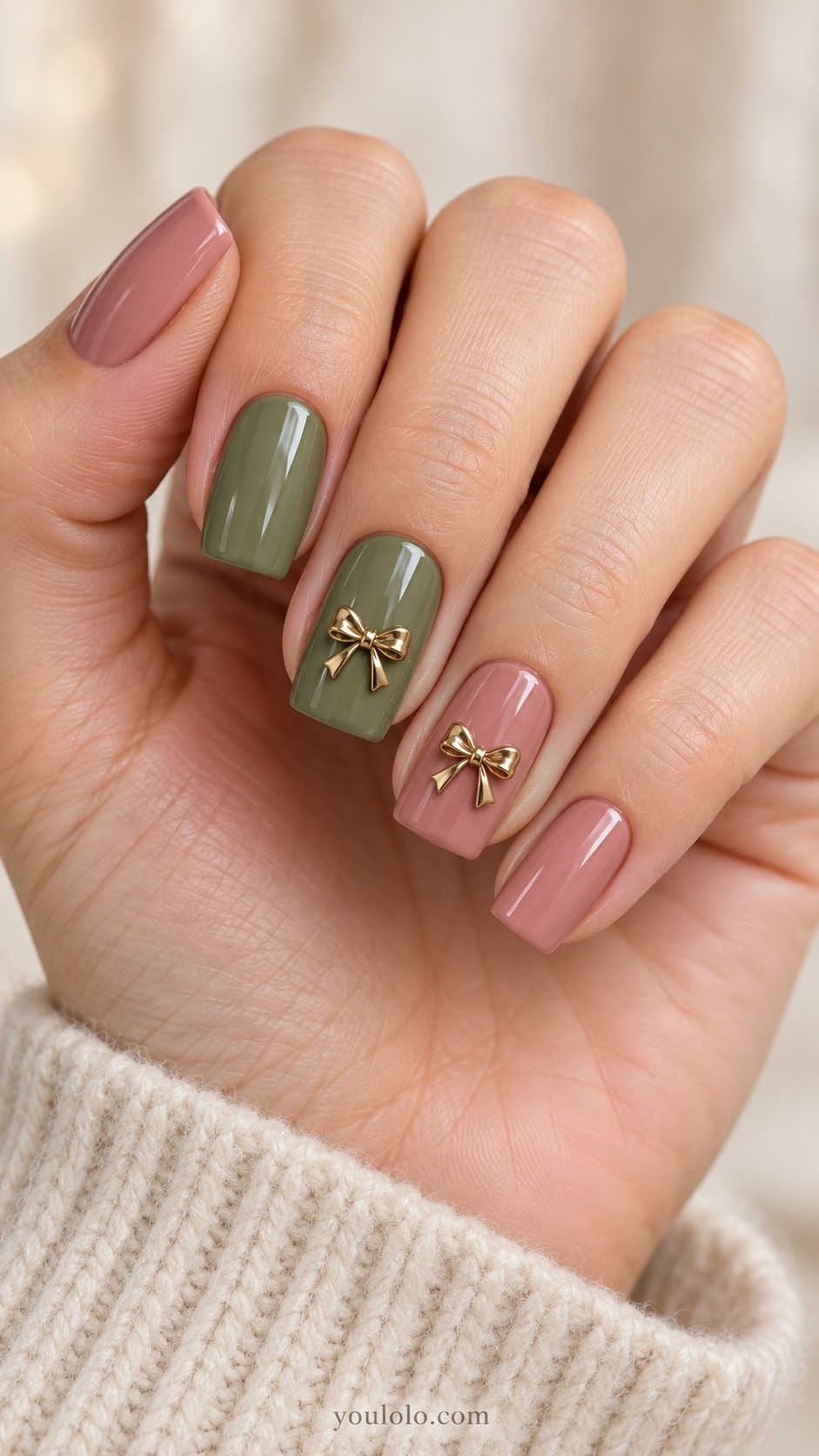
A tiny gold bow makes a muted manicure feel dressed rather than decorated. Dusty rose softens the metal, while olive gives the same detail a richer, slightly unexpected setting. Putting the bows on two different background colors lets them relate without looking like matching stickers. The remaining nails provide a quiet pause, which is especially helpful when the bow has a raised knot or delicate tails.
What to ask your nail artist for
Use dusty rose and olive square nails, with a miniature gold bow on one nail of each color. Keep the bow narrow enough to leave visible polish around it.
Make it work at your length: For shorter nails, use a painted gold bow instead of a charm. Place it slightly above the tip so the tails do not disappear over the edge.
2. Pressed-Flower Sprigs and Pink Tulips

These botanical nails use two scales of flower: a slender wildflower sprig on ivory and a pair of taller tulips on blush. The connecting detail is the fine green stem, not an identical blossom on every finger. This makes the set feel like a small arrangement rather than a repeated print. Leave most of the nail visible around each stem so the flowers retain their delicate proportions.
What to ask your nail artist for
Combine an ivory nail with a pink flowering sprig and a blush nail with two tulips. Make the stems thin and let the flower heads sit at different heights.
Make it work at your length: A short square nail can hold one tulip beautifully. Reduce the number of flowers before reducing their size, or the petals may become difficult to read.
3. Gold Heart Frames in Soft Neutrals

An open gold heart is more delicate than a solid metallic heart because the background color remains part of the design. Muted blue, warm taupe and pale pink each change its mood: blue feels cool, taupe understated and pink romantic. The beaded outline echoes a small piece of jewelry. A smooth, uninterrupted heart shape matters more here than adding extra sparkle around it.
What to ask your nail artist for
Place a fine gold heart outline on selected pastel and neutral nails. Keep each heart centered and leave the inside empty.
Make it work at your length: On shorter squares, choose a slightly wider heart with a modest point. A flat painted outline is a good alternative when you want the jewelry effect without a raised edge.
4. Black Daisies and a Tiny Flower Charm
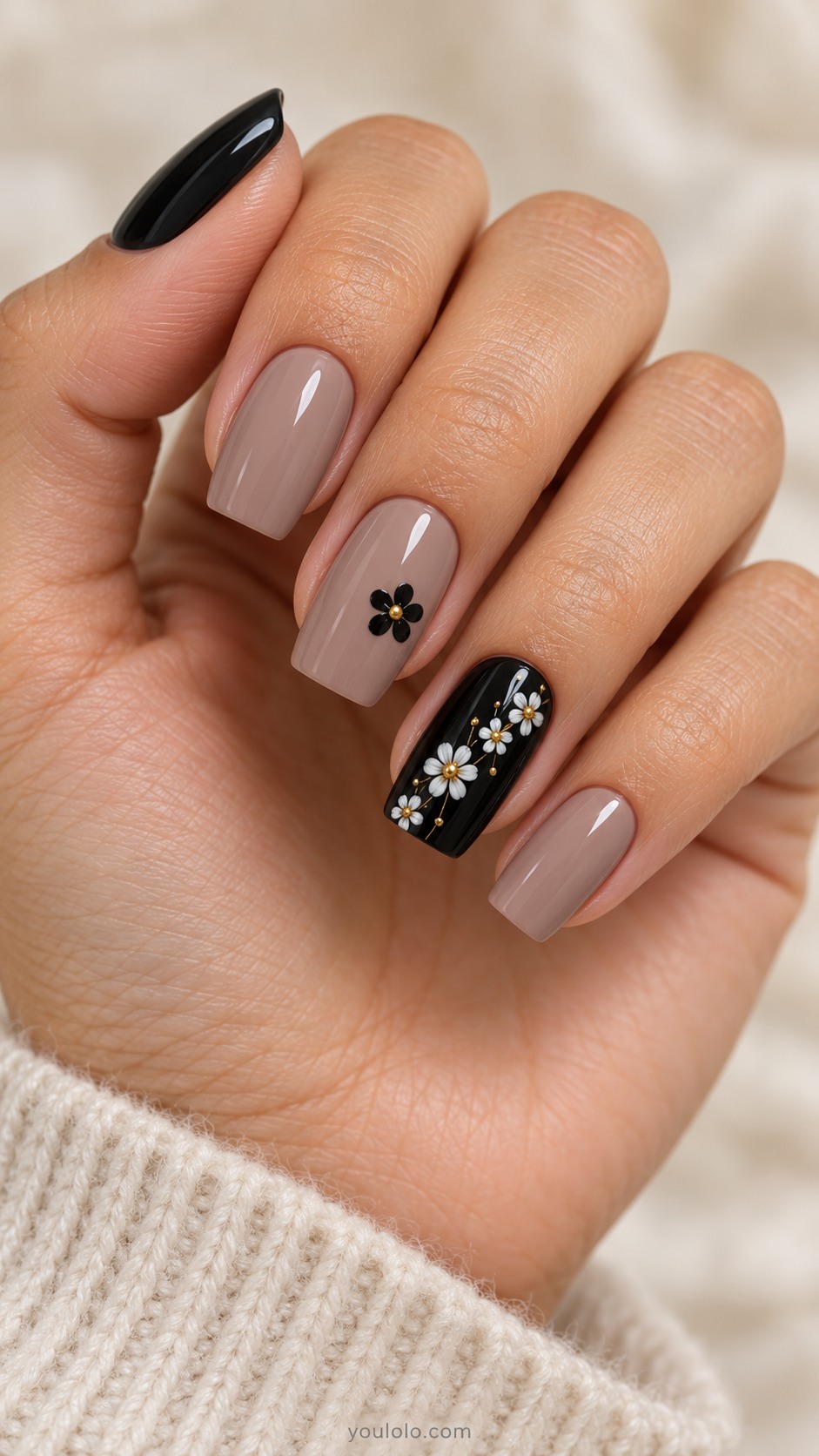
The contrast between white daisies on black and a black flower on taupe gives this set its personality. One accent is painted like a miniature floral print; the other behaves like a single piece of jewelry. Keeping the flower centers gold connects the two treatments. Glossy black companion nails make the white petals stand out, while the mushroom neutral stops the overall palette from feeling too severe.
What to ask your nail artist for
Paint small white daisies on a black accent and add one low-profile black flower with a gold center to a taupe nail.
Make it work at your length: If your nails are short, use just two daisies on the black accent. The single black flower can also be painted flat instead of built in relief.
5. Fine Gold Waves on Sage and Rose
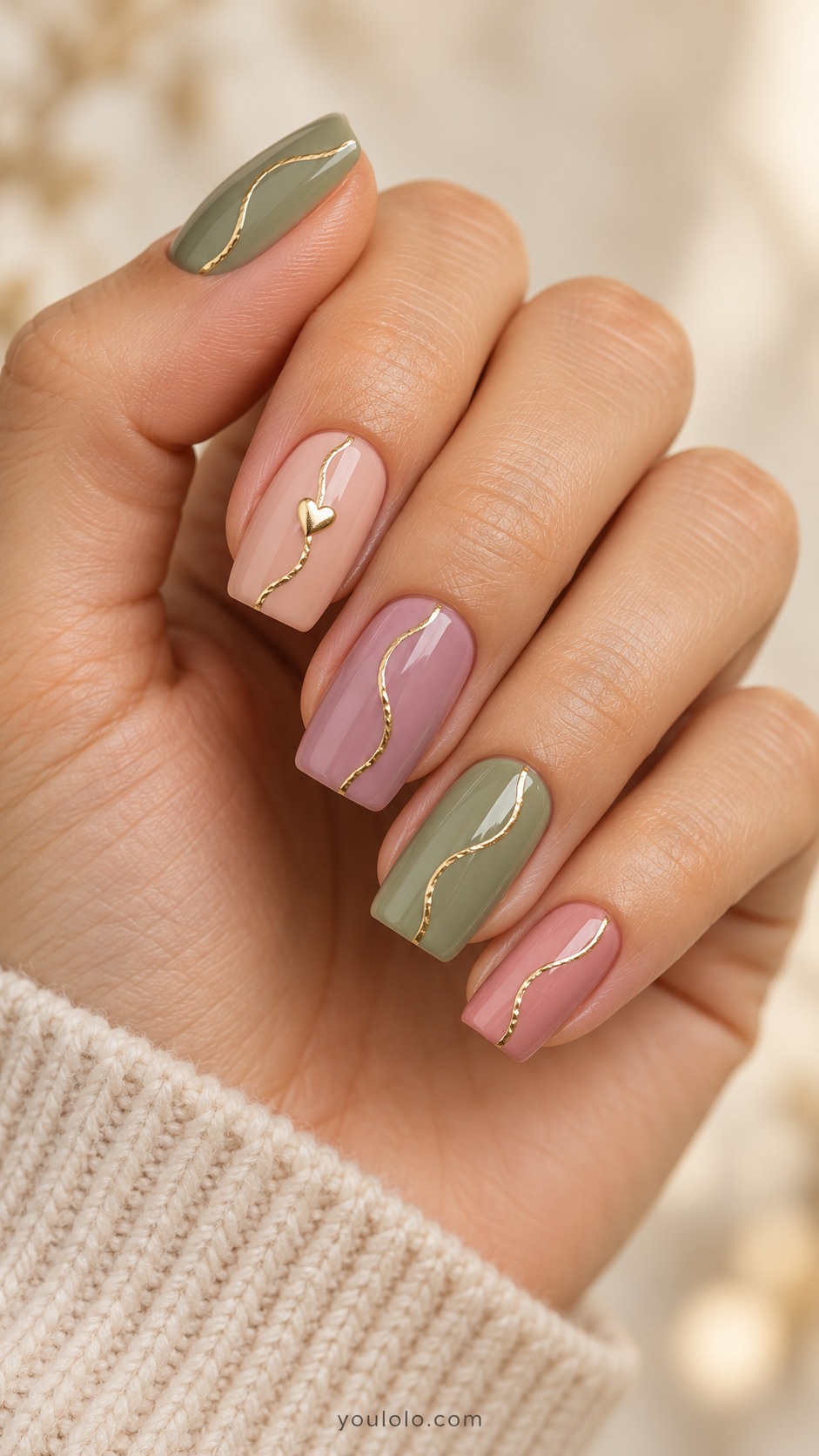
Gold lines work especially well when they wander rather than follow identical paths. Sage, blush and muted rose give these fine curves a soft background; a small heart tucked into one pink accent makes a subtle focal point. The metallic detail should feel like a line drawn across the polish, not a heavy strip sitting on top. Varying where each curve enters and leaves the nail gives the set a natural rhythm.
What to ask your nail artist for
Use a restrained sage-and-rose palette with one thin winding gold line per nail. Reserve the tiny heart for a single accent.
Make it work at your length: Ask for flat metallic tracing if you want the smoothest result. Short nails need one open curve, not several tight bends.
6. Black Bow Nails with Dots and Borders

There are two useful ways to frame a black bow: with a field of small dots or with a fine black border around an ivory nail. Combining them creates a coordinated graphic manicure without making every nail identical. The ivory background keeps the black details crisp. Smaller bows feel tailored; very large bows would change the design into a more playful, dimensional look.
What to ask your nail artist for
Use an ivory base, one dotted bow accent and one clean bow accent with a hairline black perimeter. Keep the dots well spaced.
Make it work at your length: For compact nails, choose either the border or the dots on each finger. Leaving some nails mostly plain prevents the small details from merging.
7. Rose Glitter with a Glassy Finish
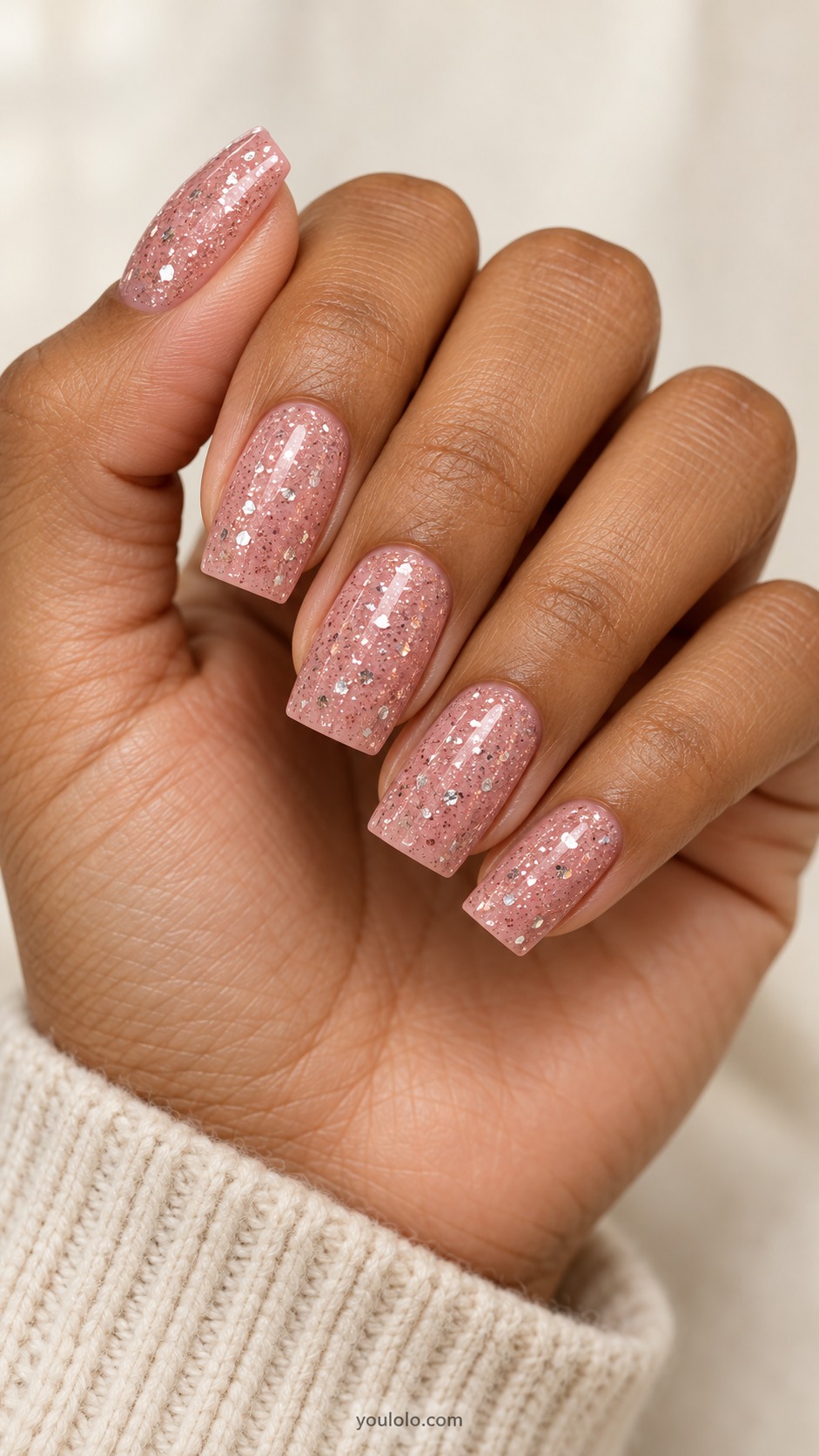
Rose glitter can be a complete manicure without additional charms or artwork. The appeal comes from the mixture of fine shimmer and occasional brighter flecks beneath a smooth glossy surface. A warm pink base keeps it soft rather than icy. It is a useful option when you love the decorative references but want an even finish and a design that reads clearly from a distance.
What to ask your nail artist for
Choose rose-pink glitter with a fine background sparkle and a few small reflective flecks. Keep the finished surface smooth.
Make it work at your length: This design suits both short and long squares. On very short nails, fine particles give a more continuous finish than large pieces of glitter.
8. Soft Marble with Metallic Veins

Marble becomes more interesting when the veins vary in weight and transparency. This set combines blush marble, milky white with soft gray veining, and a cleaner white accent with fine dark and gold lines. They share a pale background, so the different versions still belong together. Metallic details should follow only a few veins; outlining every branch would make the result look much busier.
What to ask your nail artist for
Create soft pink and white marble accents with selective gold or silver detail. Keep the dark veins thin and irregular, with open areas of pale color.
Make it work at your length: For shorter nails, ask for two or three broad cloudy areas and one fine metallic vein. Avoid a dense network of tiny lines.
9. Daisy Relief and a Fine-Line Blossom

A white daisy in shallow relief and a flower drawn in thin white lines offer two interpretations of the same theme. Sage makes the daisy petals visible, while a sheer pink base lets the outlined blossom feel almost like lace. Tiny reflective centers connect the accents. The contrast in texture is the point, so the remaining nails should stay uncomplicated.
What to ask your nail artist for
Use one sage daisy accent and one sheer-pink nail with an outlined flower. Keep the daisy low and the line drawing light.
Make it work at your length: A single flower is enough on a short nail. If you prefer no raised details, recreate the daisy with shaded white gel paint instead.
Prefer the decoration concentrated on a single finger? Explore these pink nails with one finger design for a more restrained layout.
10. Lavender Ribbons with Gold Edges
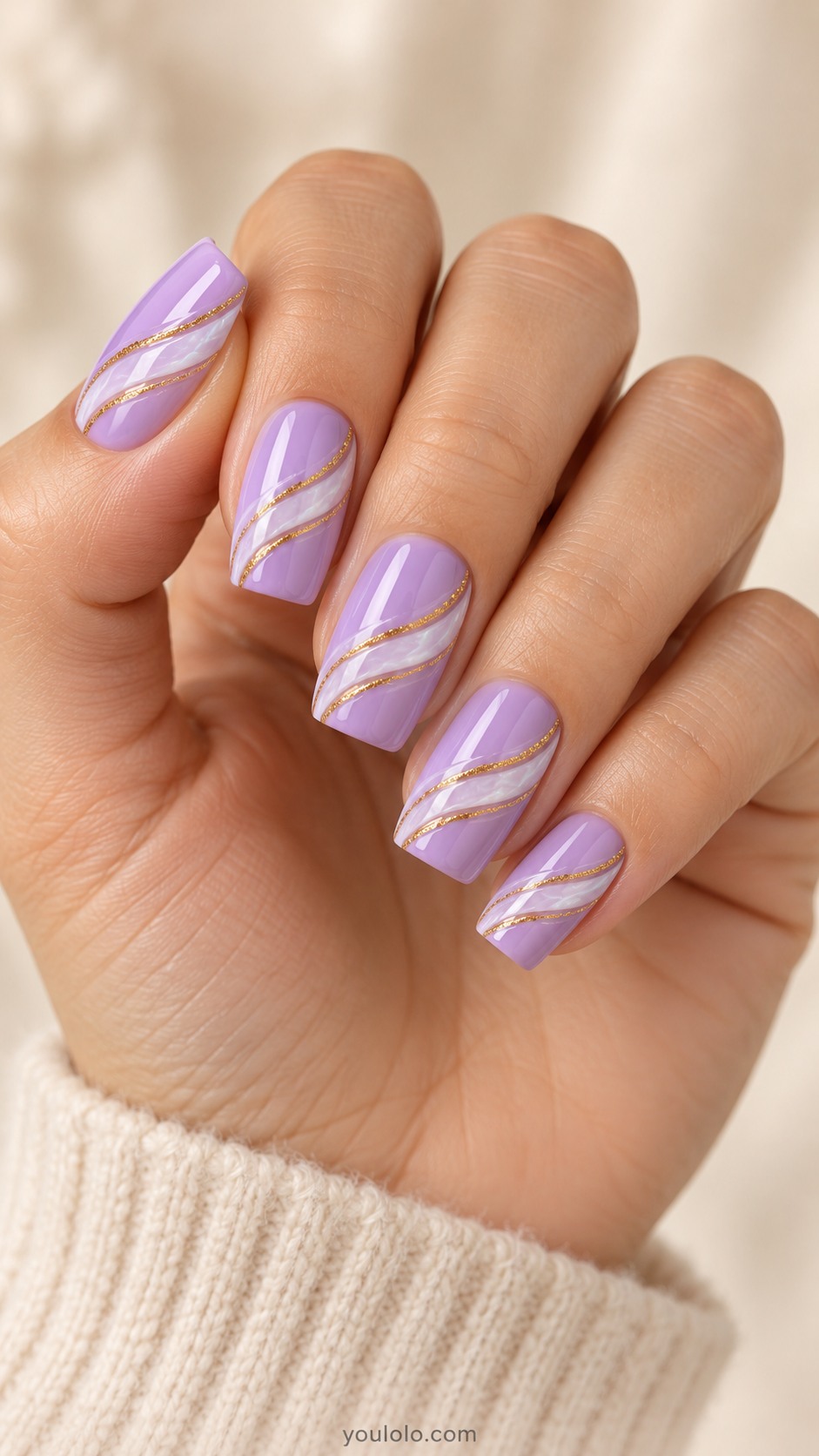
Lavender ribbons are a softer alternative to sharp diagonal stripes. Translucent white bands curve across the purple base, with a very fine gold edge catching the light. The spaces between the bands are as important as the ribbons themselves: they let the lavender remain visible and keep the pattern airy. This design works well when you want movement without flowers, hearts or gems.
What to ask your nail artist for
Paint two flowing pale ribbons over lavender, tracing selected edges in fine gold. Keep the bands gently curved and slightly different on each nail.
Make it work at your length: On short squares, one broad ribbon with a single gold edge is enough. Longer nails can carry two bands without crowding the tip.
11. Pastel Bows in Butter Yellow and Lilac
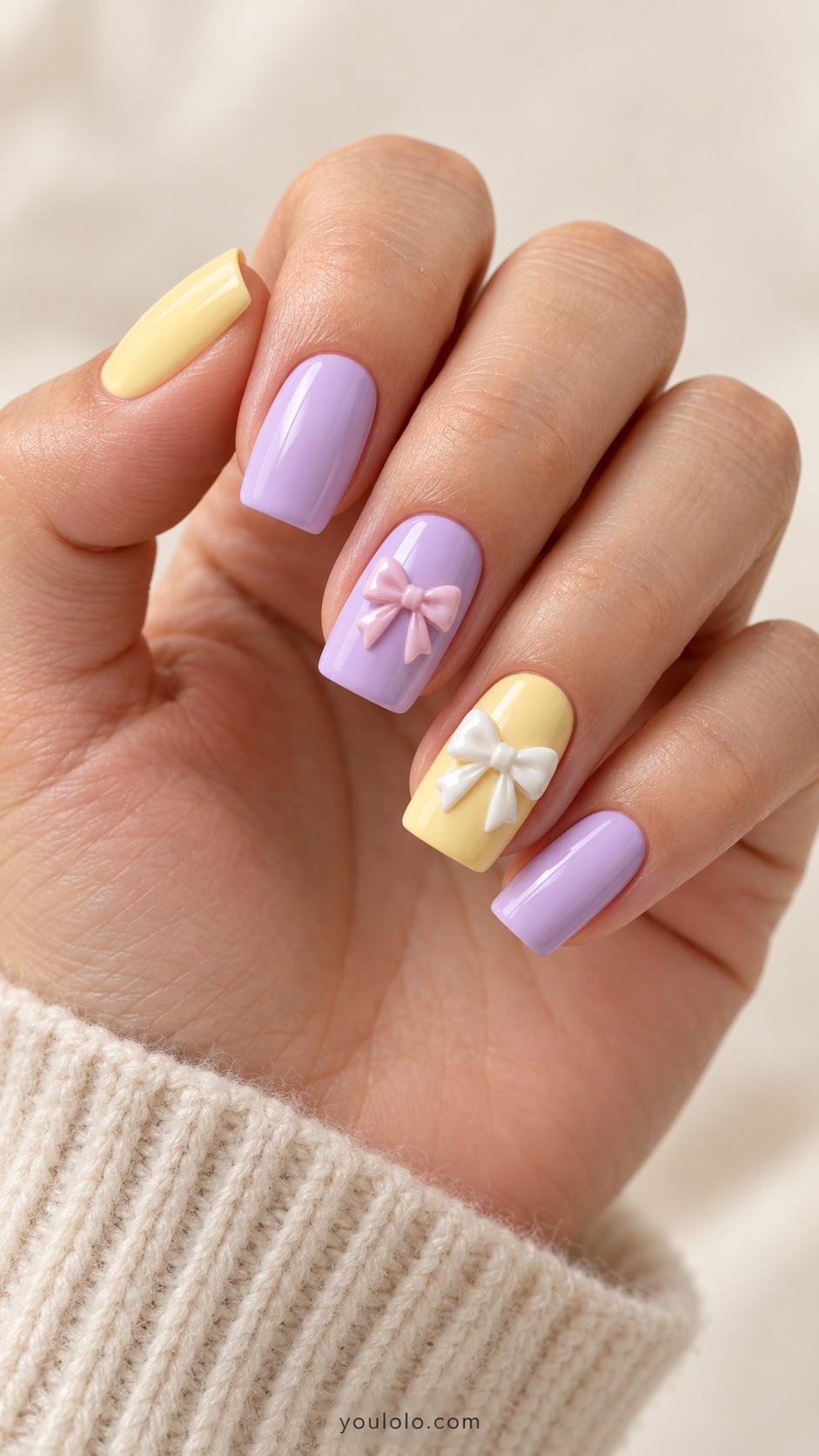
Butter yellow and lilac make a cheerful pastel pairing, while white and blush bows give each accent its own identity. The yellow nail carries a white bow; the lilac nail carries a pink one. Because both details are dimensional, a few plain pastel nails keep the set balanced. The bows should sit comfortably within the nail outline rather than stretch from one sidewall to the other.
What to ask your nail artist for
Use butter yellow and lilac with two small, low-profile bow accents in white and blush pink.
Make it work at your length: For a more practical version, request painted bows with a small highlight at the knot. You retain the ribbon effect without the extra height.
12. Amber Tortoiseshell Squares
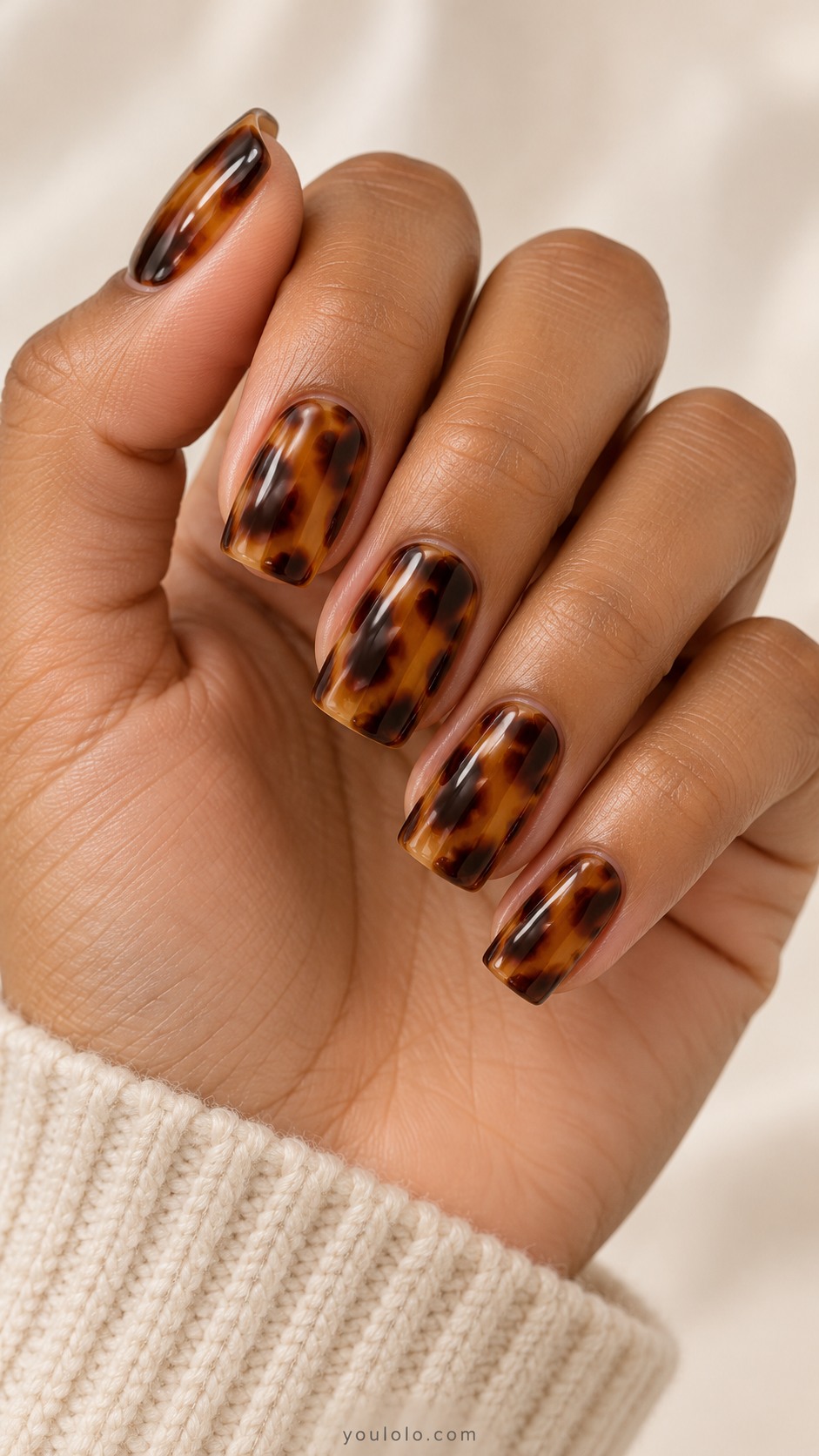
Tortoiseshell depends on depth rather than perfect repetition. Amber, caramel and dark chocolate patches should overlap irregularly, allowing light through some areas while others remain rich and opaque. A square shape gives the organic pattern a clean outline. This is one of the collection's most cohesive options because every nail can share the same treatment while still looking different.
What to ask your nail artist for
Build a translucent amber base with uneven caramel and dark-brown patches. Avoid identical circles or a repeated stamp-like layout.
Make it work at your length: Short squares suit tortoiseshell well. Keep the dark patches smaller than the nail width so the warm amber background remains visible.
13. Pearl Chains on a Sheer Nude Base

The pearl-chain motif appears twice in the reference chart, so it becomes one intentional look here. A centered row of small pearls and metallic beads turns a sheer nude nail into a narrow jewelry accent. Plain companion nails make the chain easier to appreciate. The most important proportion is the space on either side of the row; it should never fill the whole width.
What to ask your nail artist for
Create one or two nude accents with a centered vertical line of small pearls separated by tiny silver beads.
Make it work at your length: On shorter nails, reduce the chain to three pearls. Ask your artist about the height and placement of the embellishments if you prefer a low-profile finish.
14. Black Windowpane and Blush Plaid

Black windowpane and blush plaid use the same idea—intersecting lines—but produce different effects. White lines on black are graphic and bold. Translucent white lines on pink feel softer and more layered. Combining the two on accent nails makes the manicure feel considered rather than random. A few plain pink nails give the eye somewhere to rest between patterns.
What to ask your nail artist for
Use a fine white grid on one black nail and a lighter layered plaid on a blush nail. Keep the line widths restrained.
Make it work at your length: Short nails need fewer intersections. Two vertical lines and two horizontal lines can communicate the pattern more clearly than a dense miniature grid.
15. Diagonal Crystals on Dusty Mauve
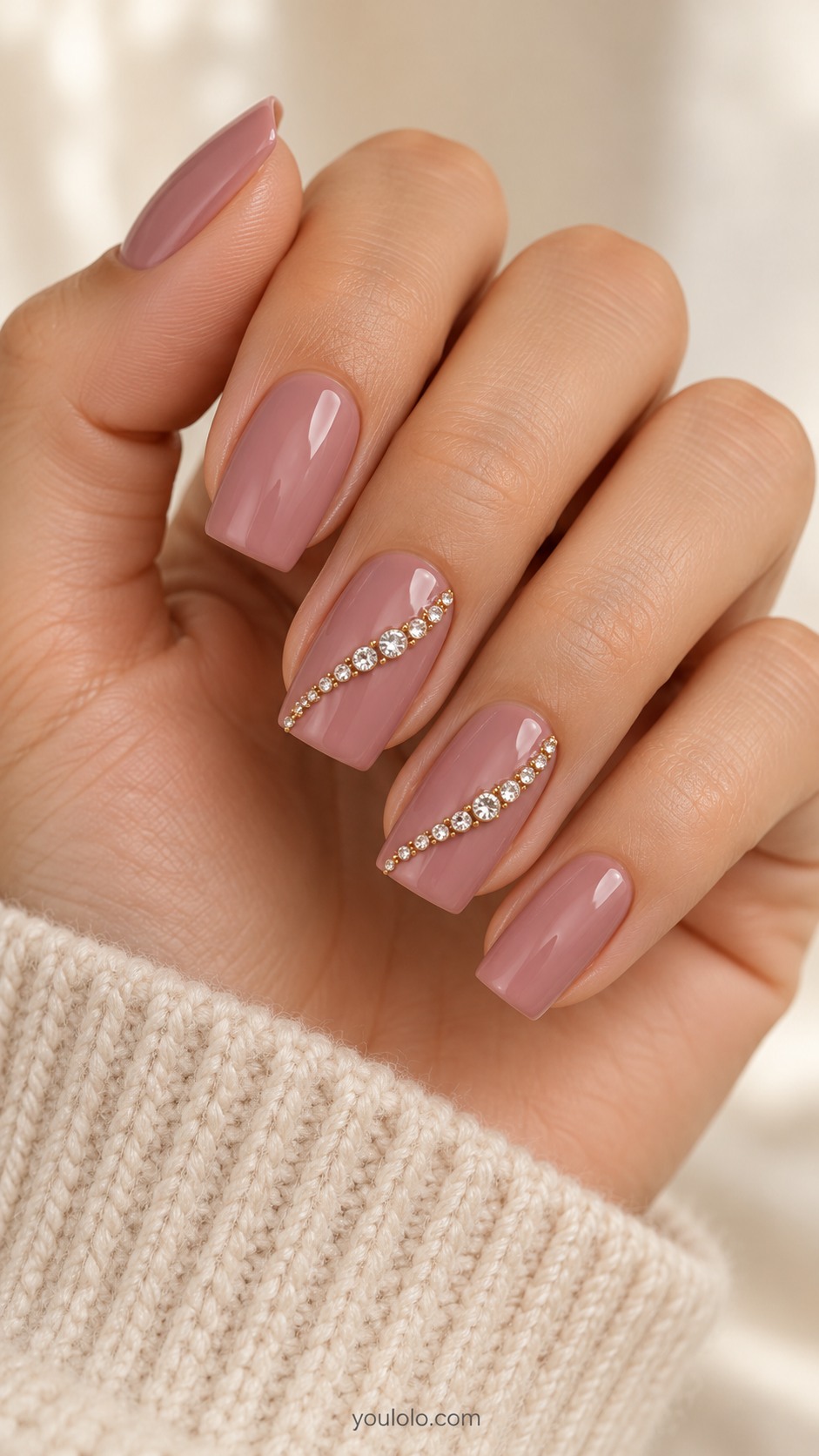
A diagonal crystal trail changes the direction of a simple mauve manicure. Instead of placing sparkle at the cuticle or straight down the center, the stones cross the nail on a gentle angle. Graduated sizes create a softer transition at each end. Gold-toned settings warm up the dusty purple base, while plain companion nails preserve the quiet color story.
What to ask your nail artist for
Place a small graduated crystal row diagonally across one or two dusty-mauve nails. Keep the largest stone modest and the ends tapered.
Make it work at your length: On shorter nails, use three tiny stones rather than compressing a long chain. Confirm the embellishment placement before it is secured.
16. Tiny Black Hearts on Pink and Ivory

Small black hearts look especially crisp against milky pink and ivory. The charm is in their spacing: a few hearts scattered with room between them feel more deliberate than a tightly packed pattern. Using both pale backgrounds adds variety without changing the motif. This set is easy to simplify because the heart itself remains recognizable even when only one accent nail carries it.
What to ask your nail artist for
Paint a handful of small black hearts on pink and ivory accents, with the remaining nails in the same plain base colors.
Make it work at your length: For very short nails, use one or two hearts per accent. Keep the shapes bold enough to read rather than making them extremely tiny.
17. Pendant Nails in Burgundy and Navy
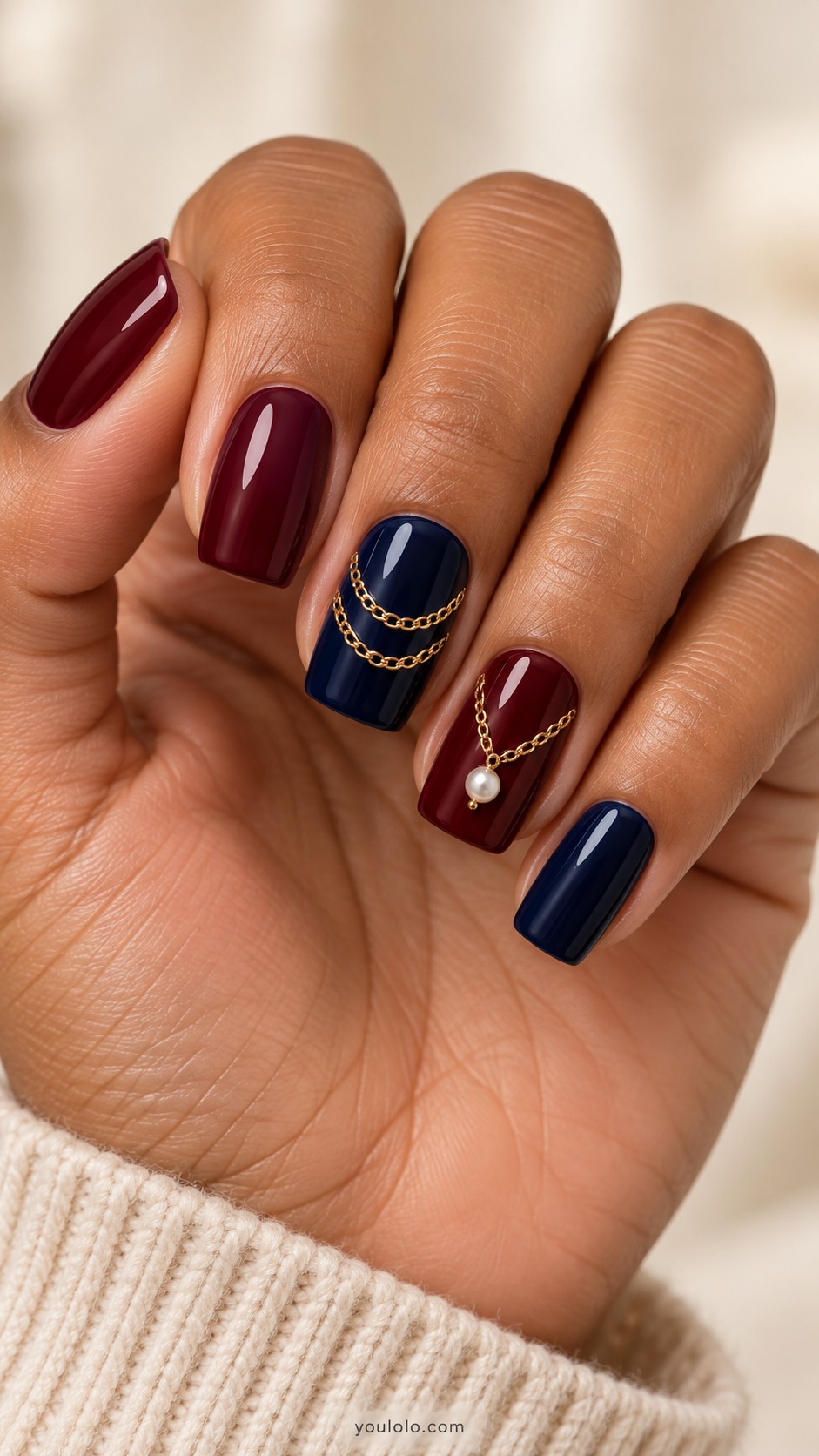
These nails borrow the layout of necklaces. A gold V on burgundy ends in a single pearl, while curved chain swags decorate a navy accent. The deep colors make the fine metallic details visible without needing large ornaments. Because the chains sit differently on each accent, they create variety while staying within the same jewelry theme.
What to ask your nail artist for
Combine burgundy and navy, adding a pearl-ended gold V to one accent and two delicate chain curves to another.
Make it work at your length: Painted chain links or fine metallic lines can replace physical chain. On short nails, choose one swag or one pendant rather than stacking several.
18. A Silver Starburst on Periwinkle
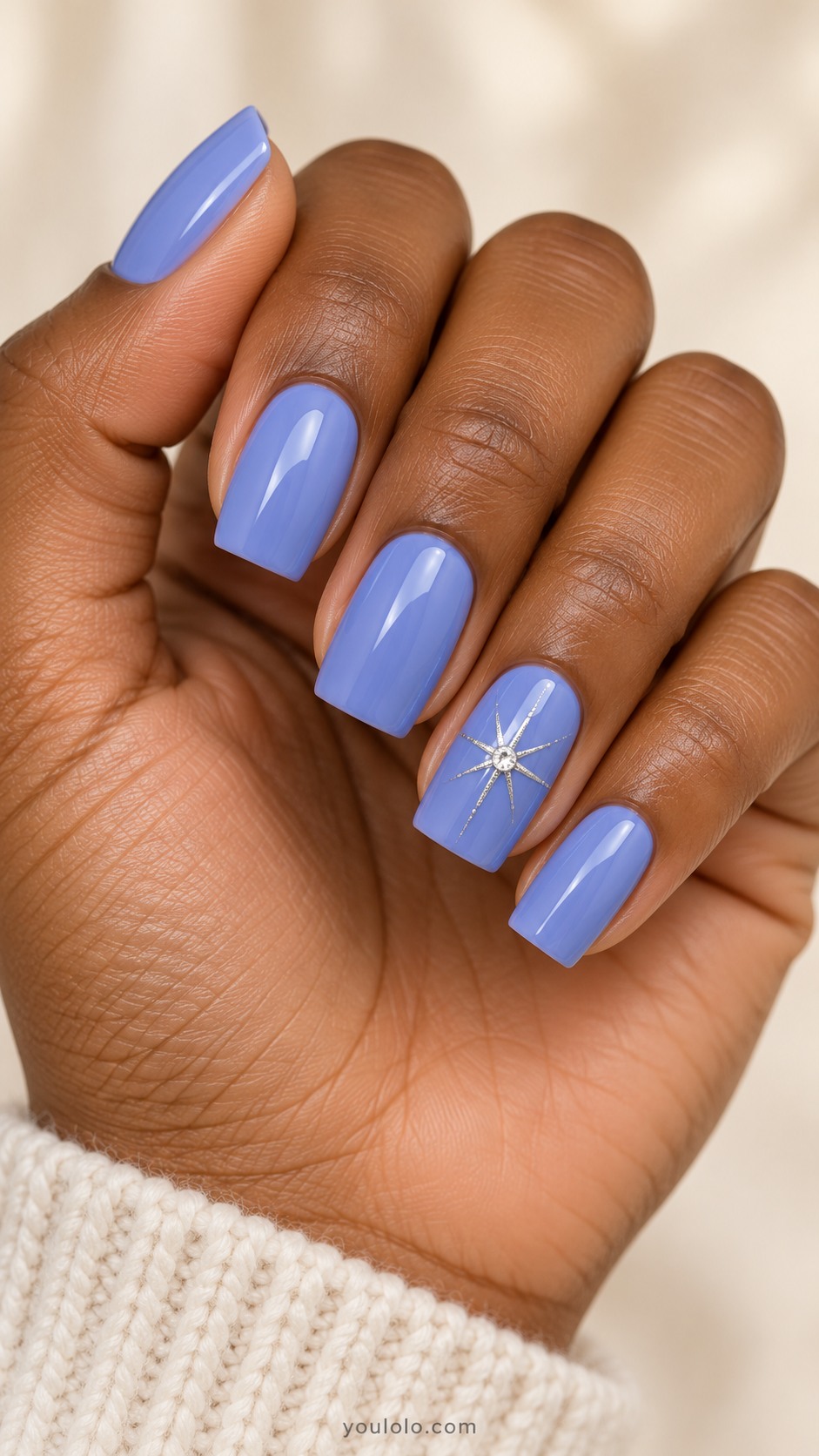
Periwinkle offers a gentler setting for a silver starburst than black or midnight blue. The pale blue-violet base keeps the look light, while the narrow rays make the accent feel precise. A tiny crystal at the center adds a single point of brightness. The surrounding nails do not need extra stars; their plain color is what makes the focal detail stand out.
What to ask your nail artist for
Use a periwinkle base with one fine silver starburst and a small center crystal. Keep the rays slender and unequal in length.
Make it work at your length: For short nails, shorten the rays rather than shrinking the central crystal into an indistinct dot. A painted center can replace the stone.
19. Rose Quartz Marble on Long Squares
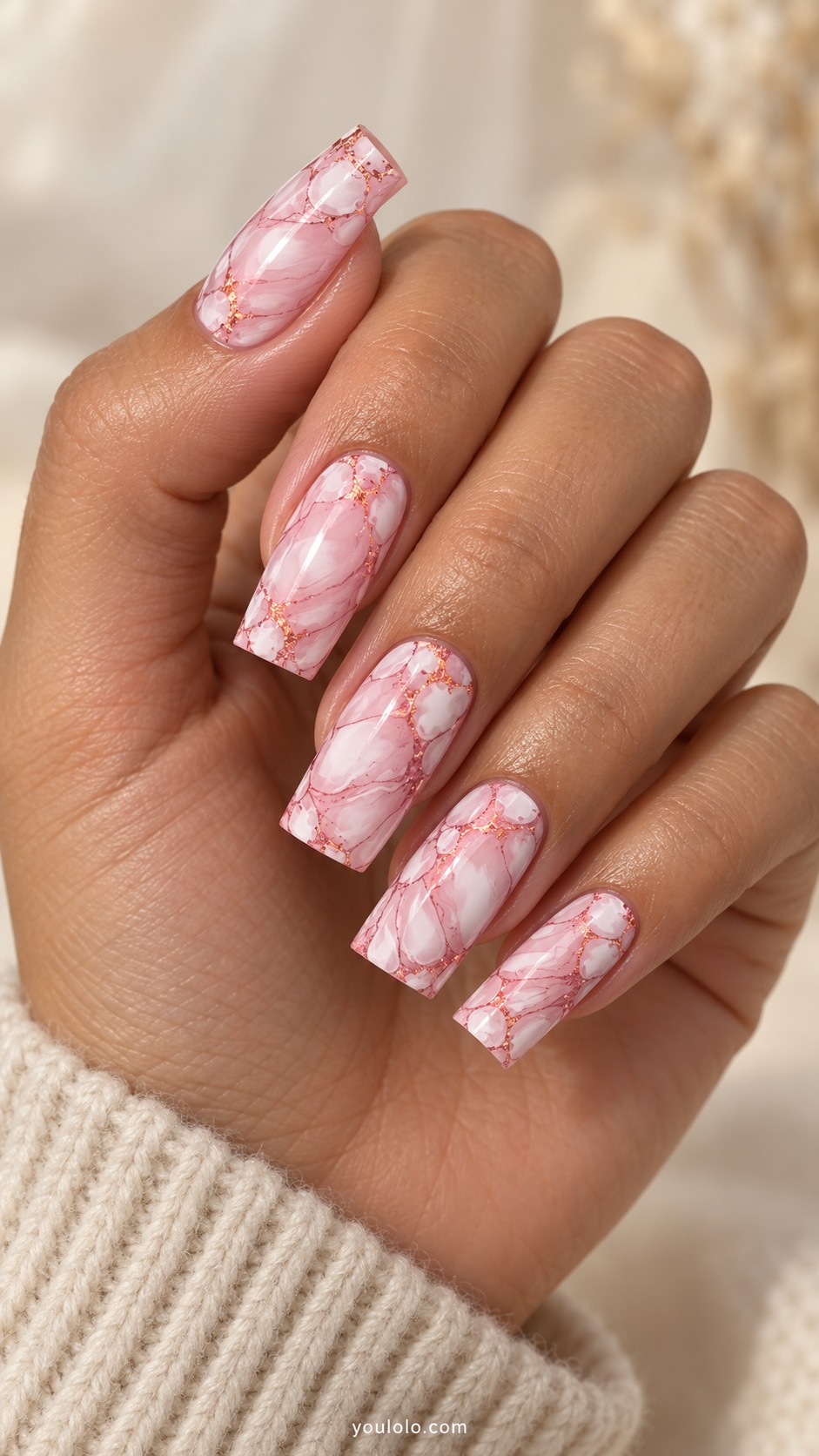
This pink marble has a softer, more cellular pattern than the fine-veined version earlier in the collection. Milky white shapes float within translucent pink, separated by dusty-rose outlines and occasional rose-gold flecks. Long square tips give the pattern room to unfold. Each nail should have a different arrangement of shapes so the manicure resembles a natural material rather than a repeated printed panel.
What to ask your nail artist for
Ask for pale-pink marble with cloudy white islands, fine rose-colored boundaries and very selective metallic accents.
Make it work at your length: At a shorter length, use fewer and larger cloudy shapes. Keep the free edge straight and the overall thickness proportional to the nail.
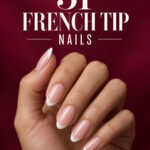
20. Sculpted French Tips with White Half-Moons
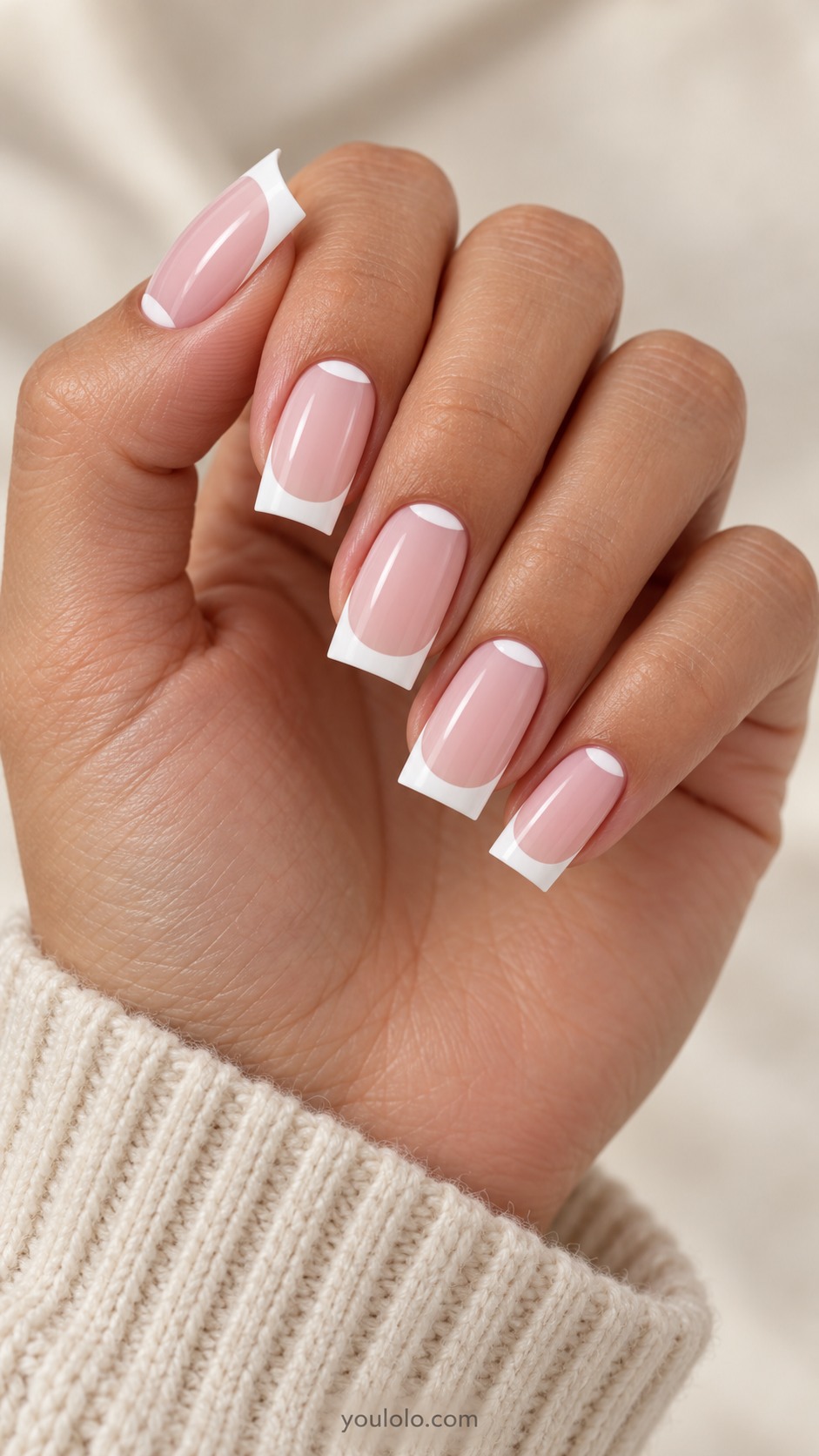
White at both ends of the nail gives this French manicure a framed effect: a crisp tip above and a small half-moon near the cuticle below. The pink center remains smooth and open. This interpretation uses a wearable straight square edge, preserving the reference's strong silhouette without exaggerating its curve. The two white areas should be balanced rather than equally thick.
What to ask your nail artist for
Create a pink-nude square French manicure with a clean white tip and a much smaller white half-moon at the base.
Make it work at your length: For short nails, narrow the French tip and make the half-moon especially small. Too much white can leave very little visible pink in the center.
If you are keeping your length compact, these short square nail designs offer more ways to balance a straight edge with small details.
21. Ruby Petals on a Blush Almond Base
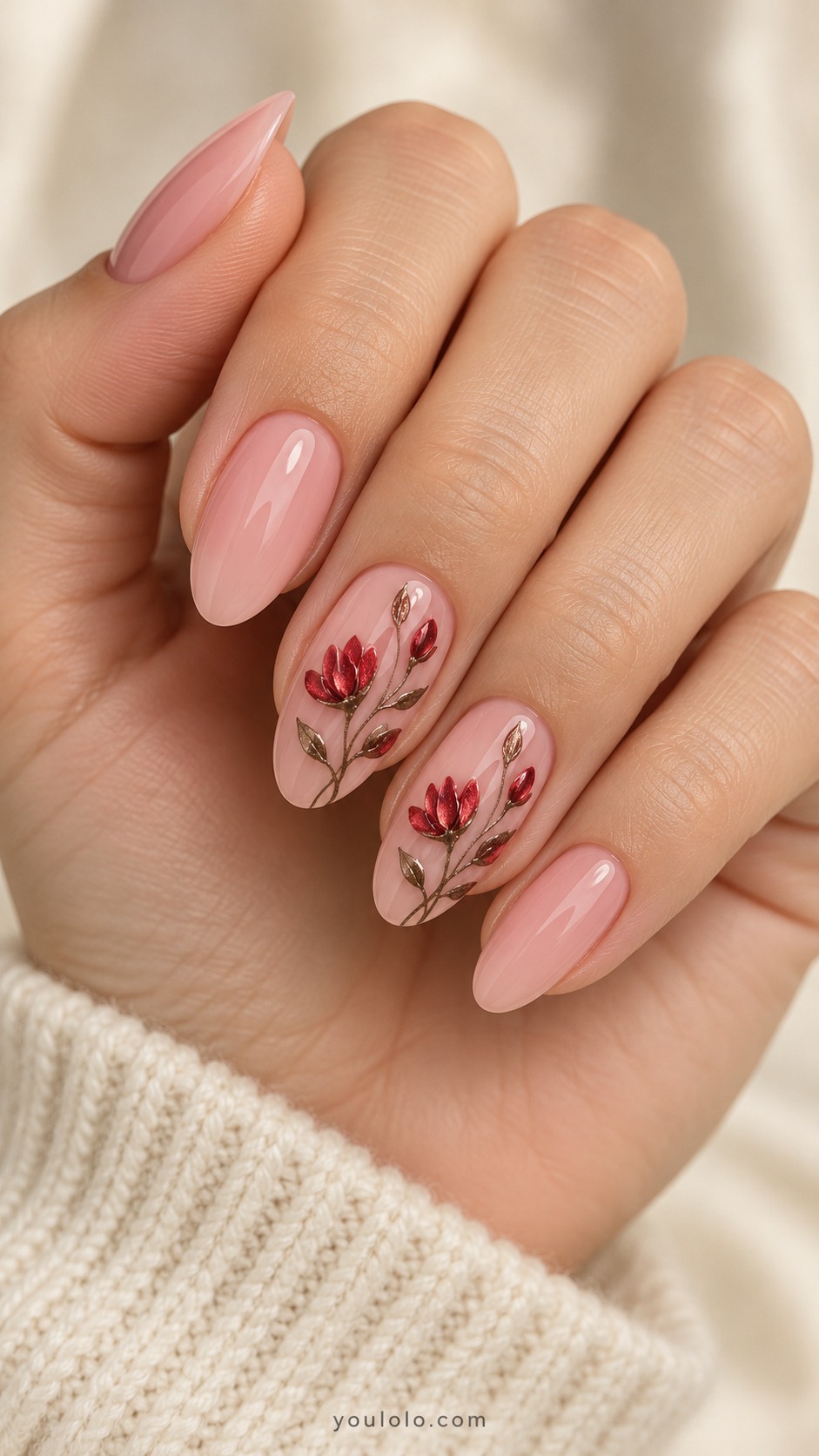
Ruby petals bring a jewel-like finish to a delicate floral design. The red flowers sit on a blush almond base, connected by fine bronze-toned stems and small leaves. Their shine supplies the drama, so the arrangement can remain sparse. One taller sprig and one smaller floral accent are enough to carry the theme across a full hand.
What to ask your nail artist for
Use metallic ruby-red petals on fine bronze stems over blush. Keep the flowers low-profile and the companion nails plain.
Make it work at your length: A shorter almond nail can hold one flower and a single leaf. Choose a clear silhouette instead of trying to squeeze in several blossoms.
22. Fuchsia Blooming Flowers on Milky Lilac
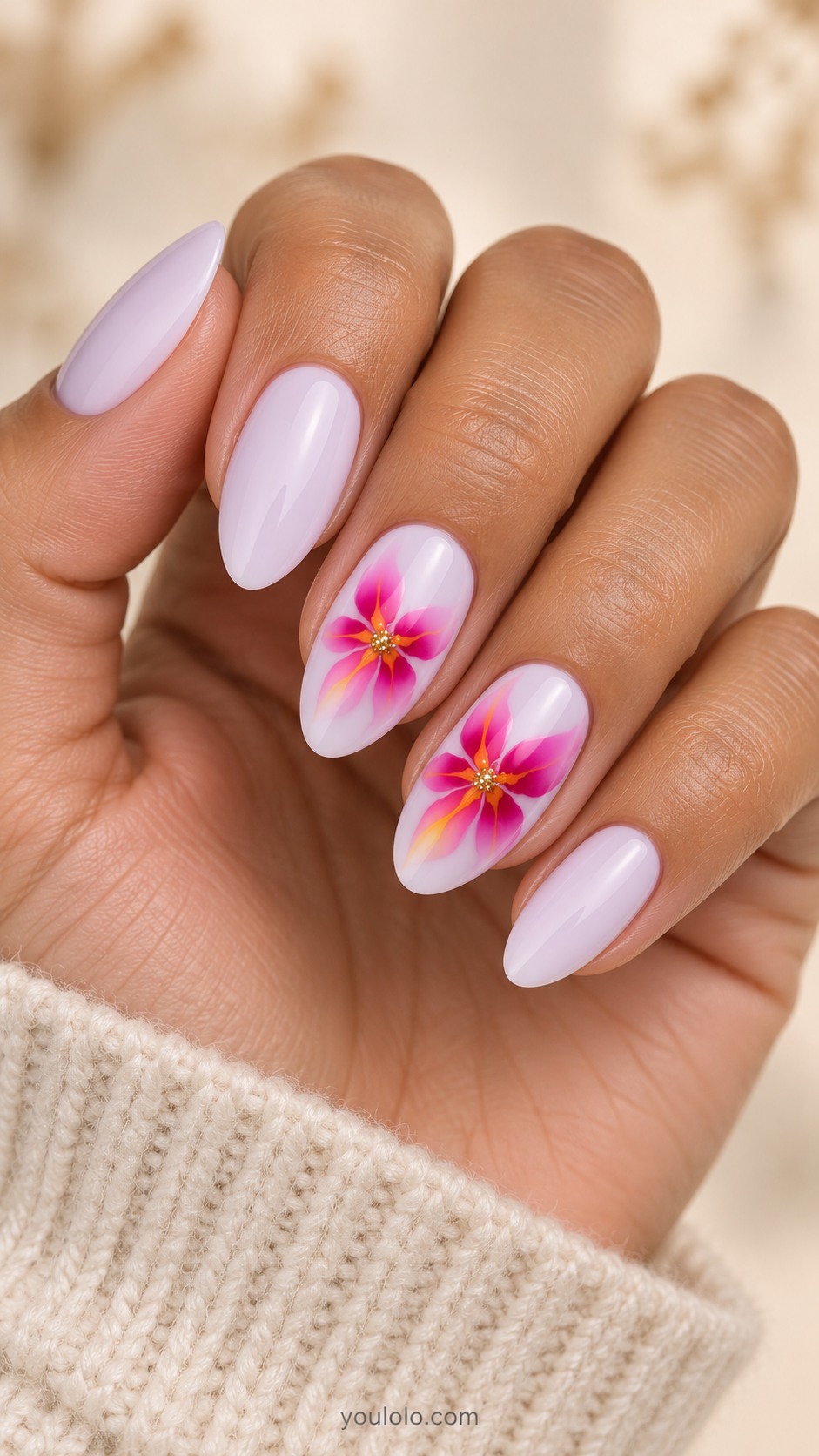
The fuchsia flower uses blurred, flowing petal edges against a milky lilac background. Warm orange details inside the petals make the pink more vivid, while a small gold center anchors the bloom. This is a softer type of floral art than the ruby sprigs: the color spreads gently, but the flower still needs a readable outline. Plain lilac nails stop the set from becoming visually crowded.
What to ask your nail artist for
Use a blooming-style fuchsia flower with warm inner accents and a tiny gold center on one or two milky-lilac nails.
Make it work at your length: On short nails, allow part of a large bloom to sit near an edge rather than shrinking every petal. Ask the artist to keep the center distinct.
23. Midnight Navy with a Magenta Glitter River
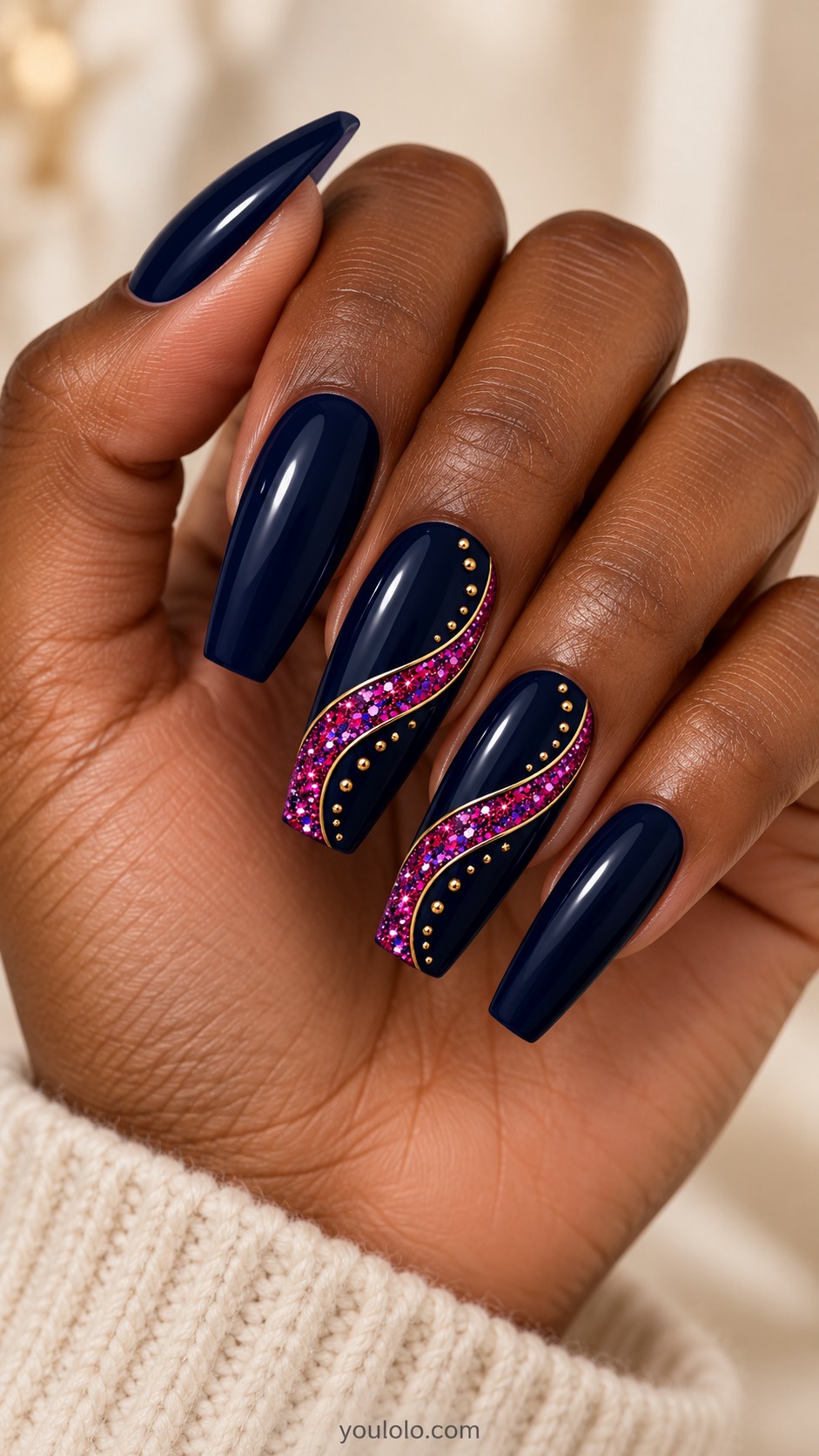
A magenta glitter ribbon across deep navy creates a dramatic contrast without covering the whole nail in sparkle. Thin gold borders define the curve, while a few gold dots follow its direction. The dark negative space is essential: it gives the ribbon a clean silhouette. Use the full composition on accent nails and repeat the navy alone elsewhere for a wearable set.
What to ask your nail artist for
Create a curved magenta glitter channel over navy, with hairline gold edges and a restrained trail of small gold dots.
Make it work at your length: For shorter nails, use one diagonal sweep and fewer dots. Keep the glitter area narrow enough that the navy remains the main color.
24. Sapphire Waves with Silver and Blue Glitter
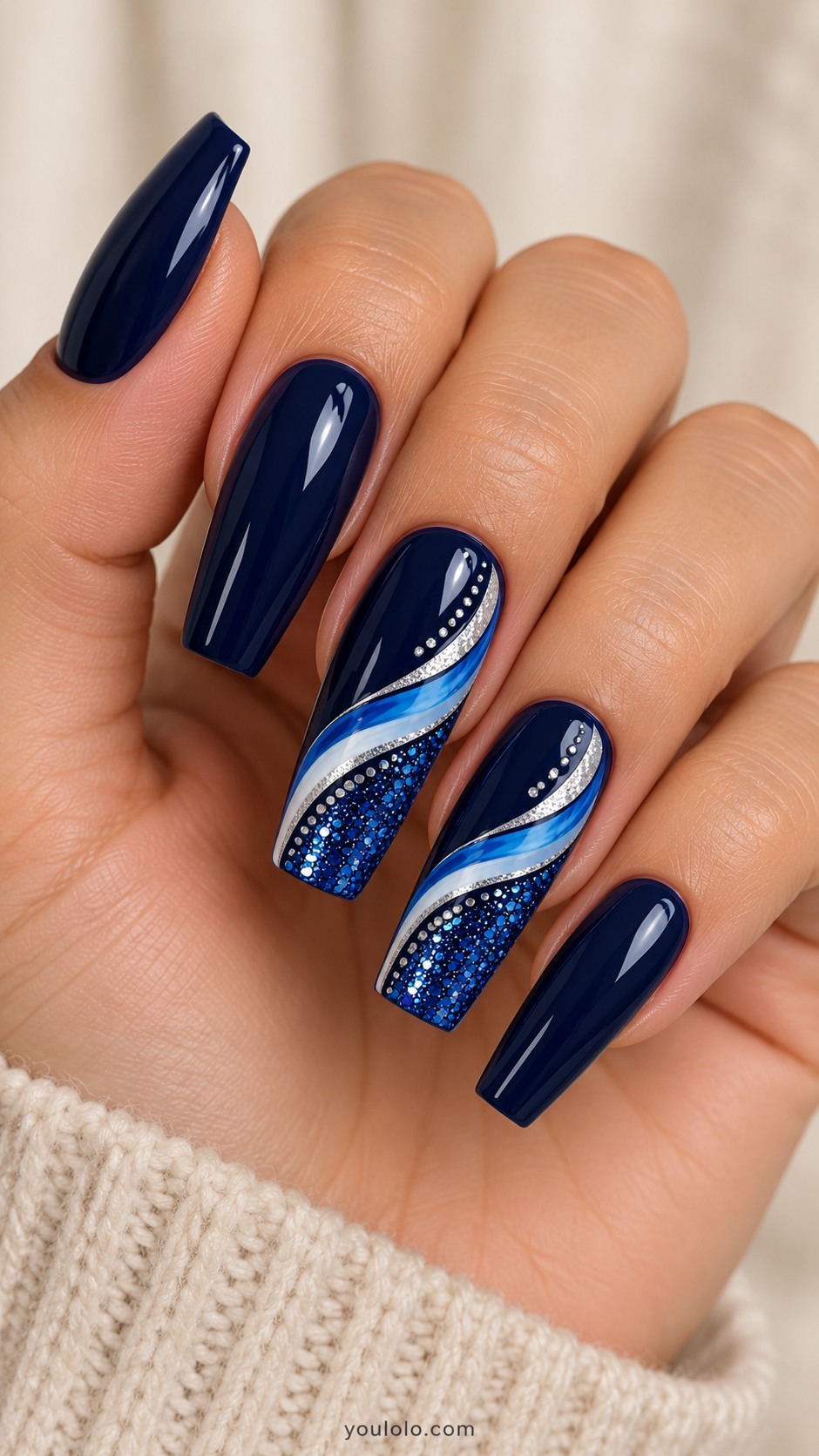
This blue version changes the mood of the ribbon design through color and finish. Sapphire, pale blue and white flow across navy, with silver outlining and a glittered section below. The lighter ribbon separates the two dark areas and makes the shape easier to read. It feels more fluid than a straight geometric stripe, especially when each accent follows a slightly different curve.
What to ask your nail artist for
Combine navy, sapphire and pale-blue ribbons with fine silver borders, a small blue-glitter area and a few silver dots.
Make it work at your length: Shorter nails can carry one blue-and-white sweep. Remove the dot trail first if the composition starts to feel too crowded.
25. Pink Petal French with Gold Tracing
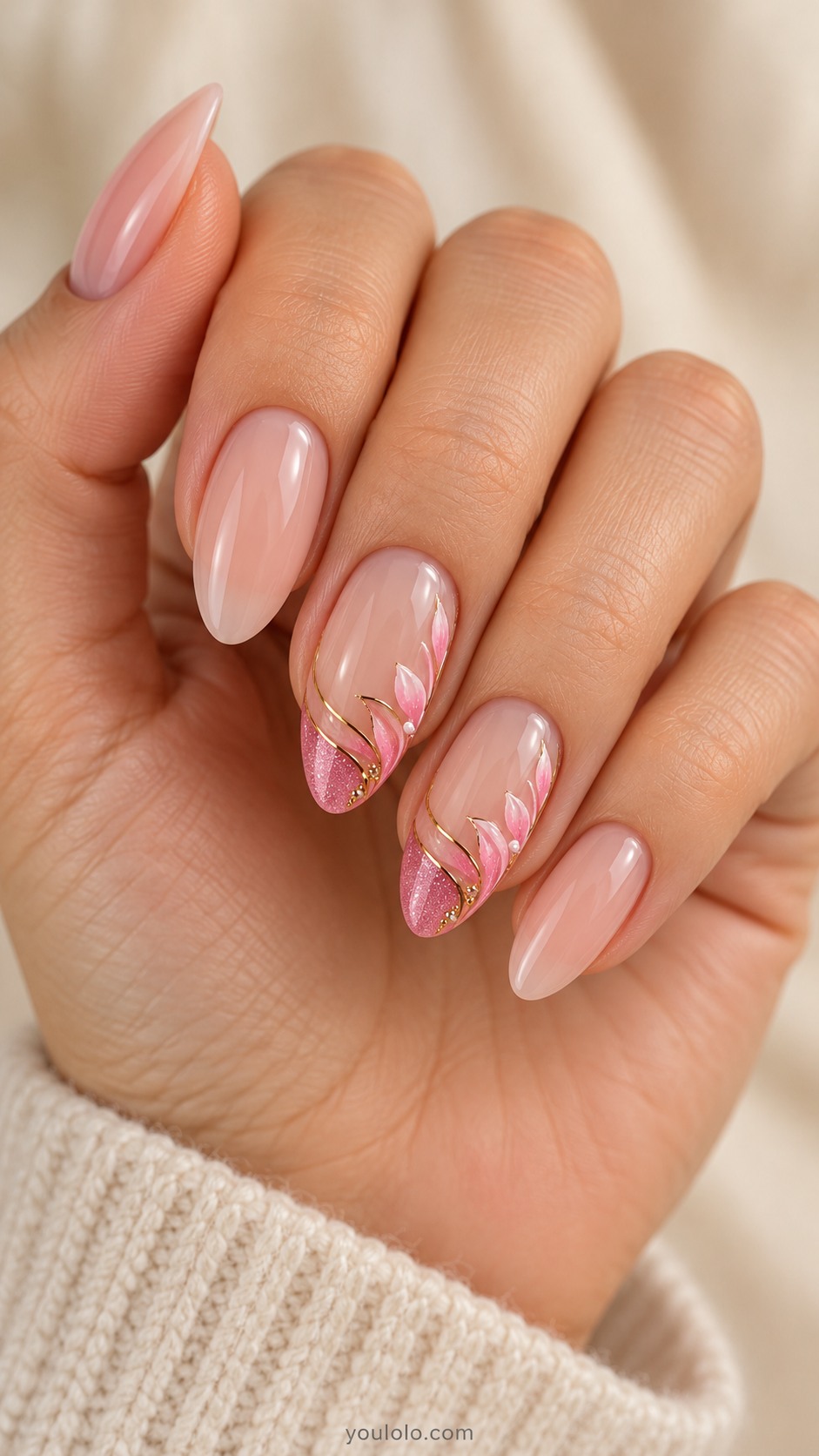
A diagonal pink glitter tip becomes the base of a delicate botanical composition. Translucent pink petals rise along one side, traced selectively in gold, leaving most of the nude center open. A few tiny beads connect the petals to the tip. The result feels lighter than an all-over floral pattern because the decoration follows the nail's edge.
What to ask your nail artist for
Use a sheer blush almond base, a pink-glitter diagonal tip and translucent pink petals along one side, with fine gold tracing.
Make it work at your length: For shorter nails, use one or two petals and a narrow glitter tip. Avoid building a thick ridge where the decorative elements meet.
26. Matte Taupe with Flowing Gold Lines

The appeal of matte taupe and gold is the contrast between a quiet surface and a reflective line. The taupe should look finely matte, while the gold curves remain smooth and bright. Each line takes a slightly different route, giving the set movement without adding another color. A clean square outline supports the flowing pattern and keeps the manicure feeling polished.
What to ask your nail artist for
Request a matte taupe base with one or two thin glossy-gold curves on each nail. Vary the curves rather than repeating the same wave.
Make it work at your length: Short squares work especially well with one open curve. Ask your artist to preserve the contrast between the matte background and the metallic detail.
27. Deep Blue Cat-Eye with a Soft Crescent Glow
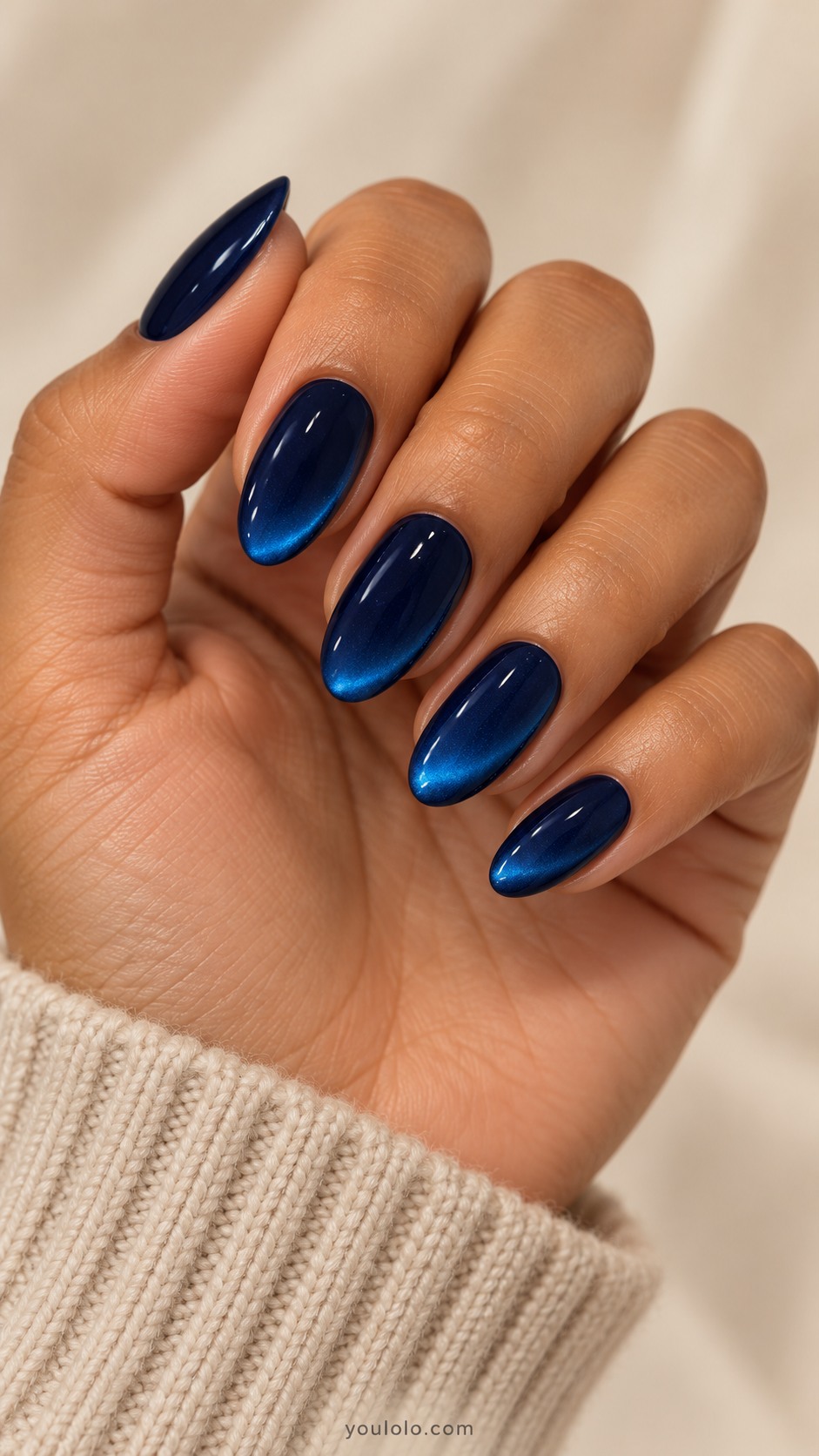
This final look trades painted motifs for light. A deep navy base holds a soft sapphire glow near the tips and lower edges, creating a curved cat-eye effect. The exact bright area shifts with the viewing angle, so a photograph captures only one version of the finish. Oval or almond shapes complement the curved highlight, and the design needs no stones or extra artwork.
What to ask your nail artist for
Choose a deep-blue magnetic finish with a soft crescent of brighter sapphire rather than a sharp stripe across the center.
Make it work at your length: This finish can work at many lengths. Show your artist the desired highlight placement and check the effect from more than one angle before the design is finalized.
How to choose a detailed manicure that still feels like you
Start with the feature you would miss if it disappeared. For the matte taupe set, that is the contrast between the soft background and the shiny curve. For ruby flowers, it is the red metallic petal. For the French manicure, it is the white framing at both ends. Once you know the focal feature, you can simplify everything around it without losing the design.
Next, choose the number of accent nails. One accent gives a quiet result; two let you combine related motifs; repeating the pattern across the hand makes a stronger statement. There is no need to combine every favorite from the collection into one manicure. Choose a main idea and, at most, one supporting detail that shares its palette.
Painted detail, raised decoration or a special finish?
| Approach | Examples in this collection | What to discuss |
|---|---|---|
| Fine painted artwork | Tulips, tiny hearts, plaid, marble and French framing | How much detail remains readable at your chosen length |
| Small raised accents | Bows, pearls, flower relief and crystals | The size, height and number of embellishments |
| Metallic tracing | Heart frames, gold waves and glitter borders | A flat painted version or a slightly raised outline |
| Light-dependent finishes | Glitter and blue cat-eye | How the color and bright areas appear in different lighting |
What to send before your appointment
Send the image of the complete set you like, a photo of your current nail length, and a note about your preferred shape. Say whether you want all the accents shown or a simpler version. If pearls, bows or crystals are involved, mention whether you prefer a flatter interpretation. A precise brief gives the artist more useful information than asking for “something similar” without explaining which details matter most.
Ask the salon to confirm that it offers the techniques you have chosen and to estimate the appointment time and price. A fine floral painting and a magnetic finish involve different work, even when both look delicate in a photograph. If the exact materials are unavailable, agree on the substitute color or detail before the appointment begins.
Detailed nail art questions
Which of these designs suits short nails?
Tiny hearts, tortoiseshell, fine gold waves, rose glitter and the blue cat-eye finish are straightforward to scale down visually. Pearl chains can use fewer pearls, and floral designs can use one blossom rather than several. Preserve the main shape of the motif instead of squeezing the entire long-nail composition into a smaller space.
Does detailed nail art require extensions?
No. Many motifs can be painted on natural nails with enough available surface. The long square marble and ribbon examples offer more room for layered artwork, but the same palette and a simplified accent can be used at a shorter length. Your artist can help match the composition to your nails.
How can I make the jewelry-inspired designs flatter?
Choose painted gold chains, outlined hearts or shaded bows instead of physical embellishments. Pearls and crystals can be reduced in size and number. The goal is to keep the jewelry-like placement, even if the material changes.
Can I combine gold and silver in one set?
You can, but repeat each metal intentionally. For a quieter result, choose one main metallic color and let the other appear only in a small center or reflective detail. The pale marble combination offers a softer setting for both metals than a heavily decorated set.
Will cat-eye nails look exactly like the picture?
The bright area changes with lighting and viewing angle. Use the reference to communicate the depth of blue and the desired crescent placement, then look at the sample or finished effect from several angles. The moving light is part of this design’s appeal.
How do I keep a mixed set from looking random?
Repeat at least one element: the base color, the metal, the shape of a line or the style of flower. In the bow-and-dot set, black and ivory connect everything. In the pendant set, fine gold jewelry details link burgundy and navy. Plain companion nails help the relationship stay clear.
Save the look you would actually wear. Choose one favorite design, decide which details matter most, and keep one simpler version in mind. A clear reference and a thoughtful edit can turn a beautiful image into a manicure that feels personal.