The Best Fluffy Pancakes recipe you will fall in love with. Full of tips and tricks to help you make the best pancakes.


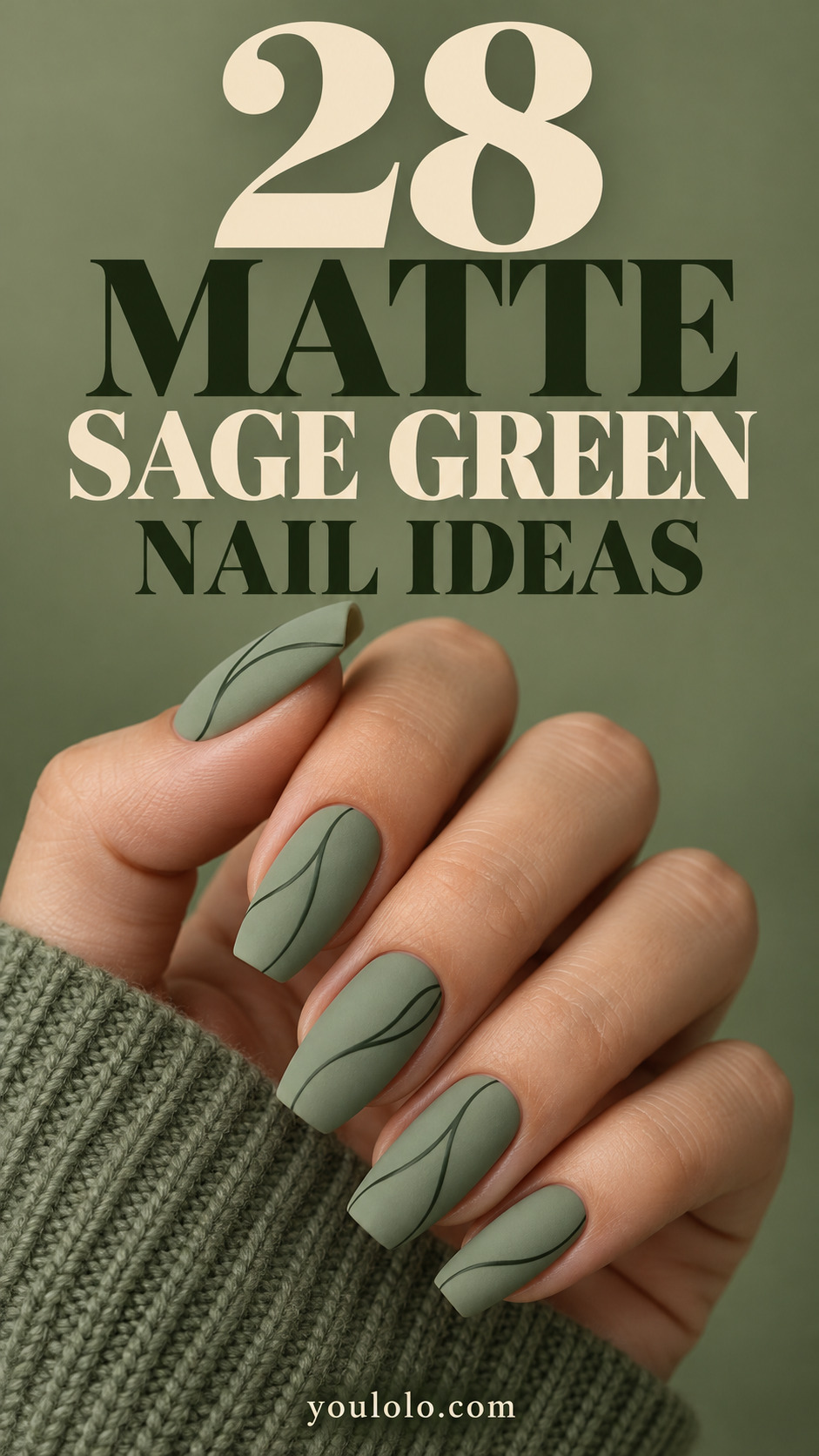
Matte sage green nails can be quiet without being plain. A dusty green becomes more graphic with a charcoal curve, softer beside ivory, or slightly dressier with a single gold arc. Because the surface does not rely on a strong glossy reflection, small changes in shade and placement become easier to appreciate.
These 28 designs start with short, simple color combinations and move through fine line art, French tips, mixed finishes and delicate patterns. Each idea includes a styling direction and the detail to preserve when you show it to your nail artist. You do not need to wear every accent at once: one clear feature is often what makes a set worth saving.
Image note: the pictures are original AI-generated manicure concepts, not photographs of completed salon work or exact product swatches. Use them to discuss color, shape and artwork with your artist.
First, Choose Your Version of Sage
Sage is a color family rather than one standardized polish shade. In this edit, pale sage is soft and milky, eucalyptus leans cooler and grayer, and moss or olive adds a deeper green note. Compare the colors together before choosing a contrasting accent. A green that looks muted against cream may look brighter beside charcoal.
For an all-matte manicure, look for a soft surface with no sharp white reflection across the nail. A metallic sliver or pearl can still catch light without making the base glossy. The two mixed-finish references later in the gallery deliberately use reflective tips or leaves; those accents should remain separate from the matte background.
Short Matte Sage Green Nails and Soft Color Pairings
Start here if color is your main decision. These compact shapes use plain surfaces and small palette changes, making it easier to compare pale sage, gray-green and warmer accents without a busy pattern in the way.
1. Soft Sage on Short Rounded Nails
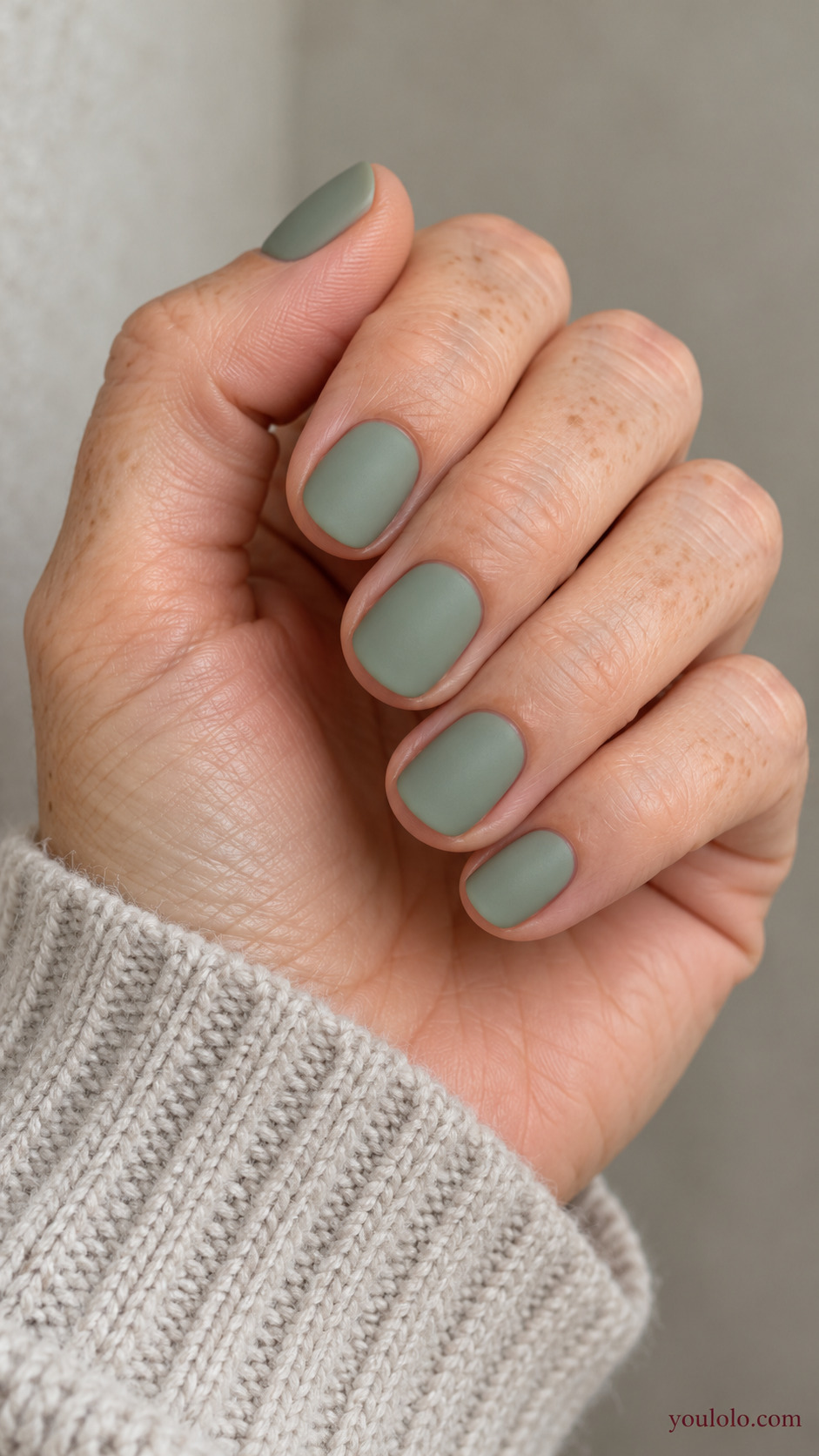
This is the quietest starting point in the collection: a pale green with enough gray to feel soft, covering a compact rounded nail. Without a reflective stripe, the outline and smooth color become the main details. Look for an even, velvety surface rather than a chalky white cast. A small amount of free edge is enough to show the shade clearly.
Style pairing: Wear it with cream cotton, a plain white shirt or oatmeal knitwear.
Detail to keep: Keep the rounded edge and soft gray-green tone; there is no need to add an accent.
2. Dusty Eucalyptus Soft Squares
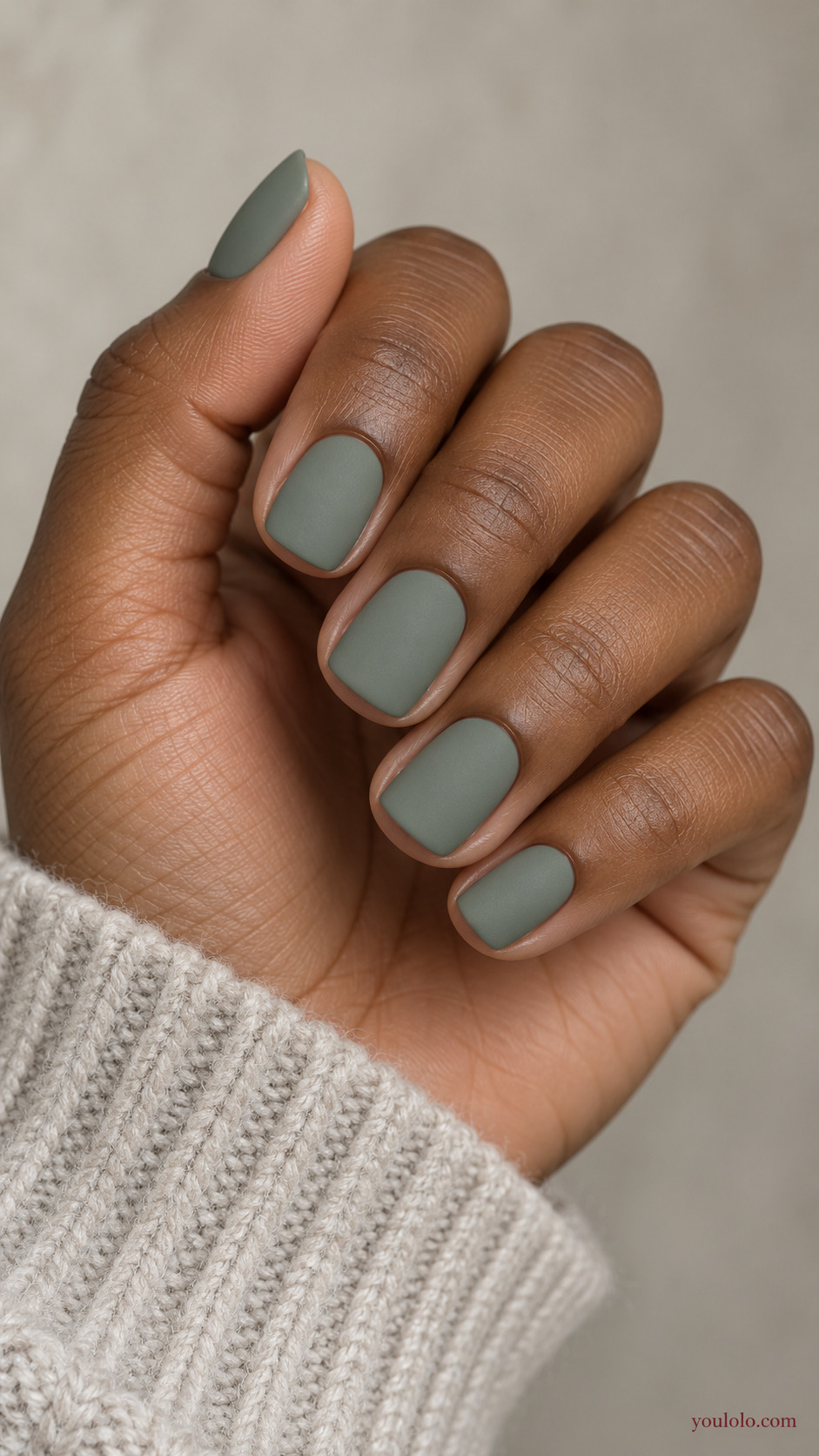
Dusty eucalyptus feels cooler and deeper than the pale sage beside it in this gallery. The soft square shape adds a little structure, while the matte surface keeps the color subdued. This is a useful reference if light green feels too pastel but dark forest green feels heavier than you want. Compare the finished swatch in daylight so the gray undertone does not disappear.
Style pairing: Try charcoal, stone or faded blue denim for a cool palette.
Detail to keep: Ask for a muted gray-green on short soft squares, with no shimmer.
3. Five Muted Greens in a Tonal Set
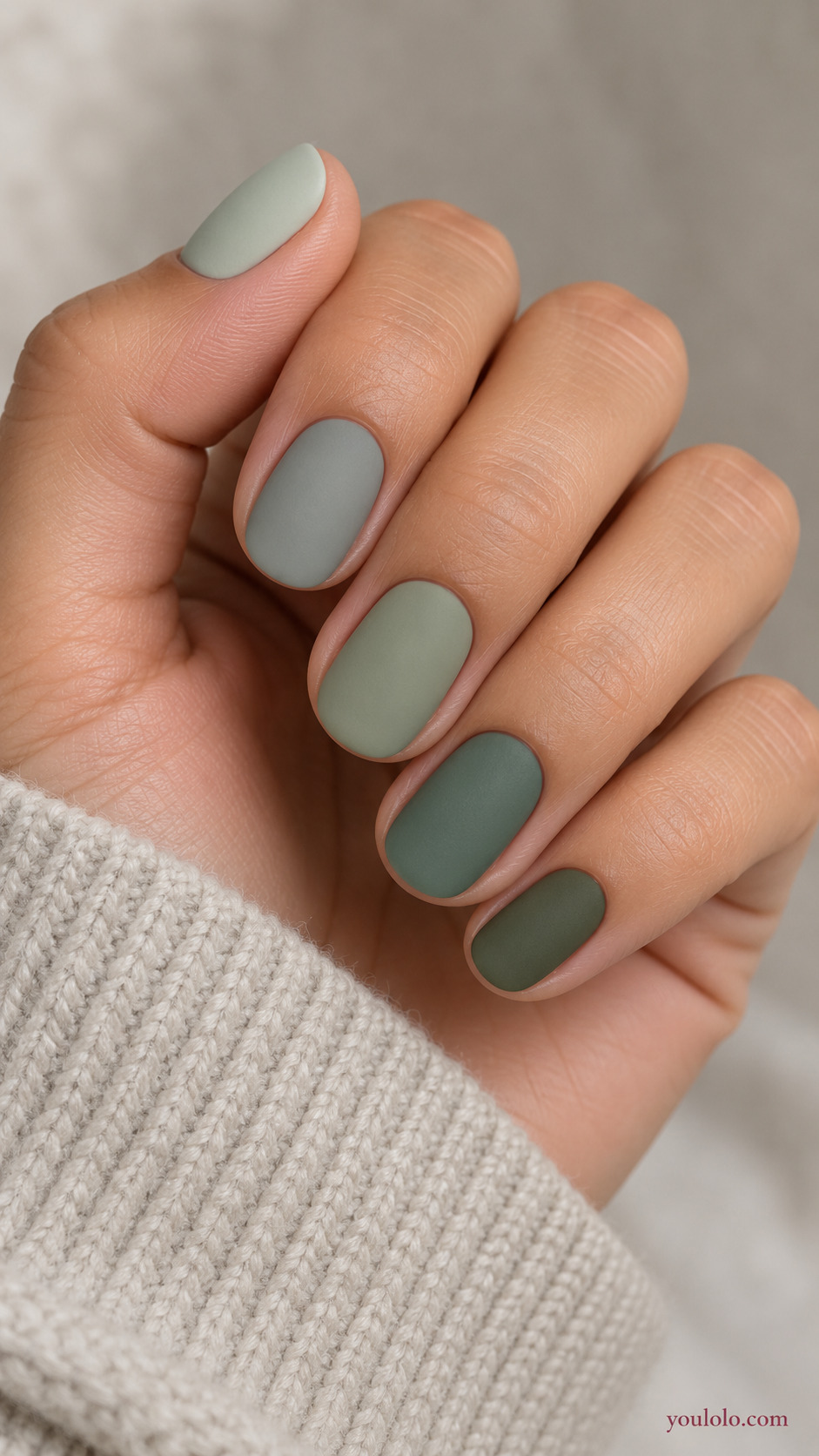
A tonal set gives each nail its own green while preserving a calm overall palette. The shades should move through a related range rather than jump from neon mint to black. I would choose the colors together on a sample wheel before the manicure starts. Keeping the same matte finish across all five makes the variation look intentional rather than like several unrelated leftover shades.
Style pairing: A single-color outfit lets the subtle differences between the greens show.
Detail to keep: Keep similar muted saturation across the shades and use one color per nail.
4. Pale Sage with One Cream Accent

One ivory nail breaks up the green without introducing a strong contrasting pattern. Its warmth matters: a creamy shade gives a softer result than a stark correction-fluid white. The short squoval outline makes this feel easy to wear, with the contrast carried by color alone. I would leave the accent undecorated so the pairing stays simple and the matte surfaces remain the focus.
Style pairing: Cream trainers, a beige jacket or a pale knit can echo the accent.
Detail to keep: Choose one full ivory accent and keep the rest in the same pale sage.
5. Sage and Blush Color Pairing
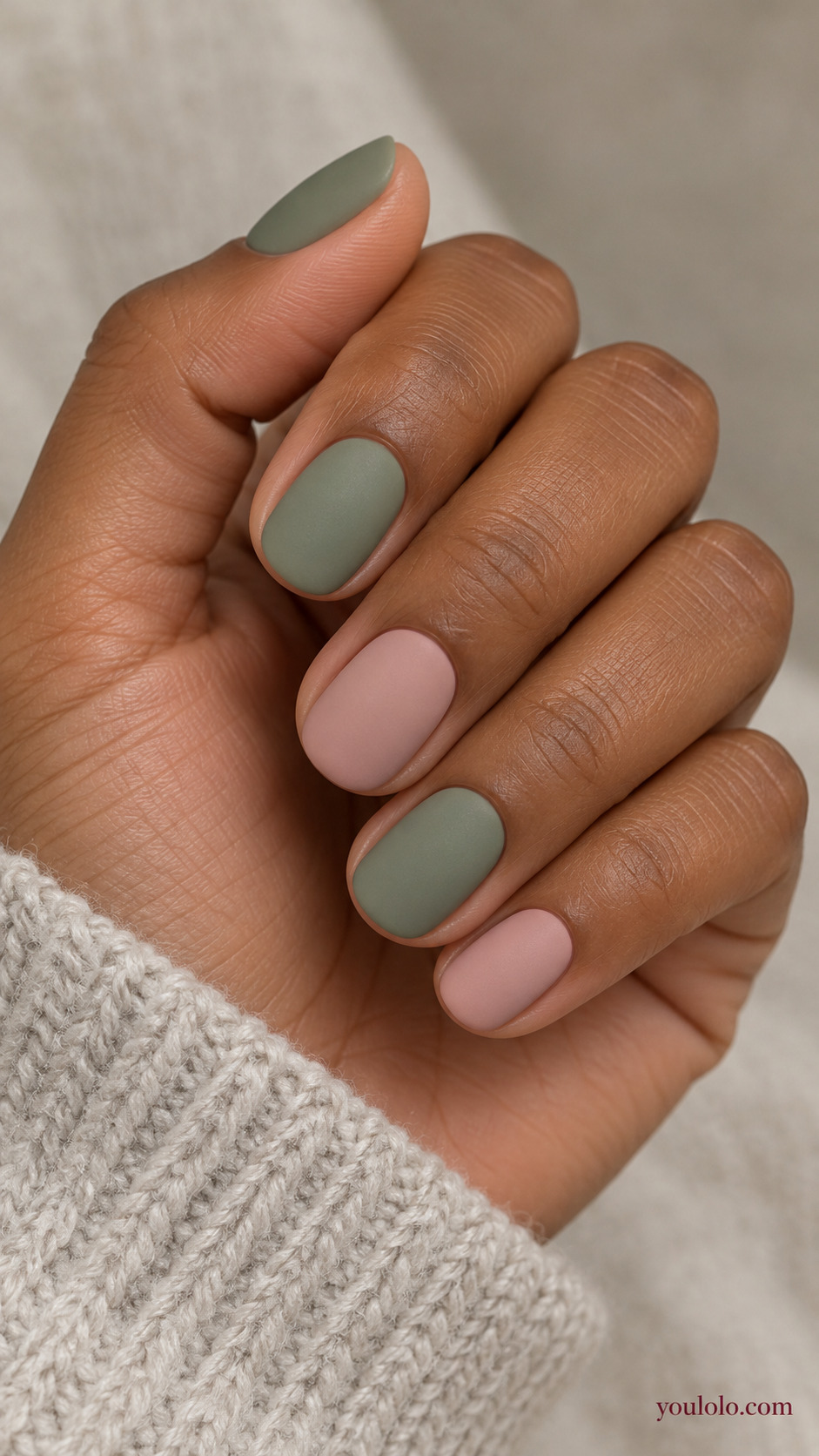
Dusty blush brings a gentle warm note to sage. Both colors need to feel similarly muted; a bright candy pink would change the mood of the entire set. With two plain blush accents, the palette has enough variation without needing a flower or a metallic line. The matte finish is especially useful here because it gives the two colors the same soft surface character.
Style pairing: Pair with rose-beige, light denim or a plain ivory dress.
Detail to keep: Match the softness of the pink and green rather than adding several more colors.
6. Muted Sage with a Moss Accent
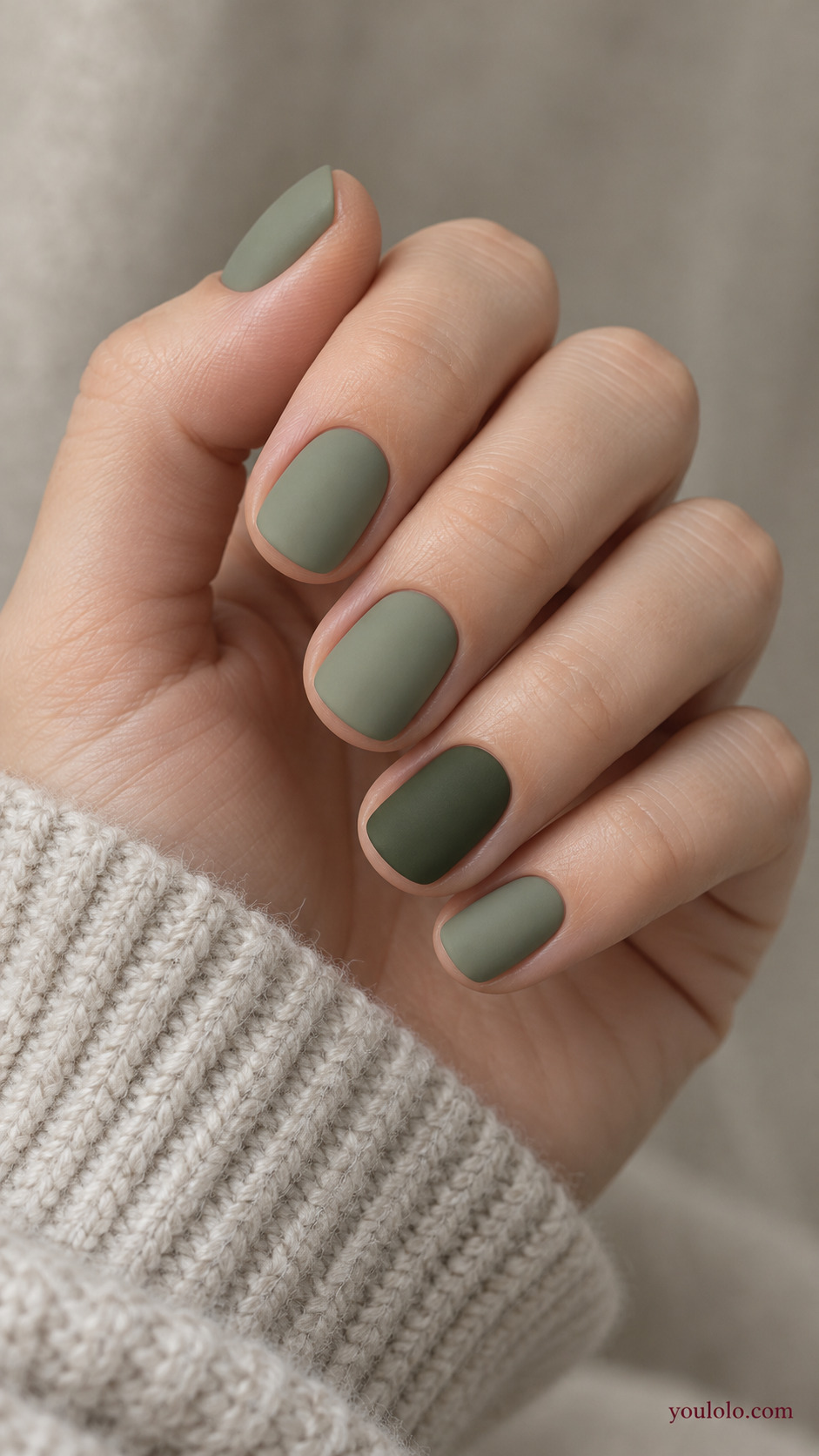
A moss accent adds depth while staying within the green family. The darker nail acts as a focal point, so the remaining sage nails can stay completely plain. Keep the moss visibly green rather than nearly black if you want the tonal relationship to remain clear. On a compact rounded shape, this creates contrast without relying on a small drawing that might be hard to read.
Style pairing: Olive outerwear and a cream base layer make an easy companion palette.
Detail to keep: One darker green accent is enough; compare it beside the sage before choosing.
Matte Sage Green Nail Art with Fine Lines
A few clear marks can change the character of the green. Compare flowing charcoal curves, an ivory arch and angular olive geometry. The amount of open space is as important as the line itself.
7. Fine Charcoal Contour Lines
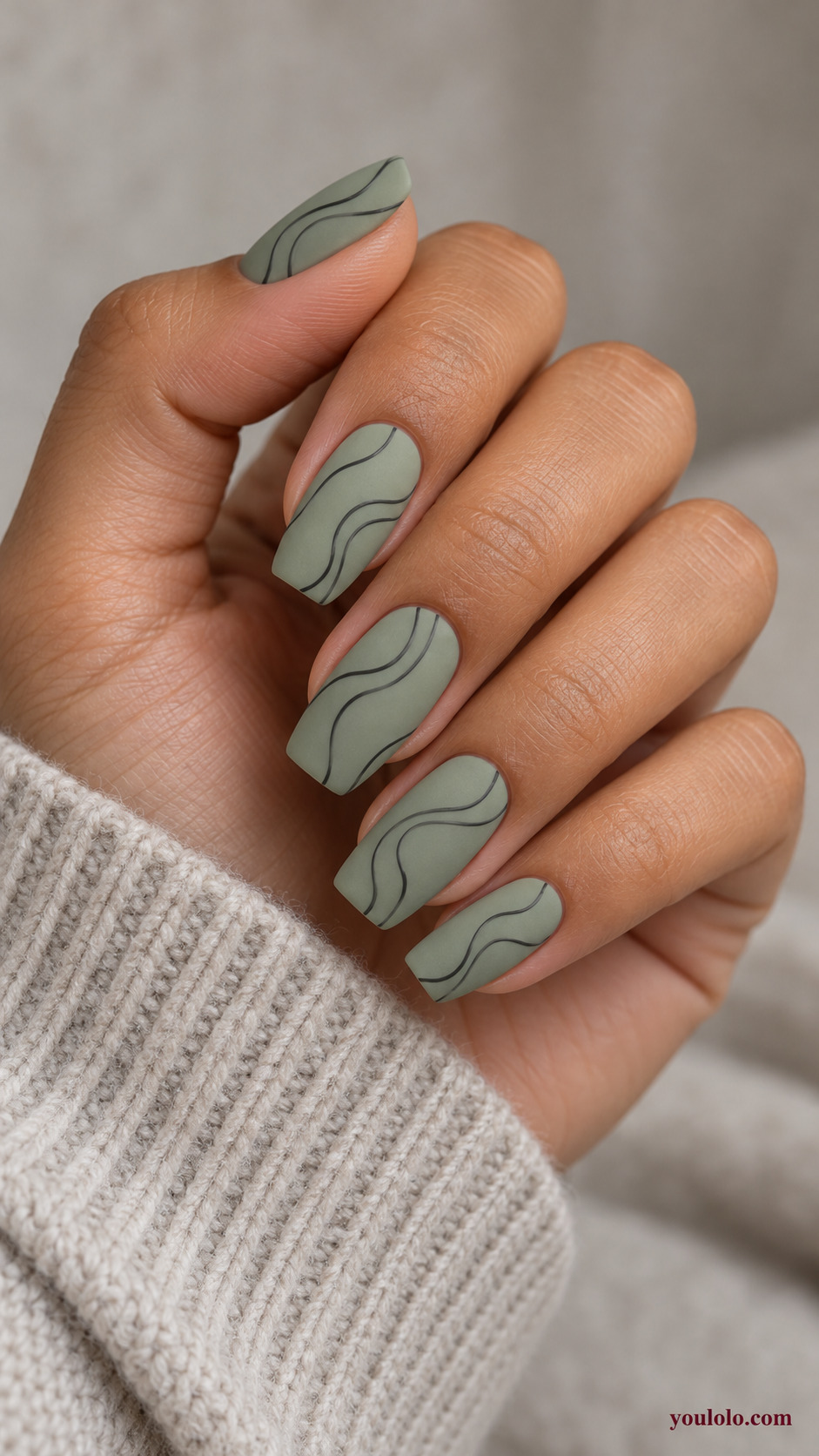
Fine charcoal curves give the matte sage a quiet graphic movement. The lines should flow across the nail without filling every open space, and their placement can change slightly from finger to finger. This is the cover-inspired direction, but the individual paths are original. A soft coffin shape provides room for the curves while keeping the overall silhouette less sharp than a very long square.
Style pairing: Wear with a simple sage sleeve or a plain black top so the linework stays visible.
Detail to keep: Preserve the thin lines and open green space; avoid turning them into a dense stripe pattern.
8. An Off-Center Ivory Arch
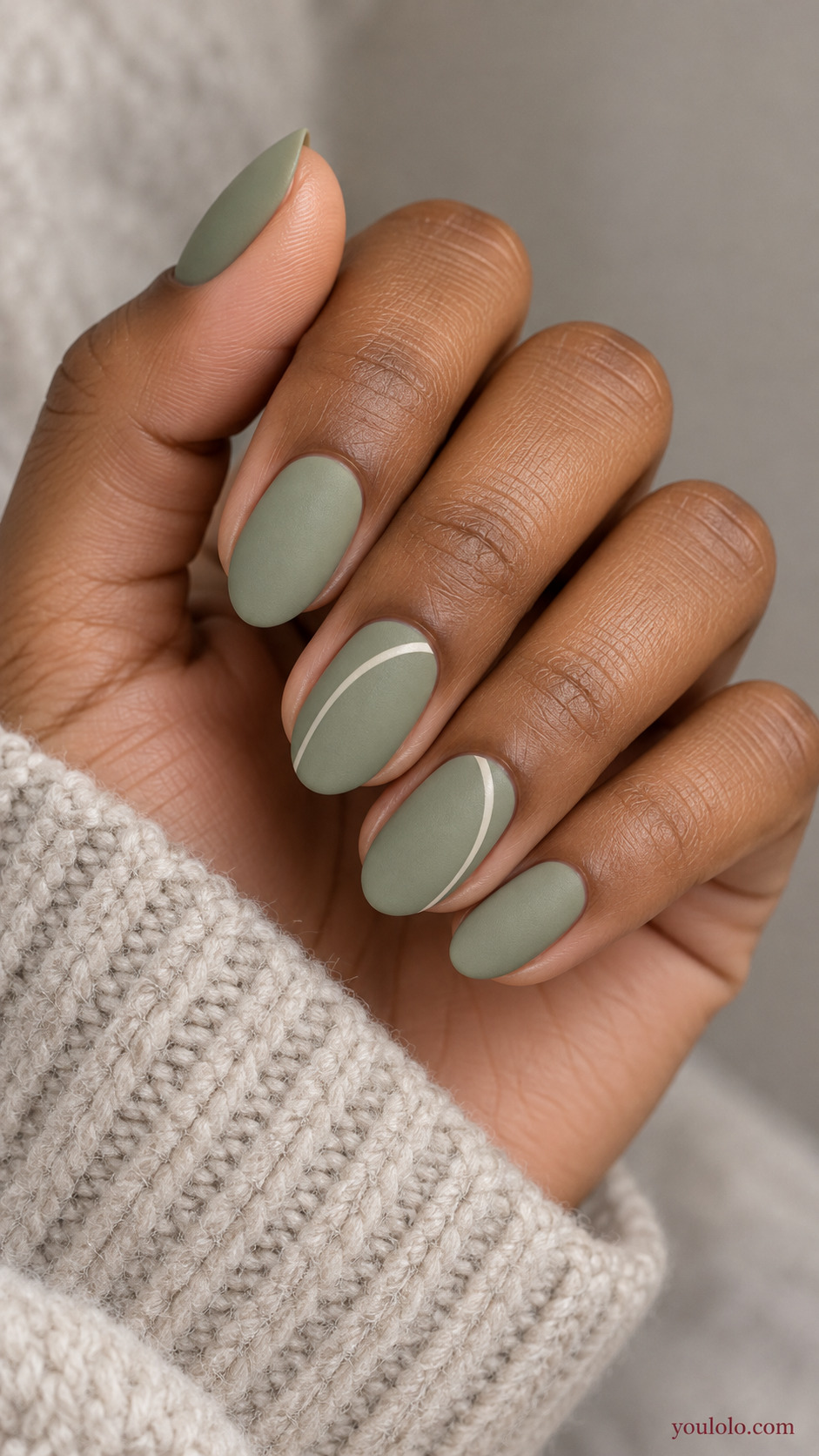
An ivory arch introduces a curved shape without making a full frame around the nail. Its off-center placement keeps the design relaxed, with most of the sage left untouched. The arch can sit on selected accents rather than repeating everywhere. On a softly tapered oval nail, the curve relates naturally to the outer outline, but it should remain a separate drawn feature rather than trace the entire perimeter.
Style pairing: Ivory linen or a soft camel layer picks up the pale detail.
Detail to keep: Keep the arch narrow, open and slightly off-center.
9. Sage with Tiny Black Dashes
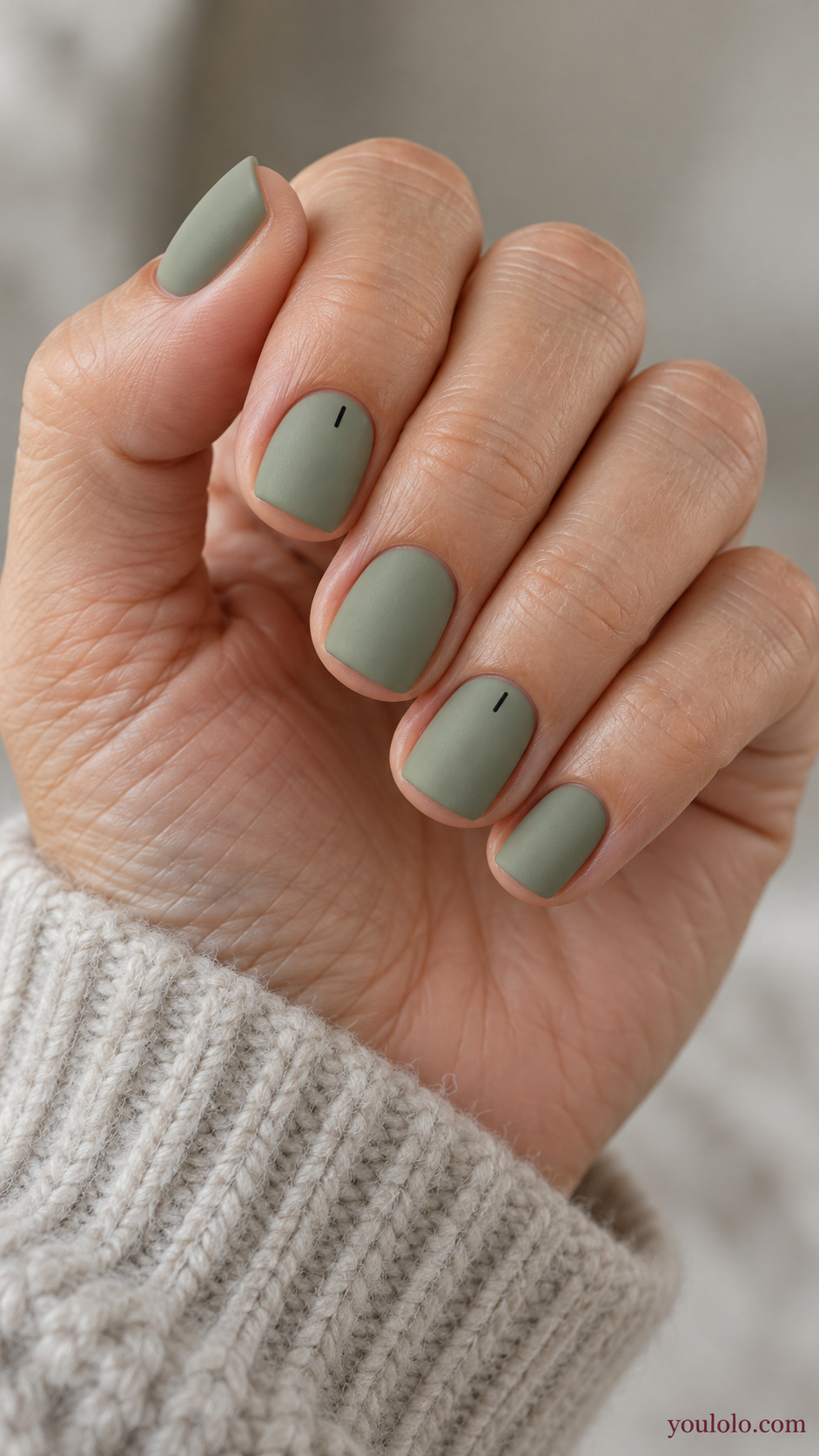
A tiny dark dash is a small but deliberate interruption in the green. Placing it near the base leaves the upper nail open, which helps the short square shape stay clear. The point is restraint: a long stripe would create a different composition. This is a good choice when you want a graphic accent that reads as a mark rather than a recognizable flower, star or heart.
Style pairing: Use black accessories to repeat the small dark accent without adding another print.
Detail to keep: Two small accent marks are enough; keep their length proportional to the nail.
10. A Single Sweeping White Ribbon
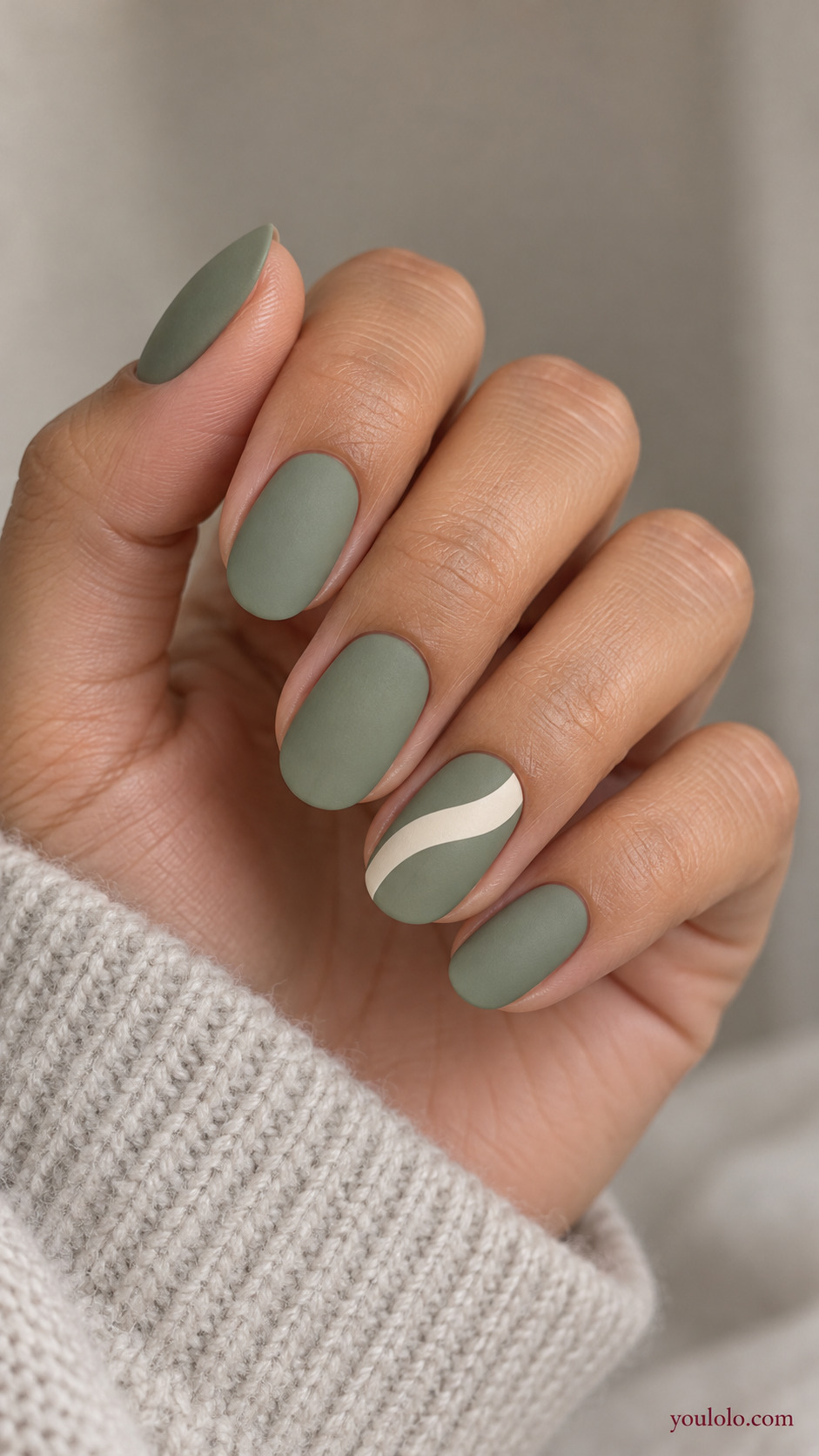
A broad ivory ribbon gives one nail a soft sweep of contrast. Unlike a fine line, it has enough width to become the focal shape, so the other nails can remain plain. The curve should feel smooth rather than jagged, with green visible on both sides. I would keep it to one accent if the manicure is short, allowing the ribbon room to read as a single gesture.
Style pairing: A cream blouse or ivory cardigan makes the color pairing feel connected.
Detail to keep: Keep one clear curve and leave out extra outlines, dots or metallic borders.
11. Sage and Nude Diagonal Windows
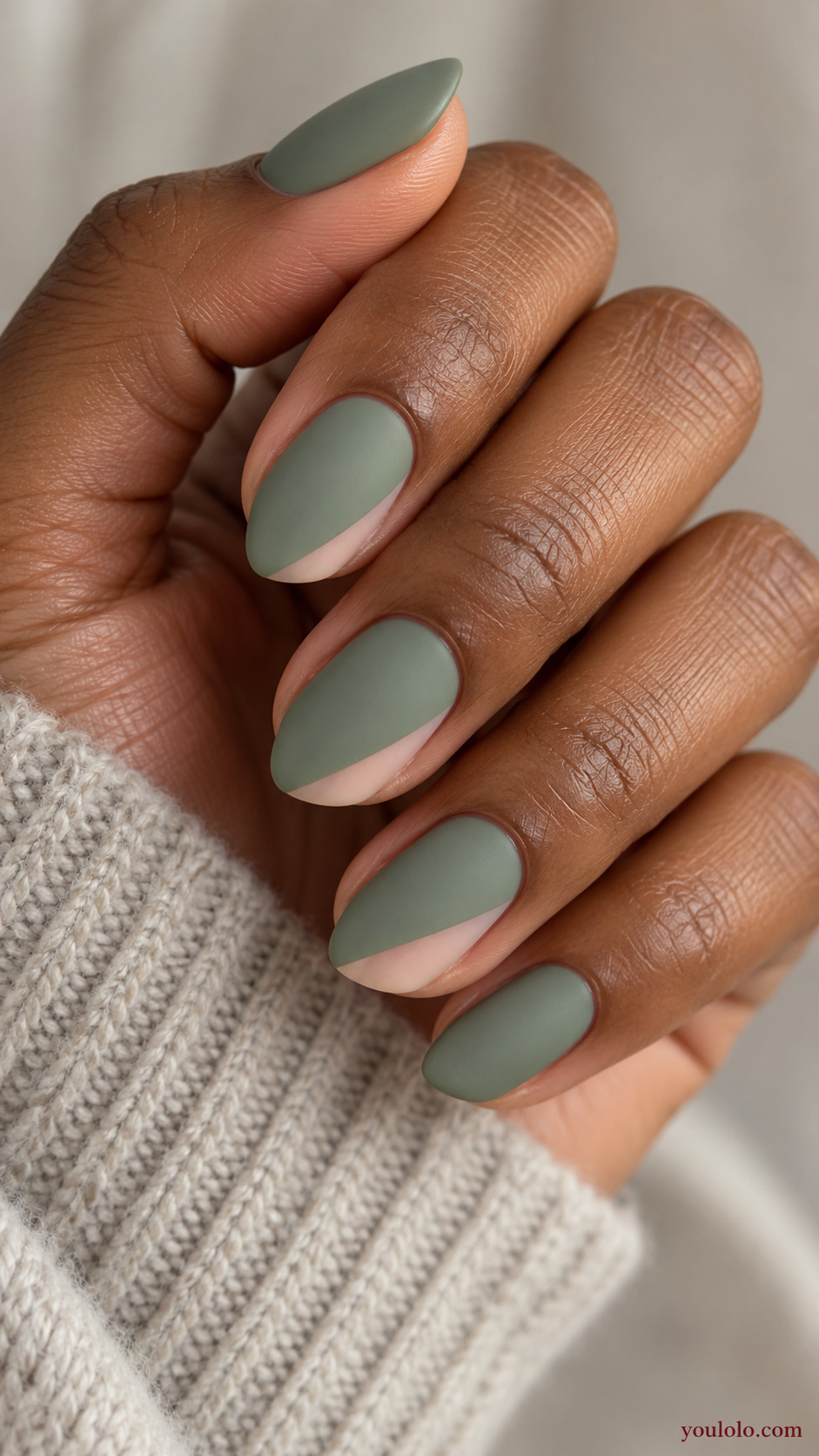
Small nude windows let the green wrap around an area of open-looking space. A triangular opening near the side creates a different effect from a standard French tip because the color still occupies most of the nail. Choose a neutral base you like on its own; it will be part of the finished composition. The matte finish should stay consistent across both sections for a quiet result.
Style pairing: Try this with beige or stone clothing when you want less all-over green.
Detail to keep: Keep the opening clearly triangular and contained on selected nails.
12. Olive Linework on Pale Sage
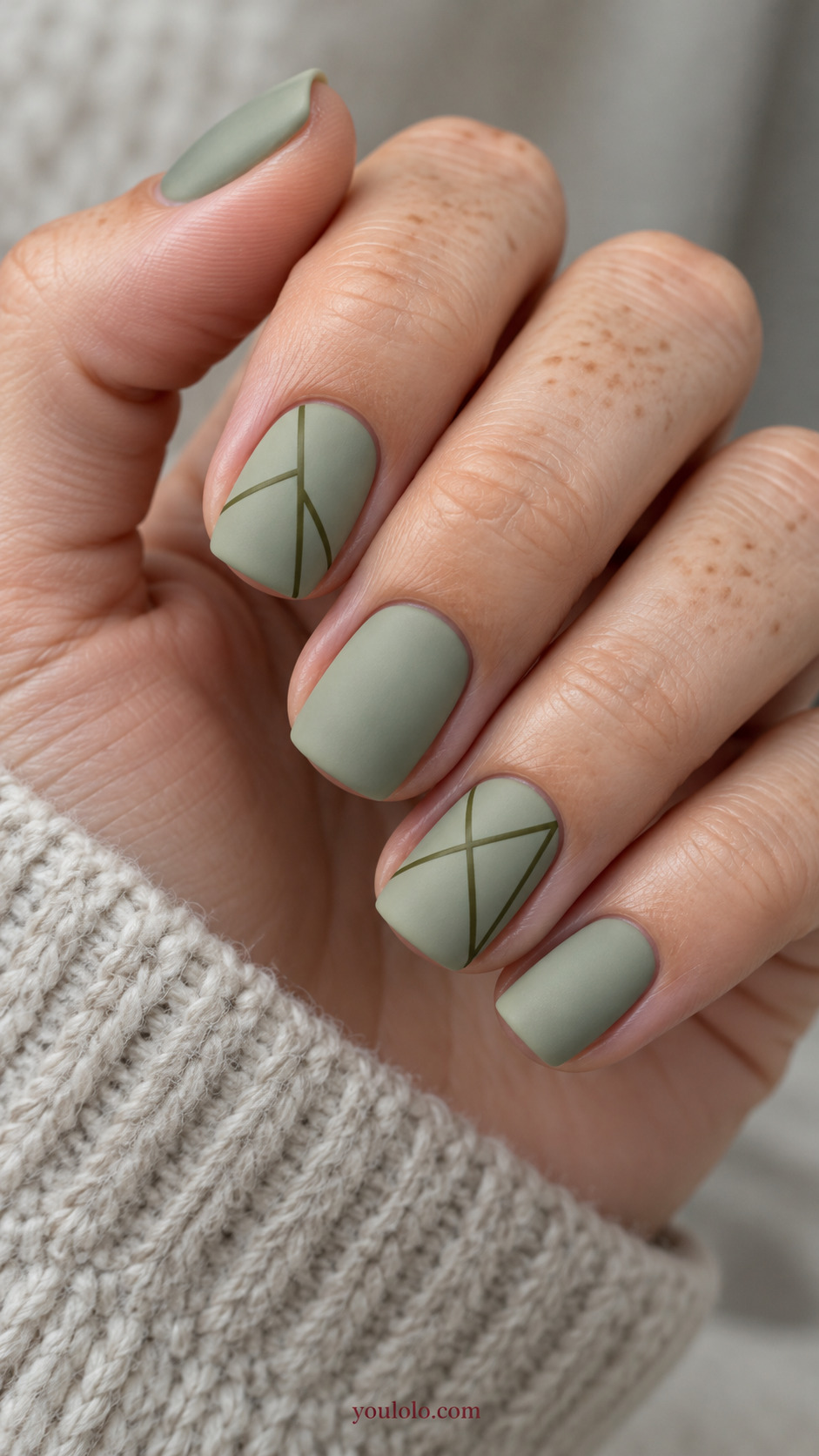
Olive lines over pale sage create a softer contrast than black. A few angular intersections suggest open geometric shapes without turning into a plaid. The pale background is important because the lines need room to separate visually. On a shorter nail, reduce the number of intersections before reducing the line weight too far. The design should still be legible when you look at your hand normally.
Style pairing: A textured cream knit works well beside the clean drawn geometry.
Detail to keep: Keep the pattern sparse and the two greens different enough to distinguish.
Matte Sage Green French Tips: Four Different Edges
French does not have to mean one identical curved band. These references change the placement, direction and colors of the border while keeping the palette soft. Choose the edge that works with your preferred nail outline.
13. Matte Sage French on a Sheer Base
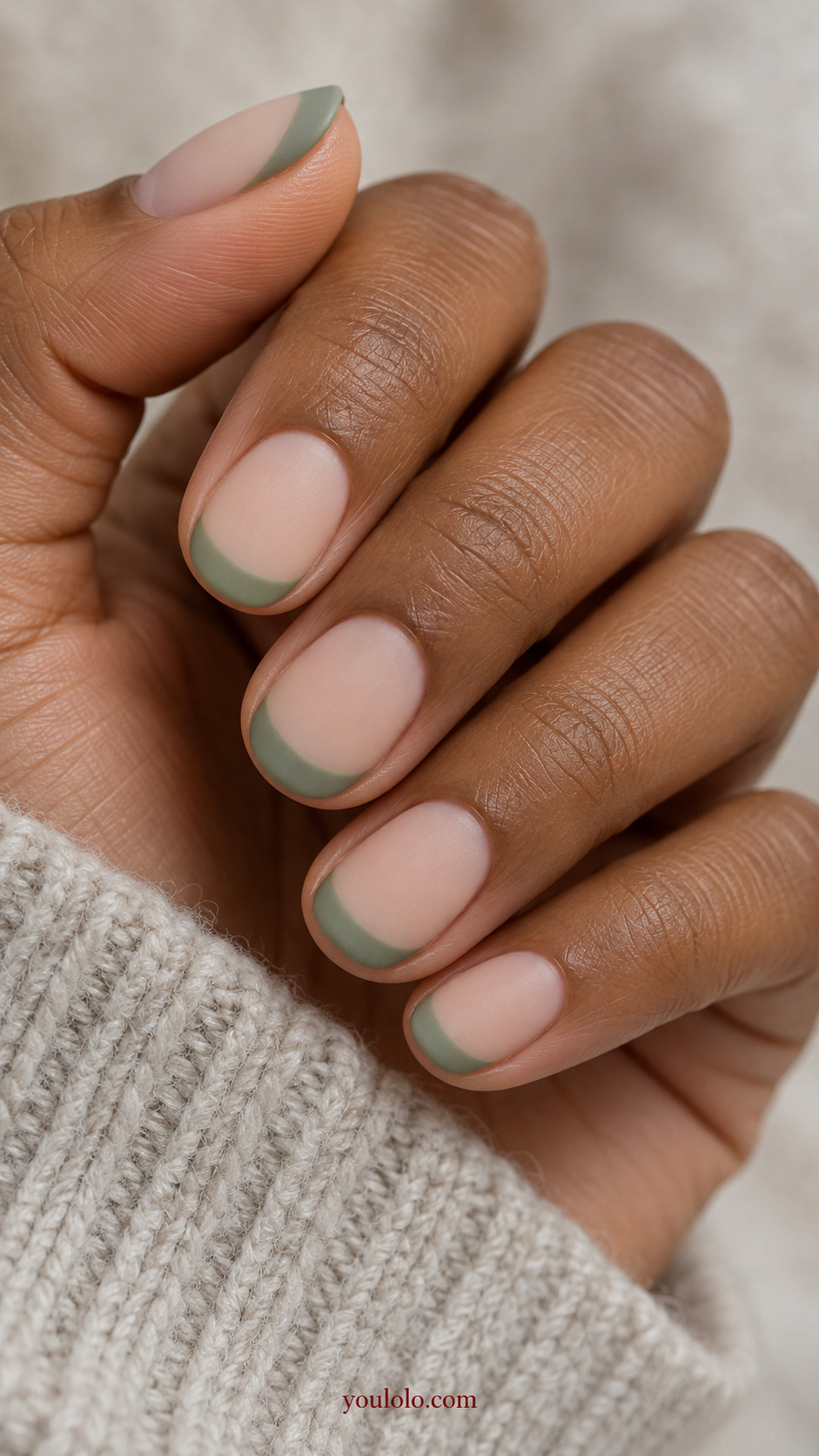
A matte French lets sage appear as a small edge of color rather than full coverage. The neutral base remains visible, and the shallow tip follows the rounded outline. The finish needs to stay soft across the whole nail, including the base; a glossy nude area would make this a mixed-finish design. This is the reference I would choose for a first green manicure with a familiar structure.
Style pairing: Wear with a white shirt, pale denim or understated everyday jewelry.
Detail to keep: Use a shallow sage tip on a short oval and keep the neutral base matte.
14. Sage Reverse French with Ivory Moons
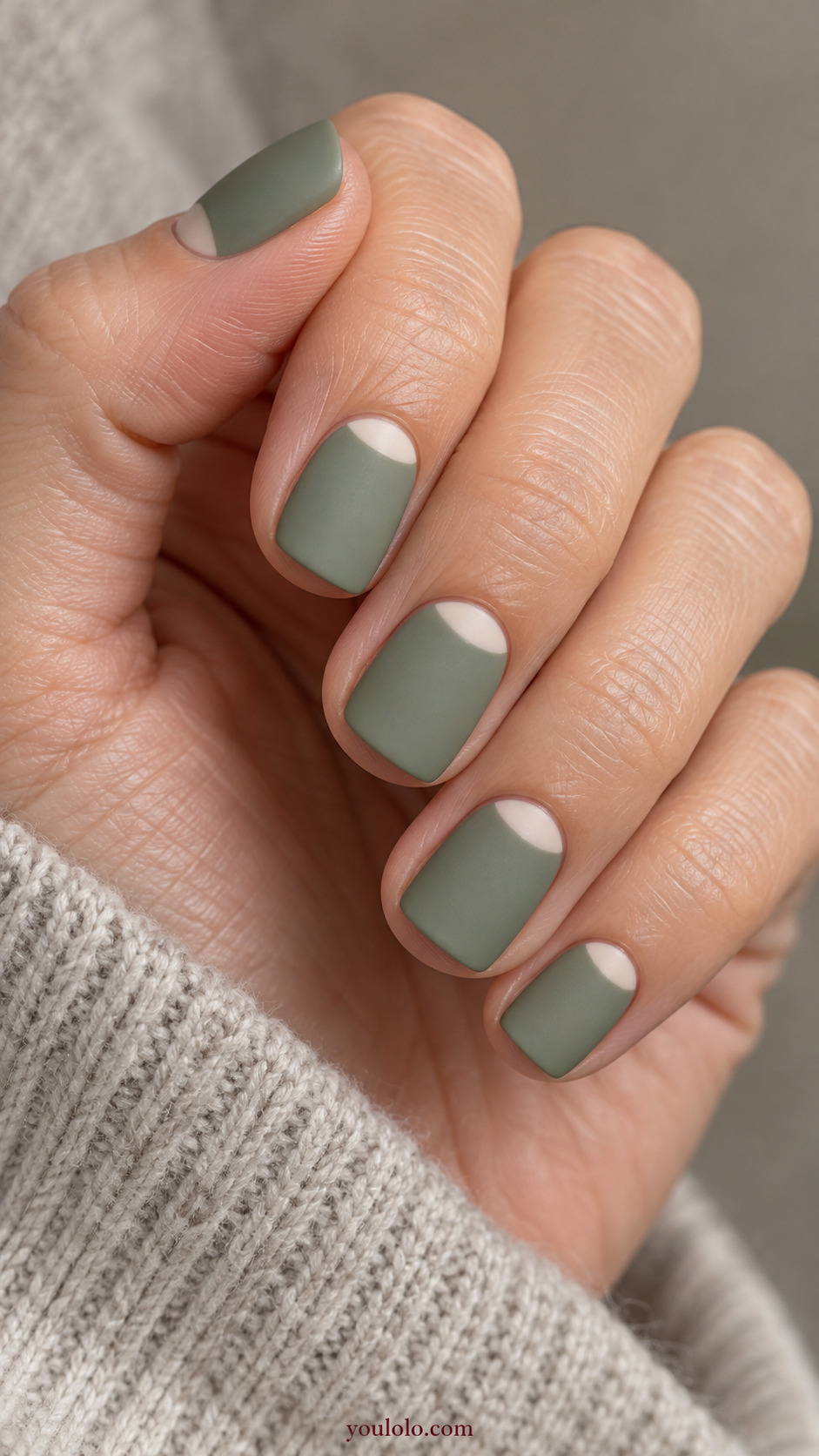
Small ivory half-moons reverse the usual placement of a French contrast. The green covers most of the nail, while a pale semicircle sits near the base. Keep the moon shallow enough that it does not consume the short nail. An opaque ivory creates a clear color contrast, whereas a nude opening would look more like negative space. Decide which result you want before choosing the base shade.
Style pairing: Cream and sage accessories can echo the two colors without matching them exactly.
Detail to keep: Ask for small ivory semicircles, not a metallic cuticle outline.
15. Double Green French Tips
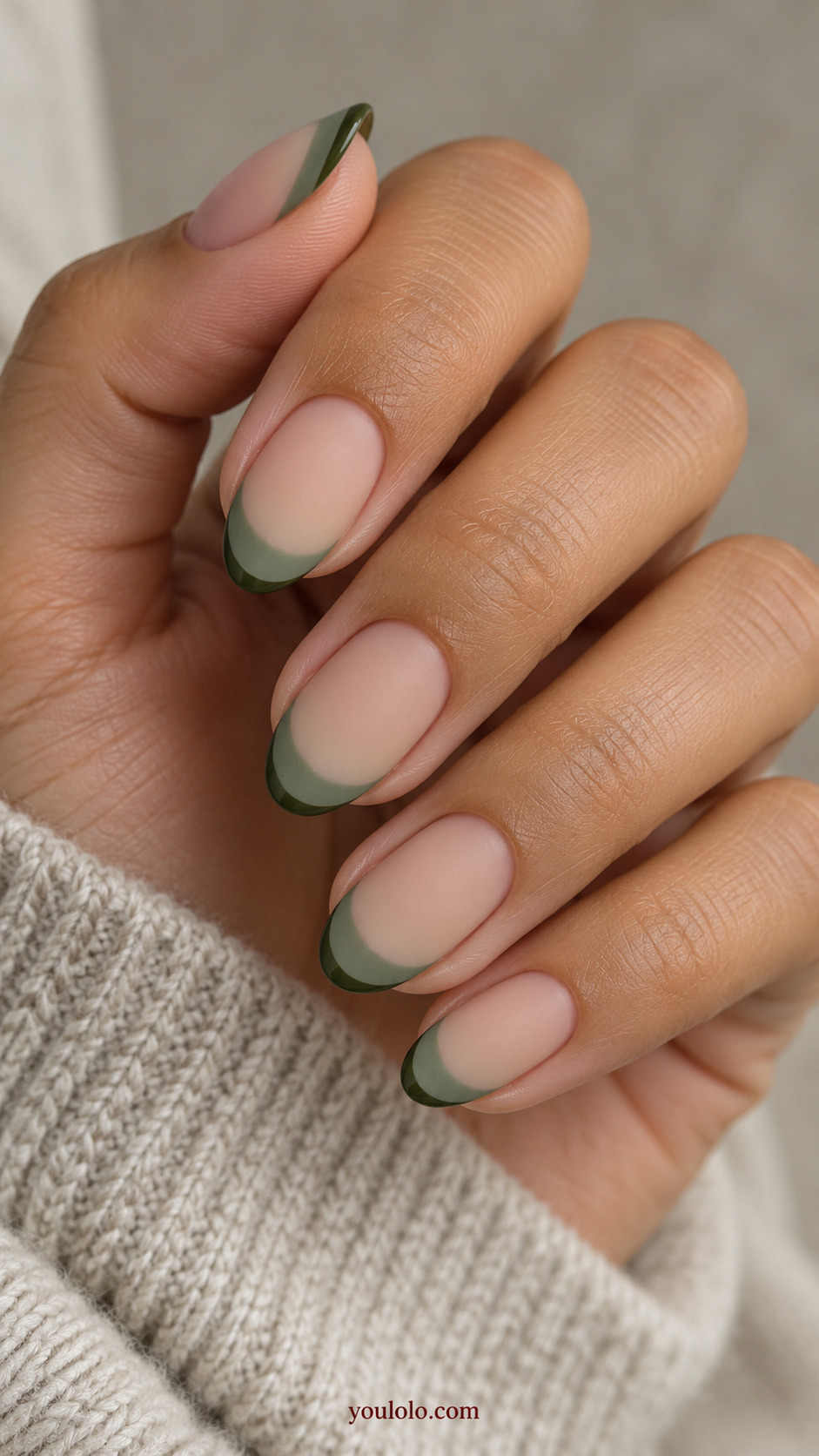
Two greens define the French edge: a muted sage tip and a darker moss line along the outer edge. The darker line should be narrow enough to sharpen the tip without taking over it. Keeping the base neutral gives both shades room to show. On almond nails, follow the curve of the outline so the result looks continuous rather than like a straight stripe across a tapered shape.
Style pairing: A plain neutral outfit makes the two-green border easier to appreciate.
Detail to keep: Keep the moss line at the free edge and the sage band visibly wider.
16. Slanted Sage and Cream Tips
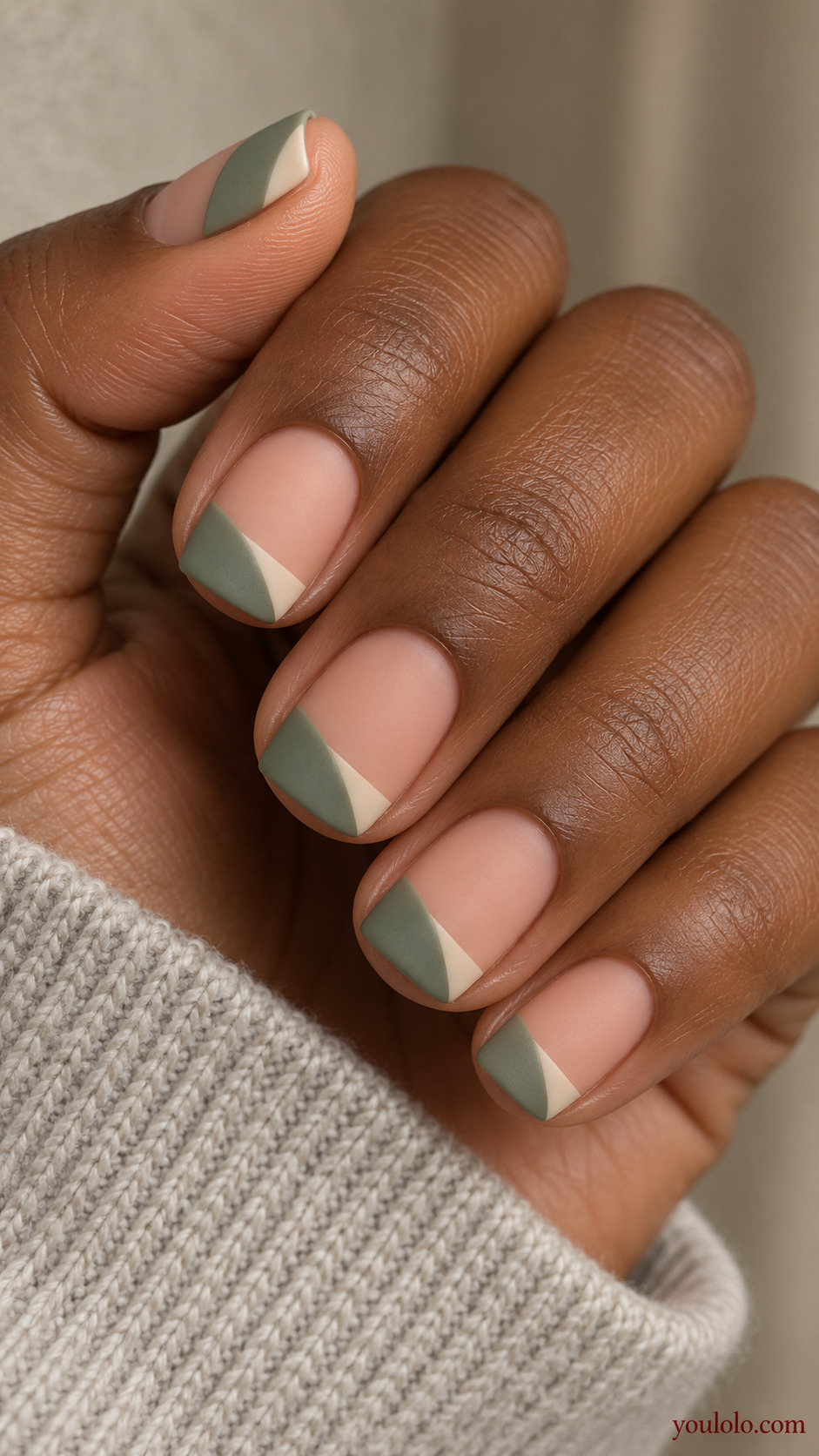
A small cream corner interrupts a slanted sage tip. The diagonal seam is the detail to preserve, while the neutral base keeps the manicure light. A square outline gives the angled color boundary a clear setting. If your nails are shorter, reduce the depth of the tip instead of squeezing a large cream block into the available surface. The colors should stay distinct even without shine.
Style pairing: Try this with cream trousers or a clean beige jacket.
Detail to keep: Keep the cream portion smaller than the sage and the diagonal border tidy.
Matte Sage Nails with Glossy Details
These two sets use the same green in contrasting finishes. A small reflection reveals the accent, while the rest of the surface stays soft. If you want a completely matte manicure, choose a different section rather than asking to remove the defining detail.
17. Matte Sage with Glossy Same-Color Tips

This design changes the finish rather than the color. A narrow glossy sage tip sits against a matte sage body, and the contrast becomes visible as the hand moves. Matching the greens matters: a different shade would turn it into a two-color French instead. Show your artist the exact boundary you want, because a full glossy top coat over the whole nail would remove the main effect.
Style pairing: This is a good partner for plain fabrics when you want a detail noticed up close.
Detail to keep: Keep gloss confined to the tip and leave the main surface genuinely matte.
18. Glossy Leaf Silhouettes on Matte Sage
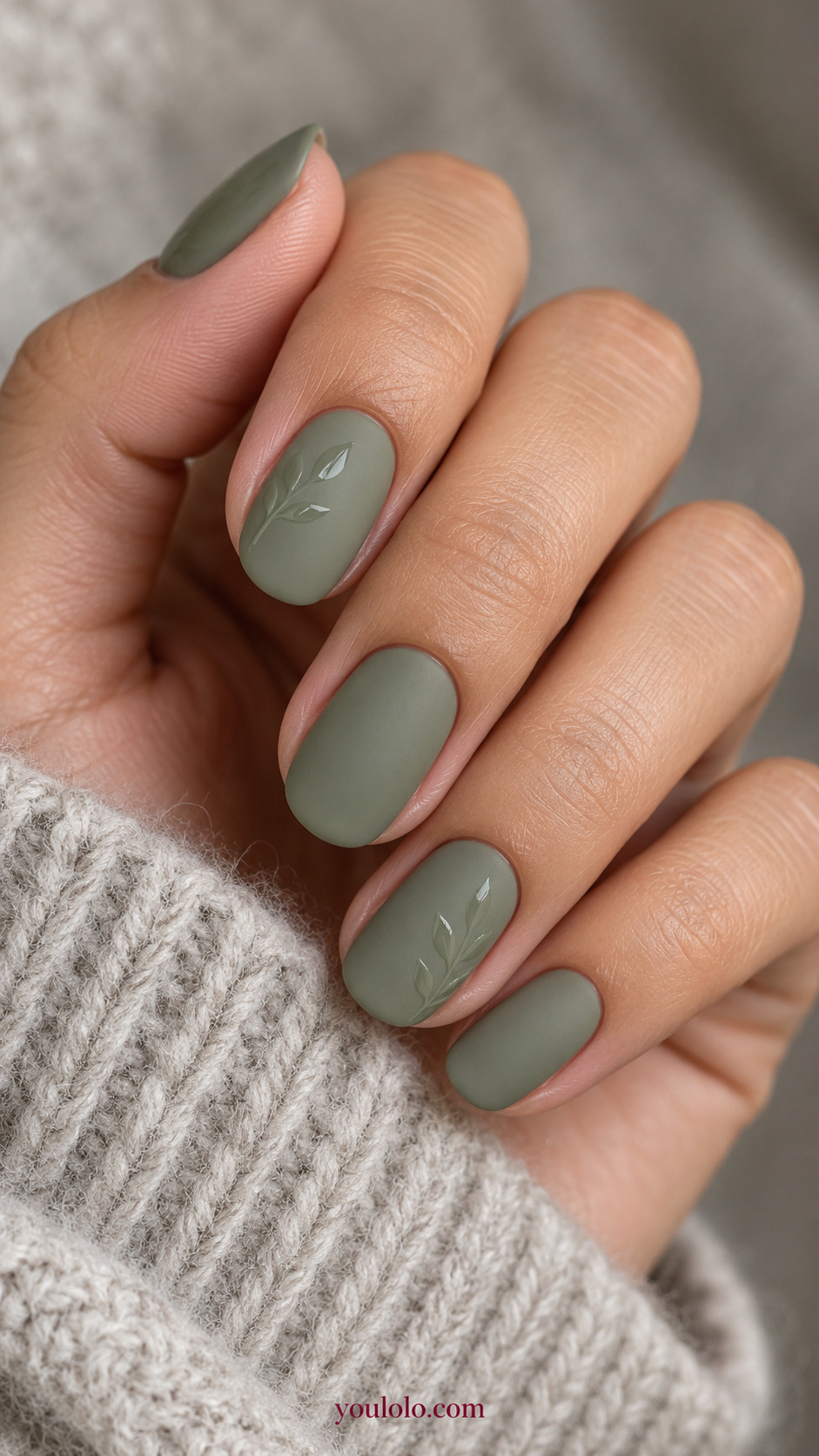
Transparent glossy leaf shapes create a subtle botanical detail on the matte base. There is no bright painted leaf color; the motif is revealed by a small change in reflection. Keep the leaves simple enough to recognize when the light catches them. This is a quiet alternative to metallic foliage, and I would use it on selected accents so the finish contrast has space to stand out.
Style pairing: Soft natural fabrics and minimal jewelry suit the understated surface detail.
Detail to keep: Ask for tone-on-tone glossy silhouettes over matte sage, not colored leaf drawings.
Small Gold, Pearl and Copper Accents on Sage
A small embellishment can add warmth or dimension without covering the green. Consider the placement and the profile of the decoration, especially when the reference is a close-up that makes a tiny detail look larger.
19. Soft Sage with One Gold Cuticle Arc
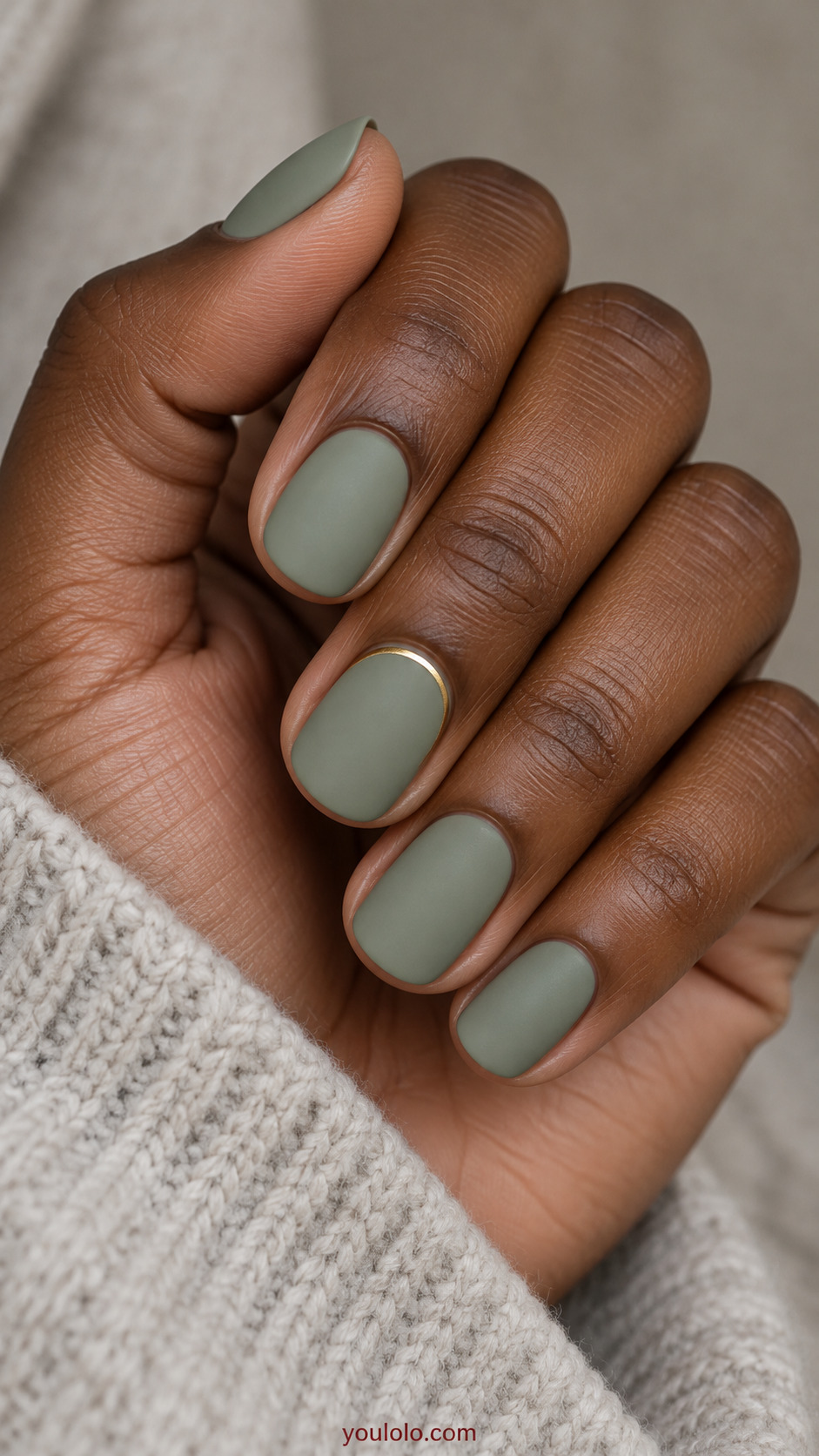
A tiny gold arc gives one nail a jewelry-like edge near the base. It should stay fine and contained, with plenty of matte sage above it. This is less decorative than a full foil accent, making it useful for a short oval shape. The gold introduces warmth, so choose its tone beside the rings or accessories you expect to wear rather than assuming all metallic shades look alike.
Style pairing: Pair with one simple warm-metal accessory and cream clothing.
Detail to keep: Use one narrow arc on an accent nail, without adding stones or a full frame.
20. Rose-Gold Sliver on Sage and Blush
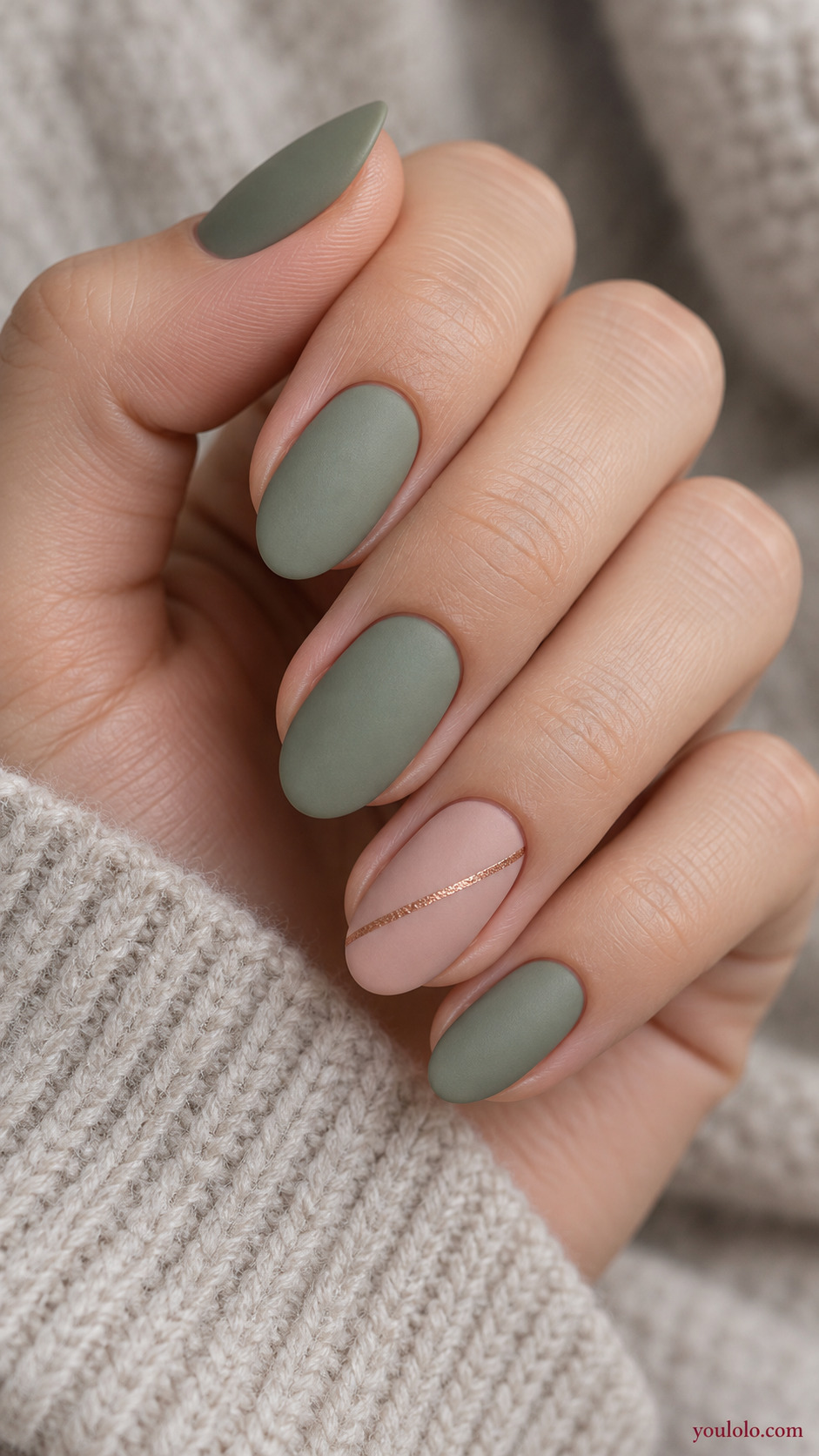
The rose-gold line belongs to the blush accent, leaving the sage nails quiet. That separation gives the set a clear hierarchy: green as the base palette, blush as the contrast and a small metallic mark as the final detail. Keep the stripe fine enough that the pink remains visible. I would avoid adding another metal to the sage nails because the single accent already connects the colors.
Style pairing: Rose-beige clothing or a warm metallic ring can repeat the accent softly.
Detail to keep: Preserve the blush accent and one fine diagonal rose-gold line.
21. A Tiny Pearl Pair on Matte Sage

A pair of very small pearls makes a softer focal point than a bright crystal cluster. Their scale is the important part: they should sit together as a little arrangement rather than cover the whole nail. The square shape gives the pair a calm background, and the matte green prevents reflected light from competing with the pearls. Discuss the side profile before choosing this raised-looking detail.
Style pairing: A cream blouse or pearl earrings can echo the accent without adding another pattern.
Detail to keep: Keep the pair small and ask about a comfortable low-profile application.
22. Sage with a Copper Foil Corner
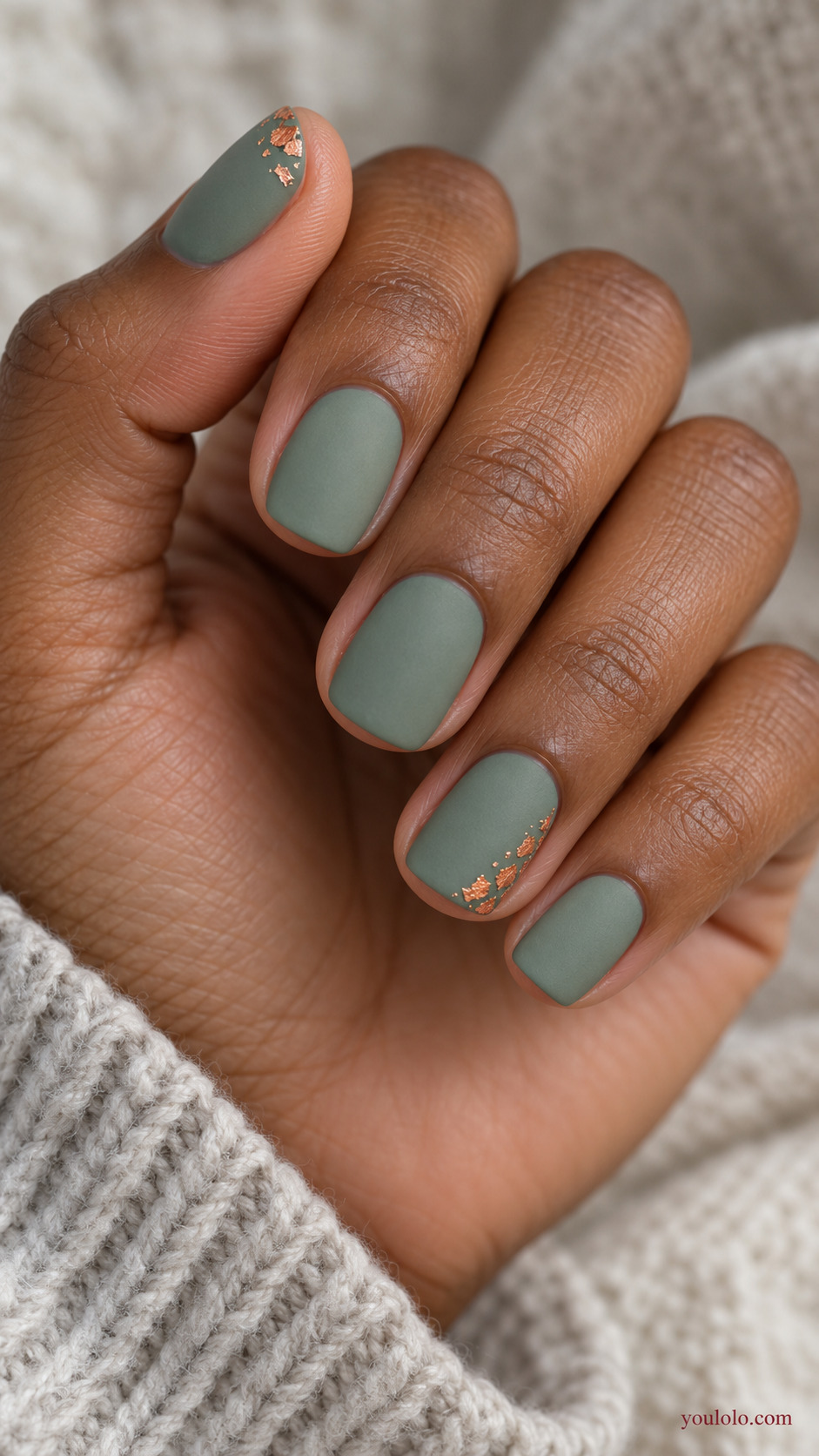
Copper foil warms up the gray-green, but the fragments stay limited to a tip corner. That controlled placement distinguishes the design from a scattered metallic manicure. The irregular shapes can vary slightly between the accents while preserving the same small area of coverage. I would leave the rest of the nails entirely matte and plain so the foil looks intentional rather than like a second full surface finish.
Style pairing: Warm brown leather or a rust-colored scarf makes a useful styling contrast.
Detail to keep: Keep the copper fragments small and confined to selected corners.
Matte Sage Green Designs with Flowers, Checks and Soft Texture
The final group uses a clear subject or a controlled pattern: a daisy, a eucalyptus sprig, ceramic speckles, tortoiseshell, gingham or a gentle gradient. Each has its own rhythm, so keep the surrounding nails simple enough for that feature to register.
23. Single White Daisy on Sage
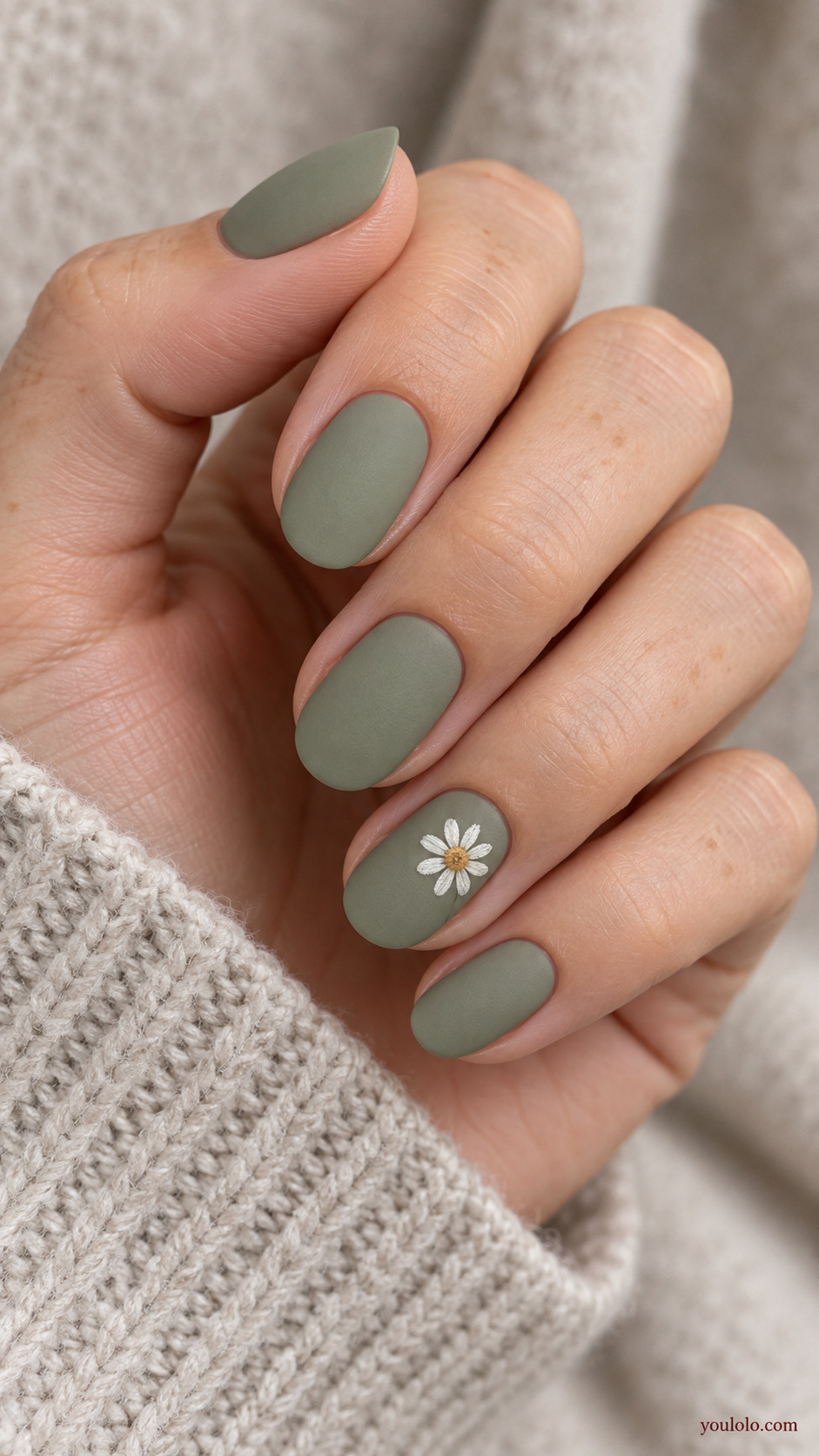
One white daisy gives the sage a clear, friendly motif. A muted ochre center keeps the flower softer than a bright yellow dot, and the surrounding nails remain plain. The petals should have enough space to stay separate. If your nail is very short, reduce the flower rather than add several crowded blooms. This is a simple botanical direction that does not need leaves, foil or a second accent subject.
Style pairing: White cotton and light denim keep the flower feeling fresh and easy.
Detail to keep: Choose one small daisy with clear petals and leave the rest of the set quiet.
24. Fine Eucalyptus Sprigs
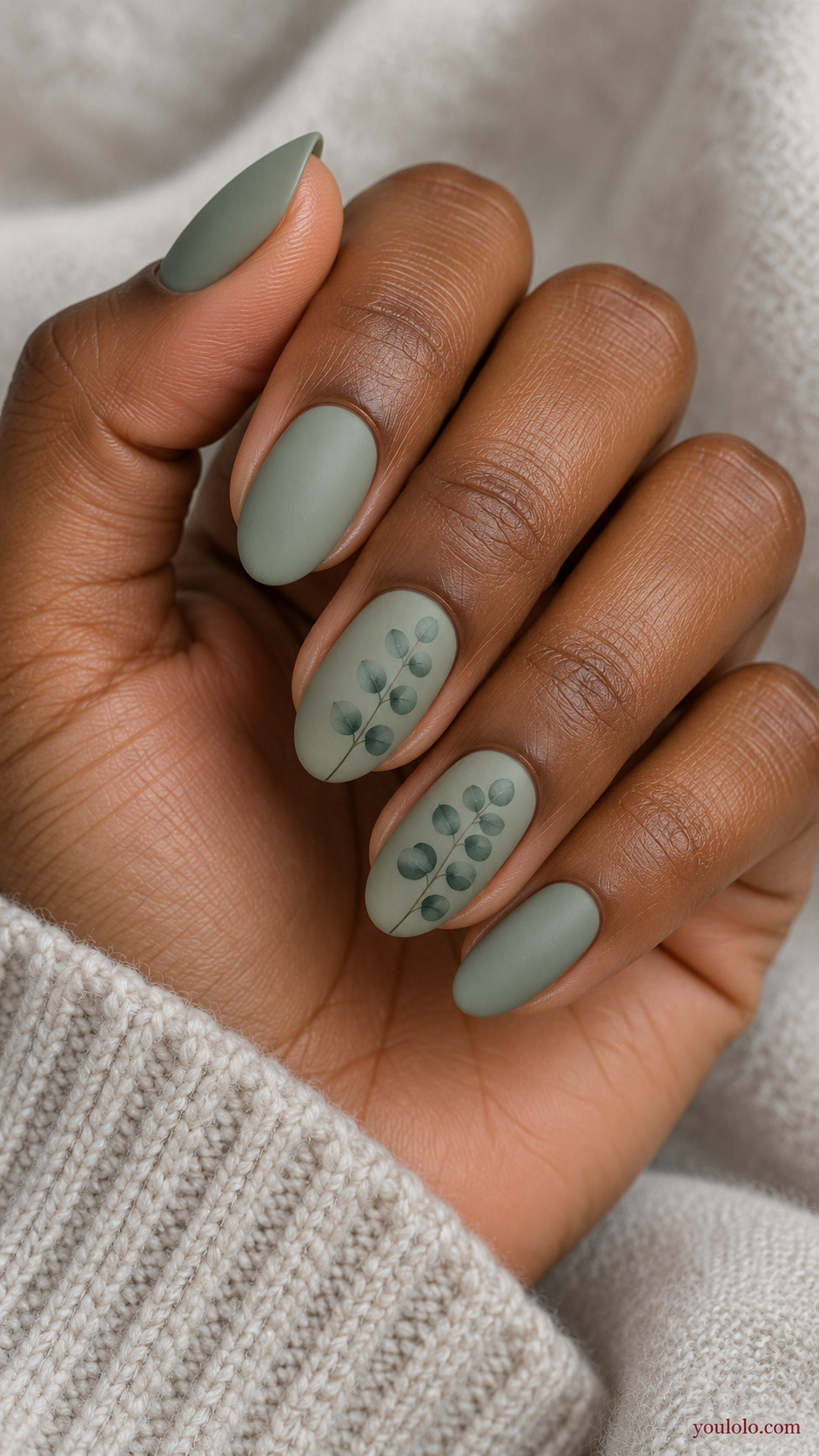
Small rounded leaves give the eucalyptus sprig a distinct botanical shape. A slightly darker green drawing over a milky sage base keeps the contrast gentle. The branches should stay airy, with background visible between the leaves. I would simplify the stem and reduce the leaf count on a short nail rather than turn the sprig into a dense patch. Plain neighboring nails help the drawing remain the focal point.
Style pairing: Try oatmeal, natural linen or an unpatterned sage layer.
Detail to keep: Ask for fine stems and separated round leaves in a darker muted green.
25. Sage and Cream Speckled Ceramic
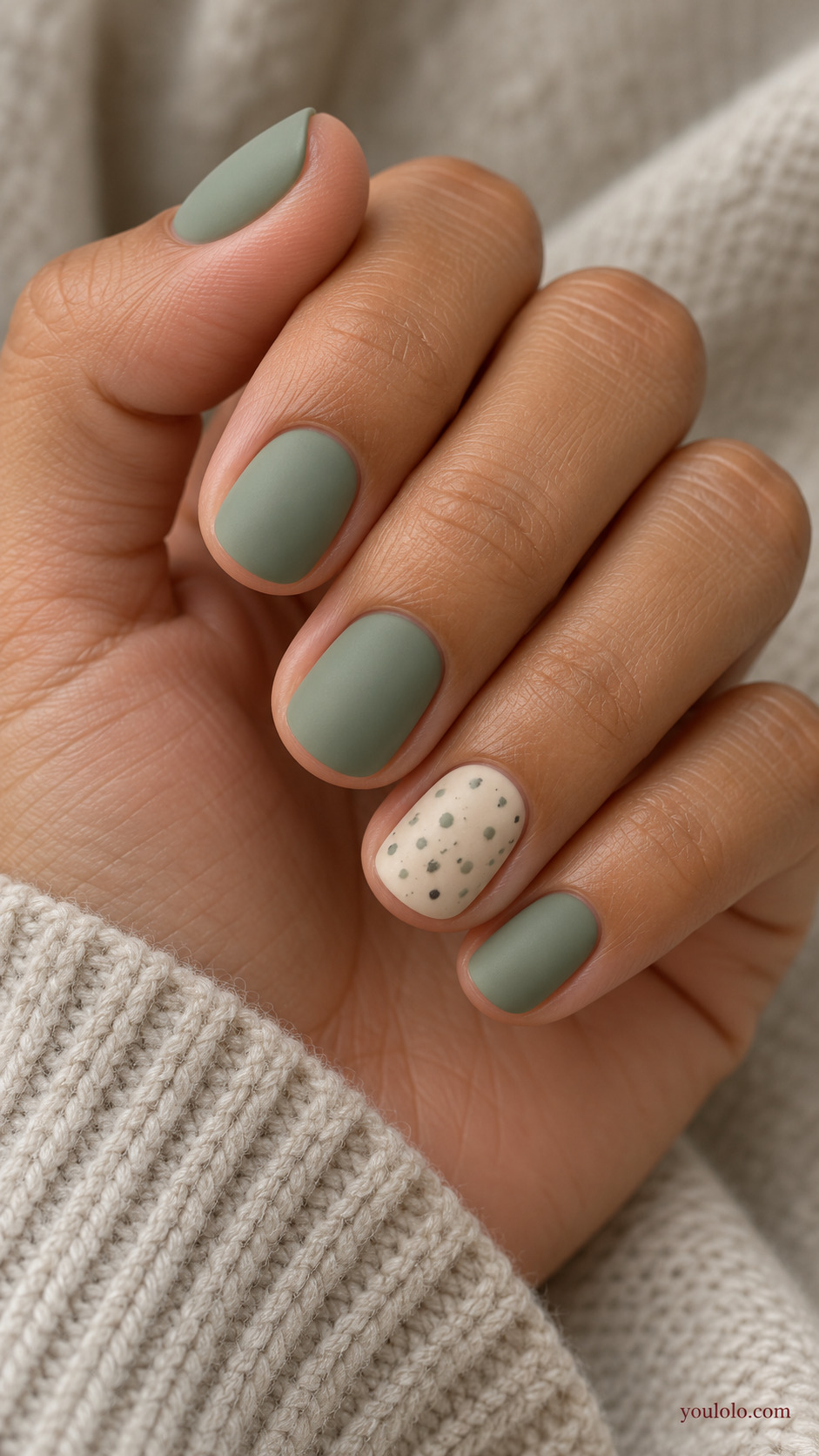
A speckled ivory accent suggests handmade ceramic beside the smooth sage. The dots are deliberately irregular in size and placement, which gives the surface a softer character than a precise polka-dot pattern. Keep most of the ivory visible between the marks. With a short rounded shape, the single accent is enough to add texture without making the whole manicure busy. The remaining nails should stay a consistent matte green.
Style pairing: A textured neutral knit or a simple cotton shirt complements the ceramic mood.
Detail to keep: Use one ivory accent with sparse sage and charcoal speckles.
26. Matte Sage Tortoiseshell Accent
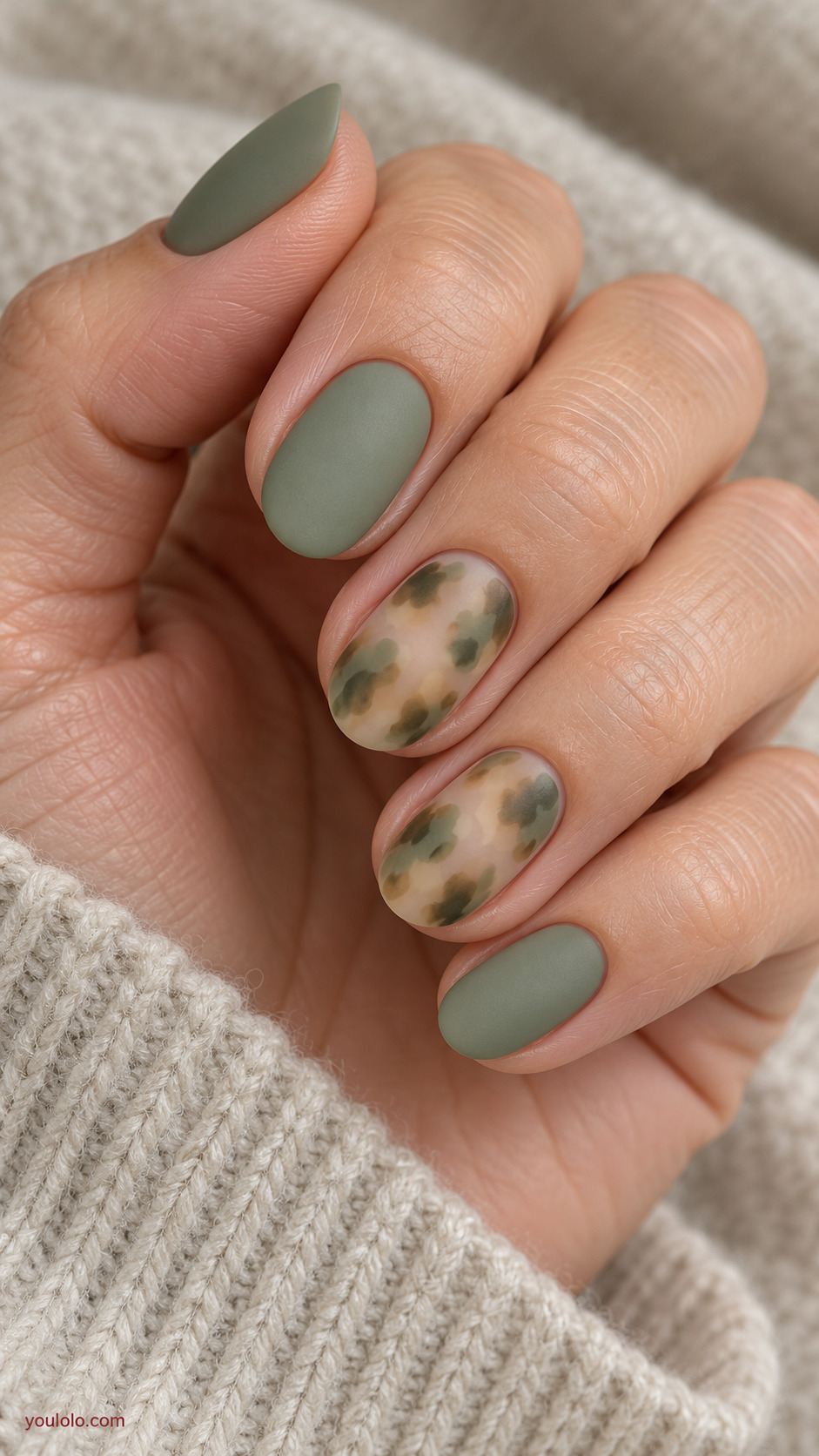
This tortoiseshell variation uses sage and olive patches over a pale warm base. The pattern relies on irregular shapes and lighter gaps, not a black outline around each mark. A matte finish makes the patchwork feel softer than the usual glossy brown version. Keep it on selected accents so the plain sage still anchors the set. Ask to see the color balance before adding more dark patches.
Style pairing: Warm beige and light brown clothing connect to the pale base of the pattern.
Detail to keep: Keep the patches uneven and leave enough light background between them.
27. Sage Green Micro Gingham
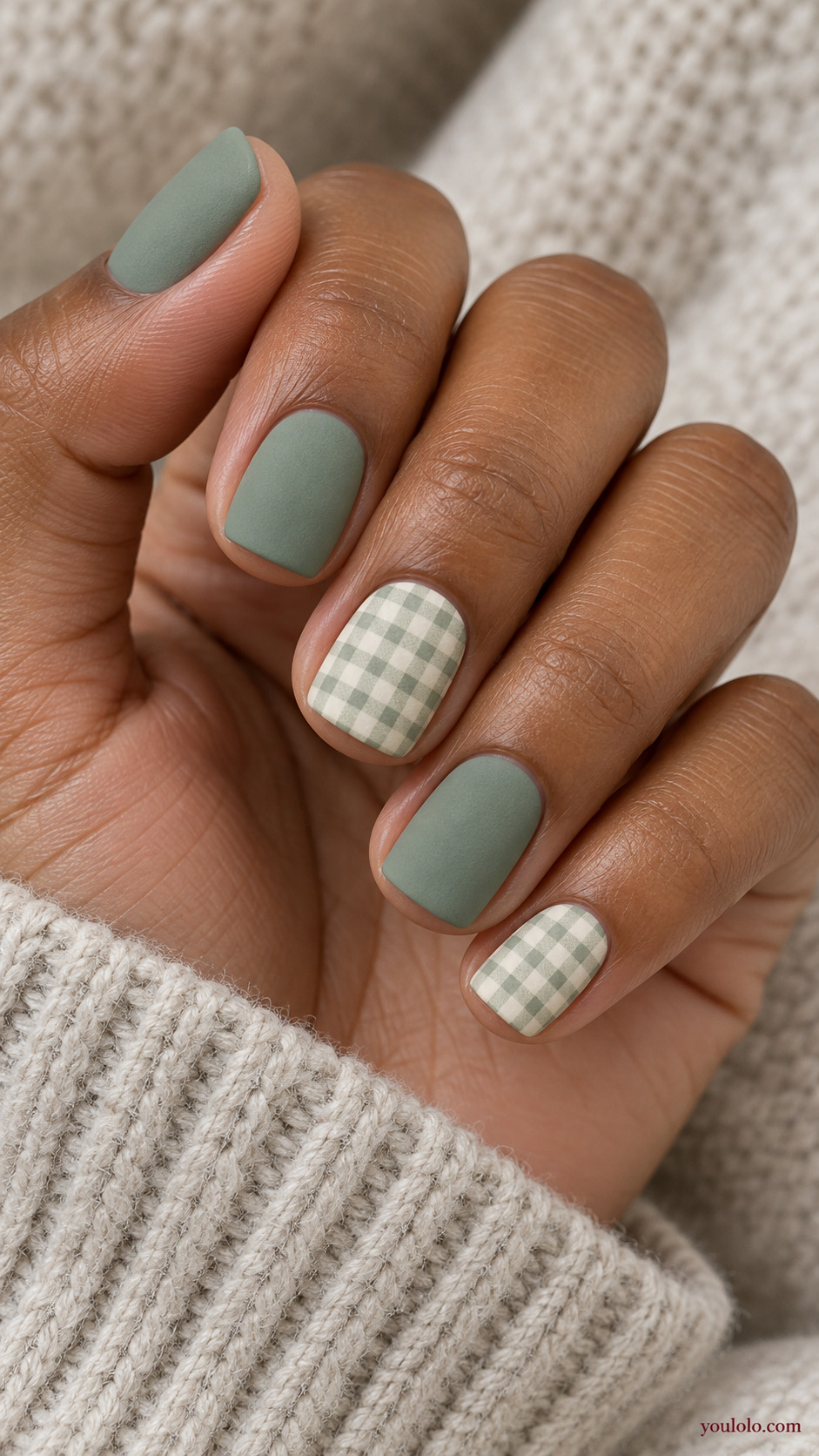
A small gingham pattern brings a tidy check to the green palette. The crossings should look a little deeper than the individual bands, giving the pattern its woven impression. On short square nails, fine checks need a clear ivory background to remain readable. I would keep the grid on selected accents and leave the other nails sage. Too many tiny checks can become visual noise, so simplify the scale when needed.
Style pairing: Choose plain clothing rather than another check print to let the nail pattern stand out.
Detail to keep: Use fine sage gingham over ivory and keep the intersections clean.
28. Soft Sage to Cream Ombre
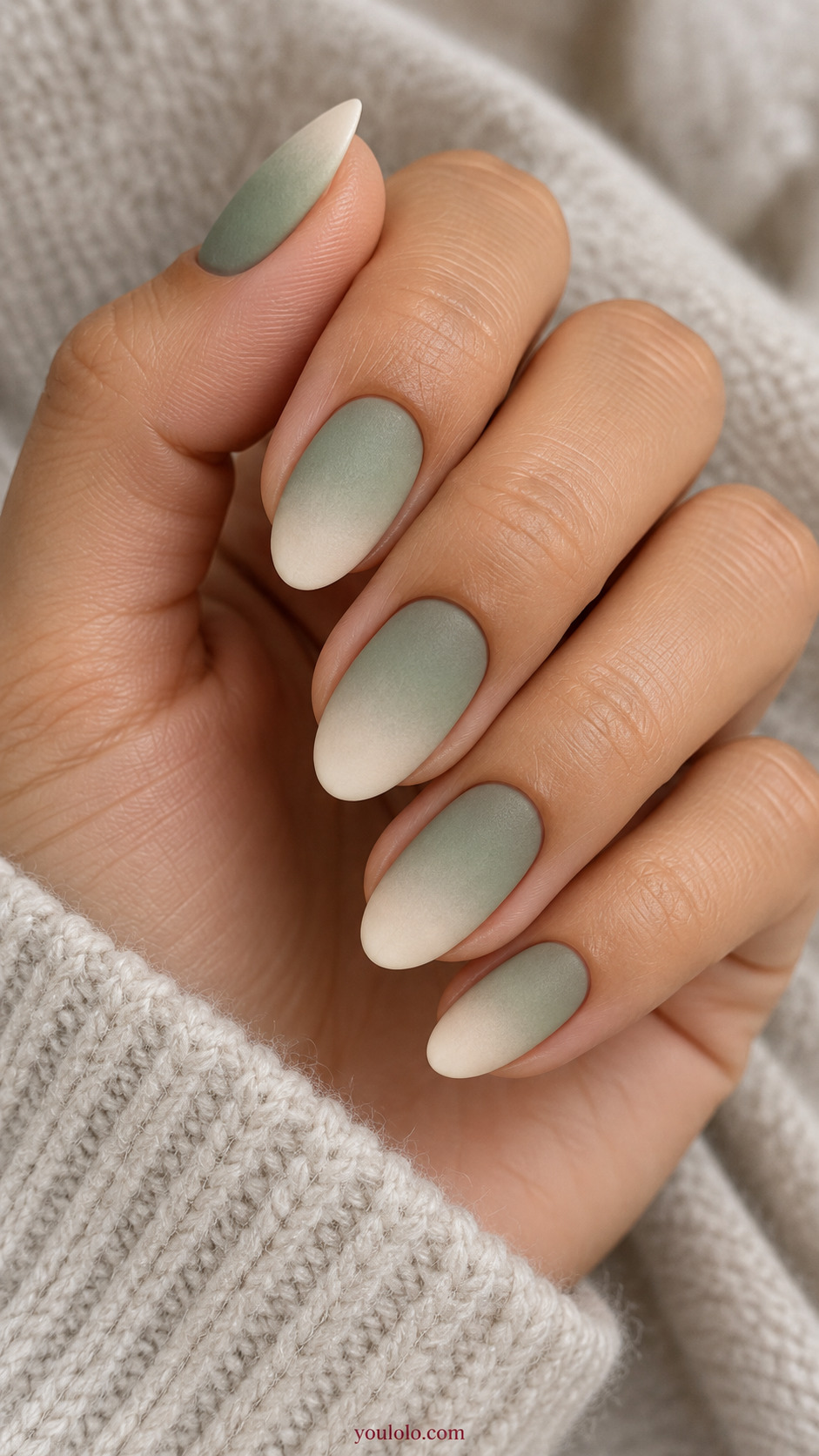
A soft fade moves from sage near the base to cream at the tips. The transition should be gradual enough that there is no obvious dividing band. Matte texture makes the gradient feel hazy, so the two colors need sufficient difference to remain visible. I would choose this when I want a softer edge than a French tip and no separate motif. The almond outline supports the gentle lengthwise movement.
Style pairing: Cream knitwear or a pale neutral dress lets the subtle fade remain the main detail.
Detail to keep: Ask for a smooth sage-to-ivory transition with a matte finish and no shimmer.
Which Sage Manicure Fits the Look You Want?
| Your priority | Designs to compare | Keep in mind |
|---|---|---|
| Very little decoration | Soft sage, dusty eucalyptus or one moss accent | Compare the actual shade in ordinary light |
| Less all-over green | Matte French or nude diagonal windows | The neutral base is part of the design |
| A graphic focal point | Charcoal contours, ivory arch or black dashes | Leave enough open green space |
| A subtle surface effect | Glossy same-color tips or leaf silhouettes | The base must remain matte |
| A small dressy detail | Gold arc, pearl pair or copper corner | Discuss the size and raised profile |
| A recognizable pattern | Daisy, sprigs, ceramic speckles or gingham | Adapt the scale to the available nail |
Match the Design to Length, Not Just the Photo
Short round and squoval nails work well with a plain shade, a small corner accent or a shallow French tip. They can also carry a pattern, but the spacing becomes more important. For gingham, fewer clear checks are better than a dense grid that only reads in a macro photograph. For a daisy, keep the petal shape recognizable instead of forcing in extra flowers.
Medium almond and soft coffin shapes give a curve or sprig more room to travel. That does not mean the whole surface needs decoration. The contour-line set leaves large green areas between the marks, and the eucalyptus design uses selected accents. If you shorten one of these references, preserve the main gesture and remove the secondary marks first.
Outfit Pairings: Build Around One Contrast
For an everyday neutral wardrobe, I would begin with pale sage, eucalyptus or the ivory accent. Cream, oatmeal and stone let the green stay soft without disappearing. A black bag or shoes can connect to the charcoal linework, while a copper detail gives the palette a warmer direction beside brown leather or a rust scarf.
If the clothes already have a print, choose plain color or one small embellishment. If the outfit is simple, the gingham, sprigs or contour lines can supply the pattern. These are styling suggestions rather than restrictions: any skin tone can be part of the reference, and the final shade should be one you enjoy seeing on your own hand.
Getting the Matte Finish Right
A matte finish is a surface choice, not a nail shape or a particular extension method. For regular polish, a compatible matte top coat can change the final sheen. For example, Essie describes Matte About You as a matte finisher for its nail color polish. Follow the instructions for the exact products you use rather than assuming a regular-polish top coat and a gel system are interchangeable.
For the glossy-tip and glossy-leaf references, tell the artist precisely which areas should reflect light. A glossy layer over the entire nail would remove the contrast. Similarly, a matte layer over the glossy accents would hide the feature. A sample nail is useful when the design depends more on surface texture than on a change in color.
When discussing touch-ups, say that you want to retain the matte appearance. A generic recommendation to restore shine does not fit an all-matte set. Ask the artist or follow the product guidance for compatible maintenance and removal; the illustration does not establish a wear time, application method or removal process.
A Simple Brief to Send Before Your Appointment
Choose one main reference and describe four things: your preferred length, the shade, the finish and the accent placement. For example: short squoval nails in gray sage, fully matte, with one ivory nail and no additional decoration. If the essential feature is the contour line or glossy tip, say that explicitly.
Also say what you would like changed. A rounder outline, less metal or a smaller flower is a useful instruction. Sending several incompatible references without identifying the priority makes the final design harder to plan. The goal is a coherent manicure adapted to your own nails, not a combination of every detail in the gallery.
Matte Sage Green Nails: Questions Before You Choose
What is the difference between sage and olive green nails?
In this collection, sage has a softer gray-green character, while olive and moss provide deeper or warmer green accents. Brands use color names differently, so compare finished swatches rather than relying on the label alone.
Do matte sage green nails work on short nails?
Yes. The first six designs use compact shapes, and the French, small gold arc and ceramic accent can also be adapted to short nails. Keep the motif proportionate and leave enough background around it.
Can I make sage green nail polish matte?
A compatible matte top coat can change the finish of a regular-polish manicure. Check the instructions for the particular formula and system. The linked manufacturer example in the finish section is a product reference, not a claim that it was used in these generated images.
Can matte nails have glossy French tips?
Yes; that is the intended contrast in design 17. The main nail stays matte while a narrow tip reflects light. Specify both the finish and the boundary so the entire nail is not finished the same way.
Does gold or silver look better with sage?
Either can be used. This edit uses gold, rose gold and copper to add warmer accents, while ivory and charcoal provide nonmetallic contrasts. Choose the combination you prefer beside your accessories rather than treating one metal as universally correct.
Which matte sage design is easiest to keep visually simple?
Plain pale sage, one cream accent or a small dark dash uses the fewest elements. If you want a pattern, choose one accent nail rather than combining flowers, lines and metallic fragments across the whole set.
Are these sage nails only for autumn?
No. The soft green and ivory combinations can be worn whenever you like them. Moss and copper can create a warmer styling direction, while pale sage, blush and a white flower create a lighter one. There is no need to restrict the color to a season.
Do the pearl designs require raised decorations?
The pearl reference shows small raised-looking elements. Ask about their size and profile before choosing them. If you prefer a smooth nail, discuss a painted interpretation or select one of the flat line-art references.
Three References I Would Save First
I would save the charcoal contour lines for a graphic set, the short matte French for a restrained everyday version, and the ceramic accent for a little texture. They share the same soft palette but solve different design choices. Pick the one feature you want to notice first, then let the rest of the manicure support it.