The Best Fluffy Pancakes recipe you will fall in love with. Full of tips and tricks to help you make the best pancakes.



Mediterranean nails can be much more than a blue French tip. A little painted lemon, a curved olive branch or a miniature blue doorway can give a manicure a whole setting. This collection brings those details together through 24 complete looks, moving between clean cobalt-and-ivory combinations, softer sea-glass colors and tiny coastal scenes.
The idea is to borrow a visual mood rather than put every coastal symbol on every finger. Some designs use a single illustrated accent with plain companion nails. Others repeat a ceramic pattern, a wave or a fine stripe across the hand. You can choose the amount of detail that feels right for your own nails, from a narrow painted edge to a small architectural picture.
Although the palette often suggests a seaside trip, these are not designs you have to save for one particular month. Olive branches, terrazzo, fine blue florals and dark-blue accents can work as decorative choices whenever you want them. If you prefer a quieter manicure, keep the cream base and choose only one motif.
Below, each look has a close-up, a description of the composition and one practical detail to discuss with your nail artist. Use the images to choose a direction, then adapt the number of accents and the scale of the artwork to your preferred length.
Find your favorite direction
For a restrained set, start with Aegean Cobalt French, Fine Wavy French or Olive Branches on Cream. For painted detail, look at Greek Tile Florals, Lemon Grove Branches and Blue Shutters. If you like texture expressed through color, compare Turquoise Sea Glass, Pebble Beach Neutrals and Coastal Terrazzo.
1. Santorini Blue Olive Sprigs

Blue olive sprigs turn a plain ivory manicure into something quietly decorative. The curved stems give the composition movement, while the small berries provide darker points of contrast. Two illustrated nails are enough to establish the theme; the plain companions make the fine leaves easier to appreciate.
Palette and placement: Ivory oval nails with slender cobalt leaves and blue olive berries painted on two accents, plain ivory companions.
The detail to discuss: Keep the sprig off-center so the leaves have room to spread without touching both sidewalls.
2. Aegean Cobalt French
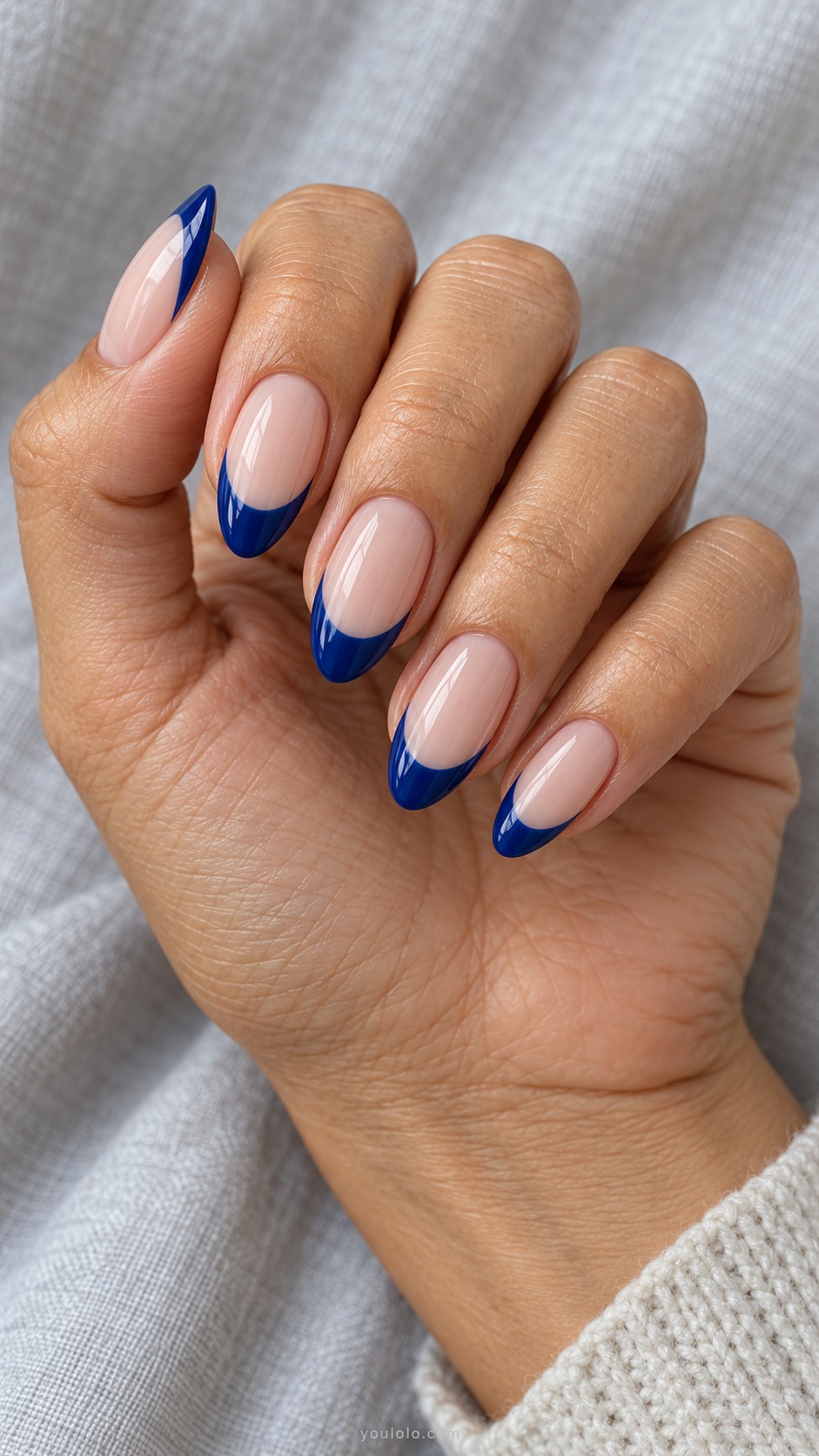
A cobalt French tip gives the coastal palette its simplest expression. The nude center keeps the look light, and the curved blue edge follows the almond shape. It is a useful starting point if you like the collection's colors but do not want miniature scenes or floral painting.
Palette and placement: Nude almond nails with deep cobalt curved French tips, narrow crisp smile lines and glossy finish.
The detail to discuss: Ask for the same relative tip depth on each finger, rather than an identical measurement.
3. Greek Tile Florals
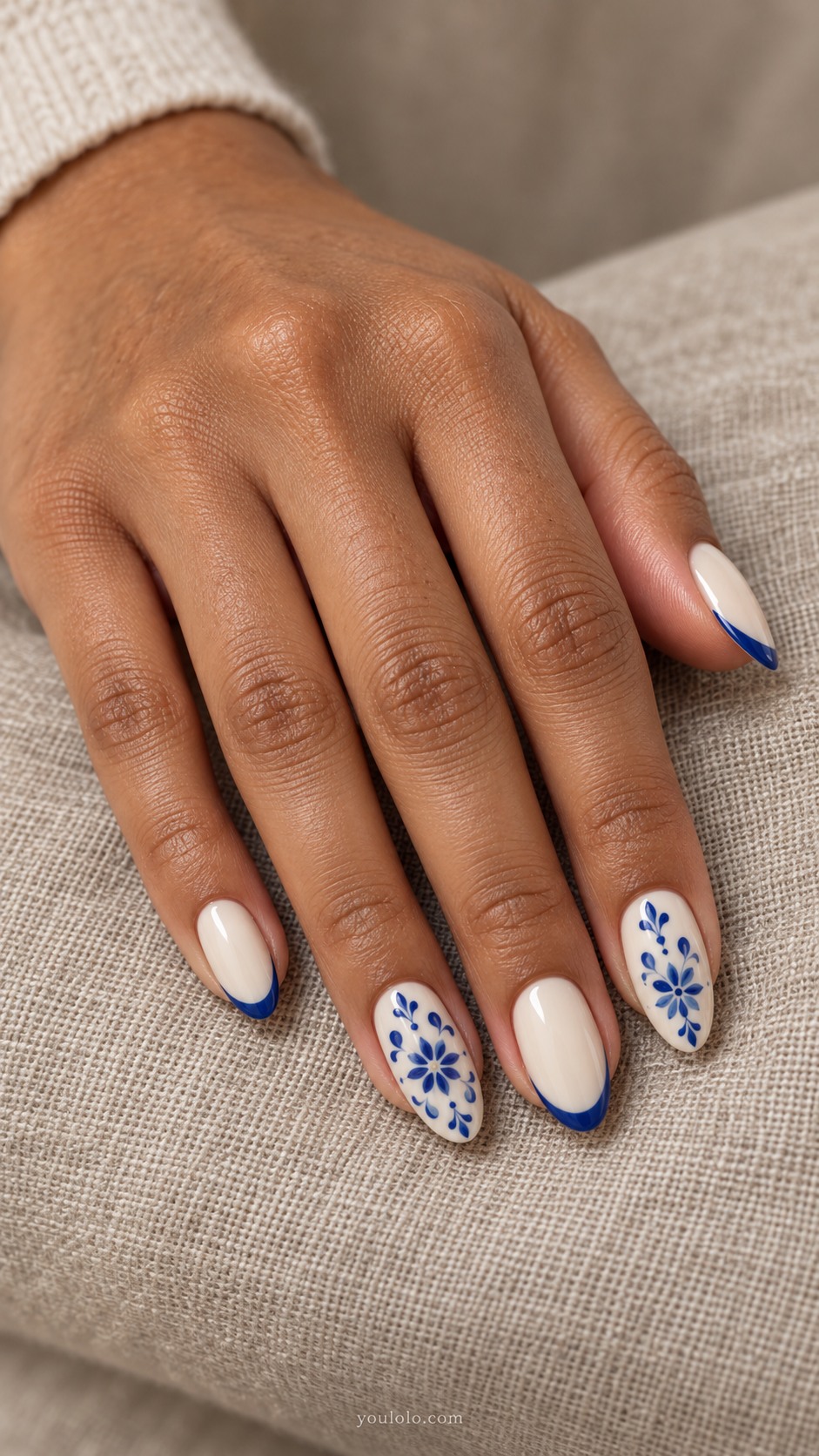
The tile-inspired design relies on rhythm: a central flower, a few leaf shapes and small surrounding marks. Cobalt against ivory keeps the detail crisp. Reserve the fullest pattern for an accent nail and repeat just the blue edge elsewhere, so the set feels coordinated rather than uniformly busy.
Palette and placement: Ivory almond manicure with intricate cobalt small floral tile pattern on two nails, cobalt micro French others.
The detail to discuss: Keep one larger central flower legible; tiny surrounding marks should support it.
4. Lemon Grove Branches

Yellow lemons bring a bright focal point to the cream background. Their slightly uneven shapes and varied green leaves make the branch feel painted rather than stamped. Keep the fruit on a couple of accents; a little open cream around each lemon makes the yellow look more vivid.
Palette and placement: Cream almond nails with hand painted yellow lemons, green leaves and fine stems on two accents, plain cream others.
The detail to discuss: A single lemon and two leaves are enough on a short nail.
5. Layered Sea Swirls
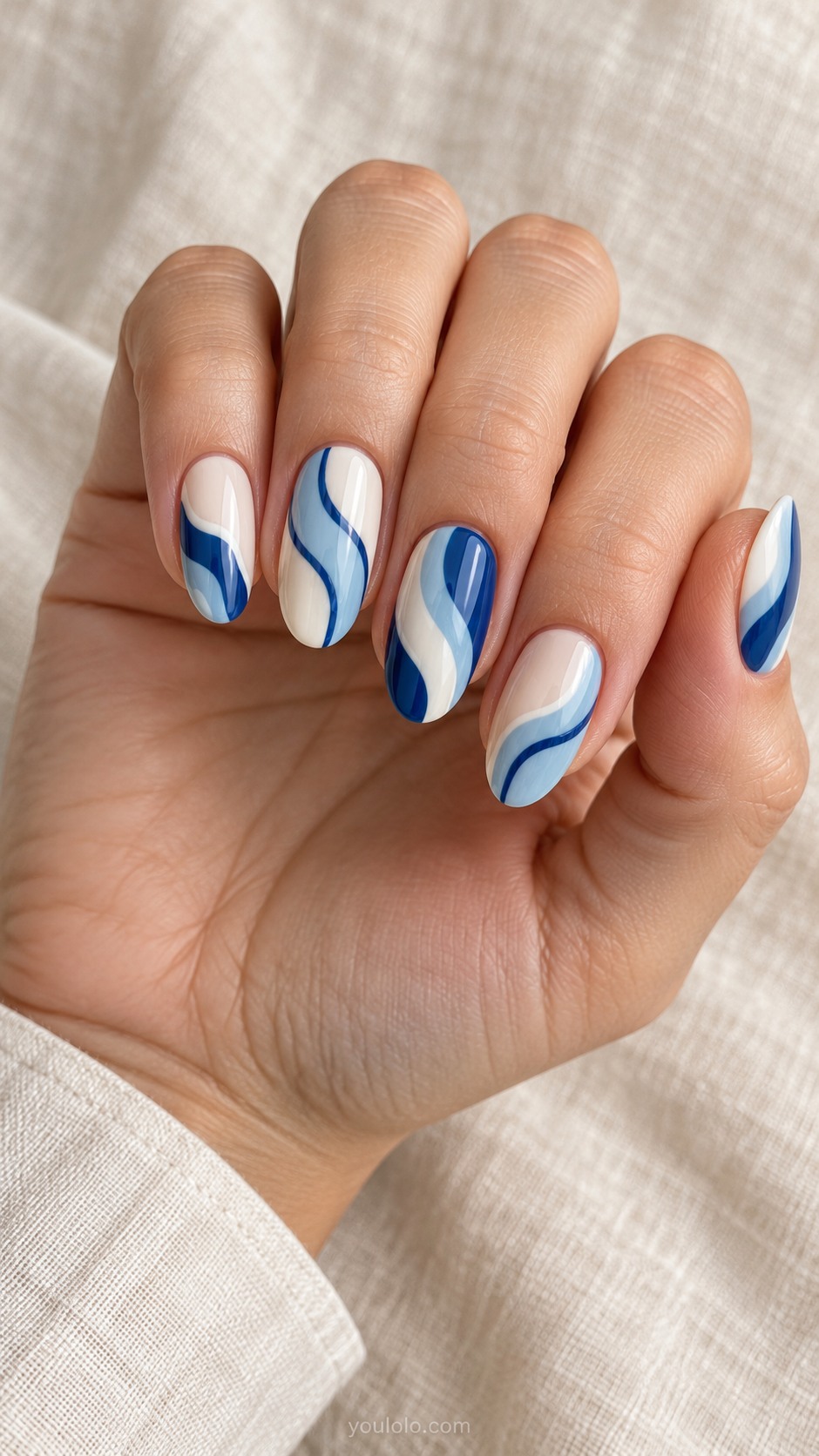
These waves use broad bands of color instead of a literal ocean scene. Cobalt supplies depth, pale blue softens the transition and ivory separates the curves. Let each nail follow a different route while repeating the same palette. The result feels fluid without requiring identical artwork across the hand.
Palette and placement: Medium oval nails with fluid cobalt, pale blue and ivory bands, different curved pattern on each nail.
The detail to discuss: Leave broad areas between the narrow bands so the colors do not become a dense zigzag.
6. Tiny Blue-Domed Houses

White houses and blue domes make a charming miniature scene when the architecture is simplified. A dome, a doorway and a few windows are enough to suggest the setting. Cobalt French tips on the other nails repeat the architectural blue without competing with the painted accents.
Palette and placement: Ivory short oval nails, two accents with miniature white houses blue domes and small windows, others cobalt French.
The detail to discuss: Make the dome the main recognizable detail instead of squeezing in a whole town.
7. Blue Eye and Gold Dots
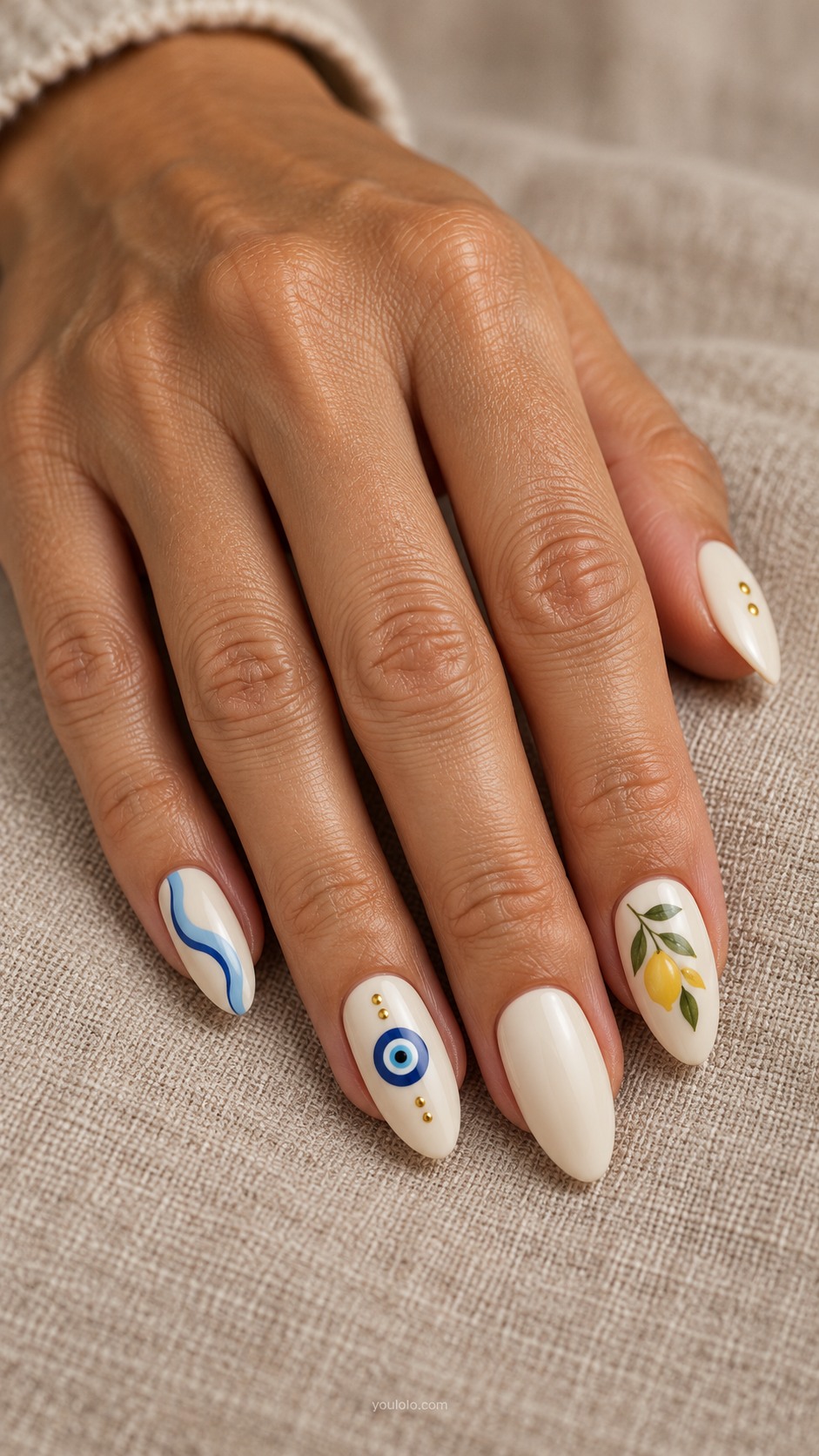
The concentric blue eye acts as one small graphic focal point. Its circular shape contrasts nicely with a long almond nail, while the ivory background keeps it visible. A few tiny gold dots add warmth. Avoid surrounding the motif with many extra symbols if you want this clean interpretation. A small lemon or blue wave on a companion nail can extend the palette while the eye remains the focal motif.
Palette and placement: Ivory almond nails with one small concentric cobalt white pale-blue eye motif centered on ring nail, two gold dots on another.
The detail to discuss: Keep the circles clean and choose a smaller motif if your nail is narrow.
8. Coastal Terrazzo

Terrazzo brings together small irregular pieces of blue, sand and taupe on a creamy base. The uneven shapes are the point: perfectly repeated chips would make it feel more like a printed grid. This is an appealing option for shorter nails because the pattern does not depend on a large central picture.
Palette and placement: Short rounded square cream nails with scattered irregular cobalt taupe and pale-blue tiny terrazzo chips.
The detail to discuss: Vary chip shapes and leave plenty of plain cream between them.
For another take on this direction, explore porcelain nail designs with painted ceramic detail.
9. Navy Coastal Stripes

Vertical navy stripes make the ivory base look especially fresh. Mixing a few fine lines with a slightly wider band adds variety while keeping the palette disciplined. The edges need to stay clean; this design works through proportion and spacing rather than embellishment.
Palette and placement: Ivory almond nails with neat vertical navy pinstripes on two accents and wider navy stripe on another.
The detail to discuss: Fewer stripes usually look clearer at a short length.
10. Turquoise Sea Glass
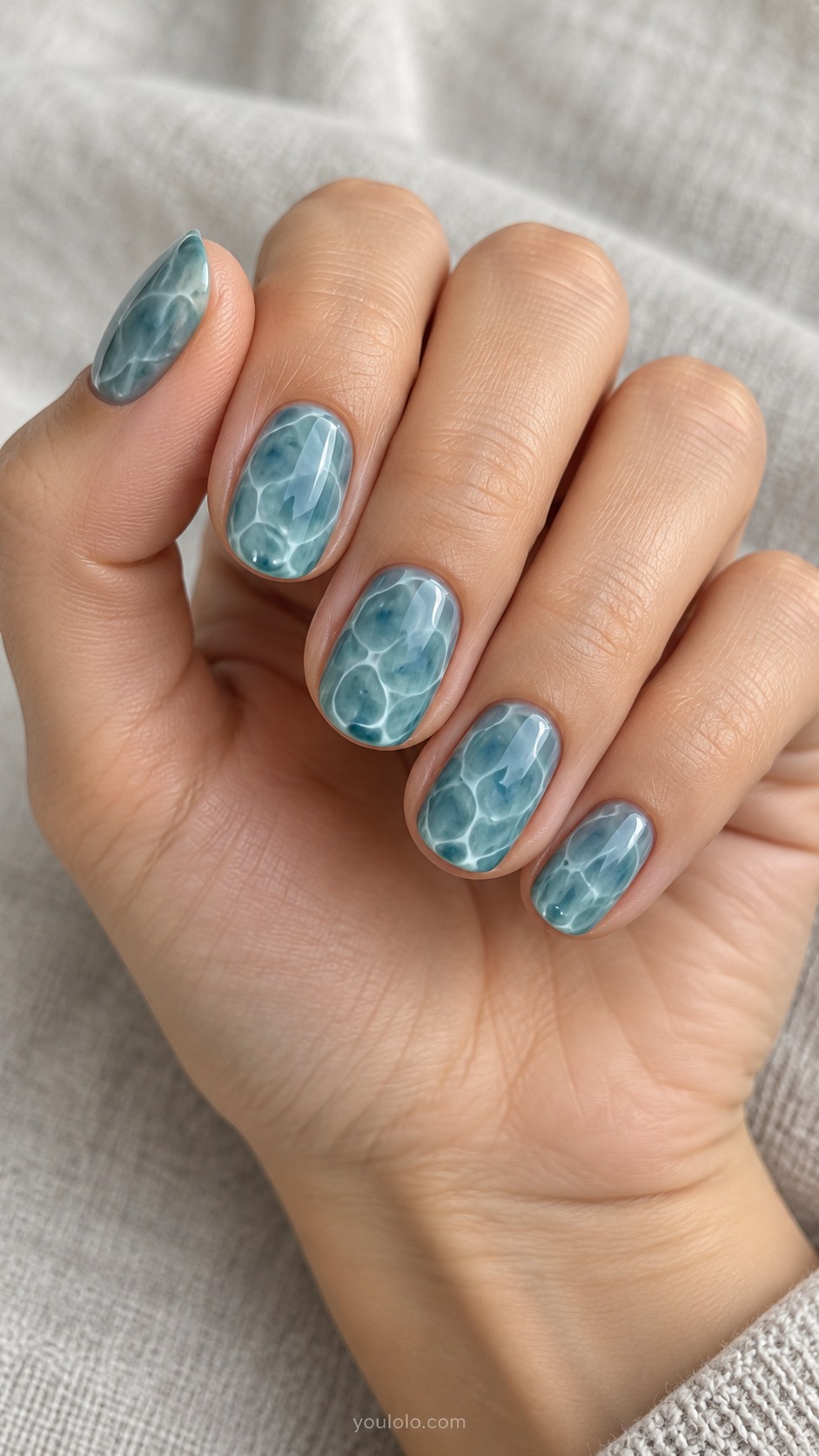
Muted turquoise and softly outlined cells suggest light moving through shallow water. The color should remain translucent enough to have depth, with the white lines fading in places. A glossy surface completes the effect. This version is about a glassy color treatment, not thick sculpted droplets.
Palette and placement: Short oval translucent muted turquoise nails with soft irregular white watery cell outlines, glassy smooth finish.
The detail to discuss: Ask for soft translucent depth rather than thick white borders around every cell.
11. Mediterranean Flower Columns

Small cobalt flowers arranged in a column make a narrow nail feel like a tiny ceramic border. Gold dots add a little warmth between the blossoms. Keep the petals simple and repeat the spacing loosely; a perfectly rigid row can look less natural than a slightly varied arrangement.
Palette and placement: Ivory oval nails with vertical row of three tiny cobalt six-petal flowers and small gold dots on two accents.
The detail to discuss: Use two flowers instead of three when the available nail length is limited.
12. Fine Wavy French
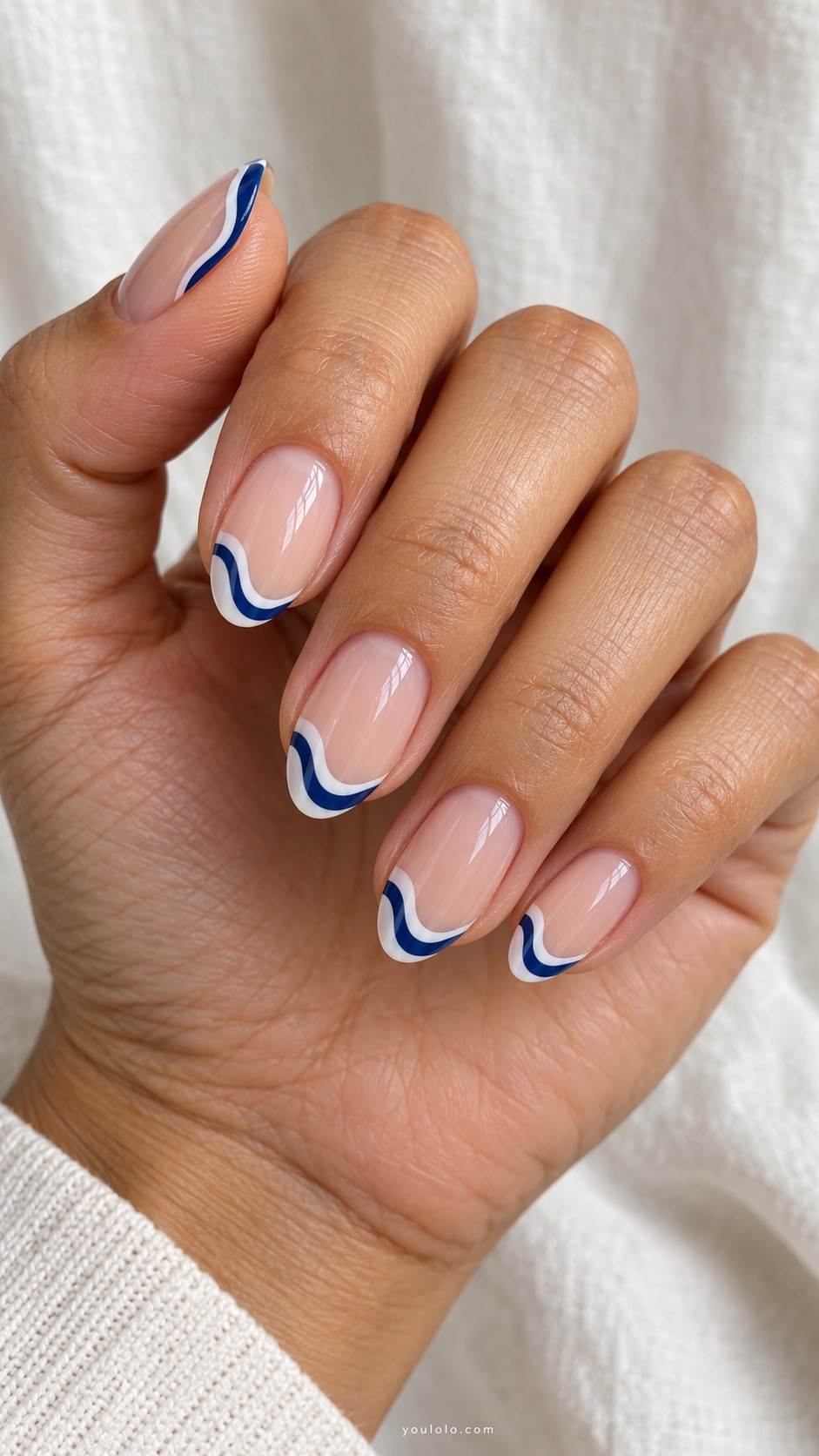
A fine wave at the tip offers a gentle alternative to a deep French. Navy and white run close together over a sheer base, leaving most of the nail undecorated. The small change in direction is enough to make the edge interesting without turning the whole manicure into a busy pattern.
Palette and placement: Sheer nude oval nails with double hairline navy and white wavy tips, clean transparent base.
The detail to discuss: Keep the wave shallow so the tip stays delicate.
13. Majolica Medallions
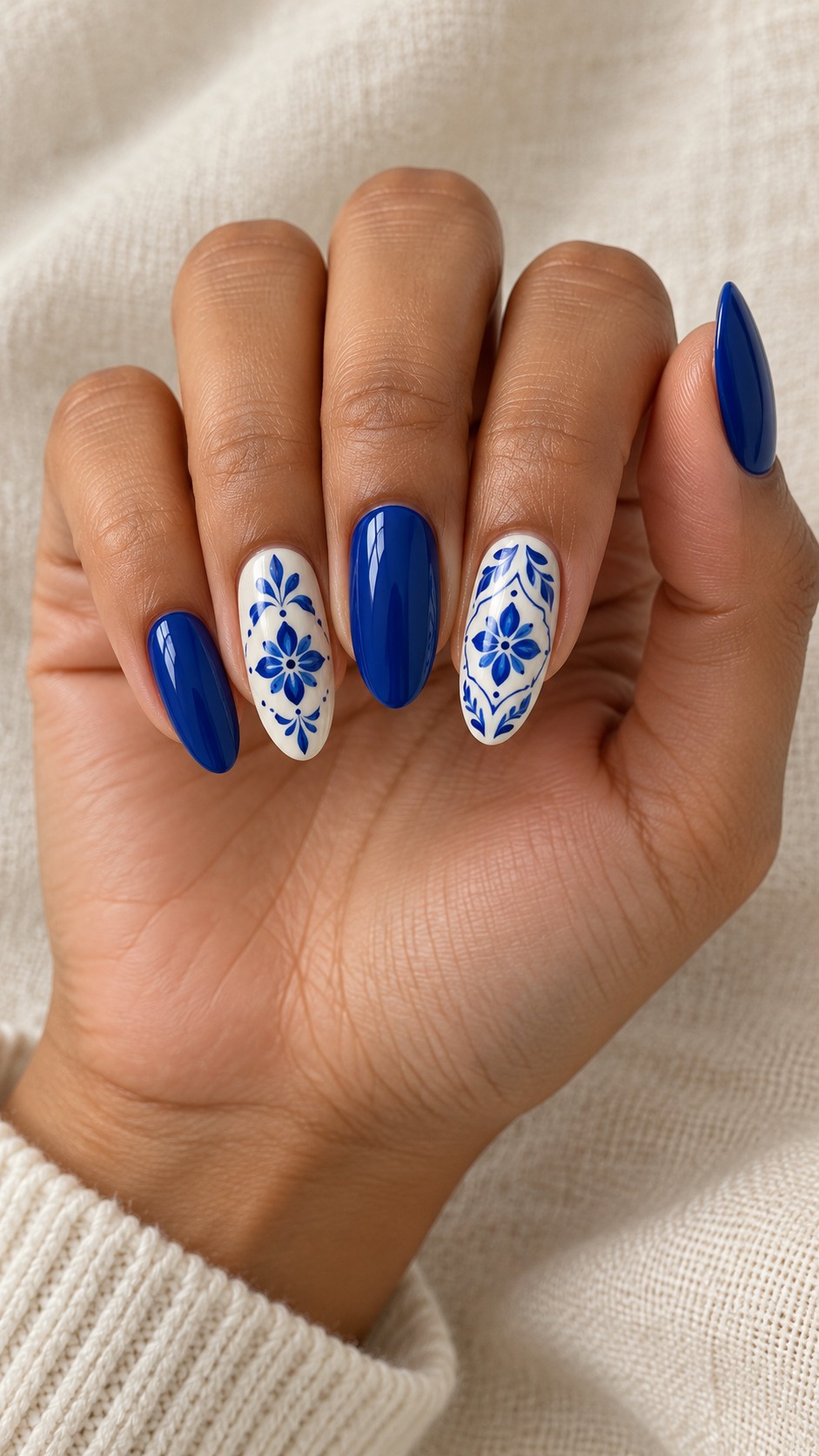
An ornamental medallion gives this set a more decorative ceramic feel. The central flower anchors the pattern, while curling leaves fill the surrounding space. Plain blue companions are useful here: they repeat the strongest color and let the detailed accent remain the focus.
Palette and placement: Ivory almond nails two accents with ornate cobalt symmetrical floral medallions and curling leaf borders, plain blue others.
The detail to discuss: Place one complete medallion on the broadest accent nail.
14. Single Starfish Accent

One blue starfish brings a playful coastal detail to a nude manicure. The subtle texture and tiny gold dots give it interest at close range, but the overall composition stays simple. It is a good example of using a single recognizable shape rather than assembling a whole themed scene on each nail.
Palette and placement: Nude short almond nails with tiny textured blue starfish flat painted on ring, minuscule gold sand dots, others nude.
The detail to discuss: A small five-armed silhouette reads better than many crowded sea symbols.
15. Pebble Beach Neutrals

Sand-colored pebble shapes create a softer interpretation of the coastal theme. Beige, ivory and translucent taupe sit close together, so the effect is quiet rather than high-contrast. Slightly irregular outlines make the pattern feel organic. Keep the surface smooth instead of turning the pebbles into bulky raised pieces.
Palette and placement: Short oval ivory nails with soft translucent beige and sand pebble shapes, subtle shadowed edges, smooth topcoat.
The detail to discuss: Keep the pebble colors close in value for a quiet result.
16. Gold Sun on Deep Blue

A small gold sun looks especially clear against deep blue. Fine rays keep it delicate, while the glossy background gives the metallic center room to shine. The rest of the nails can remain plain. This is an easy way to retain a coastal mood with a richer, more evening-oriented palette.
Palette and placement: Glossy cobalt oval nails with small thin gold sun and narrow rays on ring nail, plain blue companions.
The detail to discuss: Use fine painted rays instead of a large raised charm.
For another take on this direction, explore royal blue nails in deeper, brighter combinations.
17. Amalfi Doorways and Coastal Accents
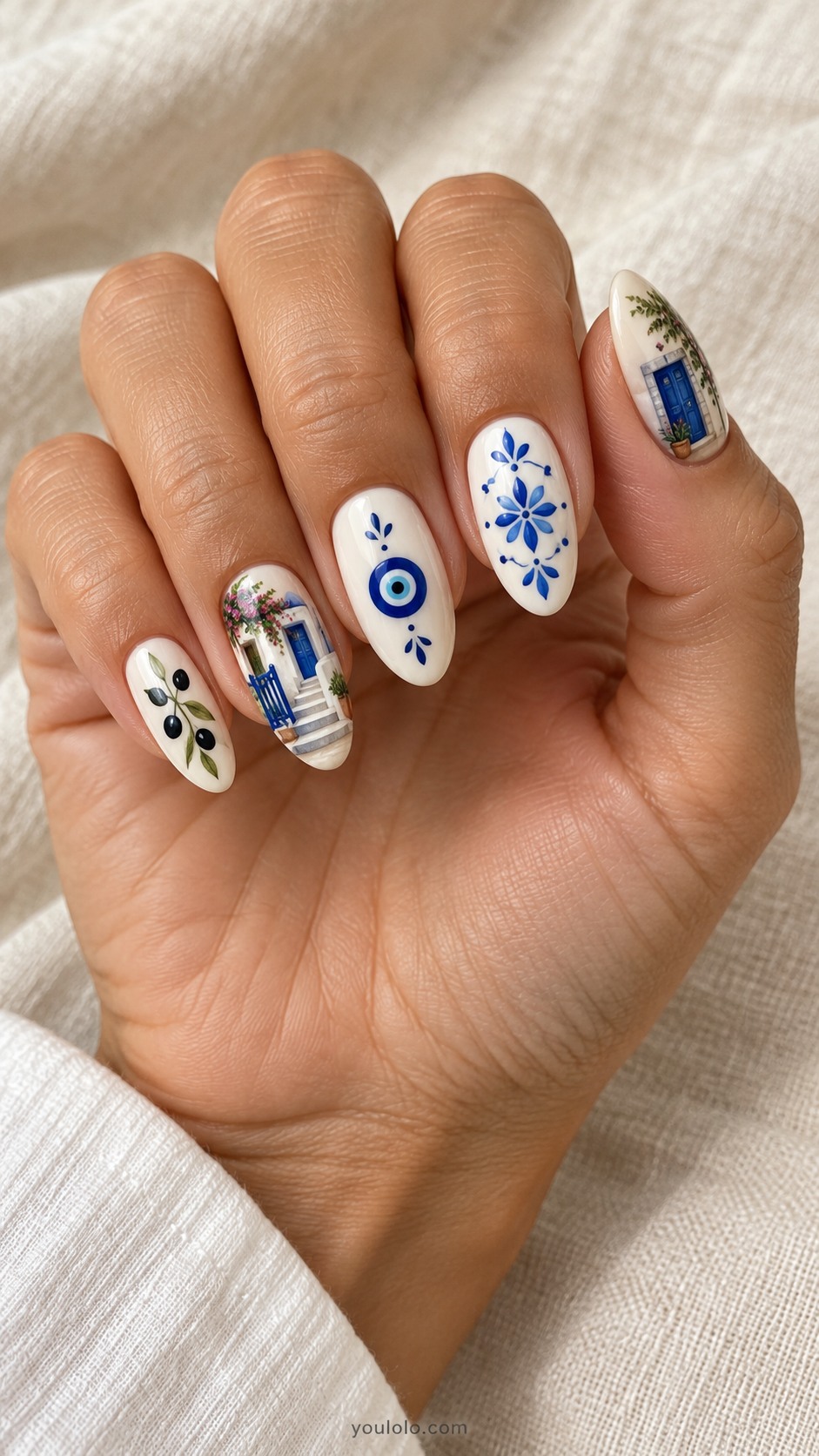
A blue doorway and a short flight of steps create the architectural focal point of this mixed coastal set. An olive sprig, a small blue eye and a floral accent repeat colors from the same palette. Keeping the ivory background consistent helps the different illustrations belong together without making every nail identical.
Palette and placement: Ivory nails with miniature blue coastal doorways and steps, paired with an olive sprig, a blue eye and a small cobalt floral accent.
The detail to discuss: Choose a clear doorway as the architectural focal point and keep the supporting motifs small.
18. Olive Branches on Cream

Green olive leaves and dark berries offer a quieter alternative to blue florals. The cream base gives the branch a warm setting, and the fine stem makes the design feel light. Vary the angle of the leaves so the sprig looks organic instead of like a perfectly mirrored ornament.
Palette and placement: Cream oval nails two accents fine green olive branches with black olives, companion cream nails.
The detail to discuss: Use varied leaf angles and a few dark berries rather than a perfectly mirrored branch.
19. Blue Shutters with Bougainvillea
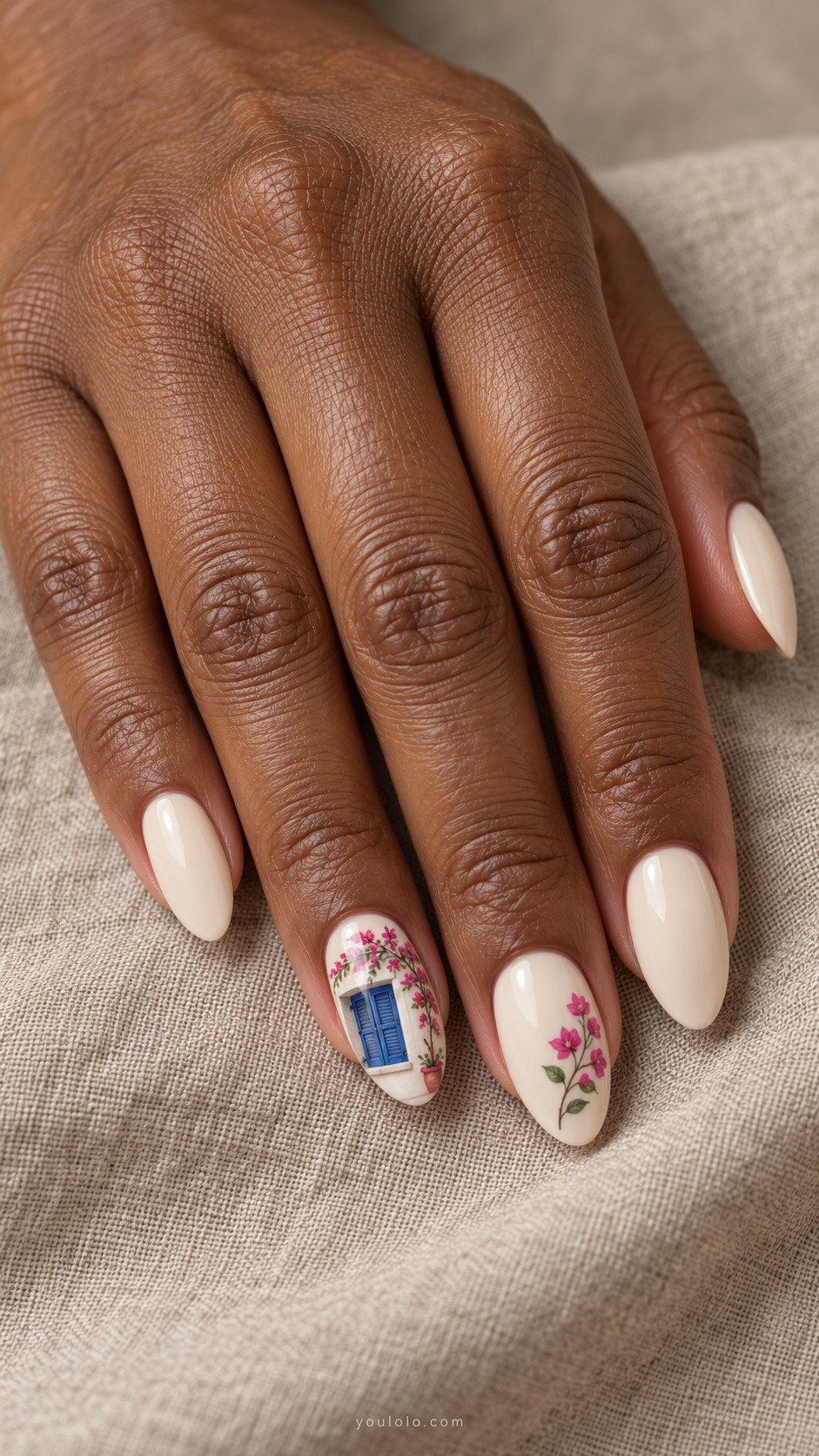
Blue shutters and climbing pink flowers combine a crisp architectural shape with softer brushwork. The shutter should remain recognizable beneath the blossoms; otherwise the accent can become a patch of blue and pink. A smaller floral sprig on another nail repeats the color without duplicating the whole window.
Palette and placement: Cream almond nails one accent tiny cobalt shuttered window pink climbing blossoms, another small pink floral sprig.
The detail to discuss: Give the blue shutters a clean rectangular outline before adding the soft flowers.
20. Turquoise Tips and Blue Vines

Turquoise French tips supply the main color, while a blue vine adds one more detailed accent. The two blues do not need to match exactly, but they should feel intentional together. A pale background on the vine nail keeps its leaves readable and gives the hand a small visual pause.
Palette and placement: Nude almond nails turquoise French tips, one ivory accent with fine vertical cobalt leafy vine.
The detail to discuss: Keep the vine fine enough that it does not overpower the brighter tip color.
21. Painted Shell and Nautical Checks

The shell and checkerboard are different kinds of pattern, connected by cobalt and ivory. A simple outlined shell feels airy; the checks provide a stronger block of contrast. Keeping them on separate nails lets both ideas work without forcing too many details into the same small space.
Palette and placement: Ivory oval manicure cobalt outlined scallop shell on one nail and cobalt ivory checkerboard on another, plain ivory others.
The detail to discuss: Pair a simple shell outline with larger checks rather than two equally dense patterns.
22. Citrus and Blue Daisies
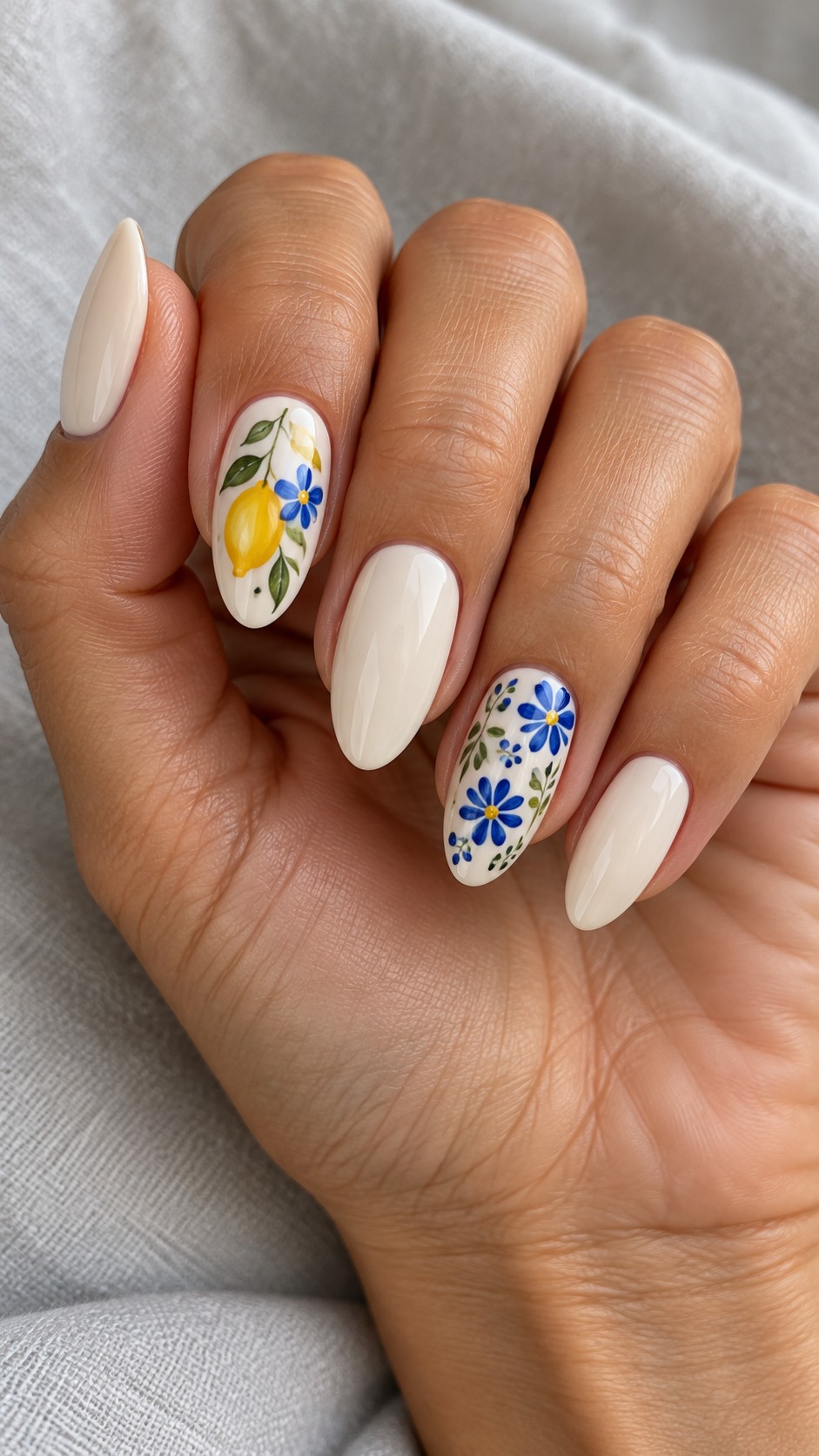
A yellow lemon and a small blue flower make a cheerful pairing against cream. The leaves connect the two motifs, while the different shapes prevent the arrangement from feeling repetitive. Use the flower as a smaller supporting detail so the fruit remains the first thing you notice.
Palette and placement: Cream almond nails with yellow lemon and small cobalt daisy green leaves on two accents, cream companions.
The detail to discuss: Let the yellow fruit remain the focal point and use the blue flower as a small counterpoint.
23. Blue Fish and Repeating Waves

A fine fish illustration feels like a tiny drawing, while repeating scallop waves behave more like a graphic print. The shared blue-and-white palette ties them together. Plain ivory nails keep the overall set balanced and prevent the two patterned accents from competing for attention.
Palette and placement: Ivory oval nails one fine cobalt fish illustration, one navy nail with repeated white scallop waves, others ivory.
The detail to discuss: Separate the fish and wave patterns so each stays readable.
24. Moonlit Village and Midnight Blue

The final look shifts the coastal palette toward night. A small village sits low on an ivory accent, leaving room for a crescent moon and a few sky marks. Deep navy companion nails frame the scene. A single gold dot adds warmth without distracting from the miniature rooftops.
Palette and placement: Glossy midnight navy oval nails with ivory accent miniature blue coastal village crescent moon and tiny birds, single tiny gold stud on navy nail.
The detail to discuss: Keep the village low on the nail to leave open sky above the roofs.
How to adapt your favorite to your own nails
Choose the motif before deciding on the number of accents. A lemon branch can be the whole idea; it does not need a shell, a sun and a village beside it. If you want a mixed set, repeat one background and one main blue across the hand. That gives the smaller changes a clear connection.
For detailed scenes, ask the artist what will remain visible at your chosen length. A doorway may be a better translation than a full building, and a single flower may work better than a complete tile pattern. Simplifying is not losing the design if its most recognizable feature remains.
| Your preference | Start here | Keep in mind |
|---|---|---|
| Very little artwork | Aegean French, fine wavy tips | Tip depth and clean edges matter most |
| One painted focal point | Lemon, olive branch, starfish | Leave open space around the motif |
| Pattern across the nail | Terrazzo, stripes, tile florals | Adjust the pattern scale to the nail width |
| A miniature scene | Shutters, doorways, moonlit village | Agree on the essential details in advance |
Before your appointment
Send the full-hand reference rather than only a close crop of one nail. Include your preferred length, shape and number of accents. Point out the detail you want to preserve if the artist needs to simplify the composition. Ask the salon to confirm the techniques, appointment time and price for that version.
For a separate source of pattern inspiration, browse the V&A tile collection and notice how borders, central motifs and repeated shapes divide a small surface.
Mediterranean nails: questions and practical choices
Can Mediterranean nail art work on short nails?
Yes. A small olive sprig, a single lemon, a narrow blue tip or a few terrazzo chips can fit a compact nail. For miniature buildings, simplify the scene to one dome or doorway instead of reducing an entire village until it becomes unreadable.
Do all the nails need different designs?
No. One or two accents often make the individual artwork easier to appreciate. Repeat the cream background, cobalt color or a small leaf shape on the other nails to keep the set connected.
What is the difference between tile art and marble nails?
Tile-inspired art uses deliberate motifs, borders or repeated shapes. Marble uses irregular cloudy areas and veins. Both can use blue and white, but the structure of the pattern is different.
Can I wear these designs outside summer?
You can treat them as color and pattern choices rather than seasonal rules. Navy, ivory, olive branches and fine ceramic florals can be worn whenever they suit your style. A darker base changes the mood without removing the coastal detail.
How do I make the collection less colorful?
Choose ivory, one blue and at most one small metallic accent. Skip the yellow lemons and pink flowers, or keep them on a single nail. The wave, stripe and tile designs offer plenty of interest within two colors.
Save your favorite set. Choose one motif and one supporting color before your appointment. A lemon with cream, an olive branch with ivory, or a tiny village with navy is enough to build a coherent set. Send the artist the full-hand image and identify which small detail you want preserved if the design needs simplifying.