The Best Fluffy Pancakes recipe you will fall in love with. Full of tips and tricks to help you make the best pancakes.


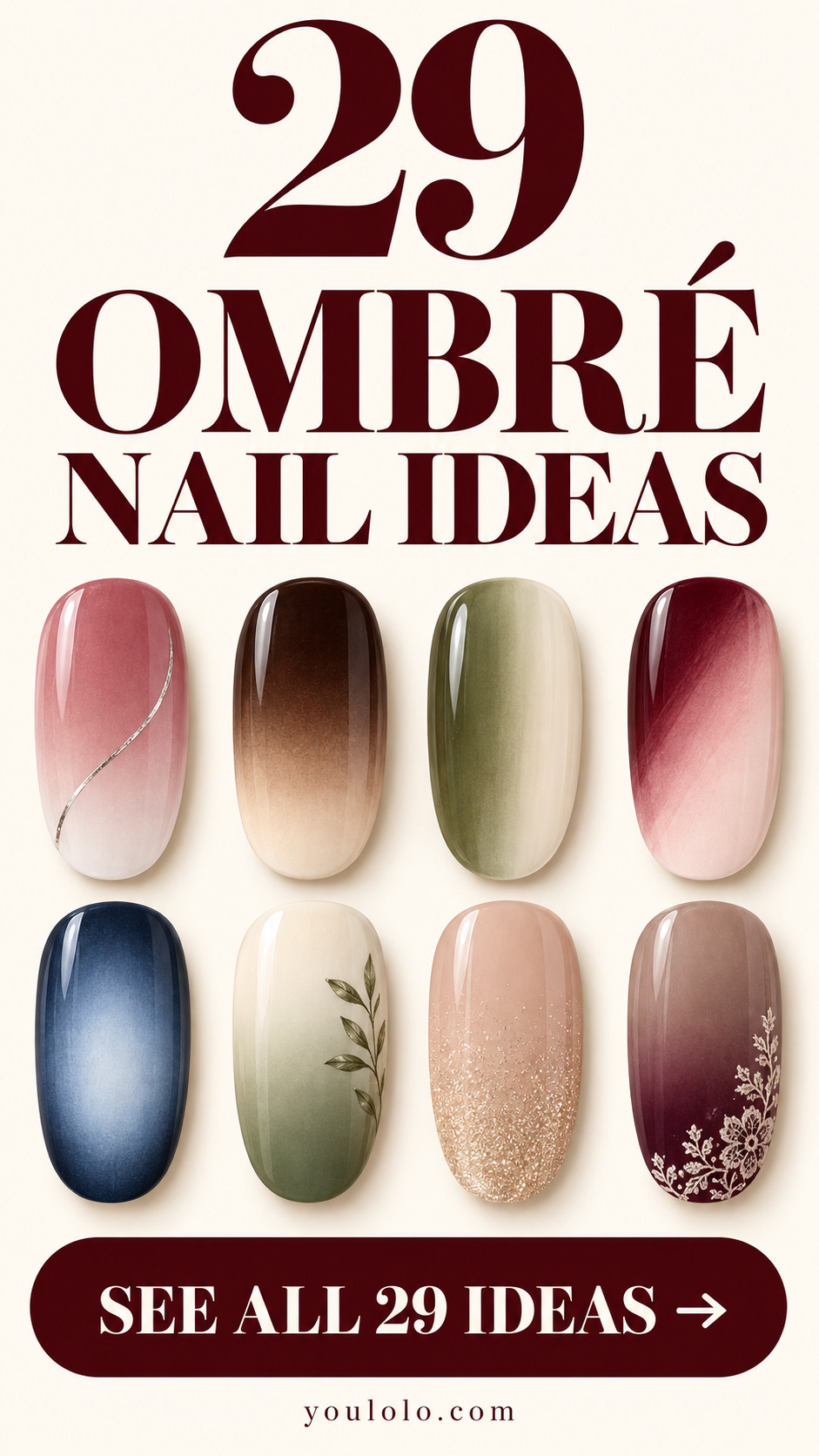
The best ombre nails give the colors enough room to meet. A smooth fade can make a dark shade feel softer, add depth to a neutral manicure or turn a simple two-color combination into the whole design.
This collection moves beyond changing the polish colors. You will find sideways and diagonal blends, reversed fades, negative-space accents and a couple of radial aura variations. Each idea includes a clear salon brief, so you can choose the direction, shape and amount of detail that suit your nails.
Ombre Nail Designs That Change the Direction of the Fade
1. Milk-Glass Fade with a Fine Silver Edge
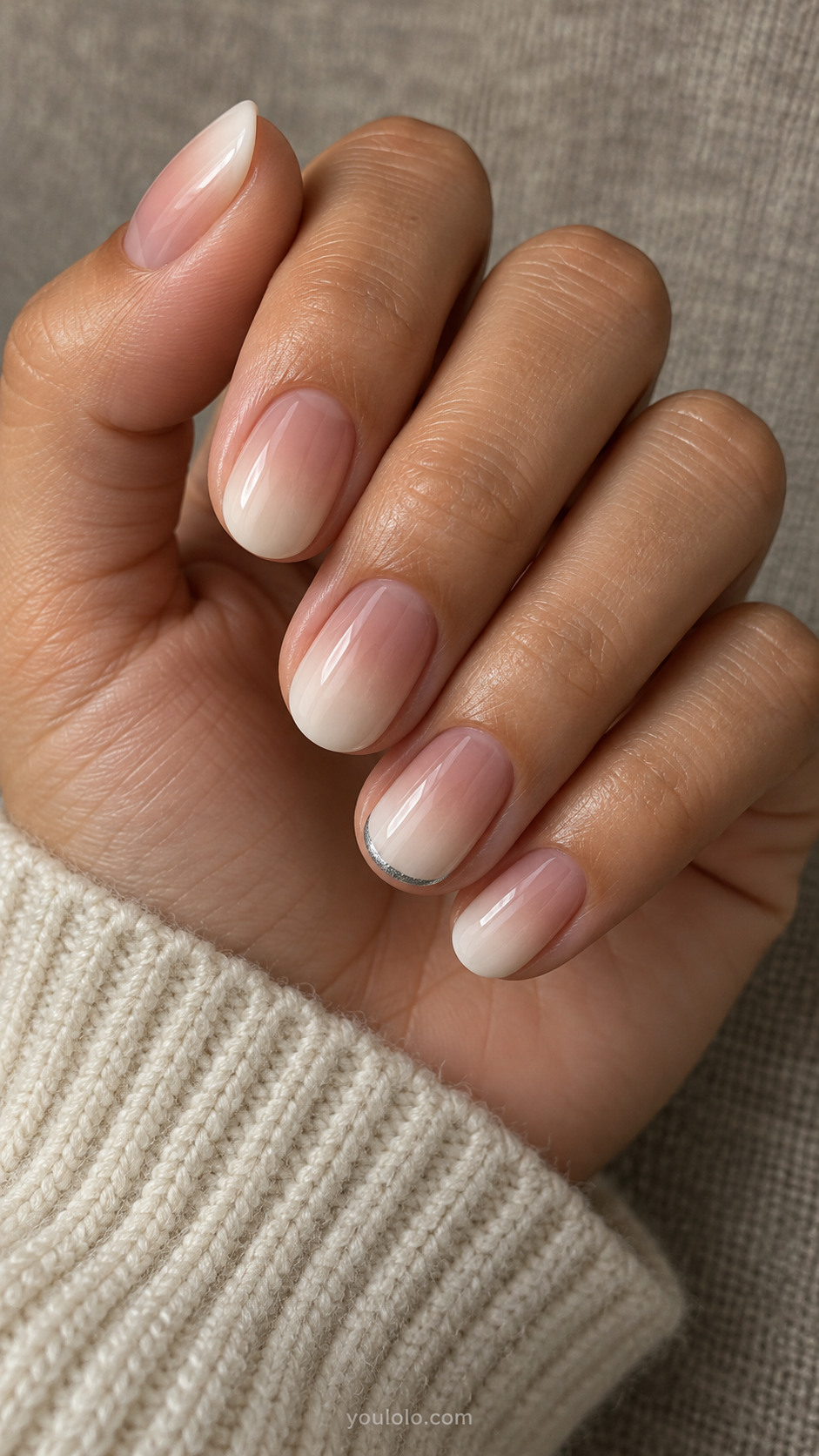
A milky fade becomes a little more dressed up with a fine silver edge on one nail. The pink should disappear gradually into ivory, without the distinct white band of a French tip. Short ovals keep this version practical. Choose a silver line thin enough that the blended base remains the main feature.
Salon brief: Ask for short oval nails with warm translucent rose at cuticle smoothly fading to milky ivory tip, ONE hairline silver edge only on ring nail. Keep the blended transition smooth and visible.
2. Reverse Mocha Melt
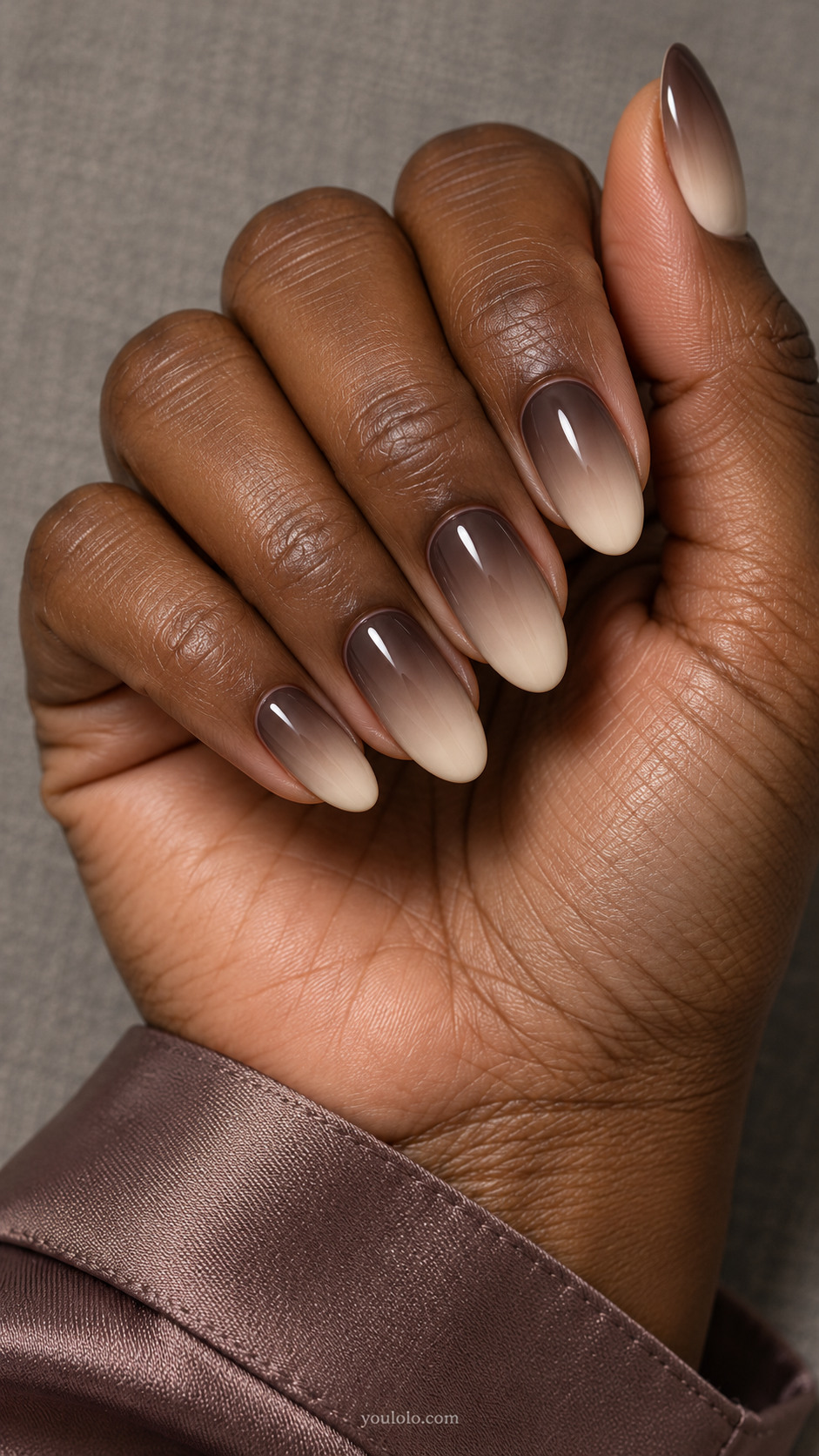
Putting the deepest brown near the cuticle changes the mood of a neutral ombré. Espresso melts through taupe before reaching a creamy tip, creating a soft reverse fade with plenty of depth. Almond edges suit the elongated transition. Ask to see the blend before extra decoration is added; this design needs no separate artwork.
Salon brief: Ask for medium almond nails with espresso at cuticle gradually continuously blending through taupe into creamy beige tips, no hard line. Keep the blended transition smooth and visible.
3. Vertical Olive-to-Cream
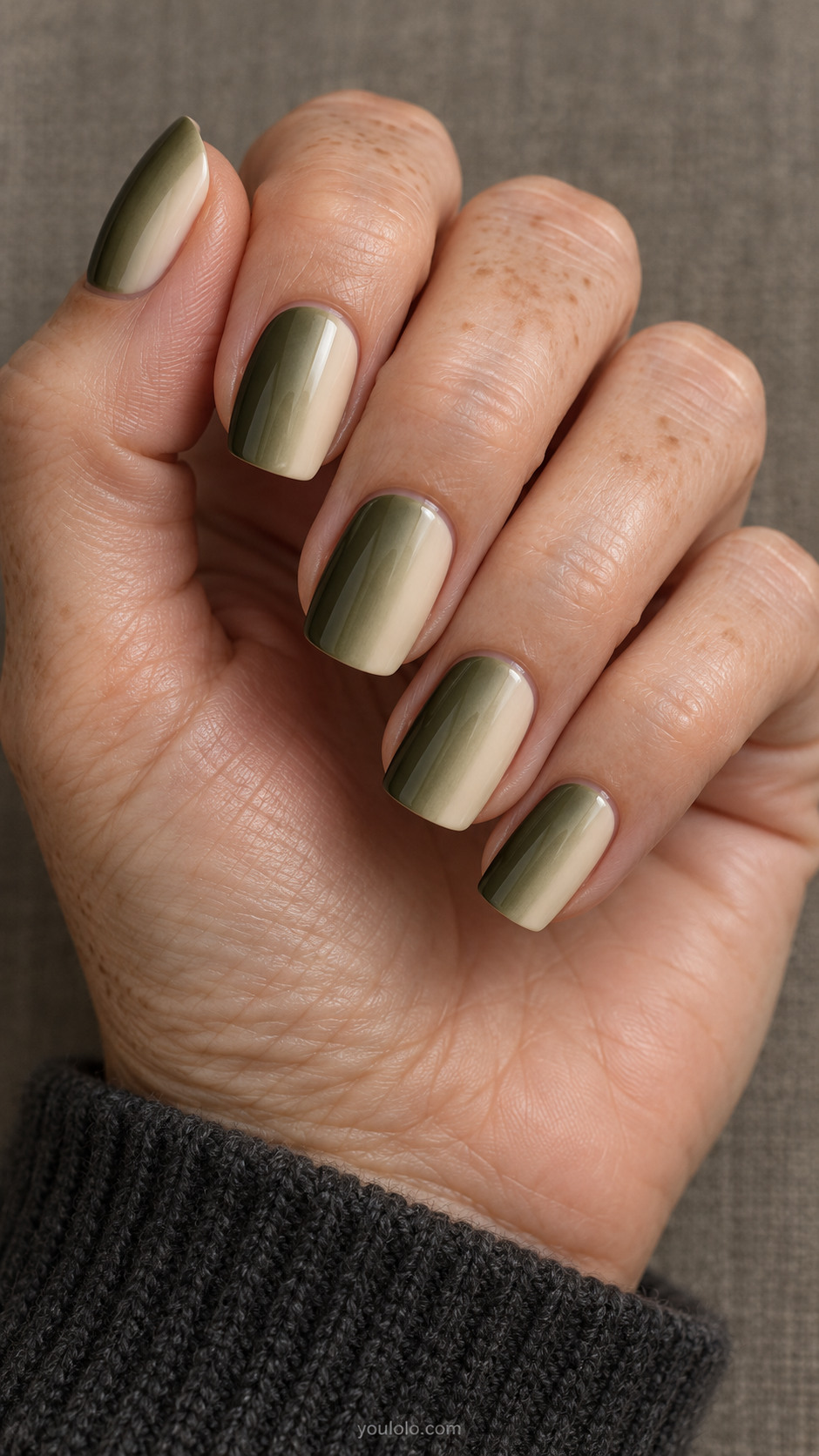
A sideways fade draws attention to nail width rather than length. Olive gives one edge depth while cream brightens the opposite side, with a soft muted transition between them. Medium soft squares show this direction clearly. Keep every nail oriented the same way if you want the set to look coordinated when your fingers rest together.
Salon brief: Ask for medium soft square nails with true smooth side-to-side gradient dark olive on LEFT sidewall gradually fading to warm cream RIGHT sidewall on every nail. Keep the blended transition smooth and visible.
4. Diagonal Merlot Veil
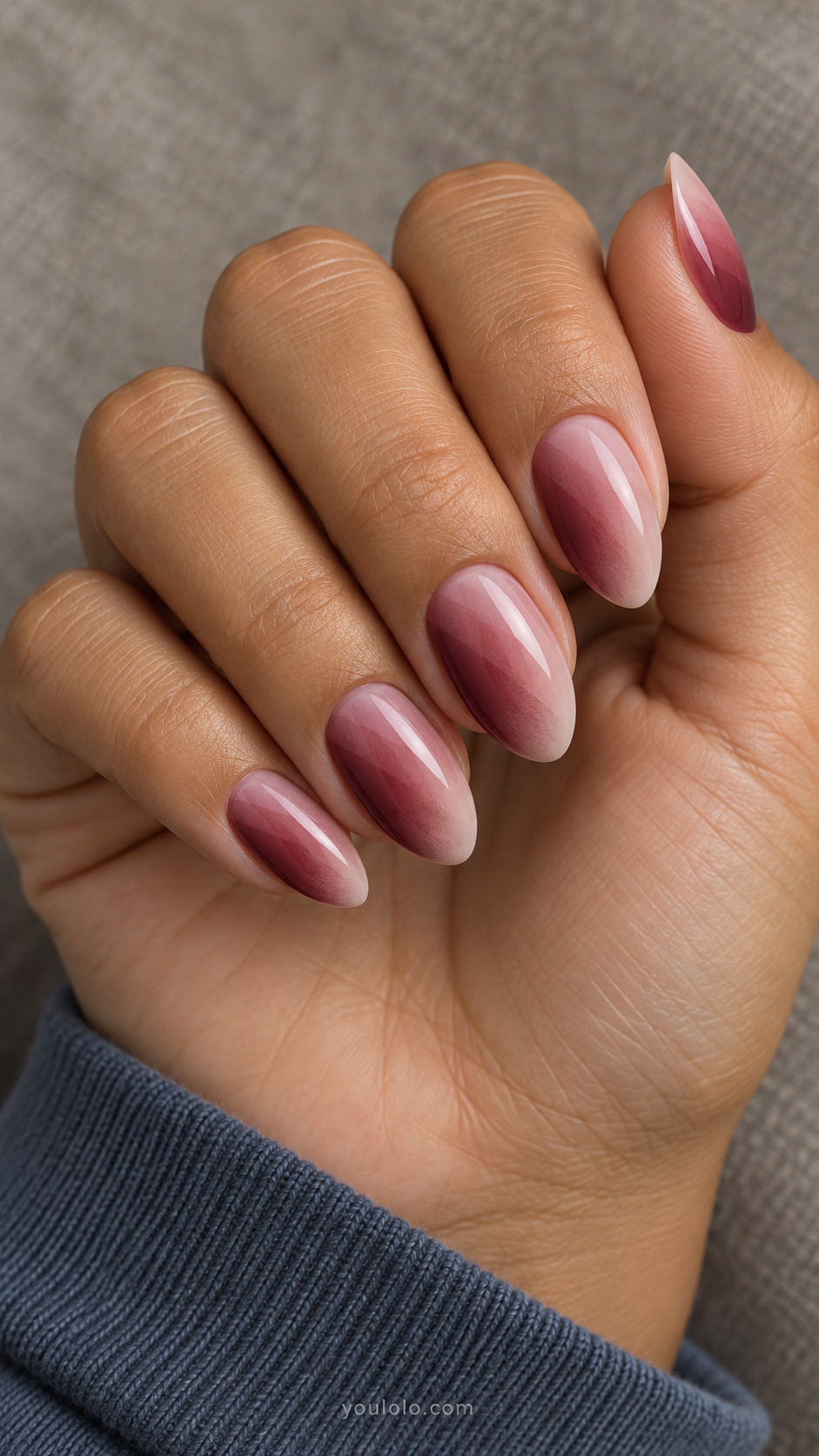
The diagonal transition makes merlot feel lighter than an all-over dark manicure. Color gathers in one corner and travels through dusty rose toward a sheer opposite edge. Almond nails give that sweep a graceful shape. The important detail is a broad blended zone; a narrow blend can accidentally resemble a sharply divided color-block design.
Salon brief: Ask for medium almond nails with soft diagonal blended gradient from deep merlot lower-left cuticle corner through dusty rose to sheer pink upper-right free-edge corner. Keep the blended transition smooth and visible.
5. Peach Center Glow
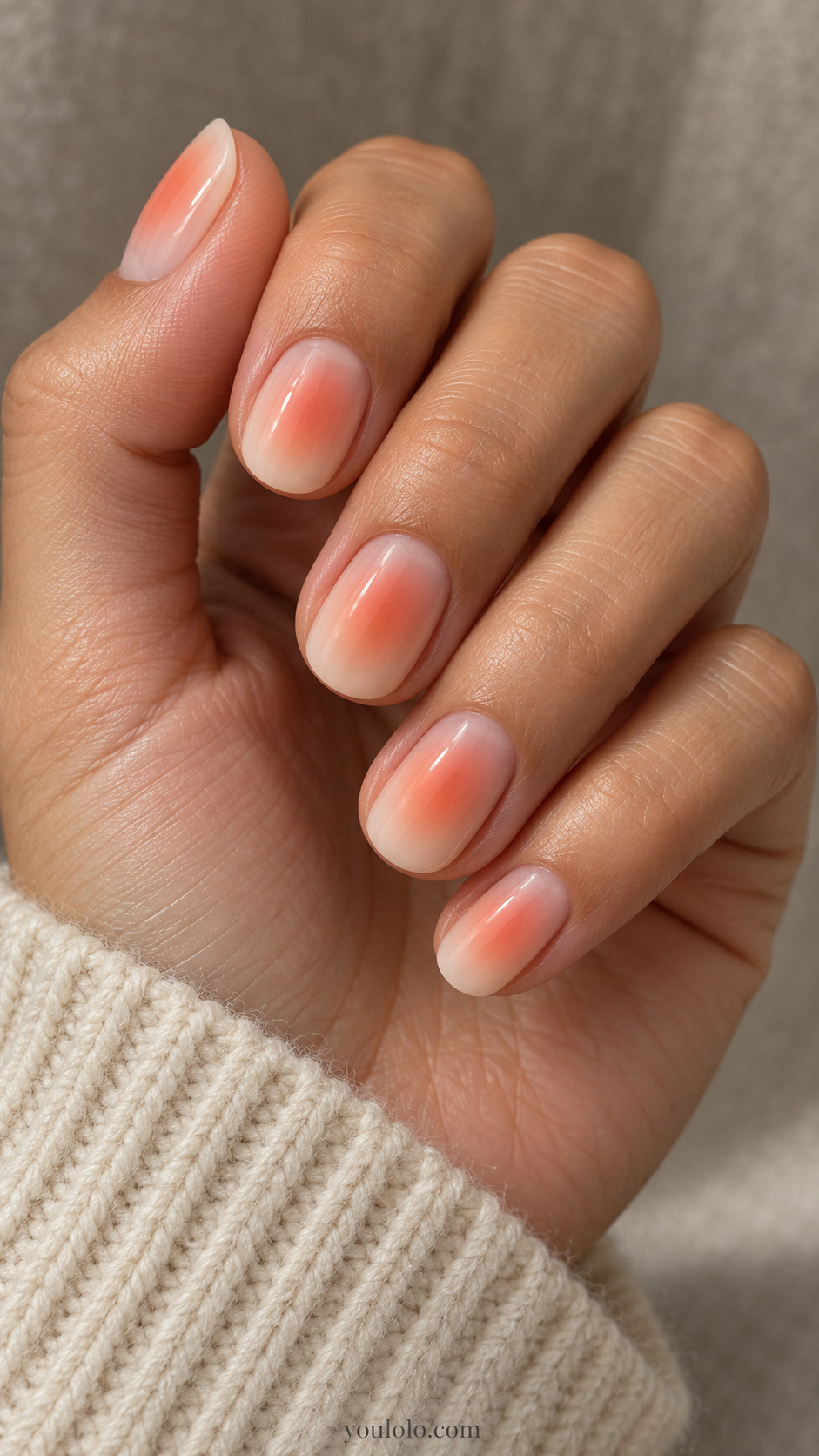
This is an aura variation within the gradient family: the peach color radiates outward from the center instead of traveling from cuticle to tip. A milky border keeps the glow soft. Short rounded nails suit the compact oval. Avoid a crisp ring around the peach, which would turn the effect into a painted circle.
Salon brief: Ask for short rounded nails with radial aura gradient warm peach diffuse oval CENTER gradually fading out to milky nude all edges, no rings or hard circles. Keep the blended transition smooth and visible.
6. Frosted Blue Double Fade
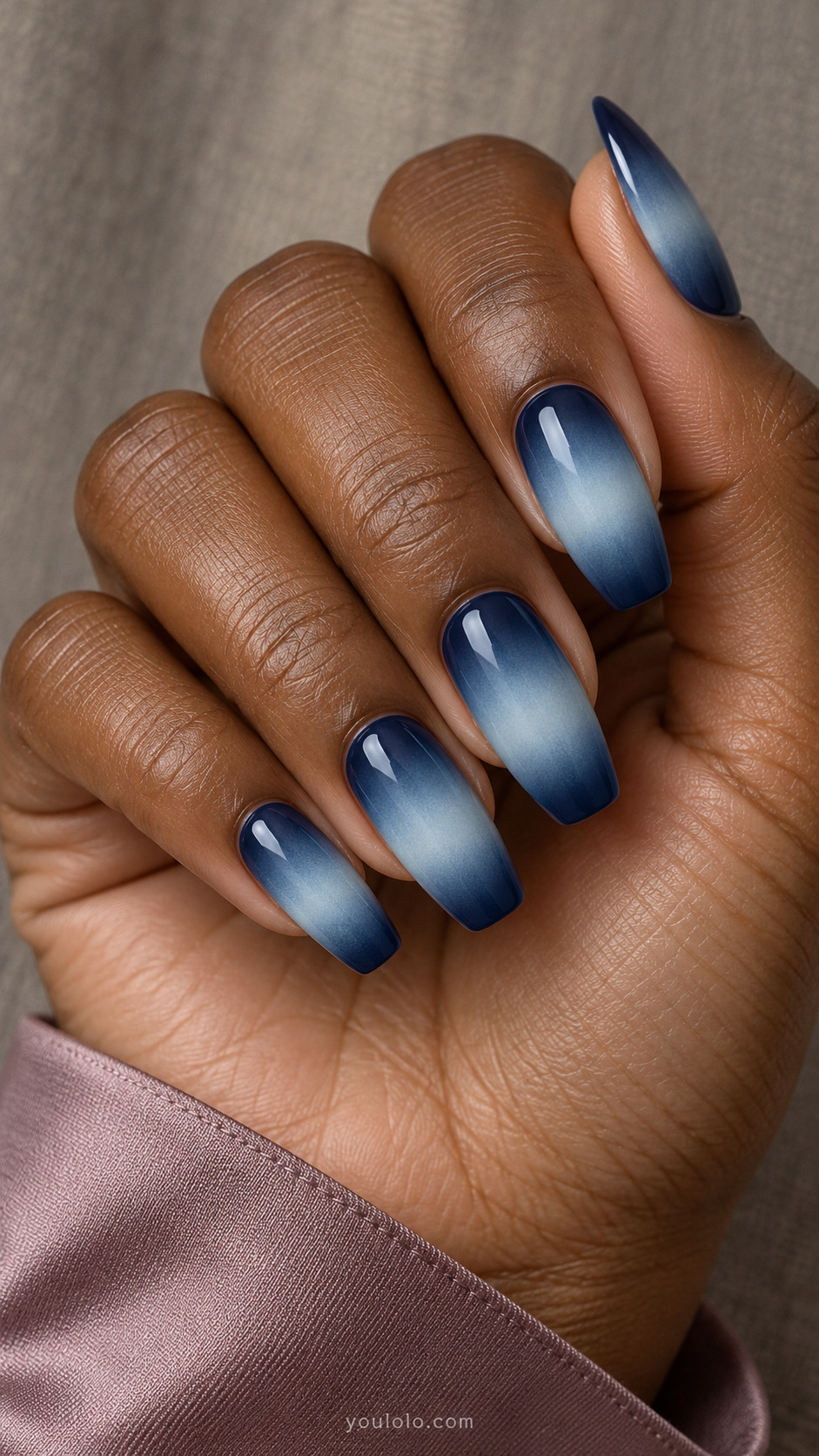
Two dark edges create a different kind of ombré. Navy at the cuticle and free edge melts into a pale blue center, forming a soft band of light through the nail. Coffin nails give the transition room to breathe. The central area should be diffused on both sides, never separated by clean horizontal boundaries.
Salon brief: Ask for medium coffin nails with navy at cuticle and tip, both smoothly fading toward icy blue soft horizontal band at center, fully blended no stripes. Keep the blended transition smooth and visible.
7. Soft Coffee Tip Fade
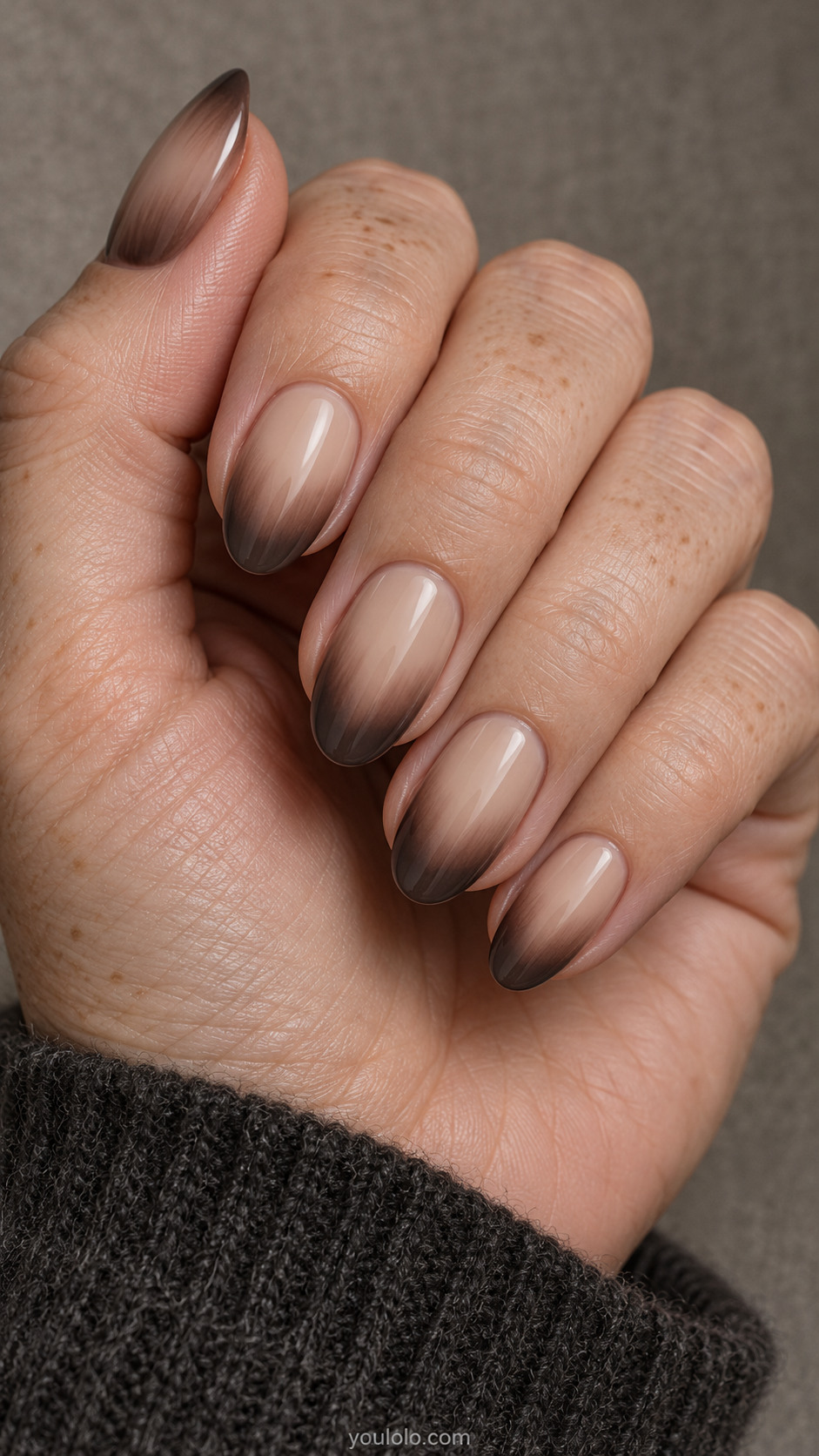
A softly tapered coffee fade frames a lighter latte base without adding a sharp French line. The depth gathers toward the free edge, while the upper nail stays warm and creamy. Almond nails echo that tapered movement. Keep the transition broad and the dark tip soft enough that the nails still look blended from a distance.
Salon brief: Ask for latte almond nails with a softly tapered espresso fade toward the tips and a broad seamless transition.
Negative Space, Soft Tips and Different Finishes
8. Rose Gradient Window
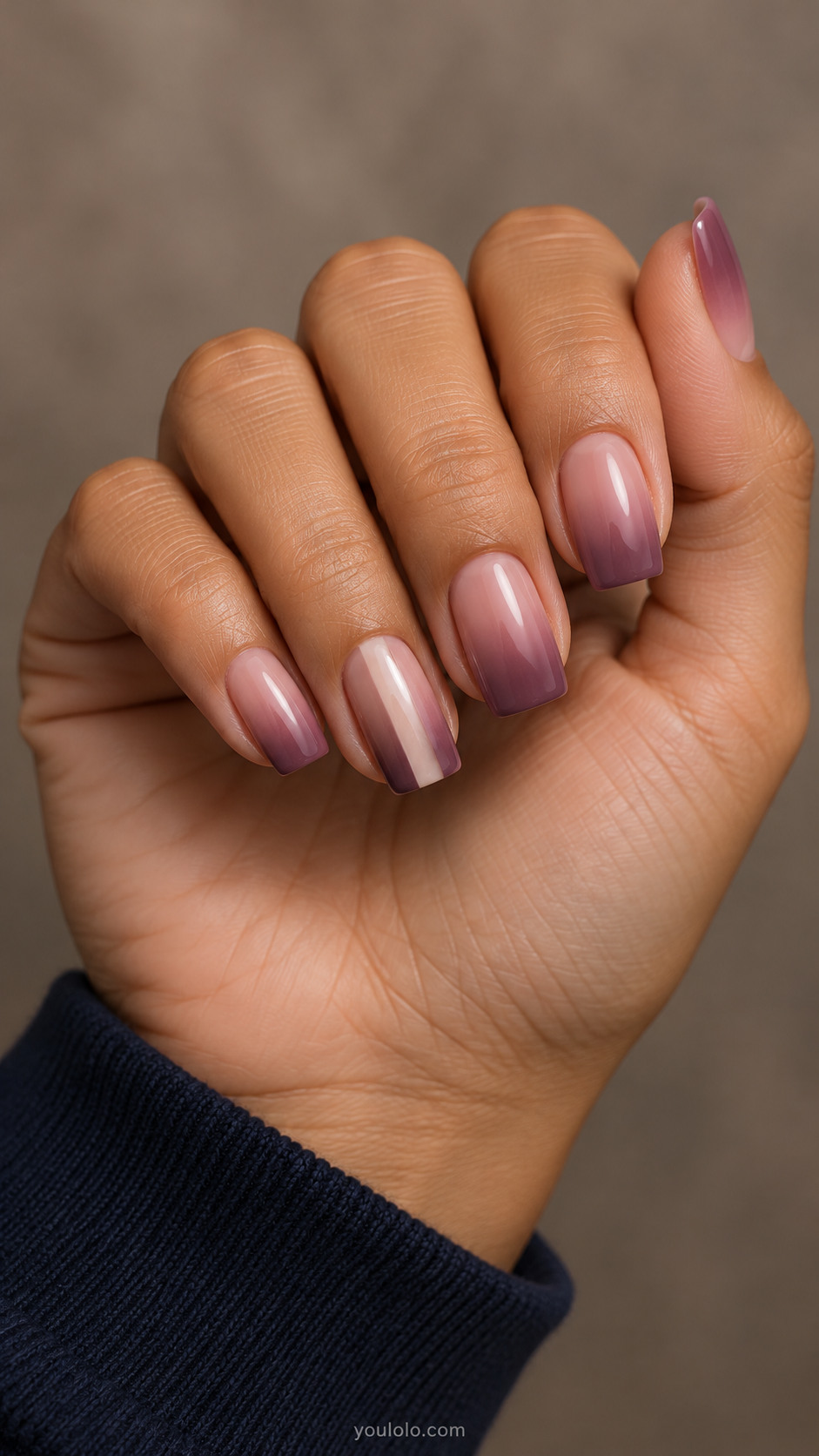
A slim clear-looking window interrupts the rose-to-mauve fade on one nail. It creates negative space without asking the whole manicure to become minimal. Square nails make the straight opening easy to read. Ask for the same gradient on the surrounding nails, then keep the window narrow so it feels like an accent rather than a missing panel.
Salon brief: Ask for medium square nails with dusty rose smoothly fading to mauve tips, on ring nail only narrow clean vertical transparent nude window through center, others full fade. Keep the blended transition smooth and visible.
9. Three-Tone Tip Melt
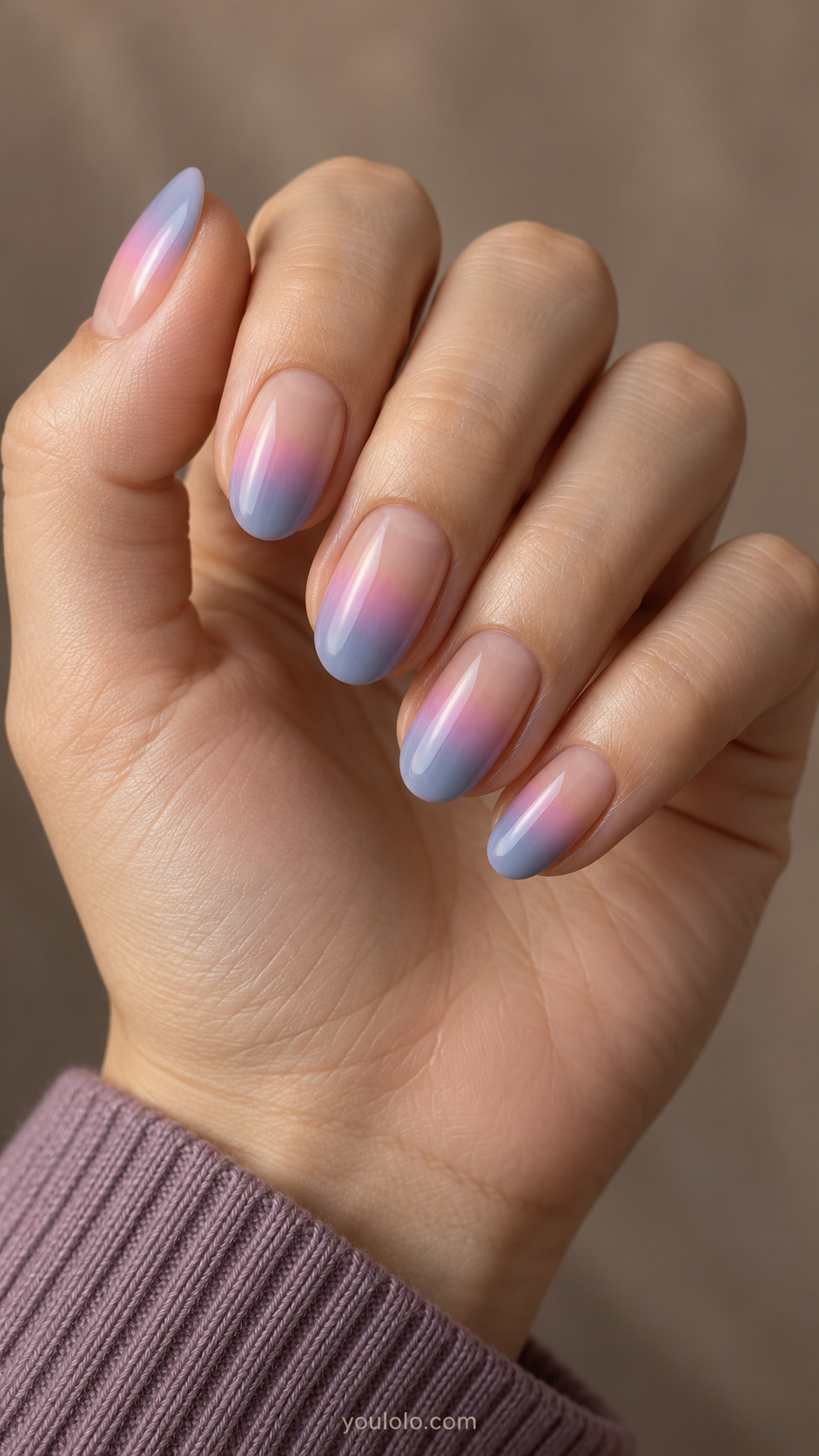
Three neighboring pastel shades can blend beautifully when the transition is concentrated at the tip. Blush moves into lilac, then slate blue at the edge, while the lower half stays sheer. This is more delicate than three equally sized color bands. Medium ovals provide enough length for each shade to appear without crowding the nail.
Salon brief: Ask for medium oval nails with sheer nude lower half, tip third smoothly blending blush into lilac into soft slate blue at free edge, no sharp lines. Keep the blended transition smooth and visible.
10. Plum Cuticle Haze
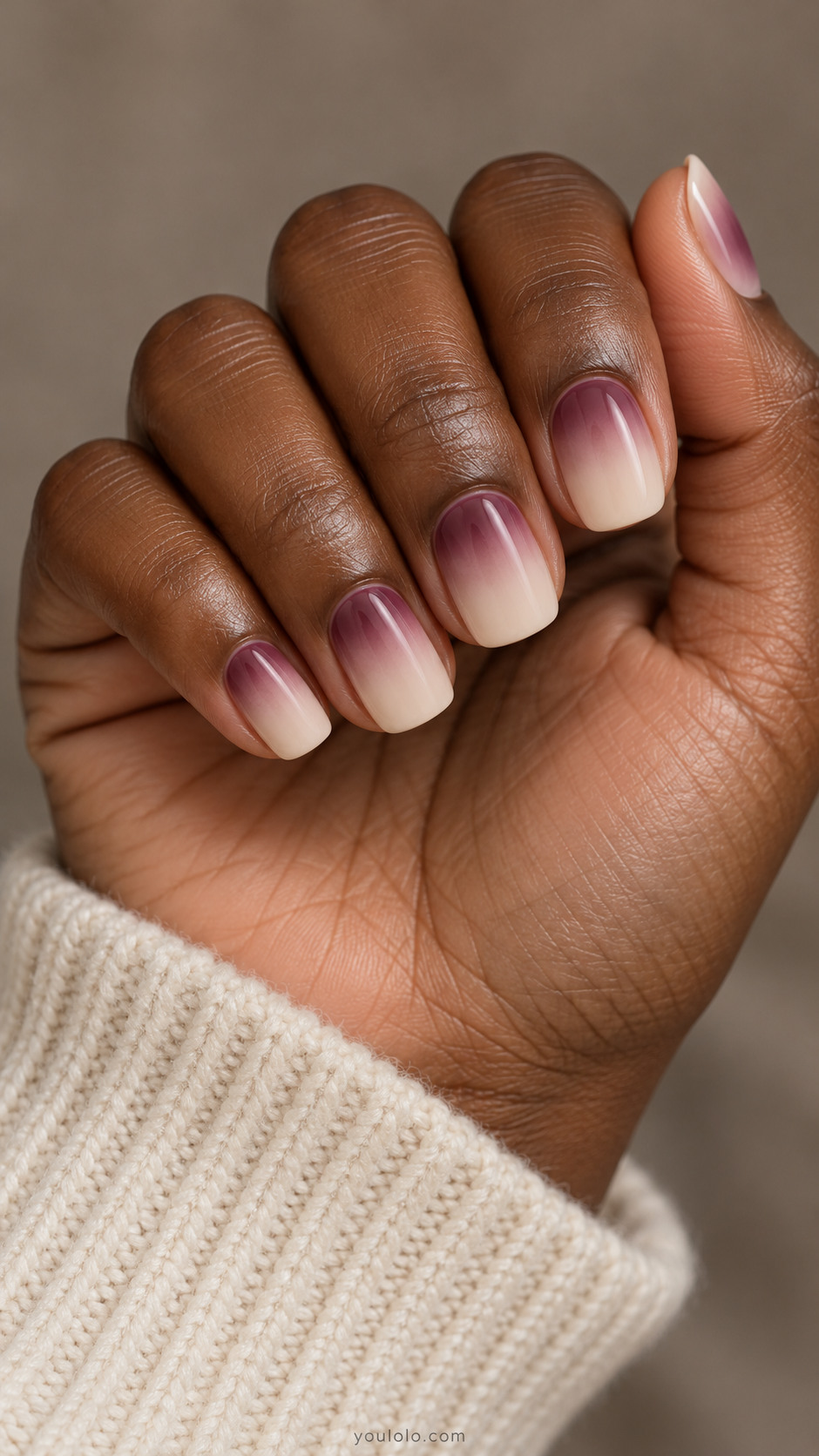
A plum cloud near the cuticle gives a light manicure a surprising point of depth. The color should dissolve before the tip, leaving most of the nail milky and open. Short squoval nails keep the effect understated. Choose a muted plum rather than a very saturated purple if you want the fade to feel softly shaded.
Salon brief: Ask for short squoval nails with milky beige nails with concentrated plum color as soft cloud near cuticle fading smoothly away by mid-nail, remaining tip beige. Keep the blended transition smooth and visible.
11. Caramel Fade with Fine Contour
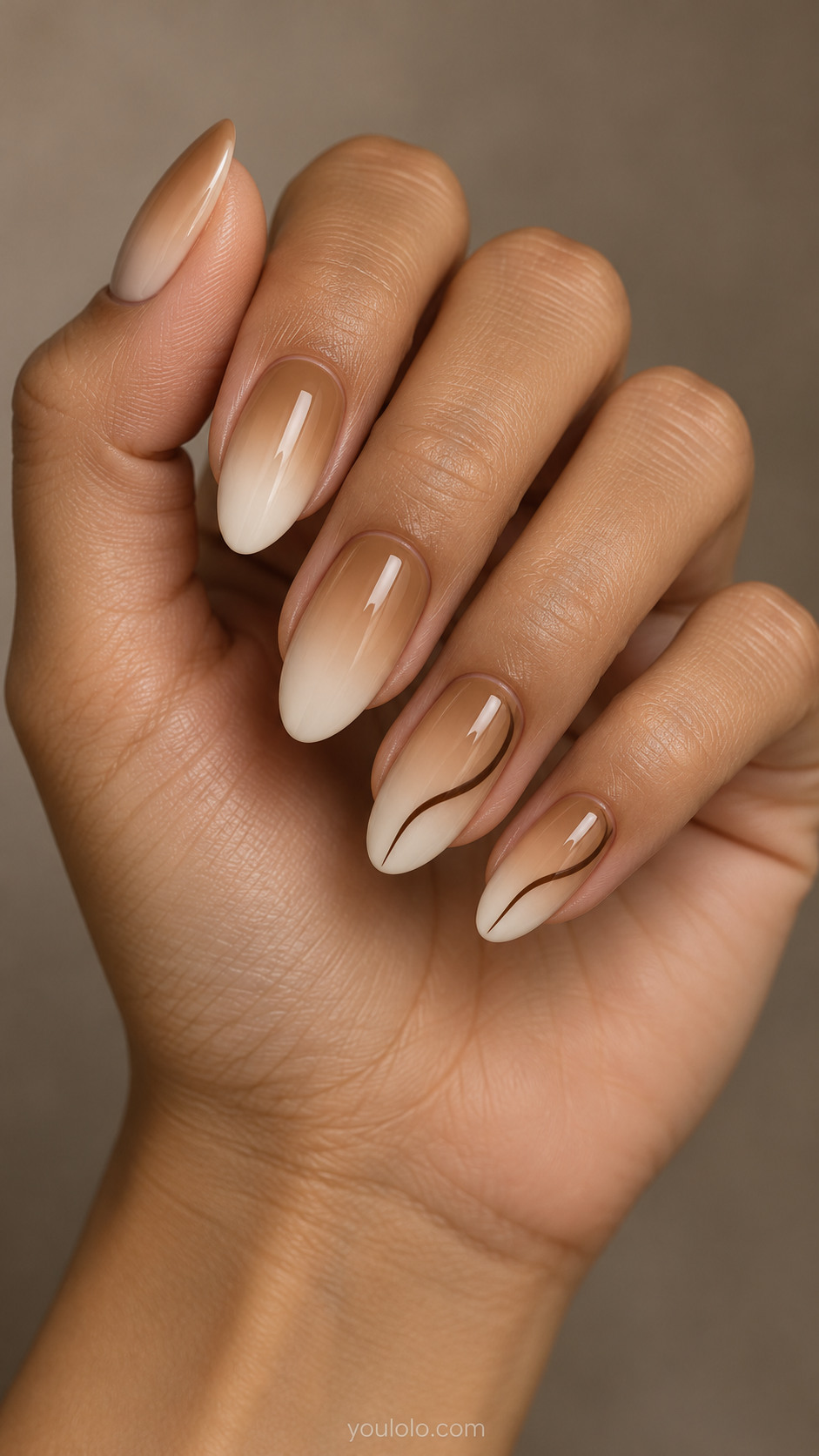
A single contour line adds structure to a caramel-to-ivory fade. The background stays smooth, while the fine brown curve brings a little movement across two nails. Let the line sit away from the sidewall so it remains visible. Almond shapes support the curve naturally, and the remaining nails need no additional detail.
Salon brief: Ask for medium almond nails with caramel at cuticle fades continuously into ivory tip, one thin dark brown gently curving contour line on two accent nails. Keep the blended transition smooth and visible.
12. Champagne Glitter Dissolve
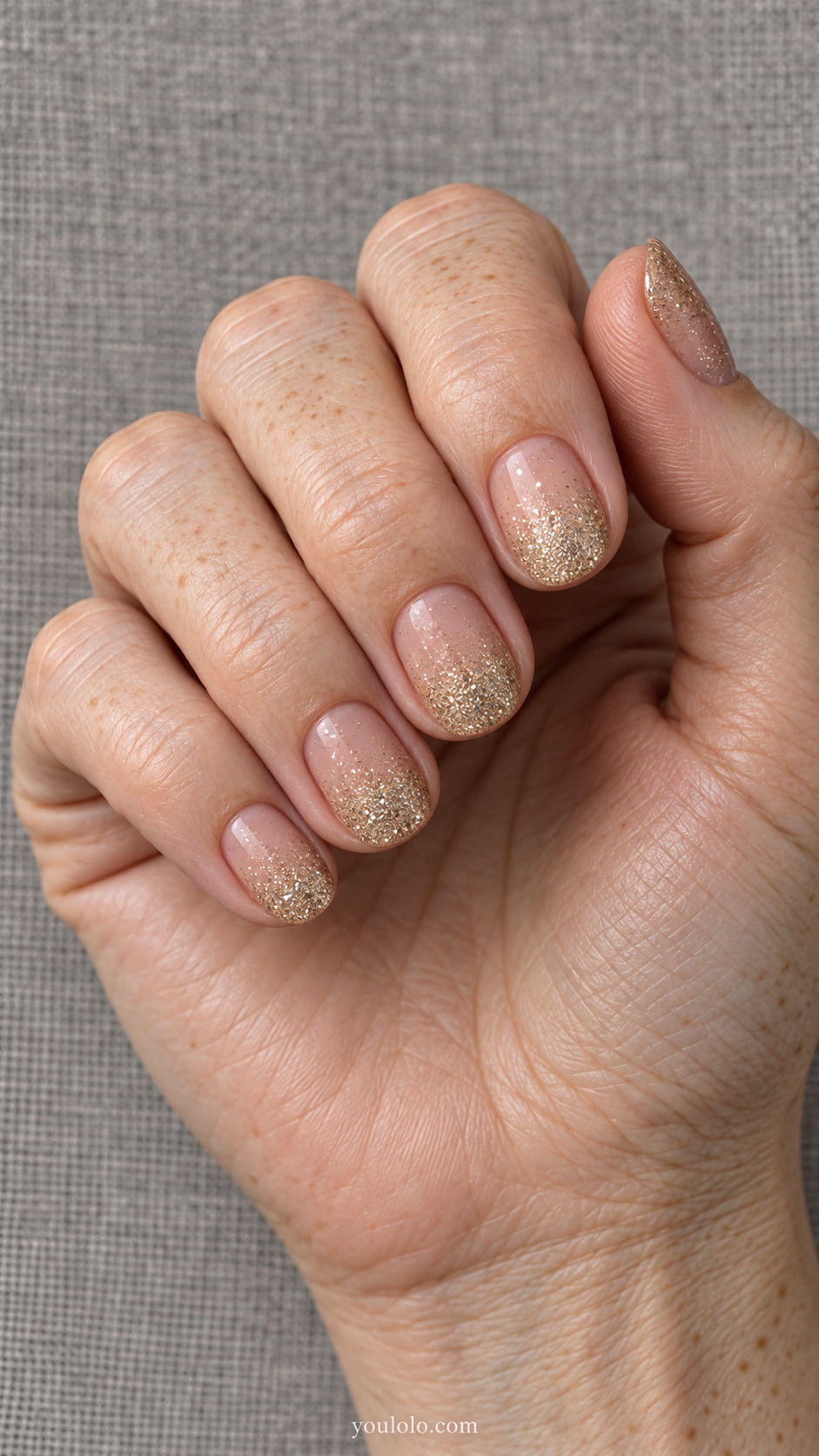
This gradient changes through glitter density as well as color. Fine champagne particles gather at the tips and become increasingly sparse toward the nude base. Short ovals keep the sparkle concentrated. Ask for small particles with a soft transition; a thick strip of glitter at the edge would create a different, more defined look.
Salon brief: Ask for short oval nails with warm nude at cuticle transitioning smoothly into champagne gold microglitter densest at tip and sparse at center, individual fine flecks. Keep the blended transition smooth and visible.
13. Matte Slate with Gloss Accent
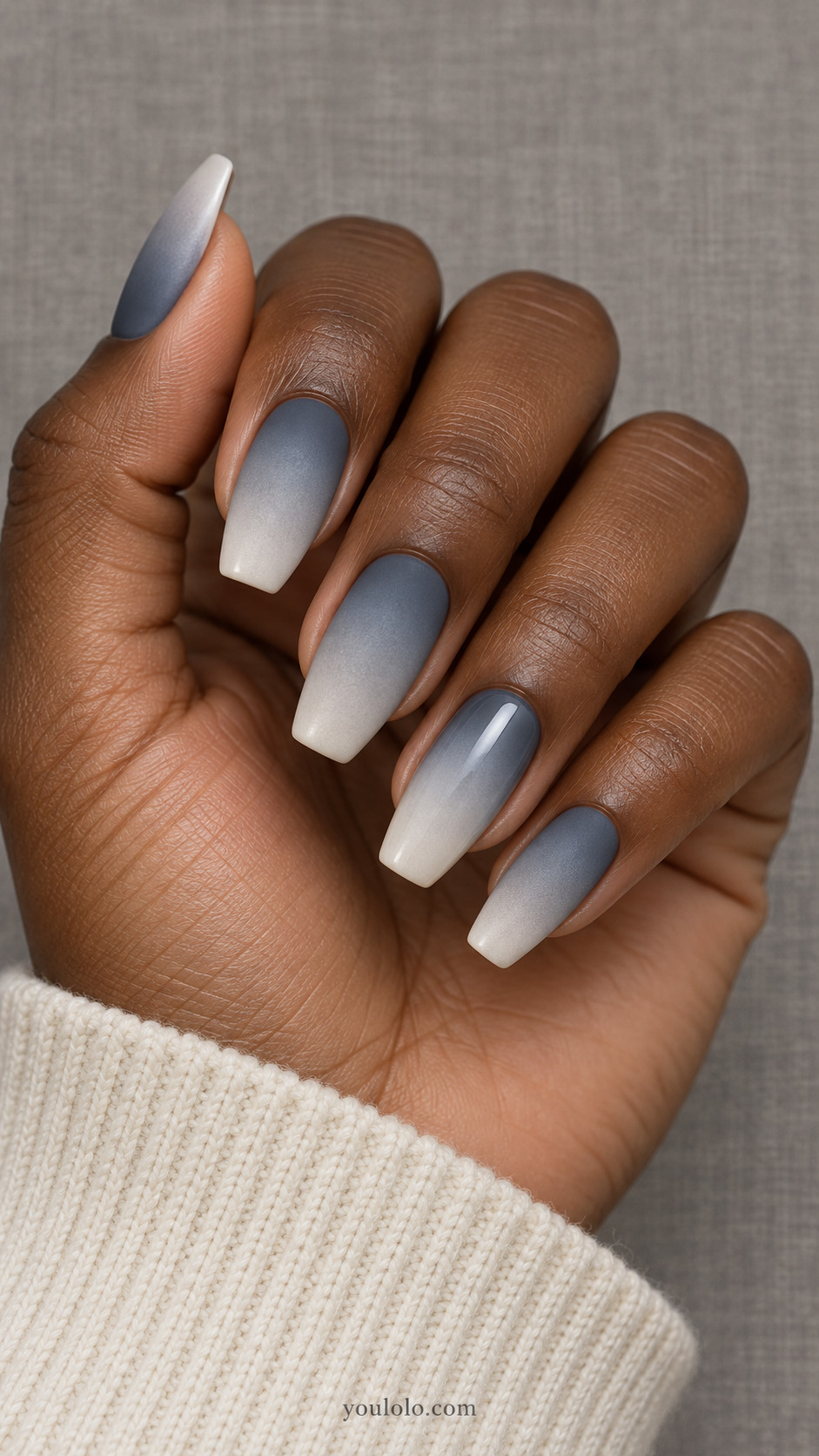
The same slate-to-pearl fade looks different under matte and glossy finishes. Keeping the colors identical makes the surface contrast feel deliberate, with one glossy nail catching a little more light. Coffin shapes suit the clean presentation. Avoid adding foil or extra patterns here, since the finish comparison already supplies the interesting detail.
Salon brief: Ask for medium coffin nails with soft gradient slate blue at cuticle through gray to pale pearl at tips, matte most nails, ring same gradient glossy. Keep the blended transition smooth and visible.
14. Sideways Burgundy with Gold Trace
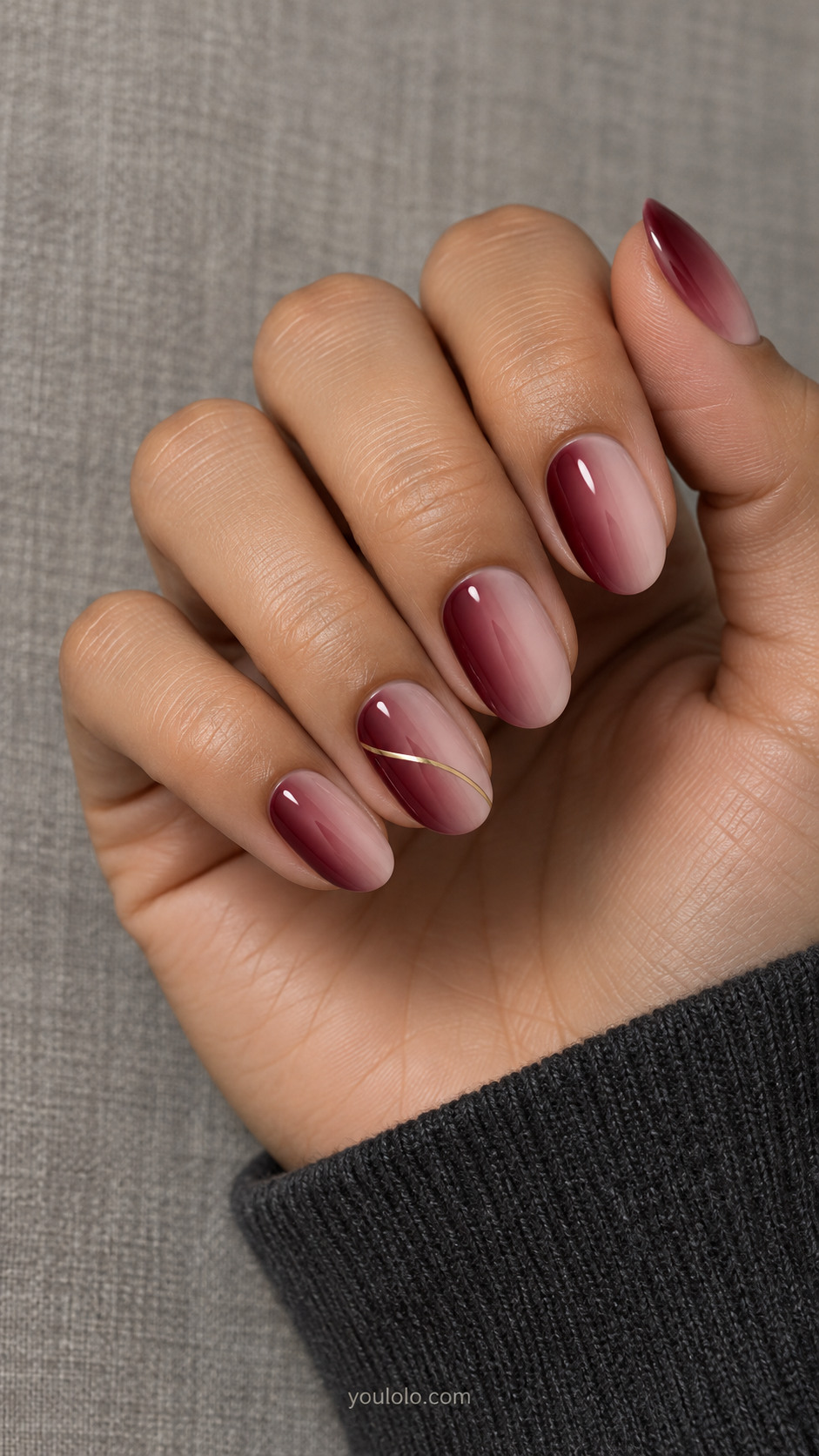
Burgundy fading sideways into nude pink leaves a light area for a fine gold trace. The metallic line belongs on one accent nail, where it can follow the blend without covering it. Oval nails soften the composition. Keep the gold delicate and the transition broad so the dark color does not read as a solid half-nail panel.
Salon brief: Ask for medium oval nails with horizontal sidewall-to-sidewall gradient burgundy on left smoothly fading to nude pink right, single hairline gold curve on ring. Keep the blended transition smooth and visible.
Subtle Nail Art over Blended Color
15. Sage Fade with Olive Sprig
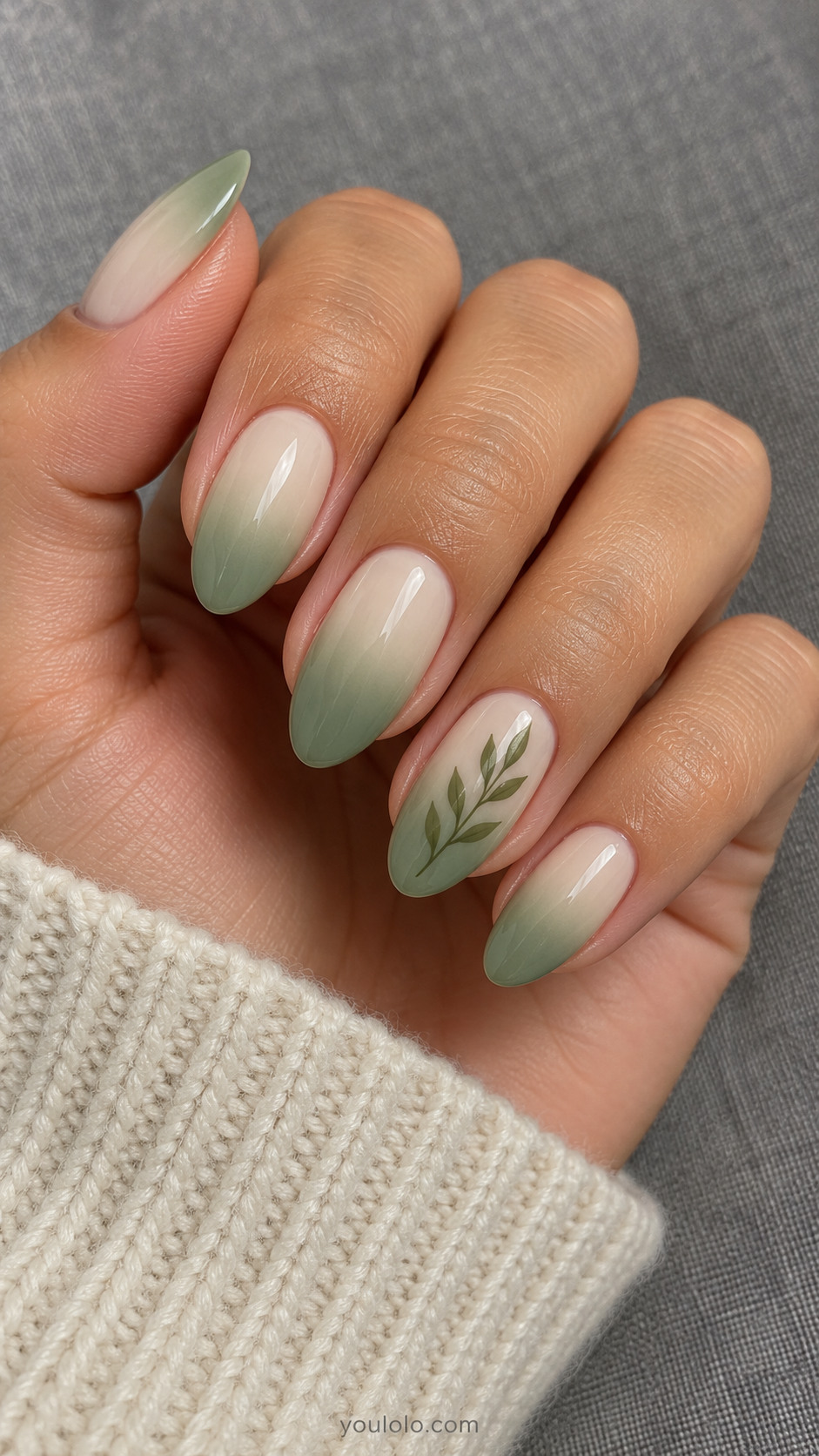
A cream-to-sage fade gives a small olive sprig a quiet background. The botanical detail should sit on a single accent nail, leaving the other gradients easy to see. Almond nails offer room for a few narrow leaves. Use a deeper green for the sprig so its shape stays distinct from the softer sage underneath.
Salon brief: Ask for medium almond nails with cream cuticle continuously fades to muted sage tips, one small flat olive leafy sprig on ring nail, not every nail. Keep the blended transition smooth and visible.
16. Berry Mist Petals
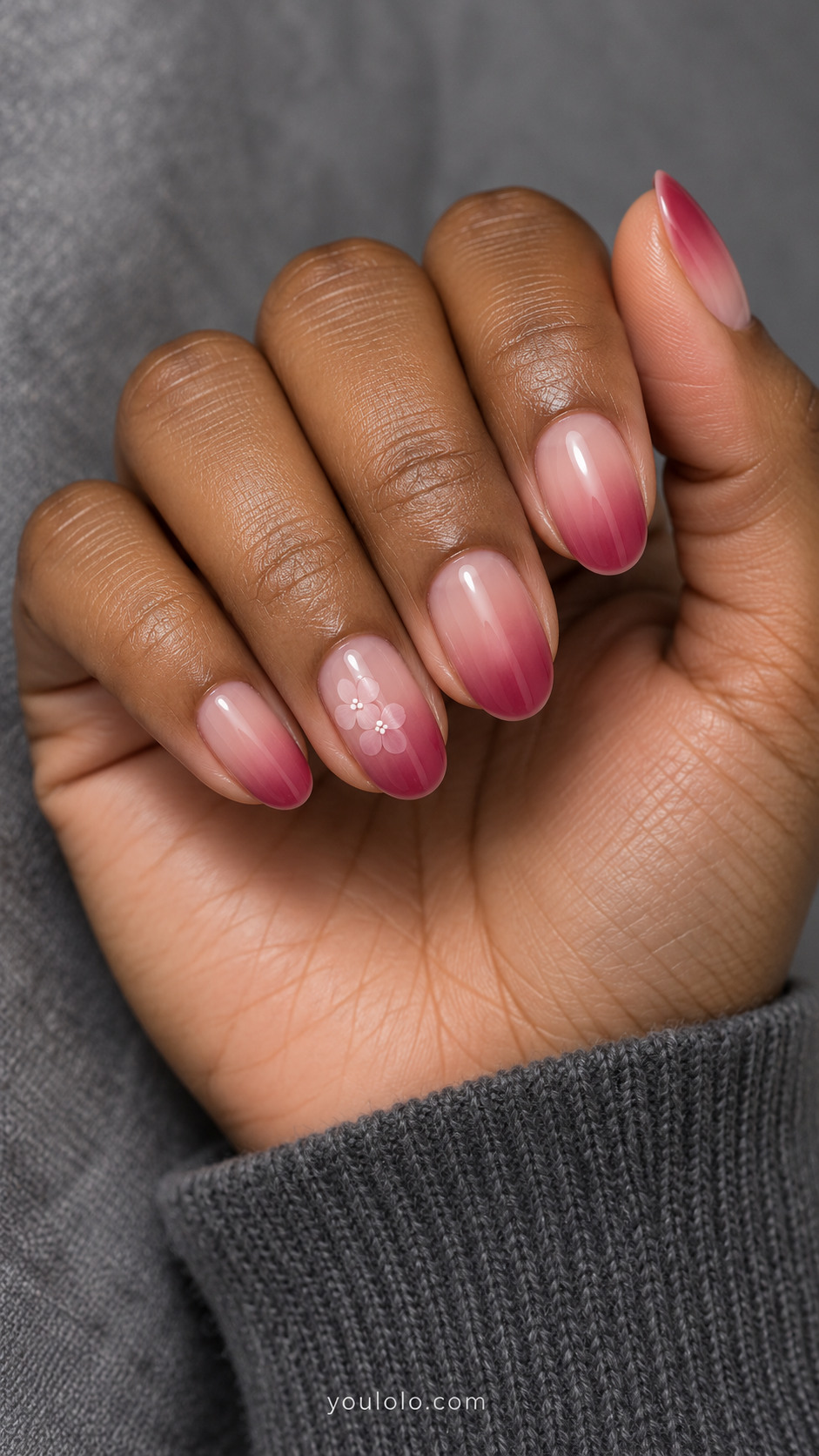
Raspberry tips bring color to a sheer blush base, while two tiny pale flowers adds softness. The flowers should remain small enough to reveal the gradient around it. Medium oval nails suit the rounded shapes. Keep the petals translucent-looking and the center simple; heavy outlines would make the delicate accent feel much more graphic.
Salon brief: Ask for blush-to-raspberry oval ombre nails with two tiny flat pale pink flowers on one accent nail. Keep the gradient visible around the petals.
17. Smoky Plum Lace Corner
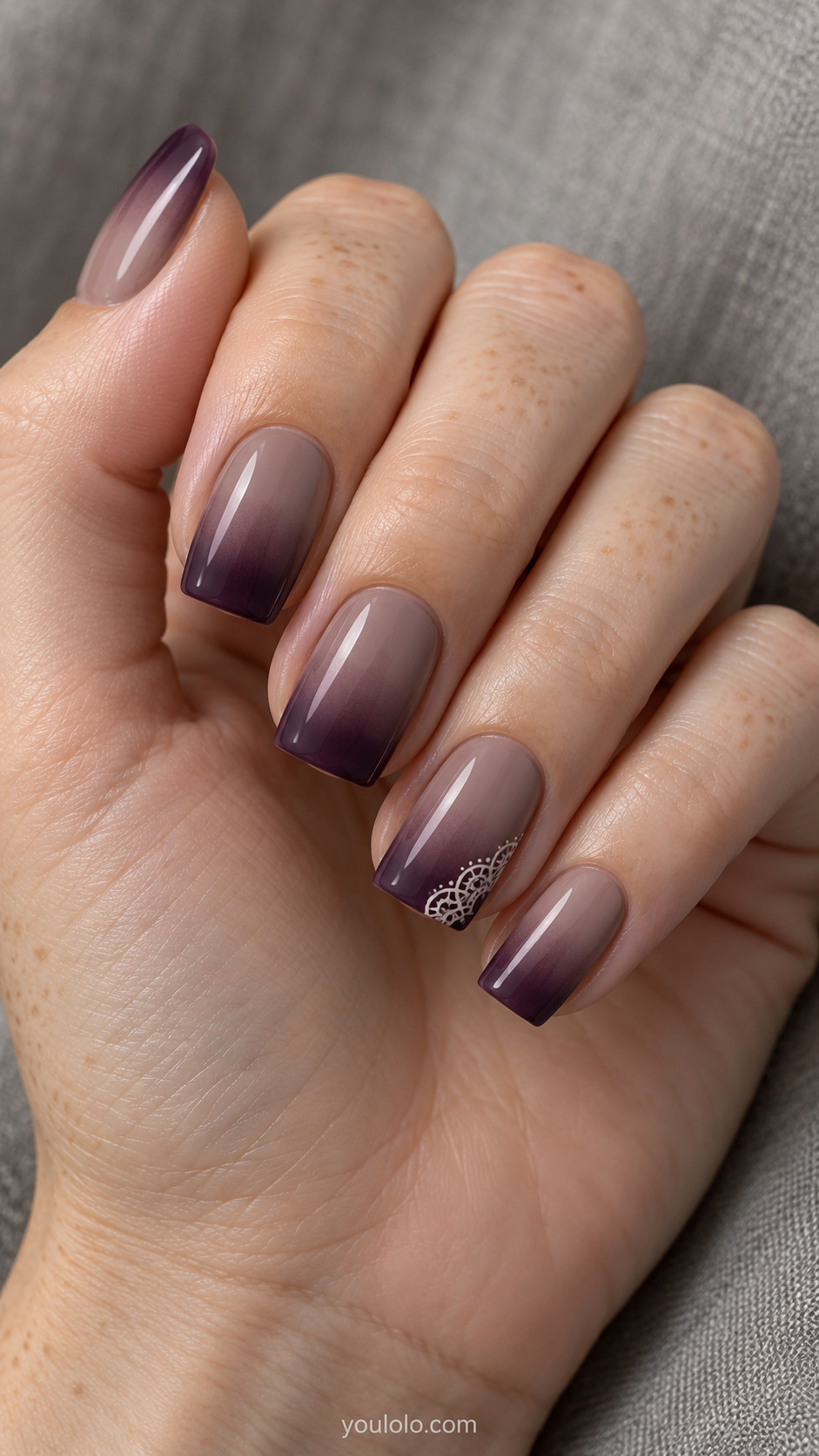
Mushroom taupe and deep plum create a smoky fade with a restrained decorative corner. A little ivory lace along one tip adds contrast without covering the blend. Medium squares provide a clear corner for the scalloped edge. Limit the lace to a short arc, allowing the darker plum to remain the strongest part of the design.
Salon brief: Ask for medium square nails with mushroom taupe cuticle smoothly blends into deep plum tip, ring tip corner tiny ivory scalloped lace arc, rest no lace. Keep the blended transition smooth and visible.
18. Nude Fade with Ivory Ribbon

An ivory ribbon-like line moves across a latte-to-blush fade without becoming a large bow. The thin looping detail adds flow, while the neutral gradient keeps the overall mood calm. Almond nails give the line room to curve. Ask for flat painted artwork and a narrow stroke rather than raised gel or a bulky decorative piece.
Salon brief: Ask for medium almond nails with latte cuticle fades into milky blush tips, one very thin flat ivory looping ribbon line across two accent nails no bow. Keep the blended transition smooth and visible.
19. Blurring Checkerboard

The pattern itself fades in this design. Dusty-rose checks are strongest near the tips, then soften into the pale pink base toward the cuticle. That gradual loss of contrast matters more than the exact number of squares. Medium squoval nails work well. Keep the checkerboard scale generous so the disappearing edges remain visible.
Salon brief: Ask for medium squoval nails with pale pink base with dusty rose checkerboard at tips gradually becoming transparent and fading into plain base toward cuticles, faded pattern not hard block. Keep the blended transition smooth and visible.
20. Petrol-to-Teal Wash
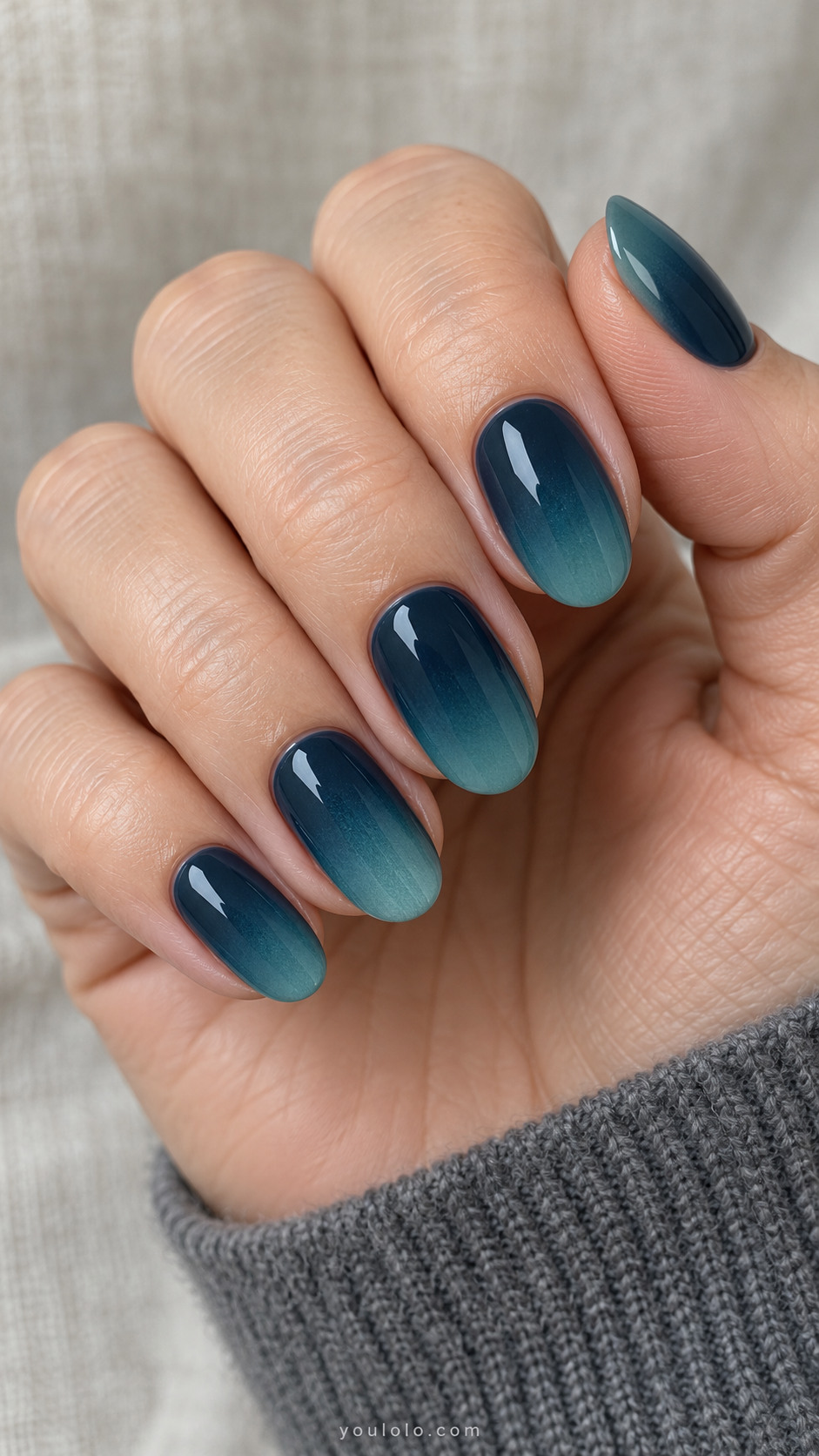
Petrol blue and muted teal create a rich cool-toned blend without needing a metallic finish. The darker base and lighter tips give each nail depth while keeping the palette consistent. Oval nails make the result feel smooth and wearable. Ask for a glossy painted gradient; a chrome powder would change the surface and distract from the color transition.
Salon brief: Ask for glossy petrol-blue cuticles gradually blending into muted teal oval tips, without chrome powder.
21. Charcoal Smoke Gradient
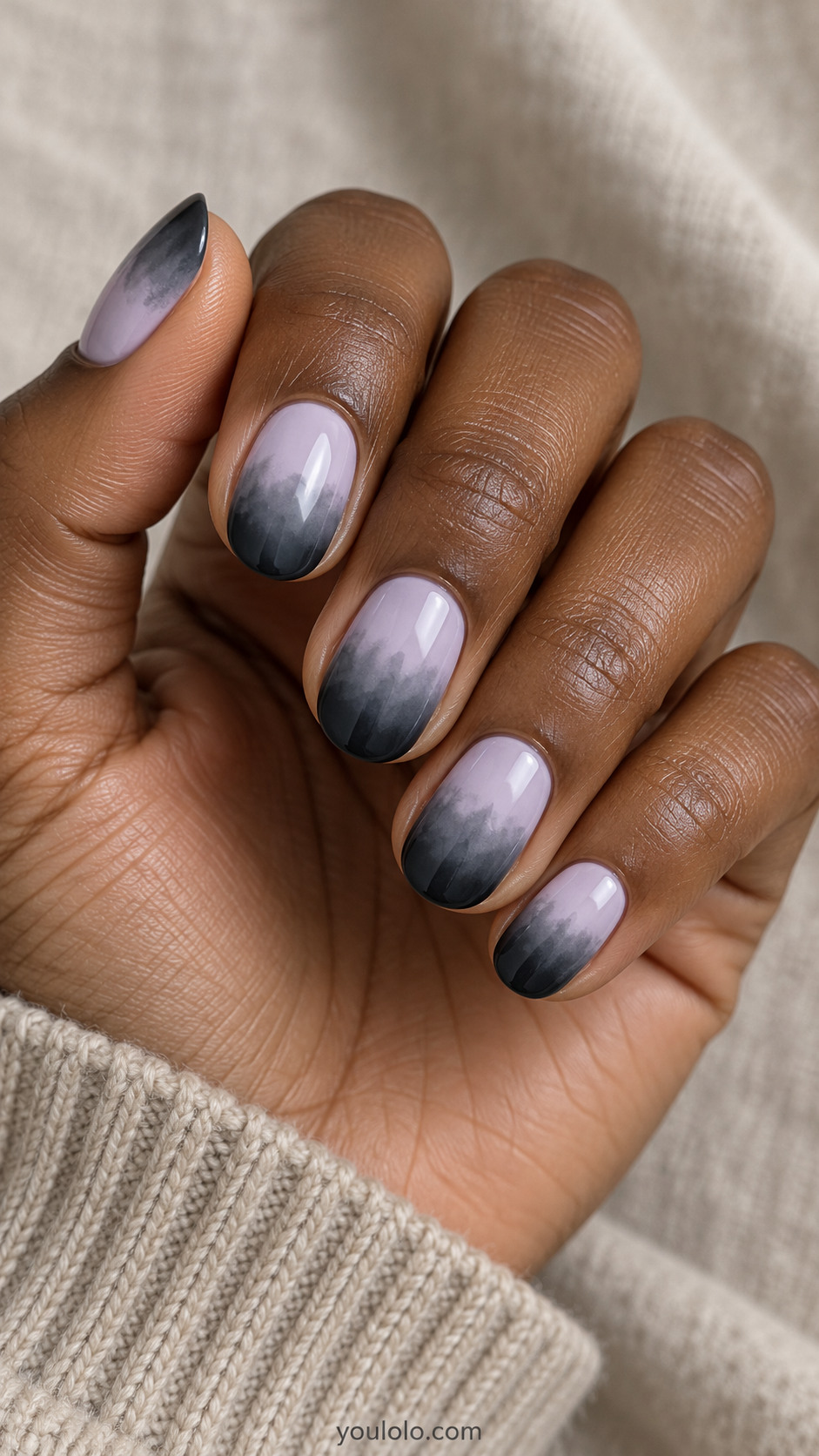
Charcoal tips soften as they meet a pale lavender base. A slightly irregular smoky transition makes the fade feel atmospheric, but the polish surface should stay smooth. Short ovals are a good match for the compact blend. Avoid strong white swirls or obvious veins, which would turn this into a marble design rather than an ombré.
Salon brief: Ask for short oval nails with pale lavender cuticle softly blends through gray into charcoal tips, diffuse irregular smoke-like edge at blend but smooth polish, no swirly marbling. Keep the blended transition smooth and visible.
Creative Gradient Layouts to Save for Your Next Set
22. Alternating Rose-Wine Direction
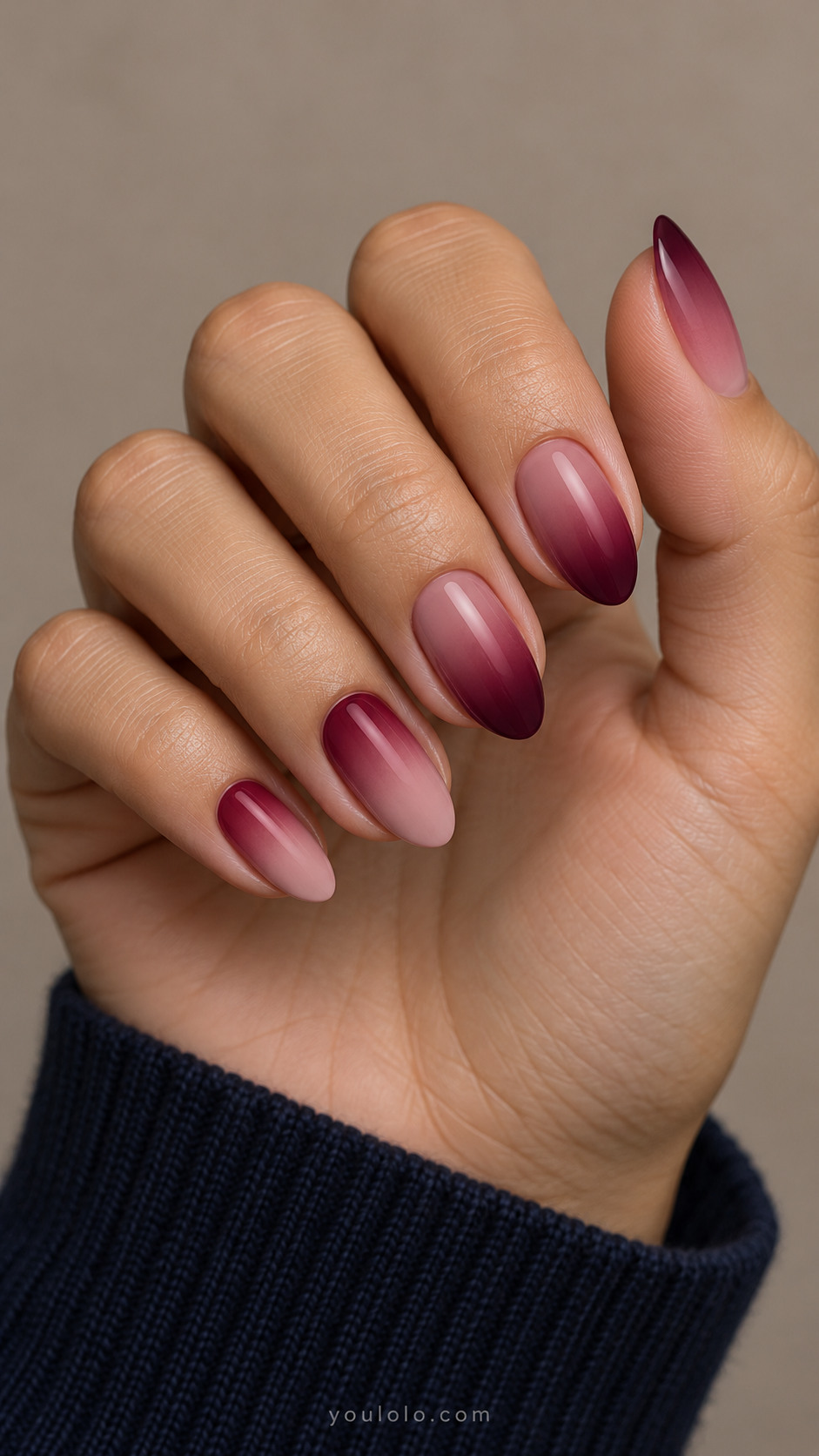
Reversing the gradient on two nails changes the rhythm of a familiar pink-and-wine palette. Some nails become darker toward the tips while others hold the depth near the cuticle. Keeping the same two colors makes the set cohesive. Use broad blends on every nail so the change in direction remains the defining detail.
Salon brief: Ask for medium almond nails with rose pink to wine continuous gradient, index middle thumb darker at tips, ring little reversed darker at cuticles, coherent same palette. Keep the blended transition smooth and visible.
23. Diagonal Teal with Fine Foil
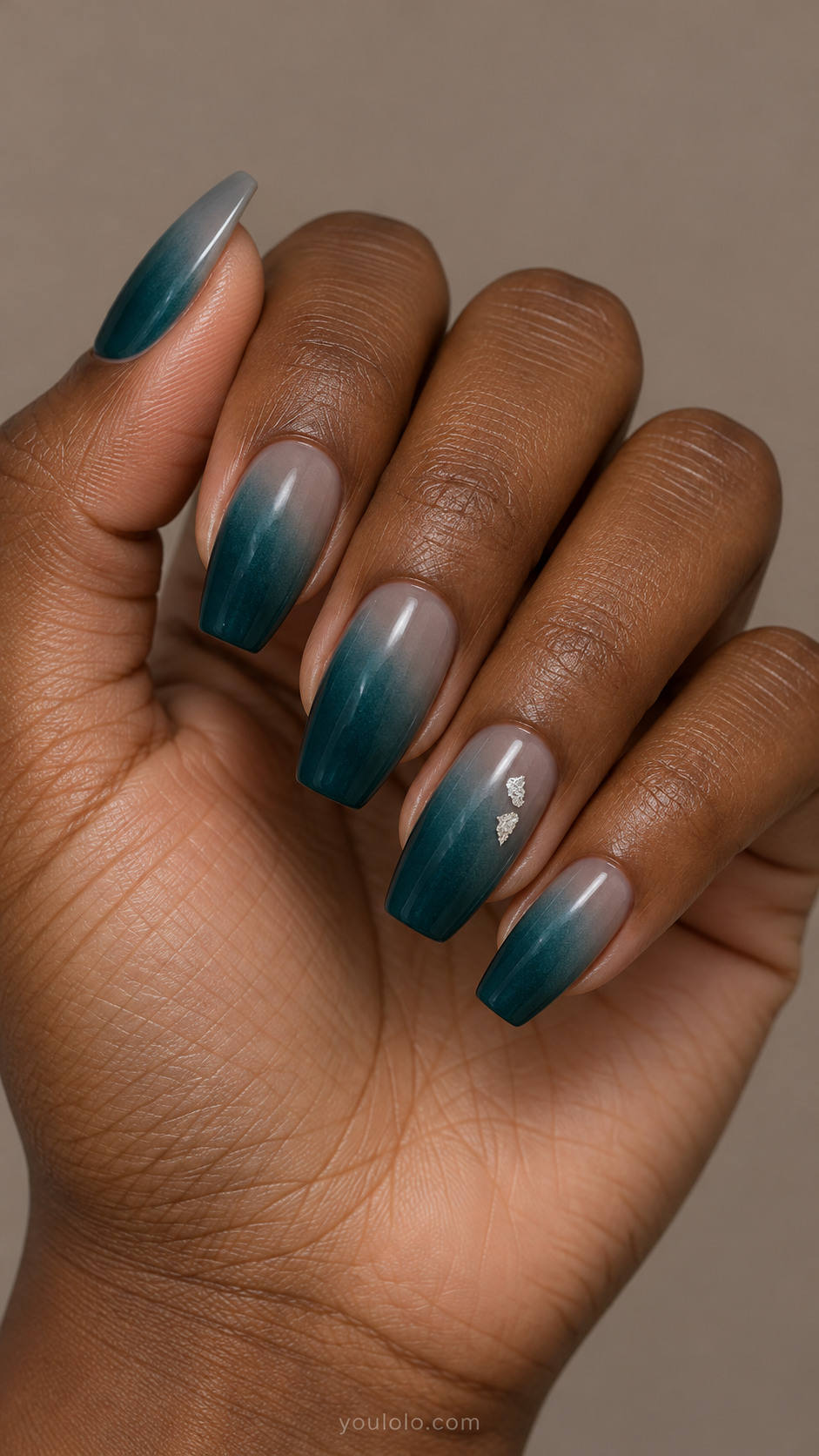
A diagonal teal fade creates a dark corner and a translucent-looking light corner. Two tiny silver foil fragments add a controlled glint on one nail. Coffin shapes give the diagonal plenty of space. Keep the foil pieces separate and small; a large metallic patch would hide the transition you are trying to show.
Salon brief: Ask for medium coffin nails with deep teal lower-left corner smoothly fades diagonally to translucent gray upper-right, two tiny flat silver foil fragments on ring only. Keep the blended transition smooth and visible.
24. Cocoa Fade with a Fine French Arc
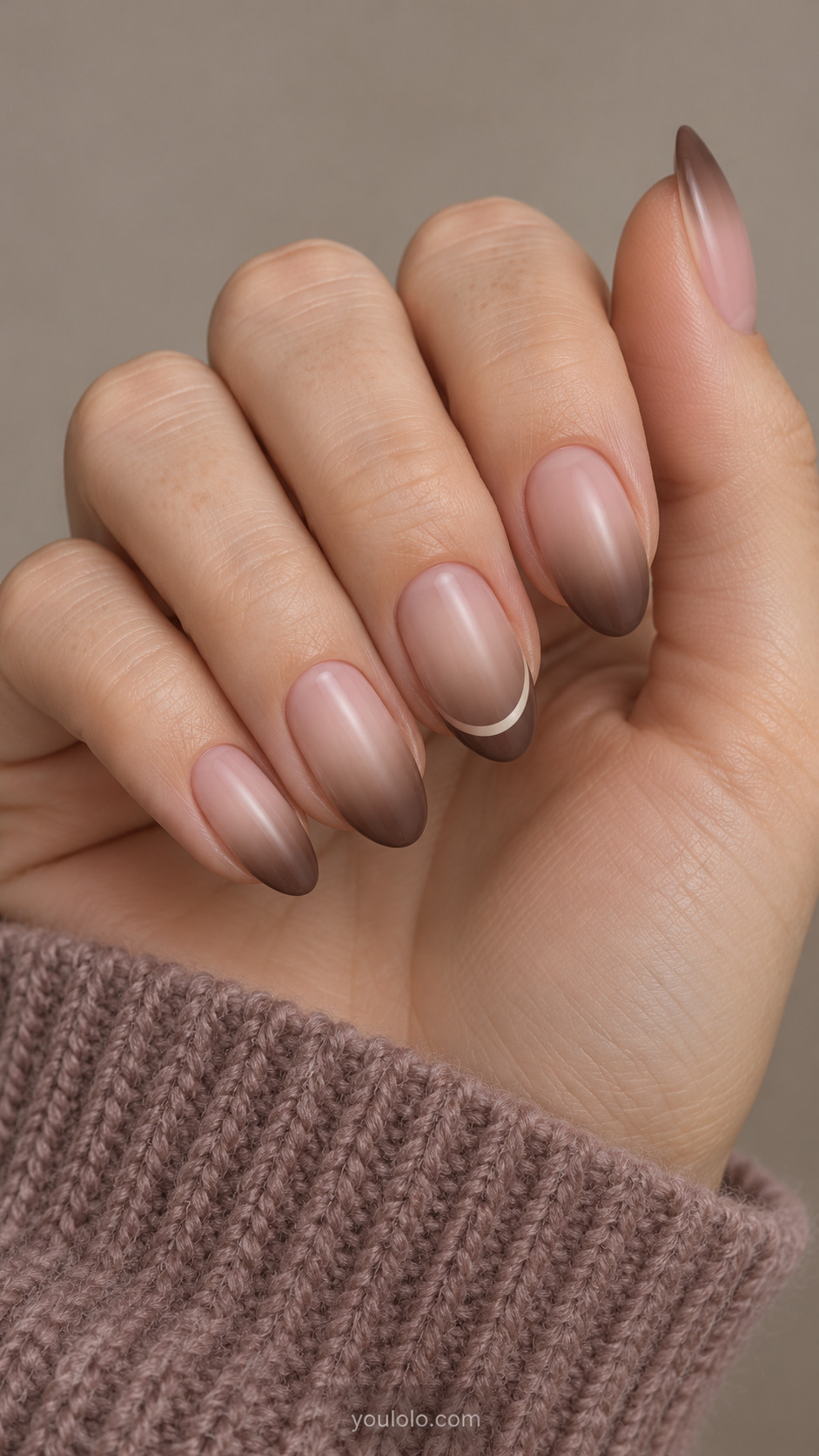
A narrow cream arc adds a crisp contrast to a softly blended nude-to-cocoa base. The small French-shaped detail sits over the gradient rather than replacing it with a solid tip. Almond nails help the curved accent feel natural. Keep the line on one nail and leave the surrounding fades uninterrupted for a cleaner, quieter result.
Salon brief: Ask for nude-to-cocoa almond ombre nails with a slim cream French-shaped arc on one accent nail.
25. Split Gradient Panels
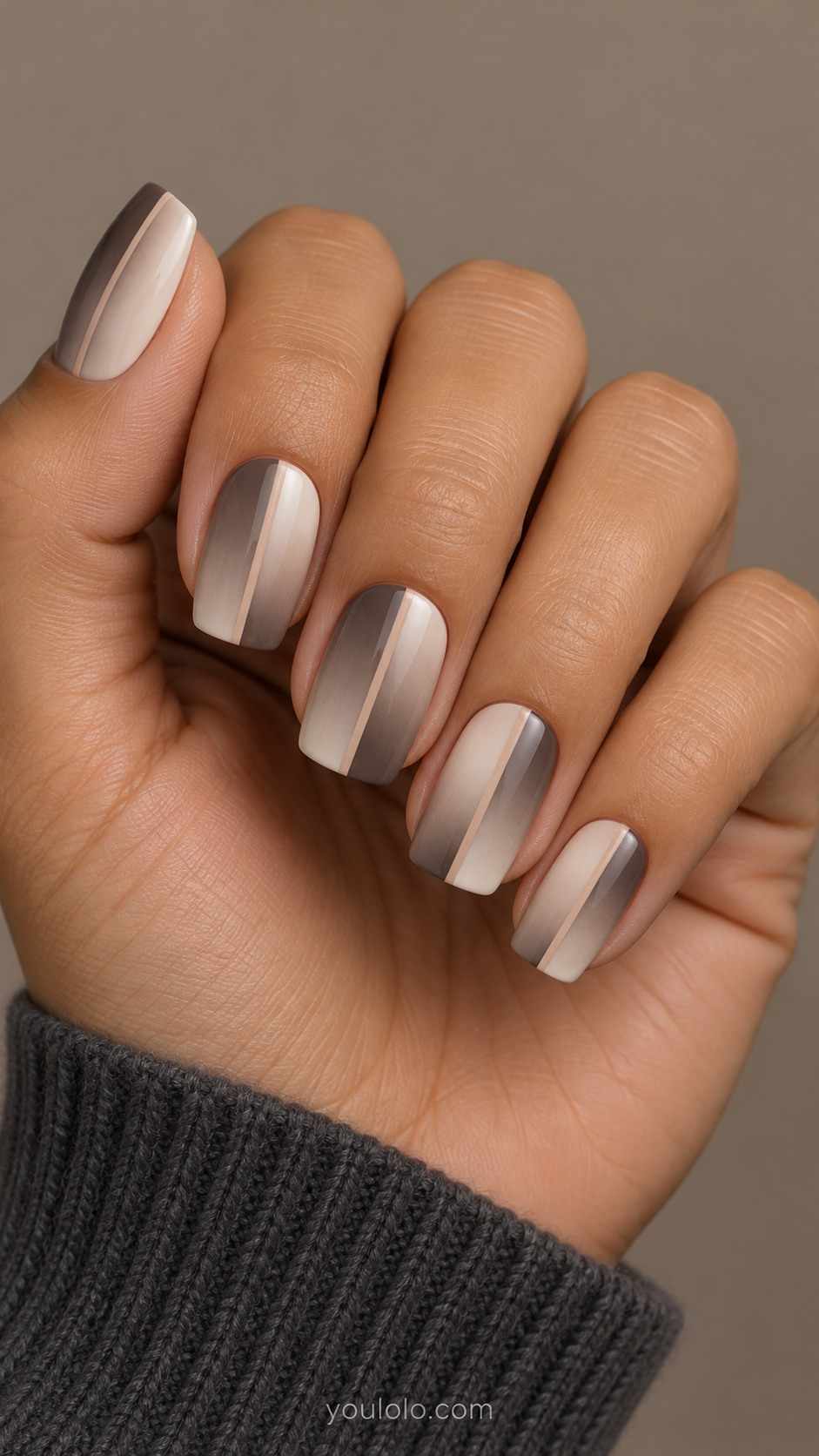
Two narrow panels travel in opposite directions, separated by a fine nude line. One moves from taupe to cream while its neighbor reverses that order. Medium square nails make the contrast easy to read. Each panel still needs a smooth blend; the central division should be the only deliberately sharp line in the design.
Salon brief: Ask for medium square nails with each nail split vertically by thin nude line, left panel smooth taupe-to-cream gradient cuticle-tip and right panel reversed cream-to-taupe. Keep the blended transition smooth and visible.
26. Amber Glow on Short Nails
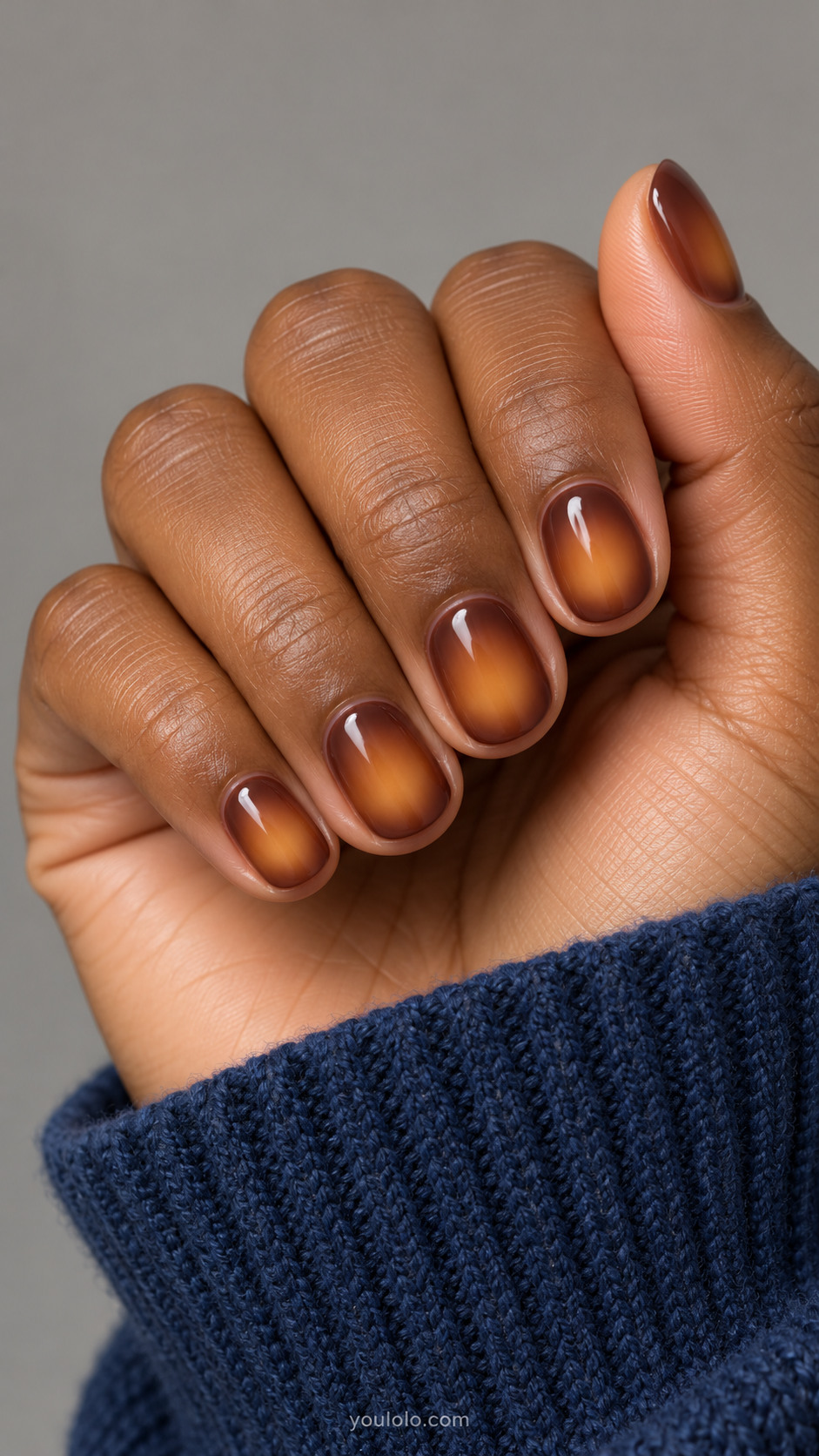
Amber glows through the center of this short manicure, surrounded by soft brown shading. Like the peach version, it uses a radial blend rather than a straight cuticle-to-tip transition, but the deeper edges create a warmer mood. Keep the amber diffuse and glossy. No glitter is needed to make the center feel luminous.
Salon brief: Ask for short round nails with soft warm brown edges blend continuously into diffuse amber oval center extending to tip, subdued glossy caramel glow no glitter. Keep the blended transition smooth and visible.
27. Soft Pink Heart Window
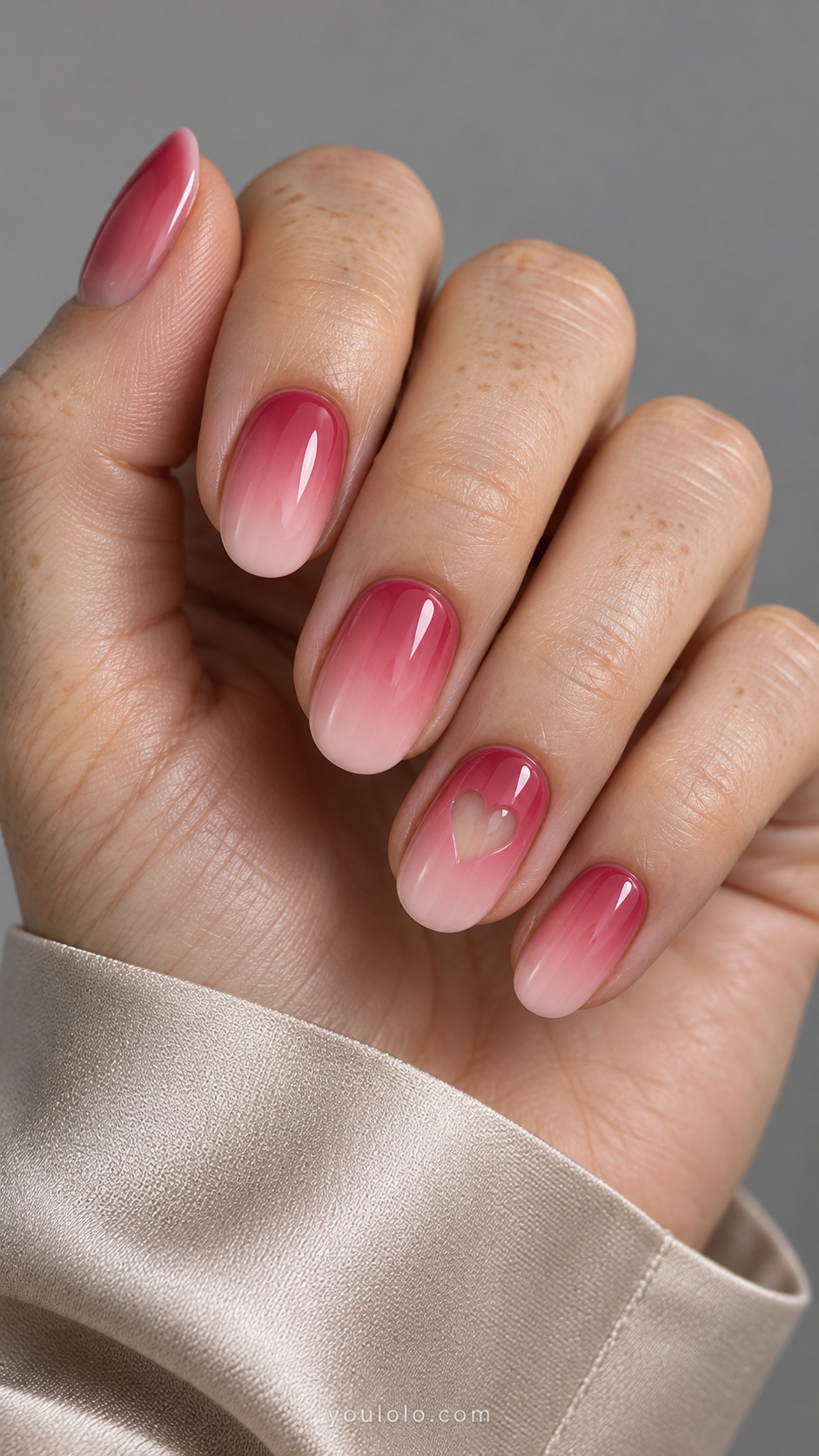
A small heart-shaped window creates a quiet break in the raspberry-to-blush fade. Leaving that shape nude gives the design a lighter touch than adding a solid white heart. Oval nails keep the surrounding curves gentle. Use the window on one nail only, so the rest of the set continues to show the uninterrupted gradient.
Salon brief: Ask for medium oval nails with raspberry cuticle smoothly fades to blush tips, one small transparent nude heart-shaped negative-space window on ring nail center. Keep the blended transition smooth and visible.
28. Icy Fade with Sparse Snow Dots
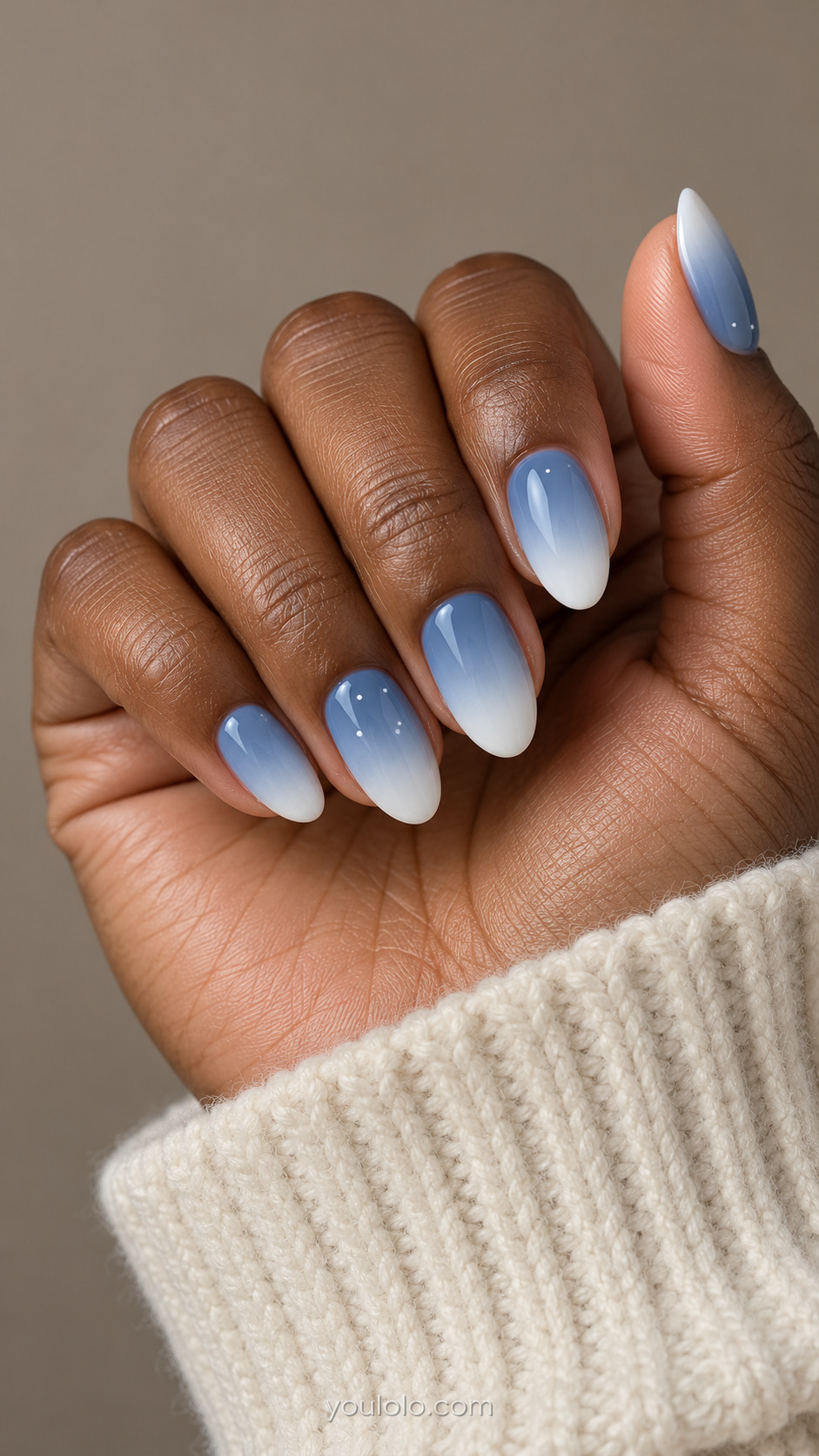
A dusty-blue base fading to white tips offers a cool backdrop for a few tiny dots. The dots sit over the blue area where they can be seen, leaving the pale tips uncluttered. Almond nails provide enough space for a long blend. Keep the dots sparse; an even all-over pattern would obscure the soft ombré.
Salon brief: Ask for medium almond nails with a smooth dusty-blue cuticle to white-tip fade. Add a few tiny white dots over the blue on selected nails, leaving the pale tips clear.
29. Latte Gradient Across the Set

This set varies the depth of the brown tips while keeping a real gradient on every nail. Caramel, toffee, taupe, mocha and espresso create a quiet progression across the hand. Short squoval nails make the collection feel grounded and wearable. The nude base should stay consistent, helping the different browns look like one considered palette.
Salon brief: Ask for short squoval nails with smooth nude-to-brown fades on every nail. Progress from caramel at the thumb through toffee, taupe and mocha to espresso on the little finger.
How to Choose Your Ombre Nails
Choose the direction before the colors. A cuticle-to-tip fade emphasizes length, a side-to-side blend emphasizes width, and a diagonal fade moves the eye across the nail. A radial or aura gradient diffuses from the center instead. These are different layouts, even when the shades stay the same.
For short nails, two related colors usually leave more room for a clear transition than several sharply contrasting shades. Medium or longer nails can accommodate a wider blend, a narrow window or an additional line of artwork. Keep the most detailed accent to one or two nails if you want the gradient to remain the focus.
What to Tell Your Nail Artist
Bring the image and specify which color belongs at the cuticle, tip or sidewall. Describe whether you want a wide soft transition or a smaller concentrated fade. Then choose glossy or matte and identify any accent you want to keep. The application method depends on the products and the artist; the reference communicates the visual result, not a universal curing or layering recipe.
Ombre Nails: Frequently Asked Questions
What is the difference between ombre and a French manicure?
A traditional French tip has a defined smile line. A French ombré or baby-boomer style blends the pale tip into the base without that sharp boundary. Ombré can also use colors and directions unrelated to French tips.
Do ombre nails work on short nails?
Yes. A compact two-color blend, soft cuticle haze or fine glitter fade can work well on short nails. Leave enough space for the transition rather than adding several narrow color bands.
Are aura nails the same as ombre?
Aura nails use a radial gradient, usually with a diffused center. Ombré is often used for a directional fade from one area to another. They share blended color, but the placement creates a different effect.
Can I add art without hiding the fade?
Keep the art small and place it on one or two nails. A fine line, tiny leaf or small negative-space opening lets the underlying blend remain visible. Dense all-over artwork changes the focus.
Should the light shade always be at the tip?
No. Reversing the colors, blending sideways or placing a dark shade at both ends produces different layouts. Decide the direction with your artist before choosing extra decoration.
Is a different solid color on each nail an ombre manicure?
That is often called a gradient or skittle set across the hand. In this collection, the latte progression also includes an actual blended transition within each nail, so both effects appear together.