The Best Fluffy Pancakes recipe you will fall in love with. Full of tips and tricks to help you make the best pancakes.

Blue and butter yellow nails combine a cool pastel with a soft, warm one. Add ivory and the palette has room for stripes, dots, or a single star without needing another bright color. The result can suggest a sunny holiday, but the design does not depend on a travel destination or a particular time of year.
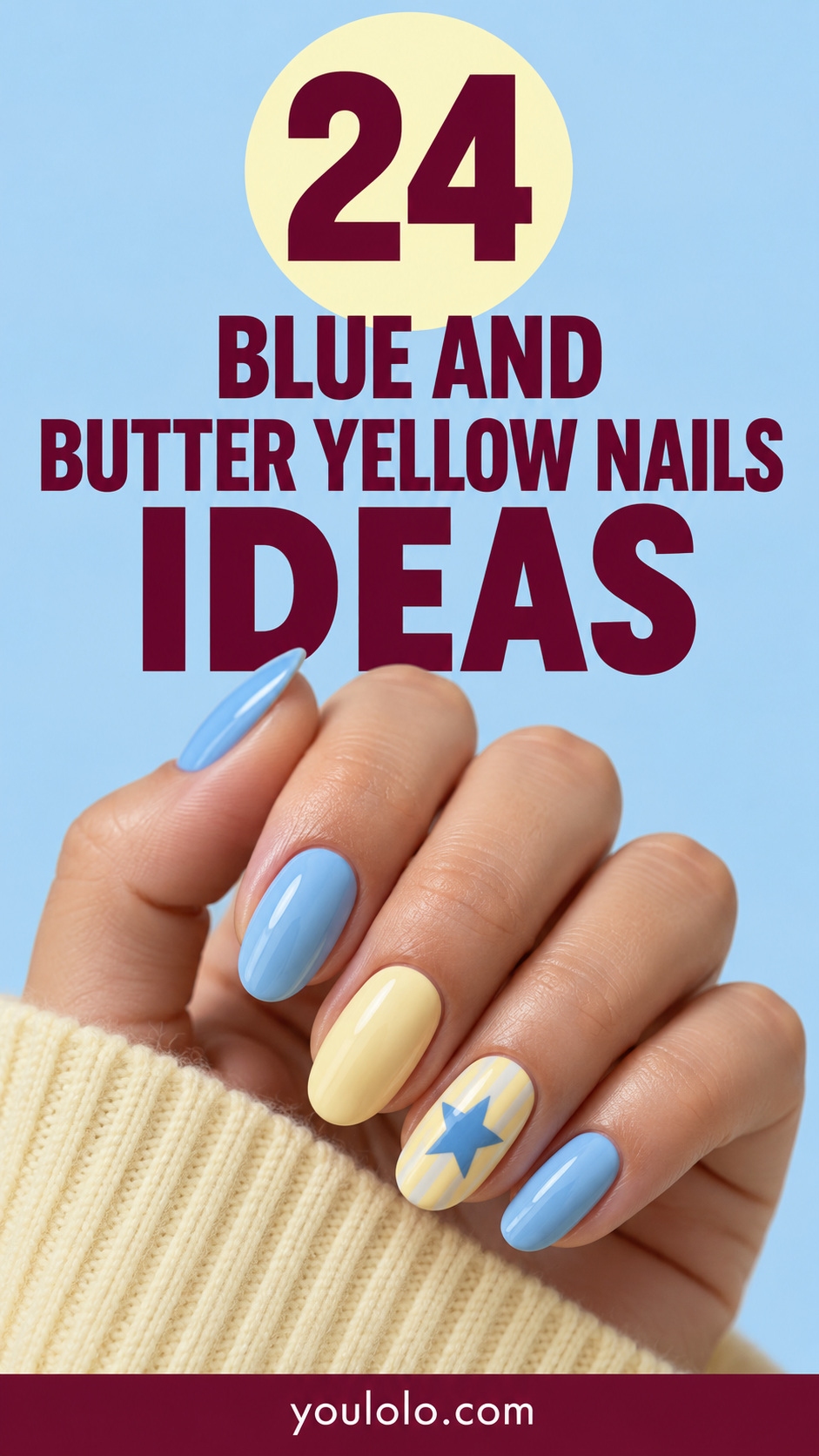
Start by choosing your blue. A muted powder blue keeps the contrast gentle; a clearer sky blue makes the yellow stand out more. For the yellow, look for the soft shade you enjoy rather than assuming that every polish labeled “butter” will look the same.
Butter yellow nails: a simple way to balance the colors
Use one shade as the main color, one as an accent, and ivory as the background for the smallest details. A five-nail set might include two blue nails, one yellow nail, one striped ivory nail, and one ivory star accent.
You can reverse that balance for a yellower manicure. Keeping the same three shades across every motif helps dots and stripes look like parts of one set.
1. Powder blue with tiny ivory dots
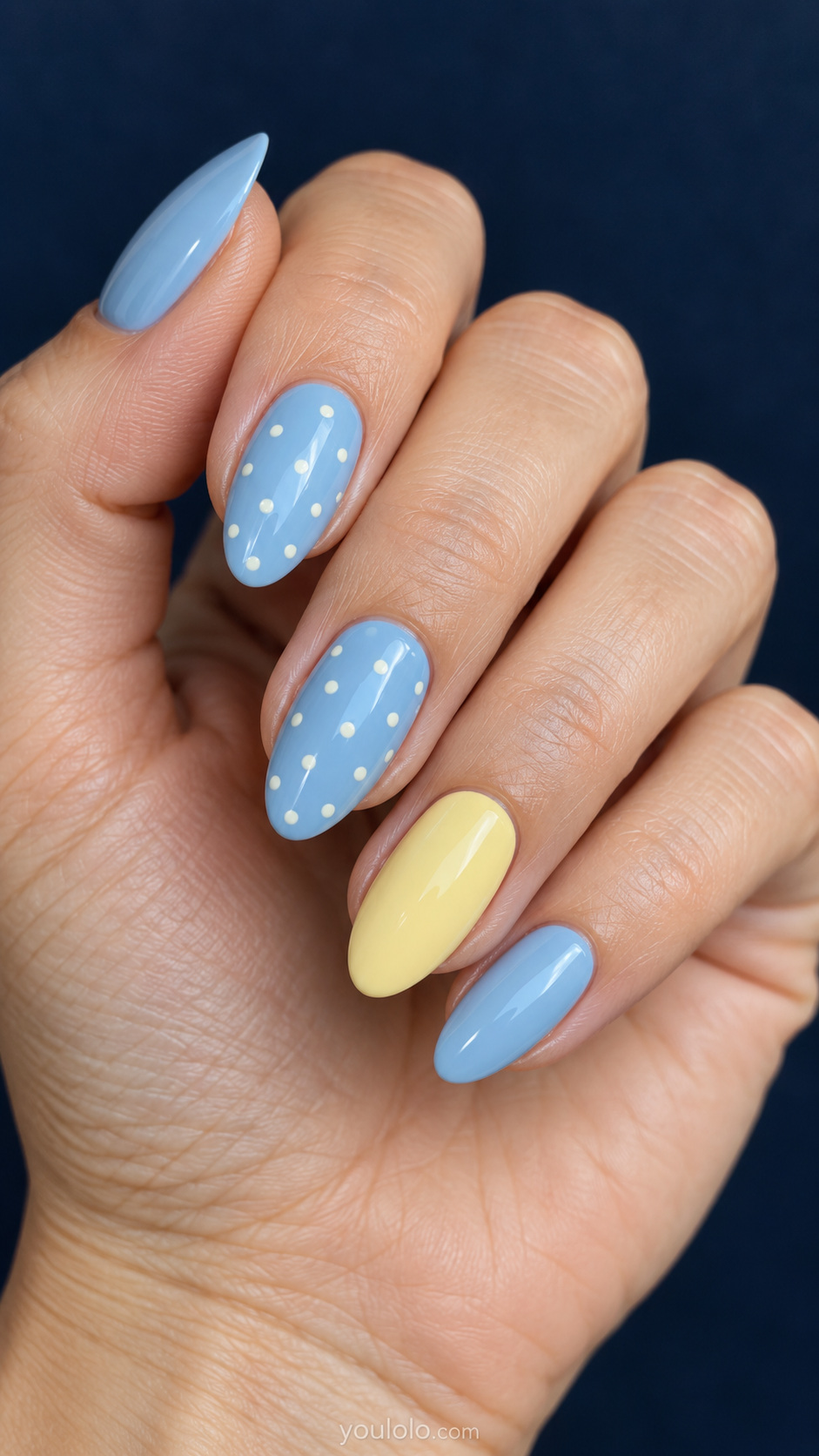
Cover most nails in powder blue and scatter small ivory dots across one or two of them. Add a solid butter-yellow nail as the color accent. The dots should have enough space around them to read individually rather than becoming a dense white texture.
2. Blue and ivory vertical stripes
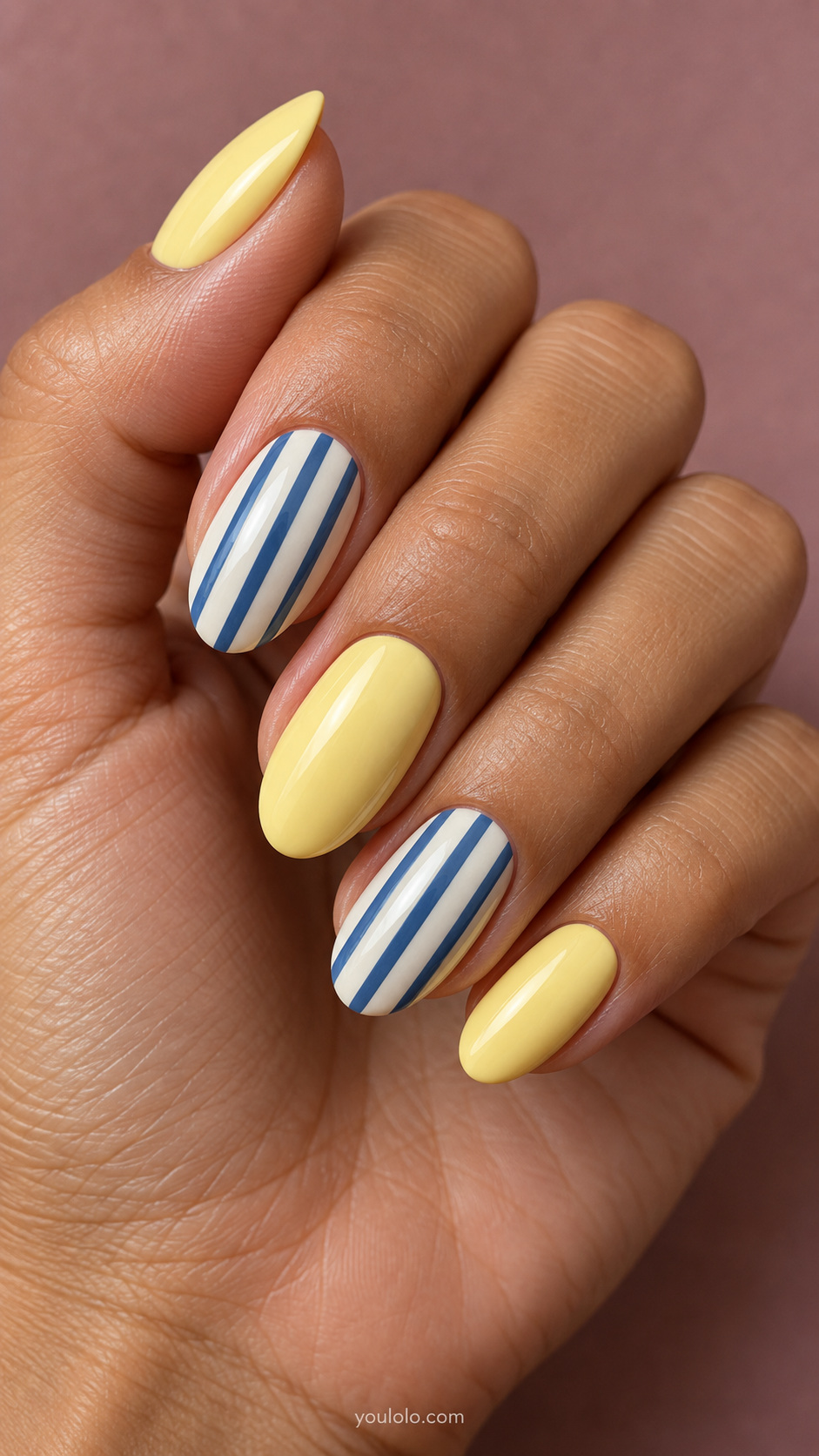
Use slender blue stripes on an ivory background, paired with solid yellow nails. Keep the stripe spacing consistent for a clean graphic effect. If your nails are short, a few visible stripes usually communicate the idea more clearly than many hair-fine lines.
3. One yellow star on a blue nail
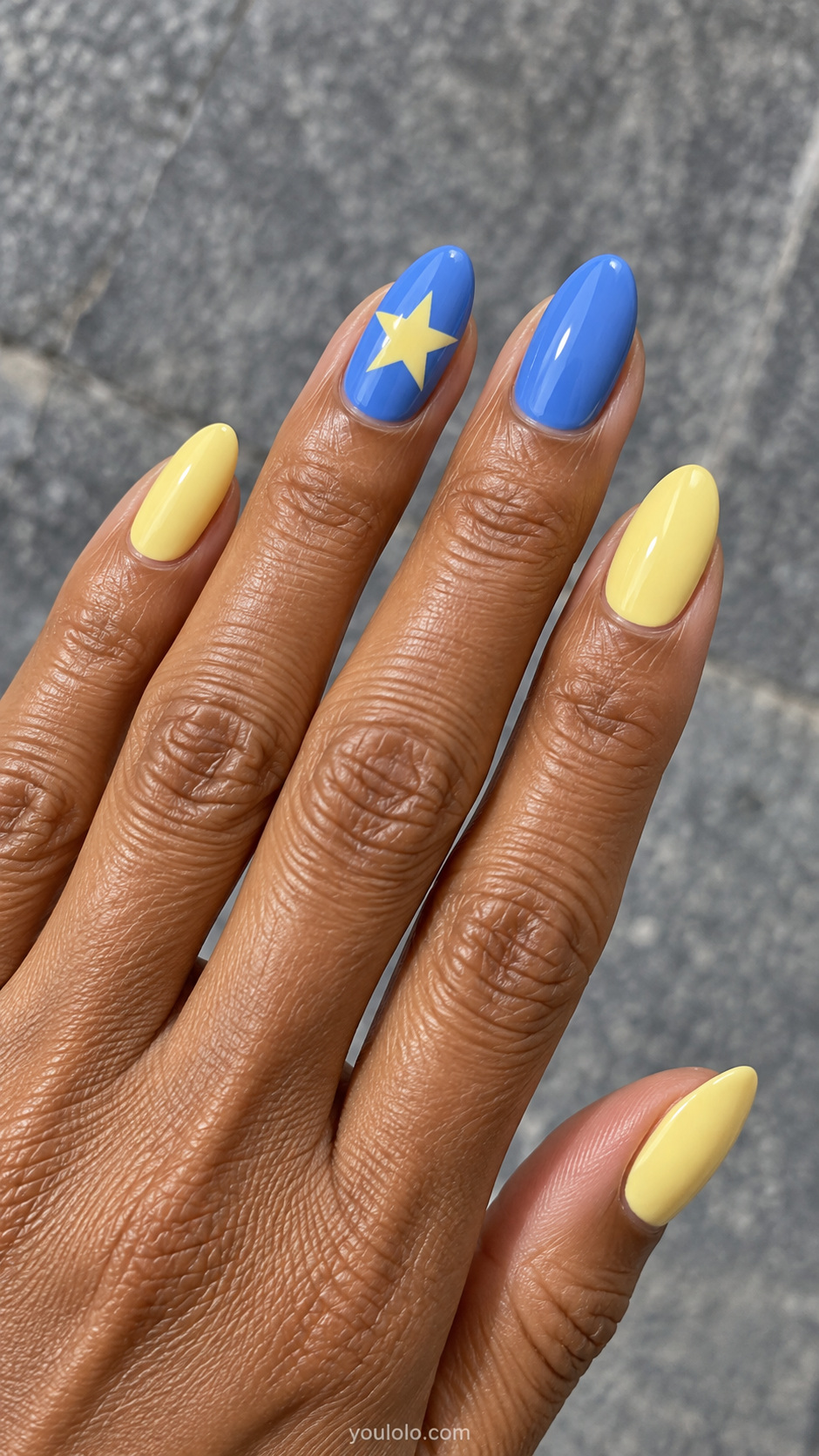
Make a single star the main detail of the set. A painted yellow star on a blue base provides the motif without adding height; a raised version changes the texture as well as the image. Leave the neighboring nails mostly plain so the star has space around it.
4. Mismatched pastel French tips

Alternate blue and yellow French tips over a sheer or ivory-toned base. Keep the tip shape consistent even when the colors change. For a small extra detail, place one tiny contrasting dot near a tip rather than adding a different pattern to every nail.
5. Blue dots on ivory with a yellow accent
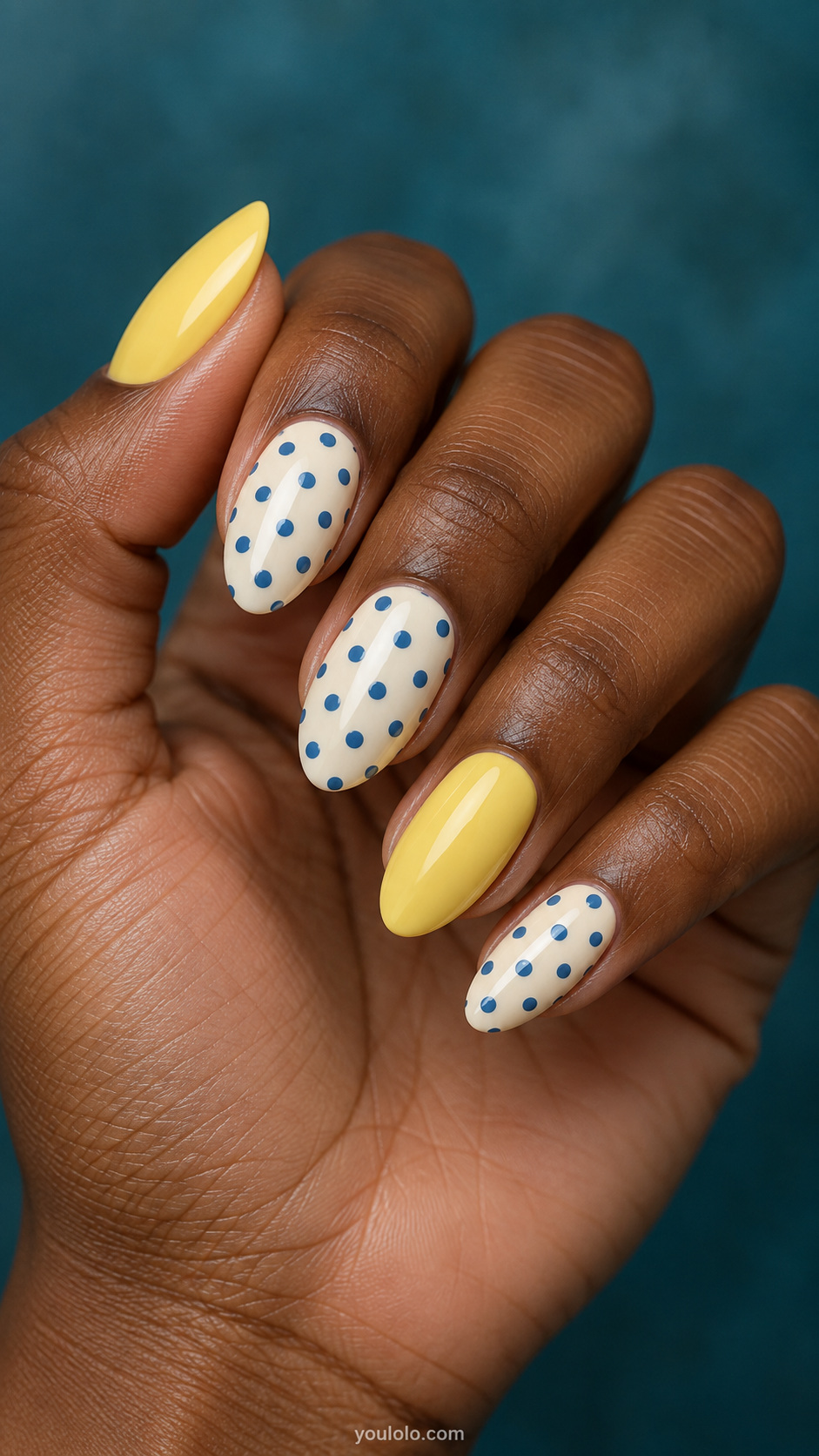
Switch the dotted background from blue to ivory and use the blue for the dots. This creates a lighter version of the palette. A solid yellow thumb and ring nail can anchor the composition without adding more tiny details to paint or match.
6. Yellow-and-ivory stripes with blue stars

Use soft yellow stripes as the background and add one blue star to an accent nail. Because both the star and stripes occupy the same surface, make the stripe contrast fairly gentle. A bold blue star will then remain easy to recognize.
7. A pastel checkerboard accent
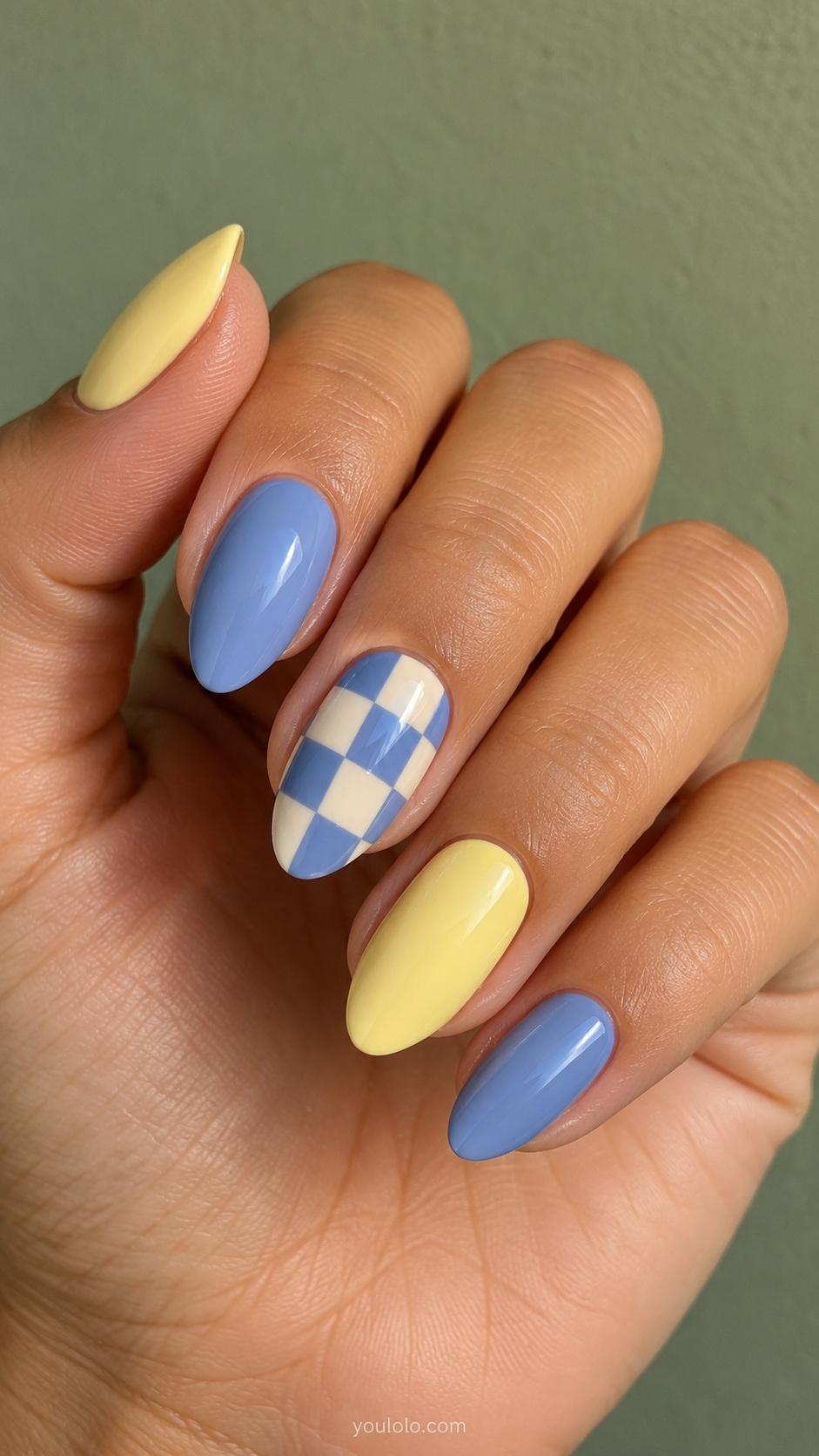
Introduce a blue-and-ivory checkerboard on one nail, then pair it with solid butter yellow and blue. Use larger squares on a shorter nail instead of shrinking the entire grid. This is the most graphic option in the group, so additional dots or raised stars are optional rather than essential.
8. Two-color waves with open space
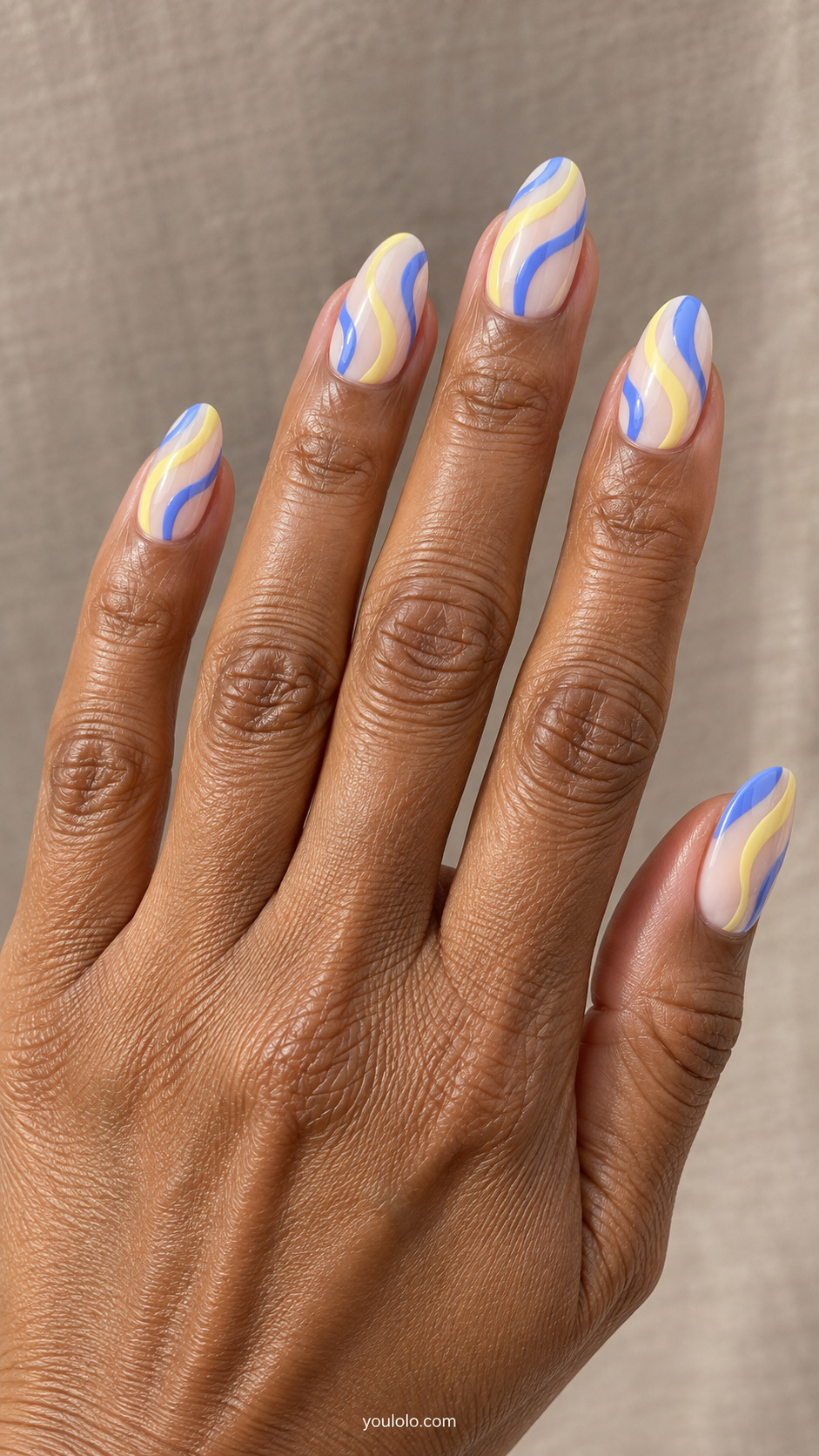
Paint curved blue and yellow ribbons across a sheer or ivory base, leaving clear space between them. The waves provide a softer alternative to straight stripes. Keep their width similar across the hand so the nails feel connected even when the curves vary.
9. Blue daisies on butter yellow
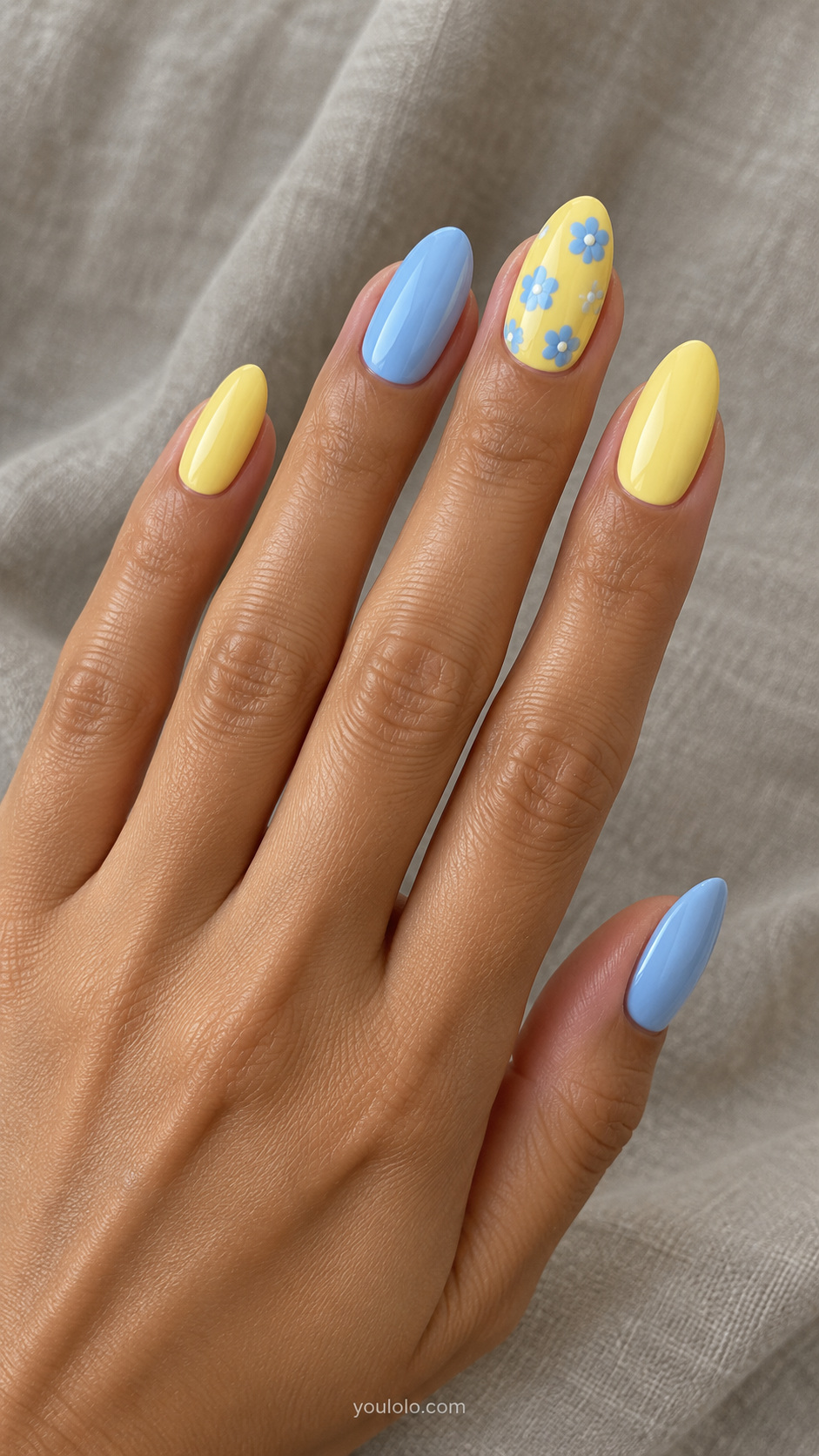
Paint a few small blue daisies over a butter-yellow accent nail, using ivory centers. Pair it with plain yellow and powder-blue nails. Keep the flowers separated by visible background so the nail still reads as yellow rather than a dense blue floral print.
10. Blue gingham with yellow nails
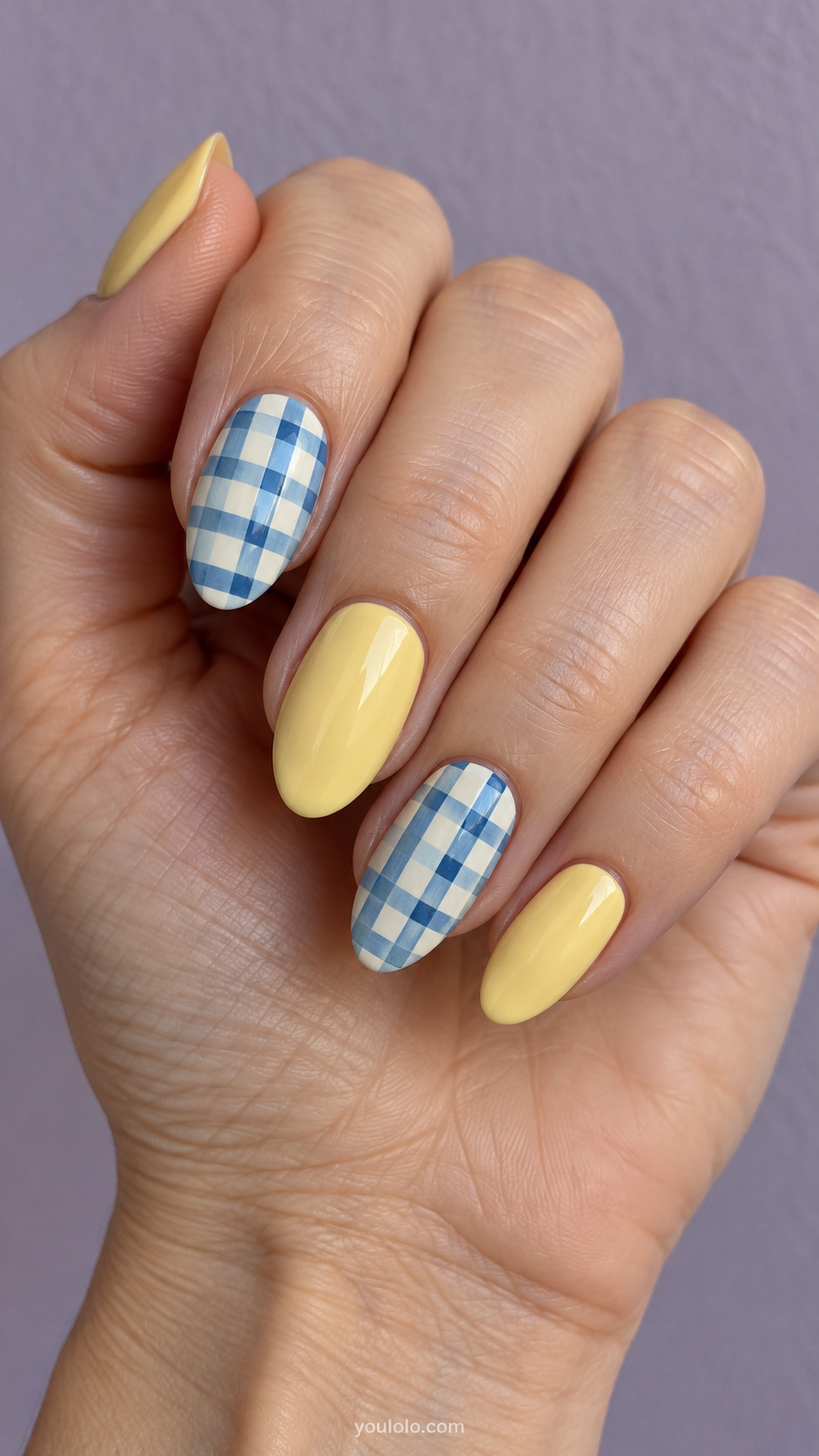
Cross fine blue lines over ivory to make two gingham accents, then leave the remaining nails butter yellow. Let the crossing points appear slightly deeper in blue. This gives the pattern a woven look and distinguishes it from the solid squares of a checkerboard.
11. Butter-yellow aura on a blue base

Place a softly blended yellow glow in the center of a powder-blue nail. The edge should fade gently rather than form a sharp circle. Repeat it on two nails and keep the others blue; limiting the effect makes the contrast easier to appreciate.
12. Alternating blue and yellow half moons
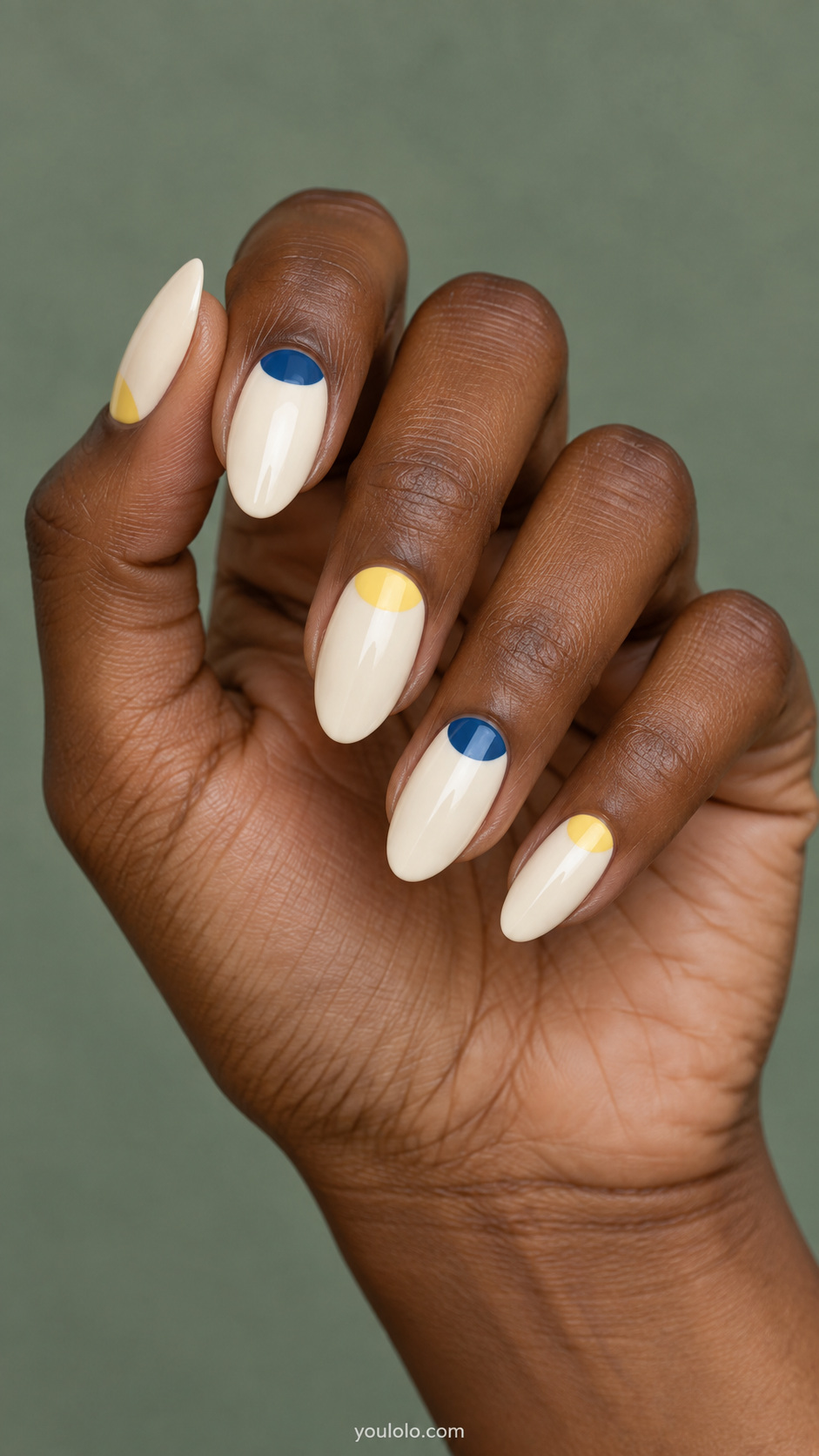
Use ivory nails with a small blue or yellow half moon near the base, alternating the colors across the hand. Leave the main nail area uncluttered. This gives the palette a graphic but quiet layout, especially when the half moons are consistent in size.
13. A blue outline around yellow French tips

Paint butter-yellow tips over a sheer base and trace their inner curved edge with a fine powder-blue line. The two colors need enough contrast to remain distinct. Avoid making the outline too broad, or it will read as a second thick tip rather than a delicate border.
14. Blue bows with yellow accents
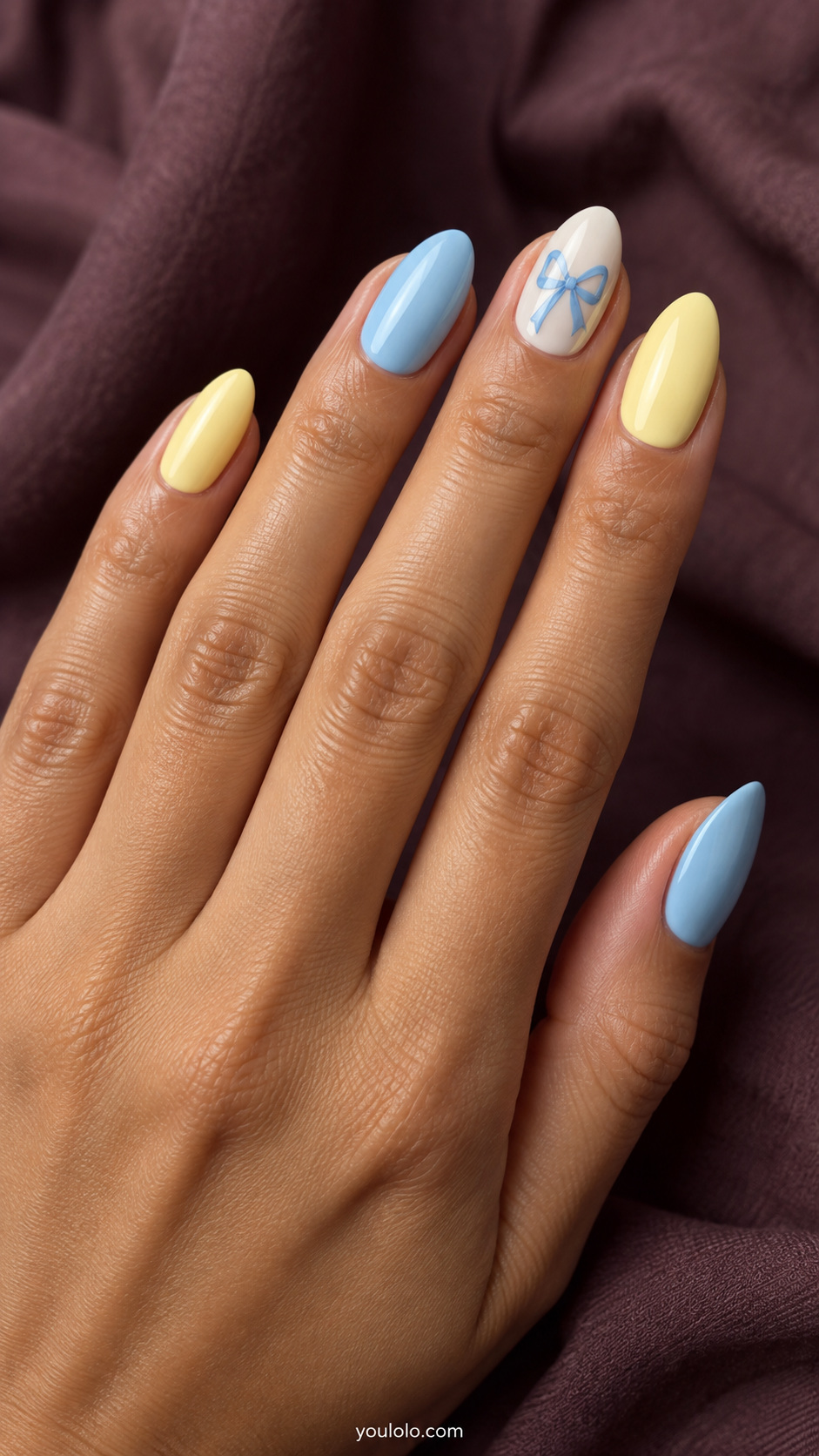
Add one small flat blue bow to an ivory accent nail, then use solid butter yellow and powder blue around it. The bow should have clear loops and short tails, with no additional dots behind it. This version uses a single decorative motif rather than an all-over pattern.
15. Yellow crescents on muted blue
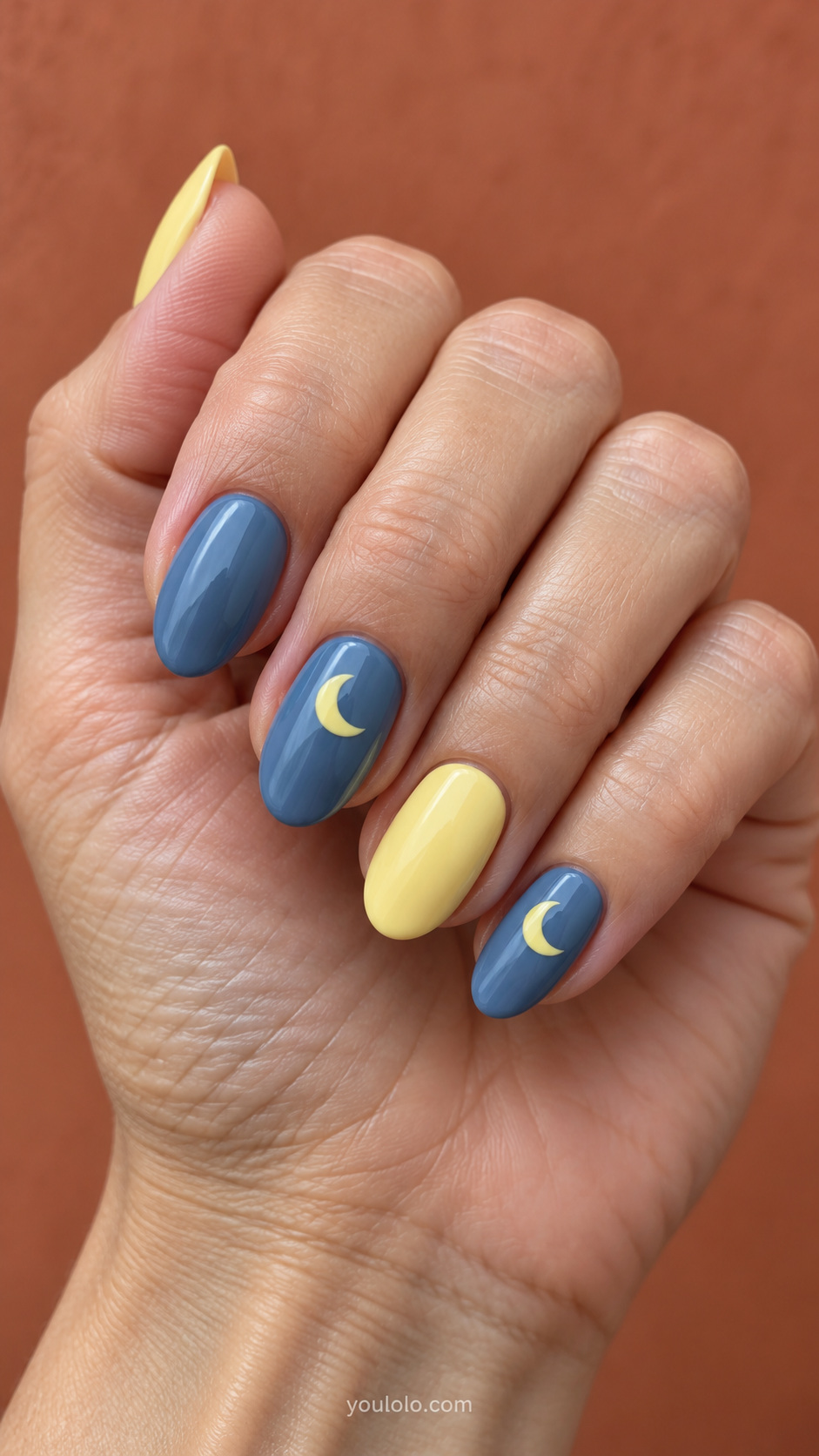
Place one small butter-yellow crescent moon on each of two muted-blue accent nails. Keep the remaining nails plain blue or yellow. Use a clear crescent silhouette, leaving enough background inside the curve that it cannot be mistaken for a dot or a small banana-shaped stripe.
16. Blue and yellow border nails
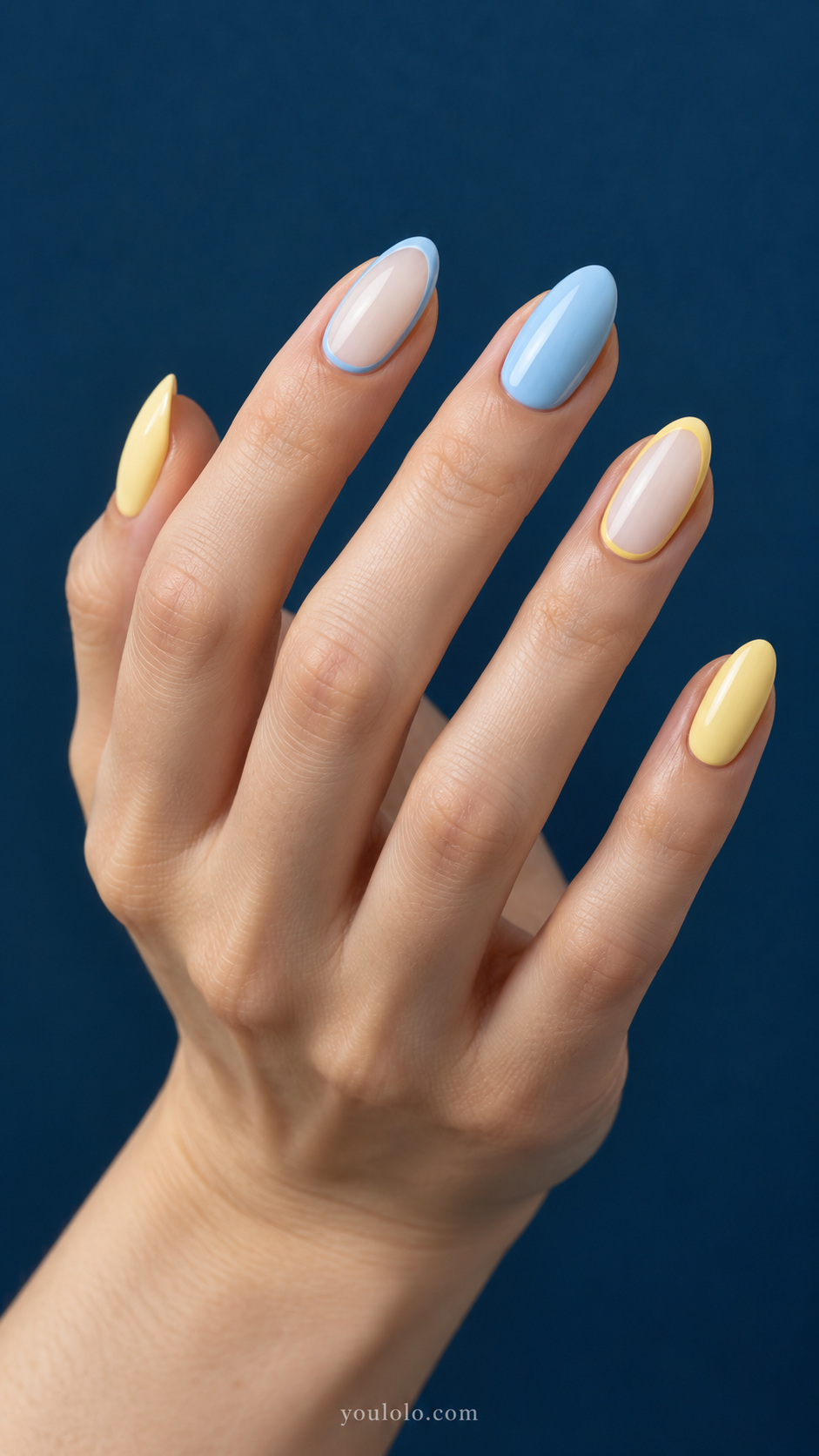
Outline an ivory nail with a thin blue border and another ivory nail with a thin yellow border. Keep the centers open and pair these with solid pastel nails. A slightly deeper yellow can make the outline more legible without changing the overall soft palette.
17. A blue fan of lines over yellow

On one yellow accent nail, draw three fine blue lines that fan outward from one side near the tip. Leave the rest of the surface yellow. This asymmetrical arrangement differs from all-over stripes and works best when the lines remain separated all the way to the edge.
18. Yellow hearts on powder blue

Choose one or two small yellow hearts on a blue accent, with plain blue and yellow nails around it. Keep the heart shape crisp and the spacing generous. A single larger heart can work better on a short nail than several miniature shapes crowded together.
19. Blue marbling with solid butter yellow
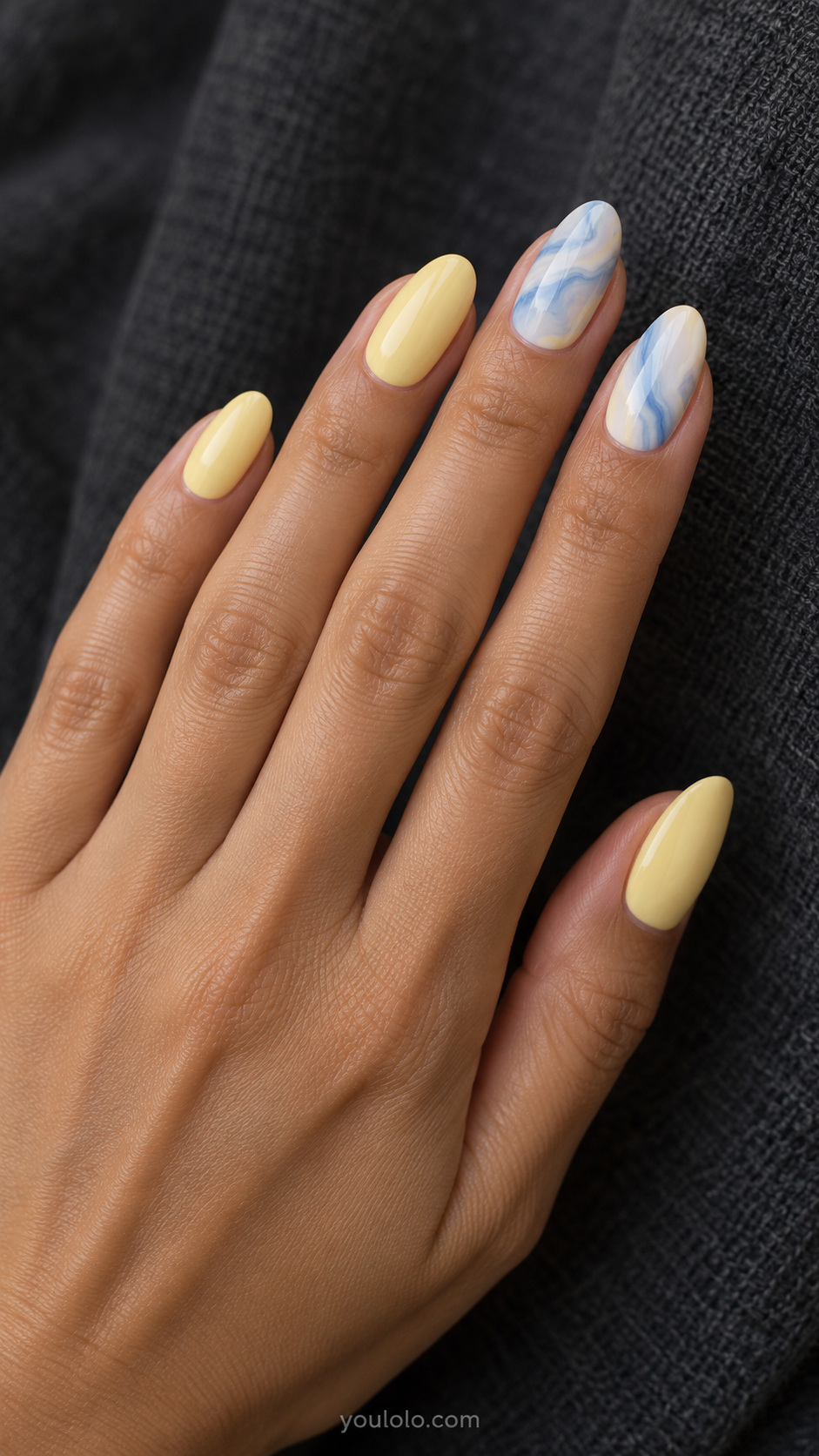
Create soft blue-and-ivory marbling on two nails and use solid yellow elsewhere. The blue veins should vary in width rather than resemble identical stripes. Leave visible ivory areas between the veins, and avoid introducing black or metallic gold if you want to preserve the pastel mood.
20. Pastel color-block diagonals
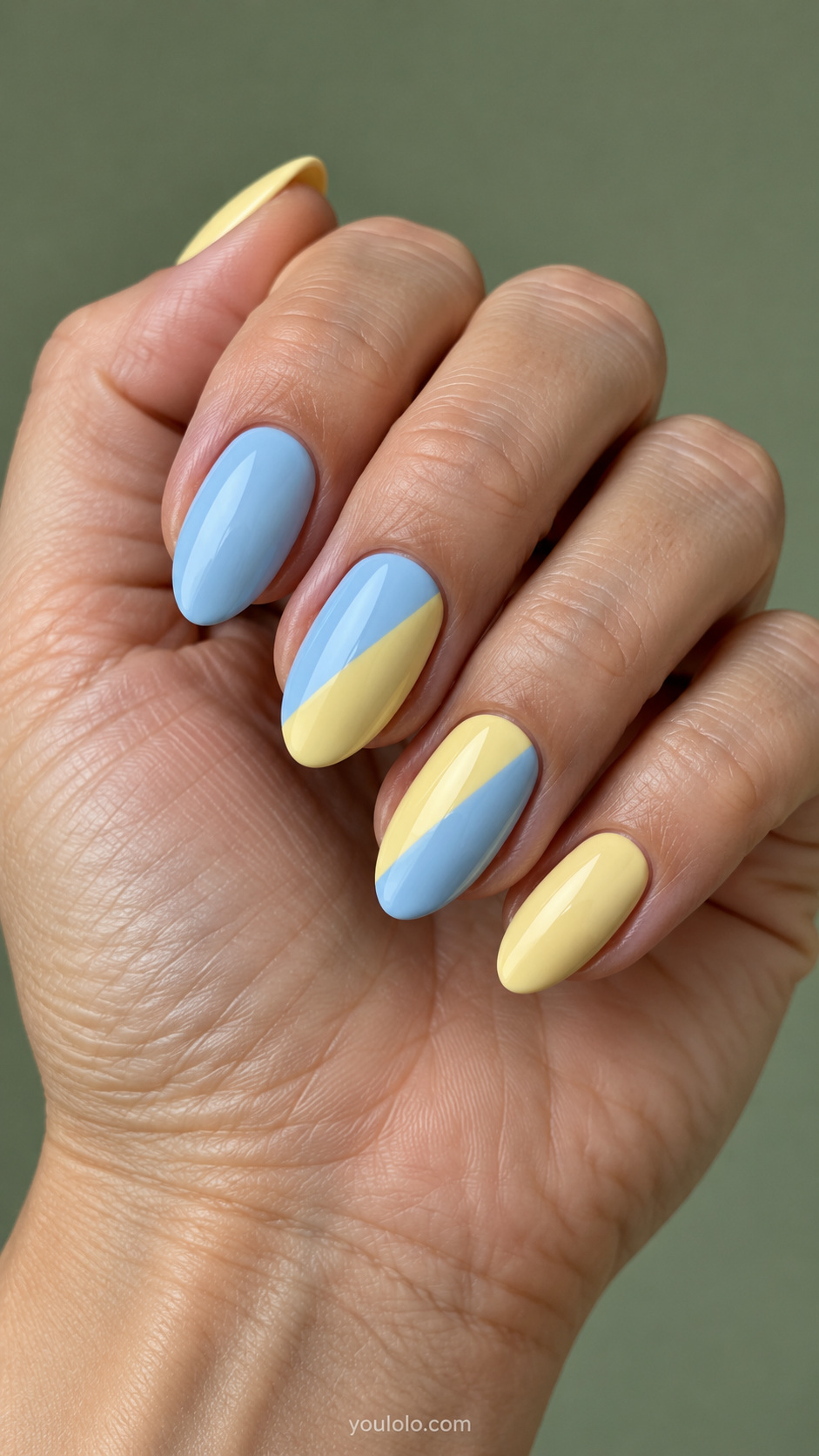
Divide two nails diagonally into powder-blue and butter-yellow sections, then repeat those colors as solids on the remaining nails. Use a straight boundary and matching gloss across both sections. This is a crisp geometric alternative to waves or softly blended aura effects.
21. A tiny blue star constellation
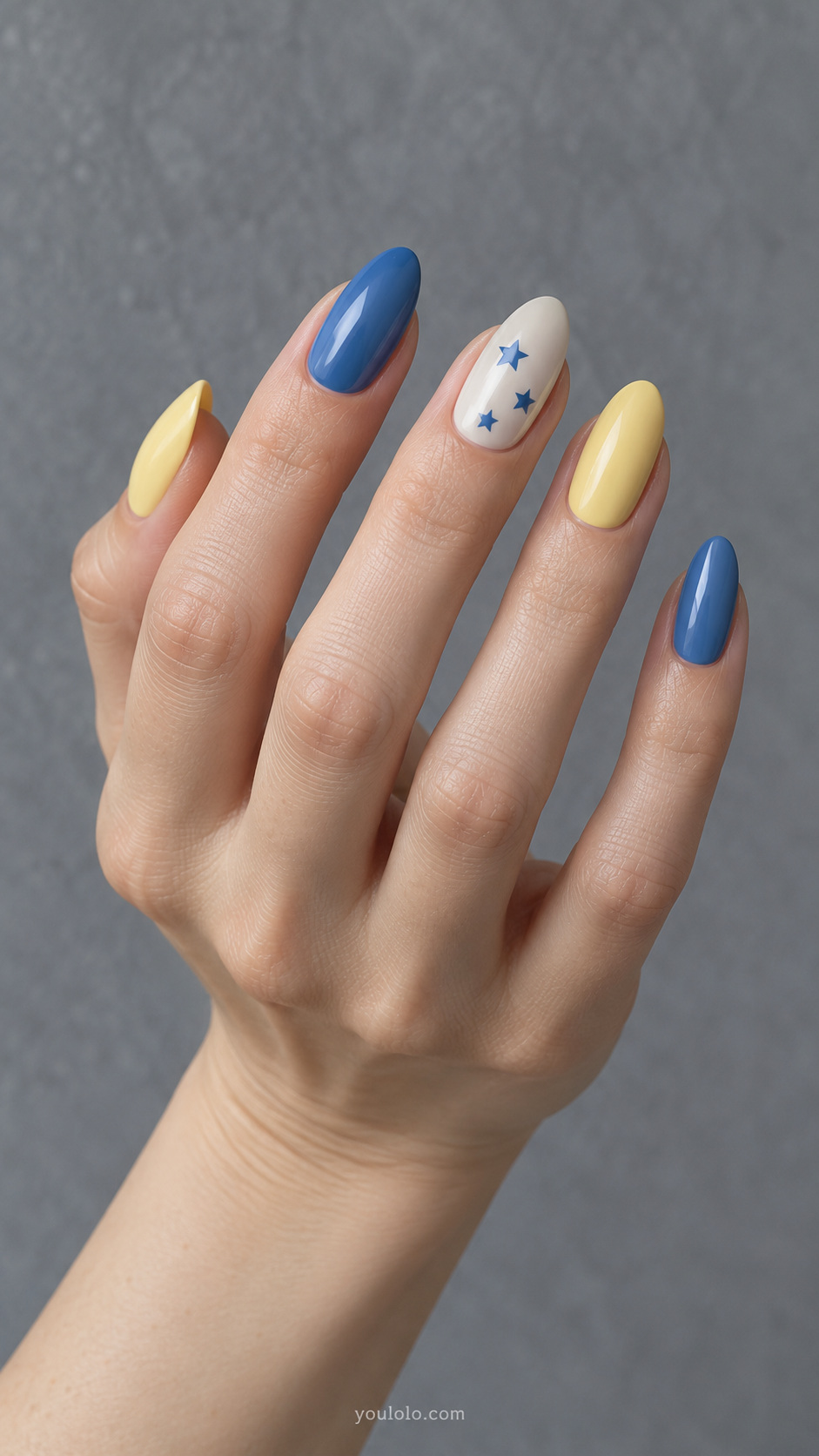
Arrange three small blue stars at different heights on an ivory accent nail, using solid yellow and blue on the other fingers. Vary their size slightly and keep them spaced apart. There is no need for connecting lines; the staggered placement supplies the constellation effect.
22. Blue tips with yellow scallop borders
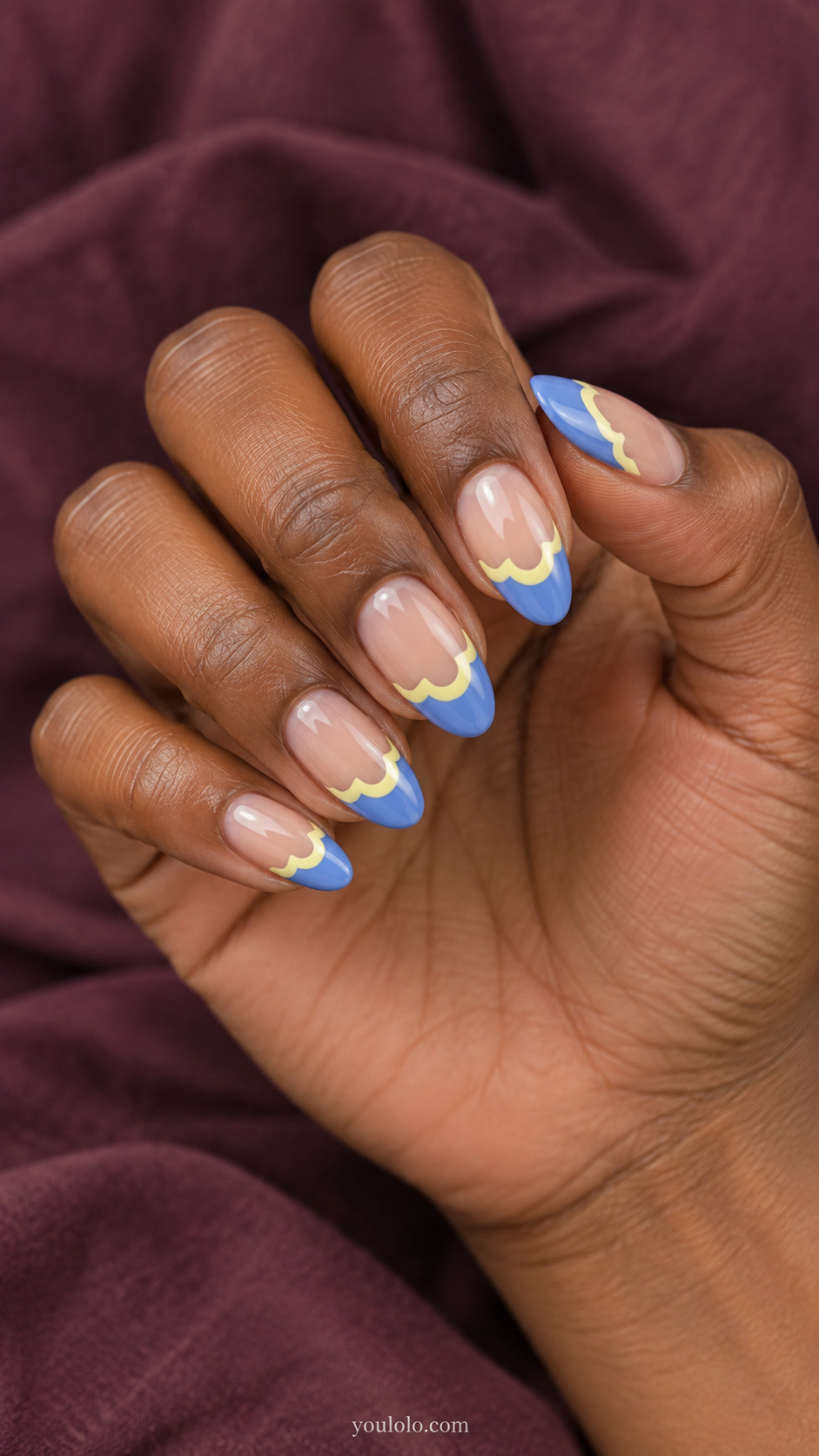
Give blue French tips a soft yellow scalloped border along the inner edge. Keep the main nail sheer and use only a few rounded scallops per nail. This design needs a clearly defined border; too many tiny curves can blur into an uneven line.
23. Butter yellow with blue side swooshes

Add a narrow blue curve along one side of each yellow nail, leaving most of the yellow surface uninterrupted. The curves can vary slightly but should follow the same direction. This creates a coordinated design with less coverage than full stripes or a divided color block.
24. Blue and yellow brushstroke accents
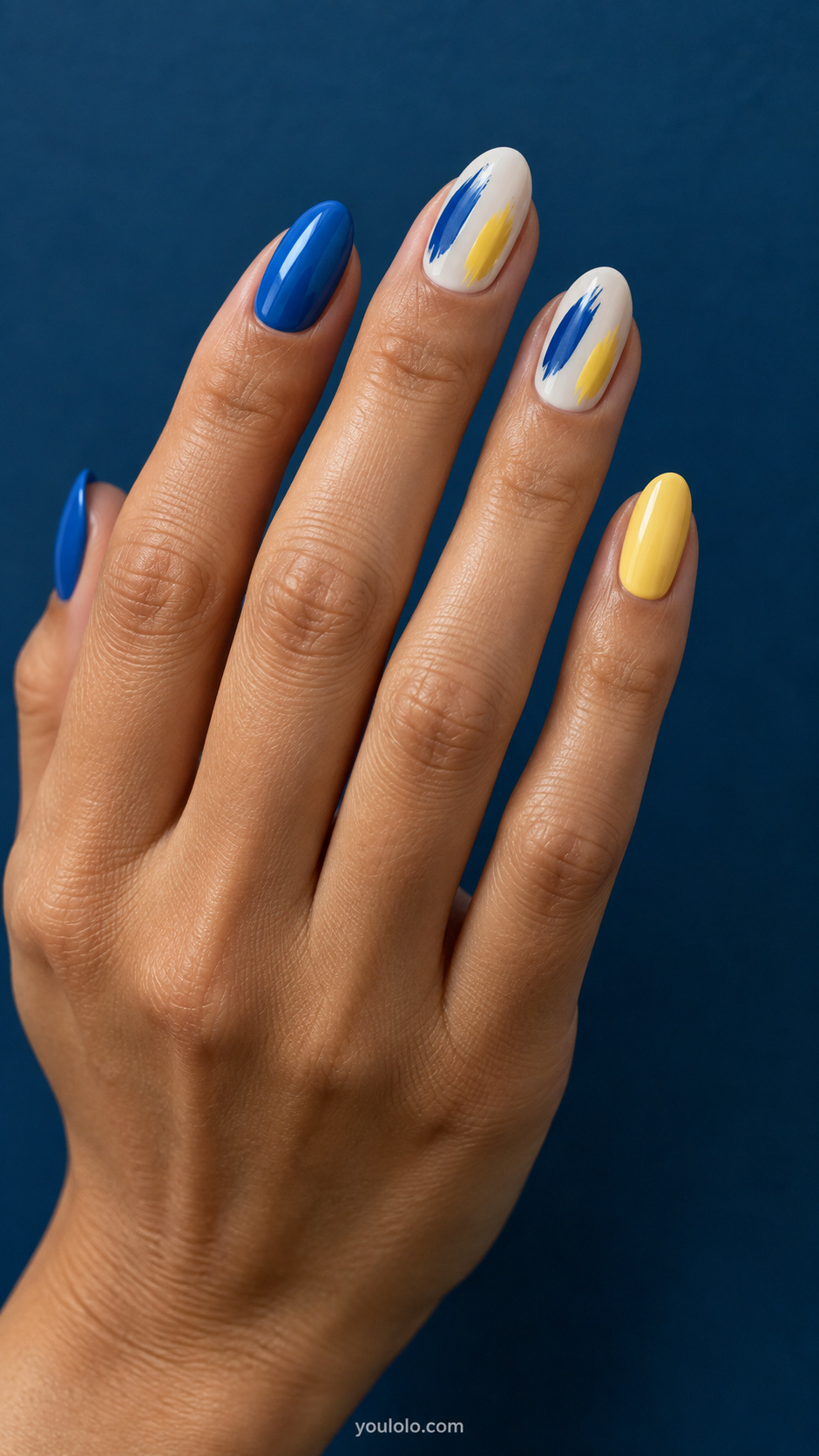
Place one short blue brushstroke and one shorter yellow stroke on each ivory accent nail, leaving their ends visibly tapered. Pair two painted accents with solid blue and yellow nails. The imperfect brush edges are intentional here, unlike the clean boundaries of the geometric options.
About the “Italian summer” label
You may see similar colors and motifs described as Italian summer or European vacation nails. Those phrases describe an aesthetic mood, not a standardized manicure technique or proof of where a design originated. For a salon appointment, the useful information is the actual palette, pattern, shape, and finish.
Ask for “powder blue, butter yellow, and ivory with thin stripes and one star accent.” That is much clearer than expecting a travel-themed name to communicate the exact result.
Choosing between flat and raised stars
Decide how much texture you want before the design is made. A painted star keeps the visual detail on a flat surface. A raised charm becomes a physical feature of the nail, so discuss its size and placement with your artist or check the press-on listing carefully.
You can also mix one star nail with flat patterns elsewhere. There is no need to add three-dimensional decoration to every finger to preserve the idea.
How to balance butter yellow nails with blue
Butter yellow nails can be the main color of the manicure or a small accent among blue nails. Choose the balance before the artwork. A yellow-led set feels warmer; a blue-led set makes the yellow look like a bright detail. Ivory is useful when you want a separate background for a star or flower.
For a simple starting point, compare the French tips in design 4 with the half moons in design 12. Both use clear areas of color. If you prefer a softer transition, design 11 places a blurred yellow center inside blue. These are different layouts rather than interchangeable names for the same effect.
Decide how graphic the manicure should be
Striped butter yellow nails need distinct boundaries between colors. The marbled option allows softer edges, while the brushstroke option deliberately leaves tapered marks. Bring the reference that matches the finish you want; the same shades can produce a very different manicure depending on the edges.
On shorter nails, keep stars, hearts, and bows large enough to recognize but small enough to leave space around them. One motif on an accent nail is a useful starting point. If the surface looks crowded, simplify the pattern before changing the entire palette.
Use the blue shade to change the mood
Powder blue gives butter yellow nails a gentle contrast. A clearer or deeper blue makes the edges and small motifs more noticeable. Compare your chosen blue with the yellow in the same light, because a muted shade on a screen may look different from a physical polish sample.
For a flat design, ask for painted stars or bows. If you want raised decoration, agree on the size and placement separately. Butter yellow nails do not need a charm on every finger; one accent can carry the idea while the remaining nails repeat the palette.
For the dotted options, see OPI’s Dotticure tutorial as a reference for arranging individual dots. Choose the blue, yellow, and ivory shades from this collection rather than assuming the tutorial uses the same palette.
If linework is the part you like most, our pink striped manicure collection gives more arrangements to compare. A simple racing stripe or chevron can also be adapted to butter yellow nails with a blue accent.
Butter yellow nails: frequently asked questions
Does this palette work on short nails?
Yes. Solid colors, a few dots, and one simple star are straightforward ways to keep the motifs legible on a smaller surface.
Do the two hands need to match?
No. Repeat the palette and use a similar amount of pattern on each hand. Different placements can still feel coordinated.
Can I order the design as press-ons?
Yes, if a seller offers the artwork and suitable sizing. Check the product’s measurements, attachment instructions, and removal guidance; the color scheme alone does not tell you how the set is constructed.

[…] another direction, explore our blue and butter yellow nail ideas and compare the amount of pattern before choosing your next […]