The Best Fluffy Pancakes recipe you will fall in love with. Full of tips and tricks to help you make the best pancakes.


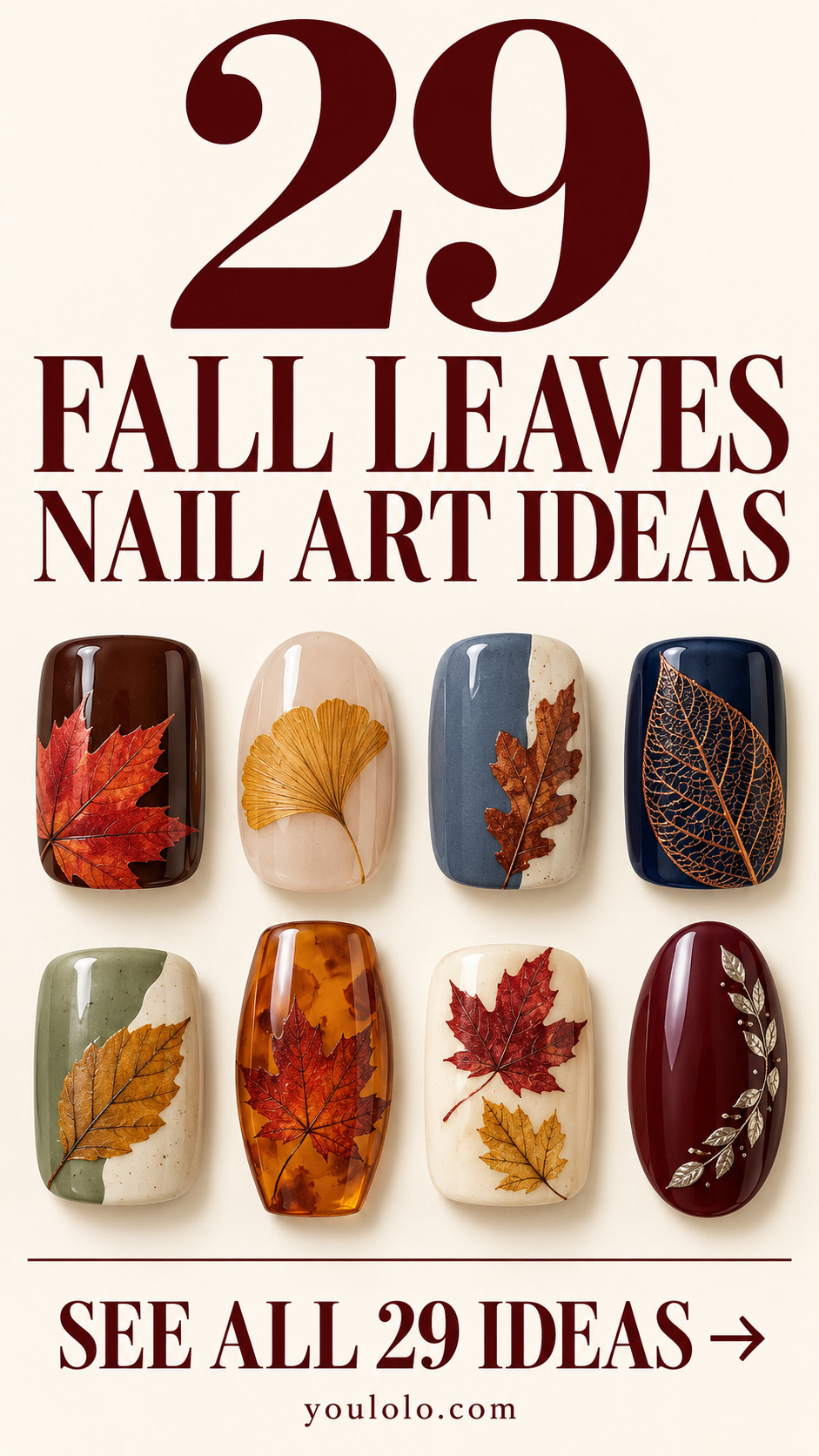
Fall leaves nail art can be much more than a gold decal on brown polish. A cropped maple, a little ginkgo fan or a fine leaf outline changes the whole mood of a manicure. This collection brings together 29 distinct arrangements, with short, square, oval, almond and coffin shapes to compare.
Start with the amount of artwork you want: one accent, a repeated small motif or a full graphic set. Each look includes a short salon brief so you can explain the placement and scale, not just point to a color. Save the design that matches your nail length, then adapt the base shade to your own taste.
Small leaves and clean shapes for everyday nails
1. Maple Corner on Short Squares
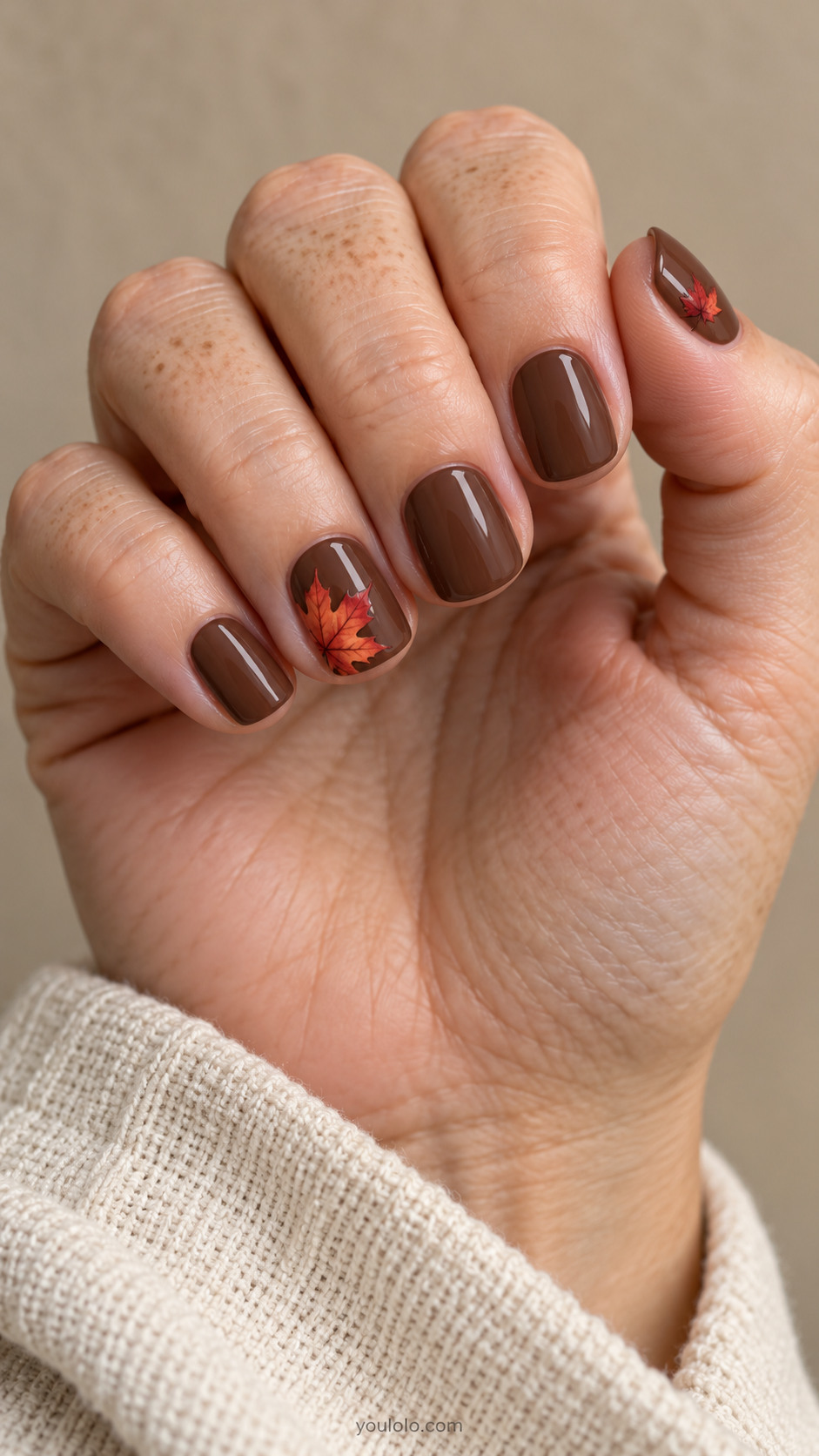
A maple leaf does not need to sit in the middle of the nail. Letting its pointed edges enter from one corner gives this short set a bolder, more graphic look. Milk chocolate keeps the red lively without a stark white background. Keep the other fingers plain so the cropped leaf remains the first thing you notice.
Salon brief: One large corner maple, chocolate base, crisp red edges.
2. Ginkgo Fans from the Cuticle
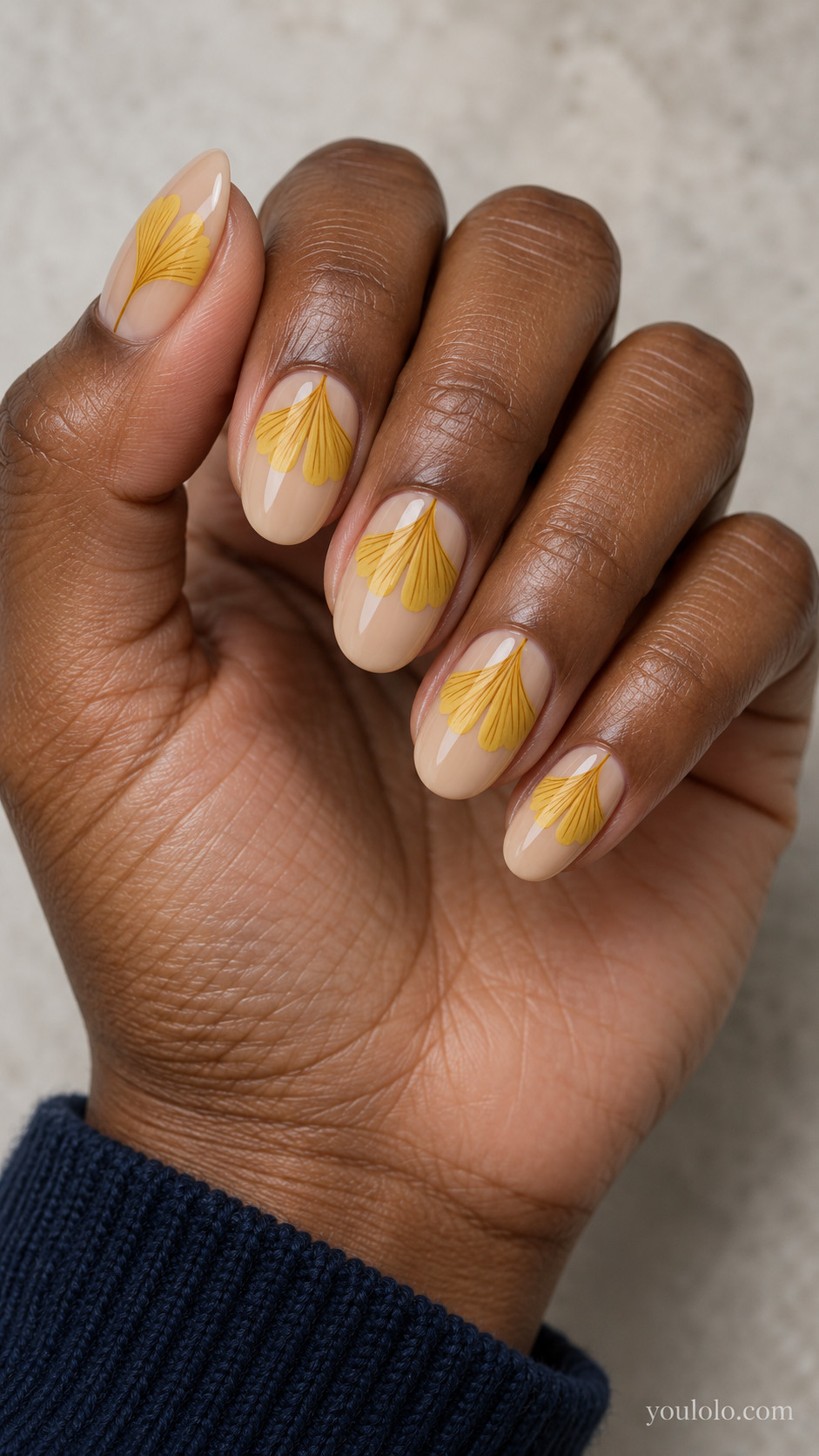
The ginkgo fan opens toward the middle of each nail, with fine veins spreading from a small point near the cuticle. Mustard paint feels softer than bright metallic gold, especially over sheer beige. Ask for a little clear space between the leaf and skin; that breathing room keeps the lower edge neat while the fan supplies the shape.
Salon brief: Mustard ginkgo fans opening from near the cuticles; leave clear margins.
3. Oak Leaves on a Narrow Side Panel
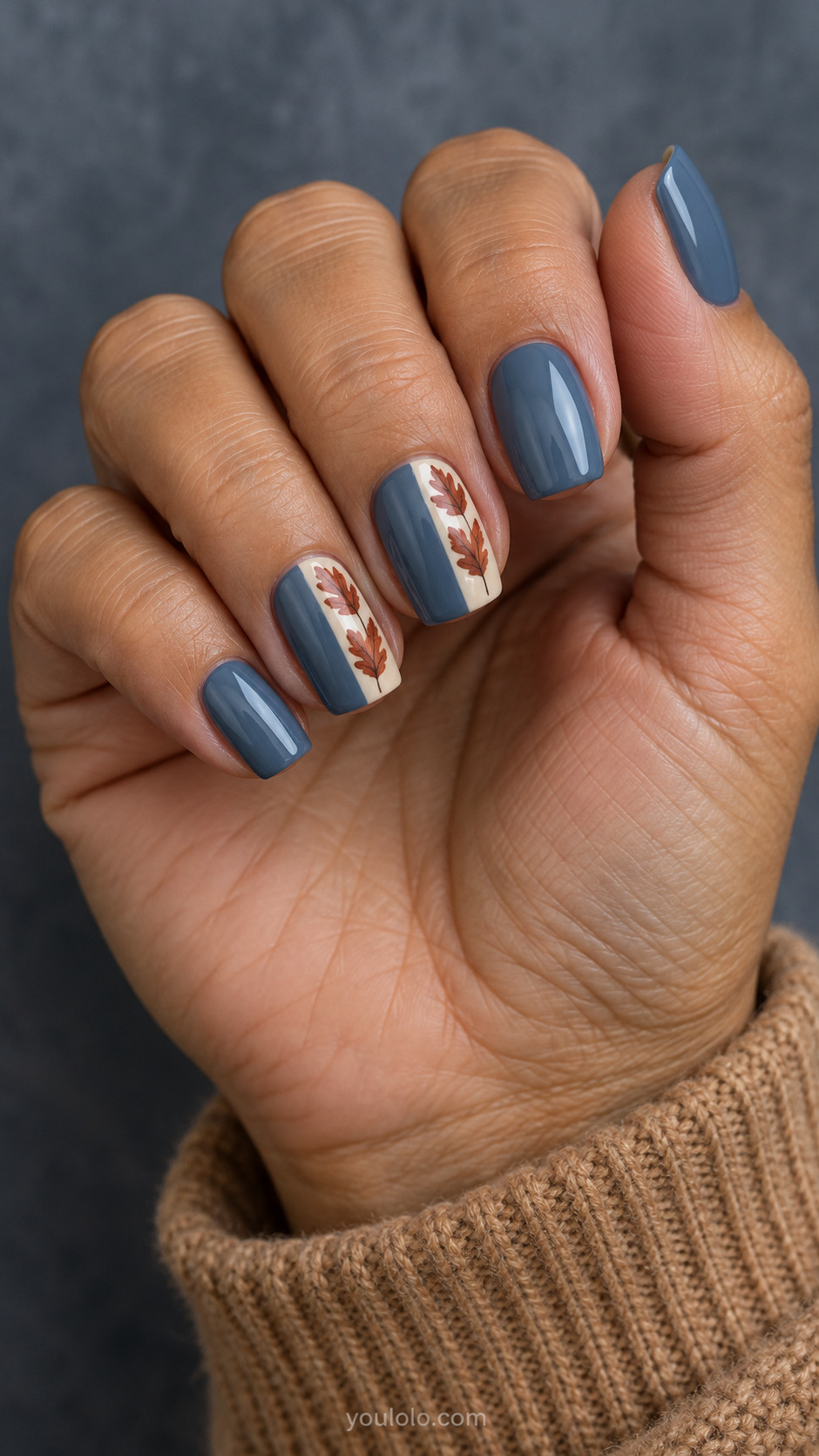
A narrow ivory panel gives the oak leaves their own space without turning every nail into a full print. The dusty blue is an easy partner for rust, and the squared edges make the little panels feel intentional. Keep the oak silhouettes small enough that their rounded lobes remain recognizable rather than merging into an orange stripe.
Salon brief: Two ivory side panels with small rust oak leaves.
4. Falling Birch Confetti
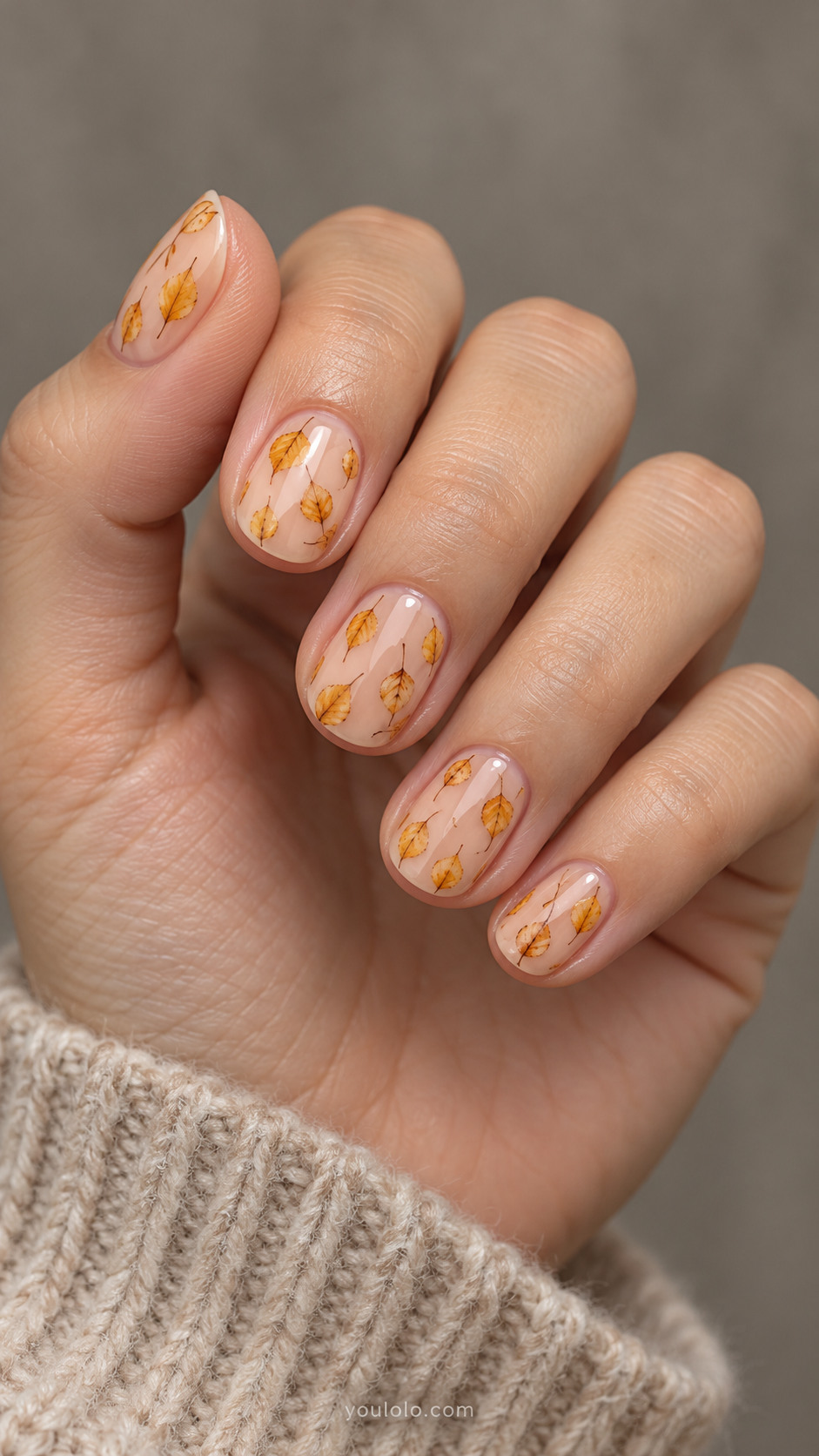
Think scattered leaves, not glitter confetti. Tiny yellow birch shapes give these short nails movement, with each one turned in a slightly different direction. The peach base lets the nail show through and keeps the pattern light. A few fine stems are enough detail at this scale; there is no need to outline every miniature leaf heavily.
Salon brief: Sparse yellow birch leaves on sheer peach, no glitter.
5. Maple French Corners
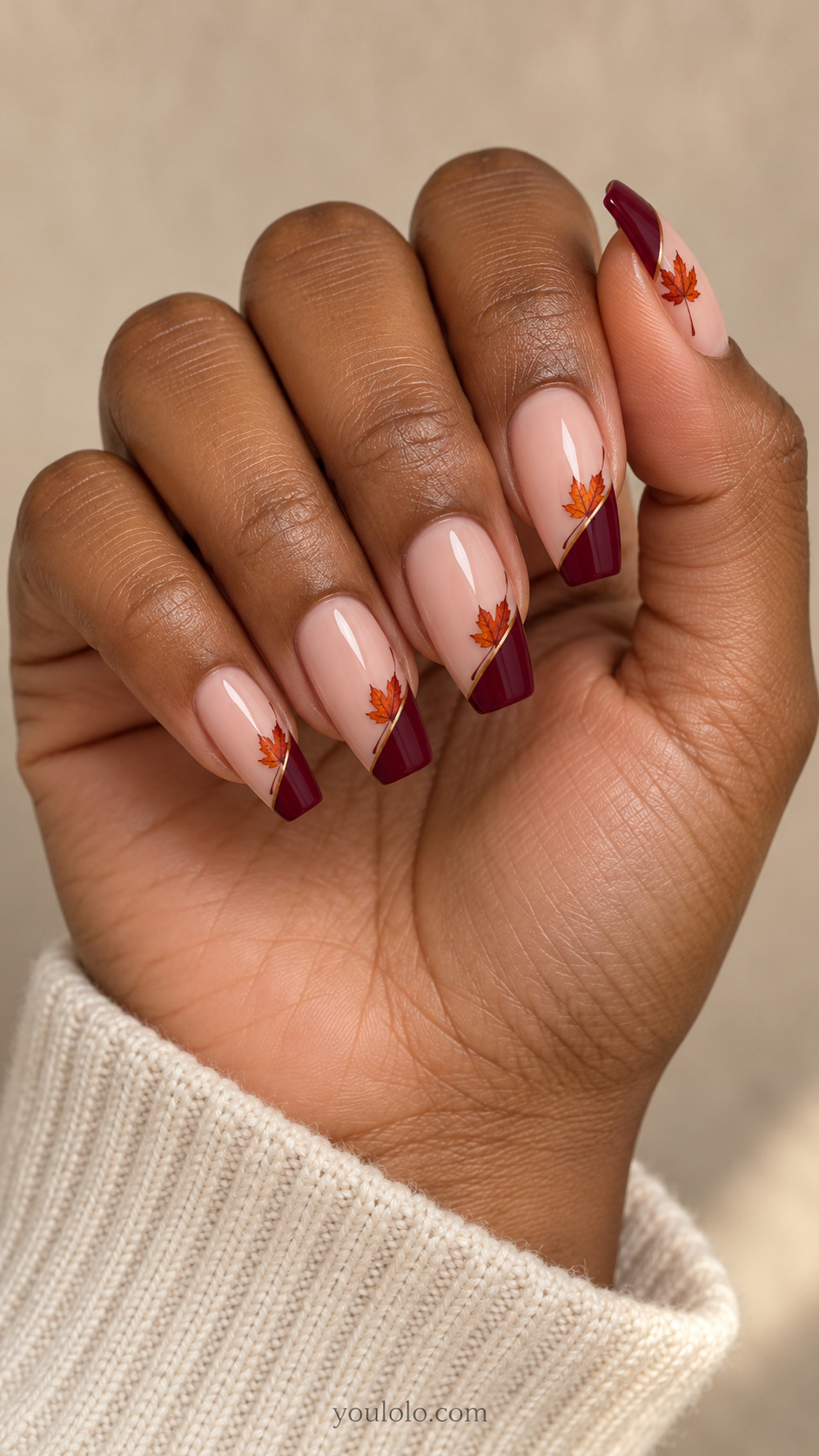
These diagonal tips leave more visible nude space than a deep French smile. Small maple leaves sit against the burgundy edge, as if they have landed on it. The trick is restraint: one leaf per nail gives the angle room to read. A medium coffin shape provides a clean corner while staying practical enough for a modest extension.
Salon brief: Diagonal burgundy corners with one orange maple at each border.
6. Outlined Aspen Leaves
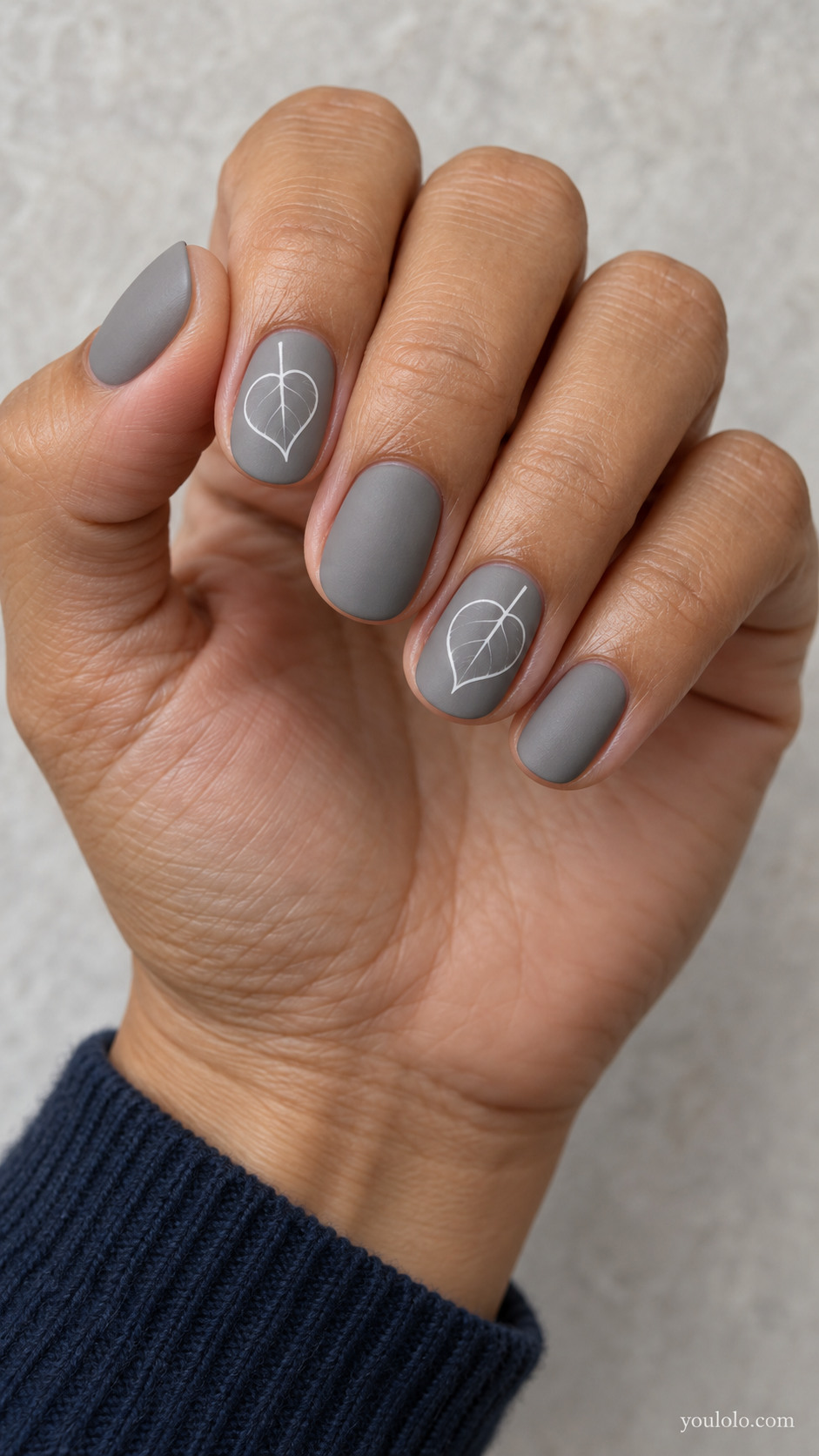
Outline-only leaves are a quieter way to wear autumn nail art. White lines sit softly against warm gray, and the rounded aspen shape is gentler than a pointed maple. Alternate illustrated nails with plain ones to avoid a busy all-over pattern. The matte finish helps the drawing look deliberate rather than disappearing into a glossy reflection.
Salon brief: White aspen outlines on matte gray; alternate plain nails.
7. Leaf Windows in Espresso
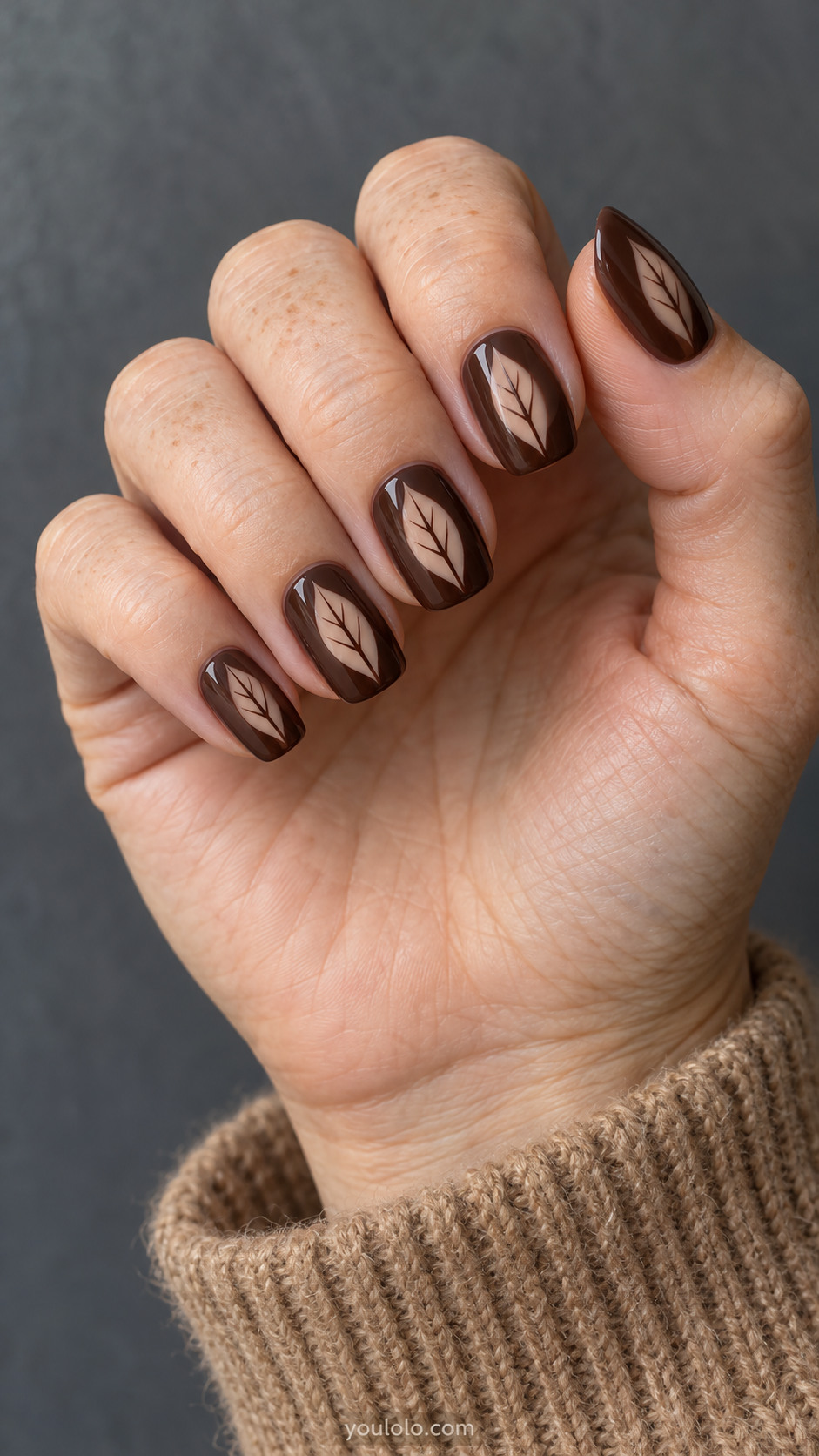
The leaf is the space left unpainted. Espresso surrounds a small oval window, with slim branching veins tying the shape back to the surrounding color. This is a graphic option for someone who likes dark nails but wants a fresh detail. Keep the window comfortably inside the nail edges so the manicure reads as a planned design.
Salon brief: Espresso surround, clear leaf windows, fine branching veins.
8. Terracotta Leaf Tile
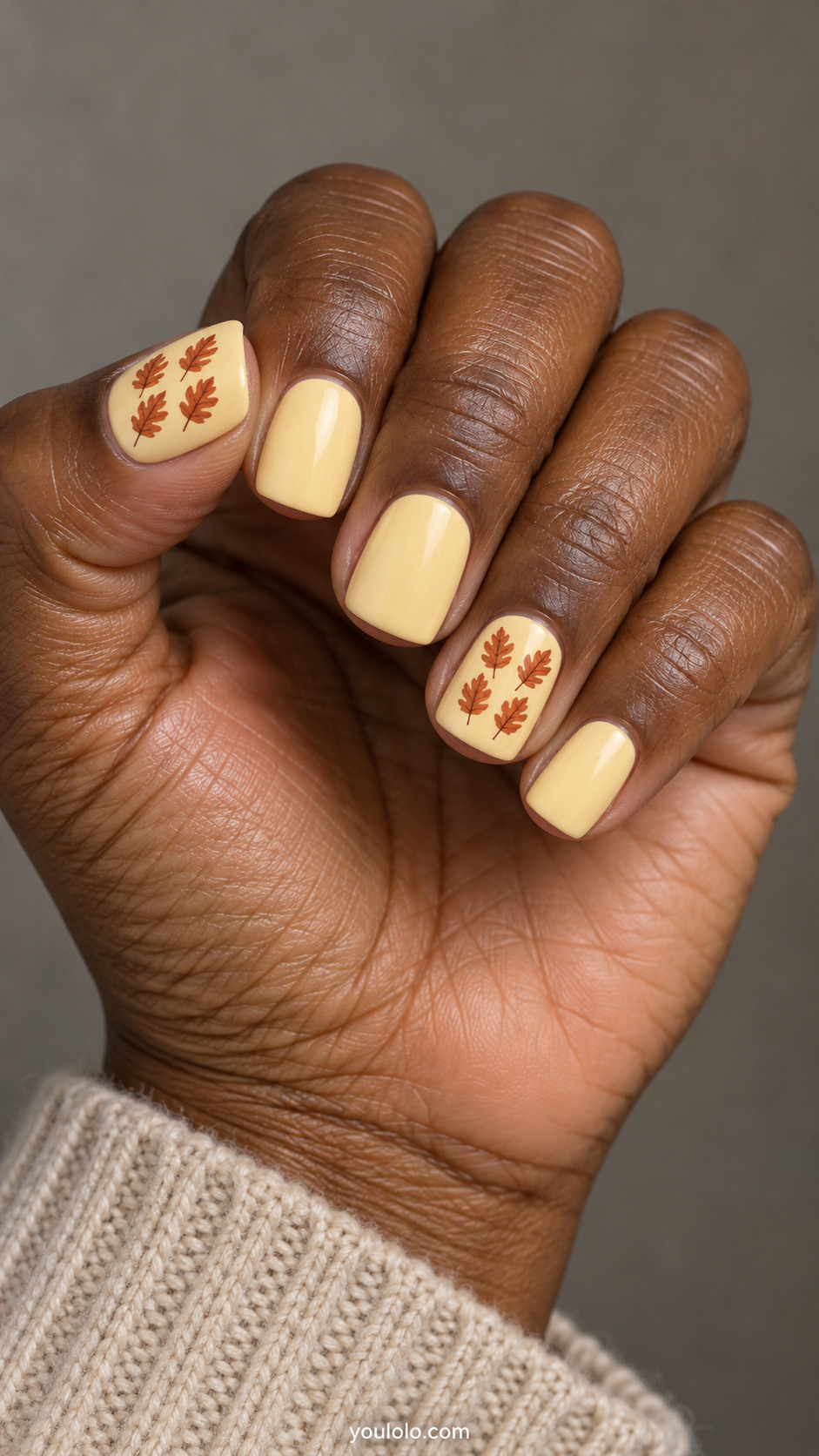
A repeated tile layout feels different from a loose botanical sketch. Four little oak leaves sit in a tidy block, giving the accent nail a pattern you can recognize from a distance. Pale yellow softens the terracotta without making it sugary. Limiting the tile to the thumb and ring finger keeps the small square shape from feeling crowded.
Salon brief: Four-leaf terracotta tile on two pale yellow accent nails.
Detailed leaf art with room to breathe
9. Watercolor Japanese Maple
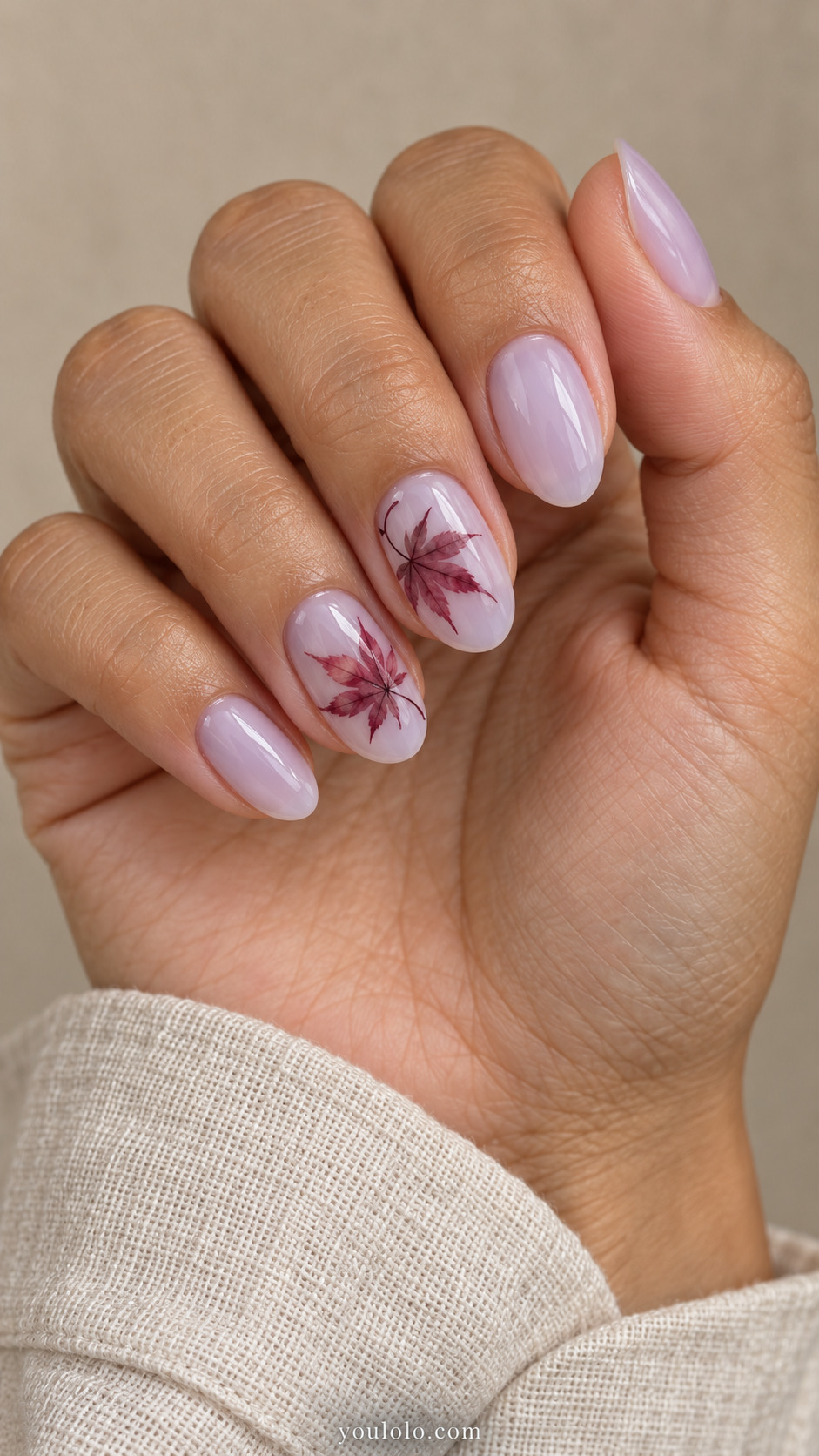
Slender Japanese maple lobes bring an airy, almost ink-like quality to the set. Burgundy washes make the leaves feel light instead of solid, while milky lavender adds a cooler autumn mood. Give each accent leaf enough room for its narrow points. The plain fingers are useful here: they keep the watercolor detail from competing with another pattern.
Salon brief: Two airy burgundy Japanese maple accents on milky lavender.
10. Copper Leaf Vein Cutouts
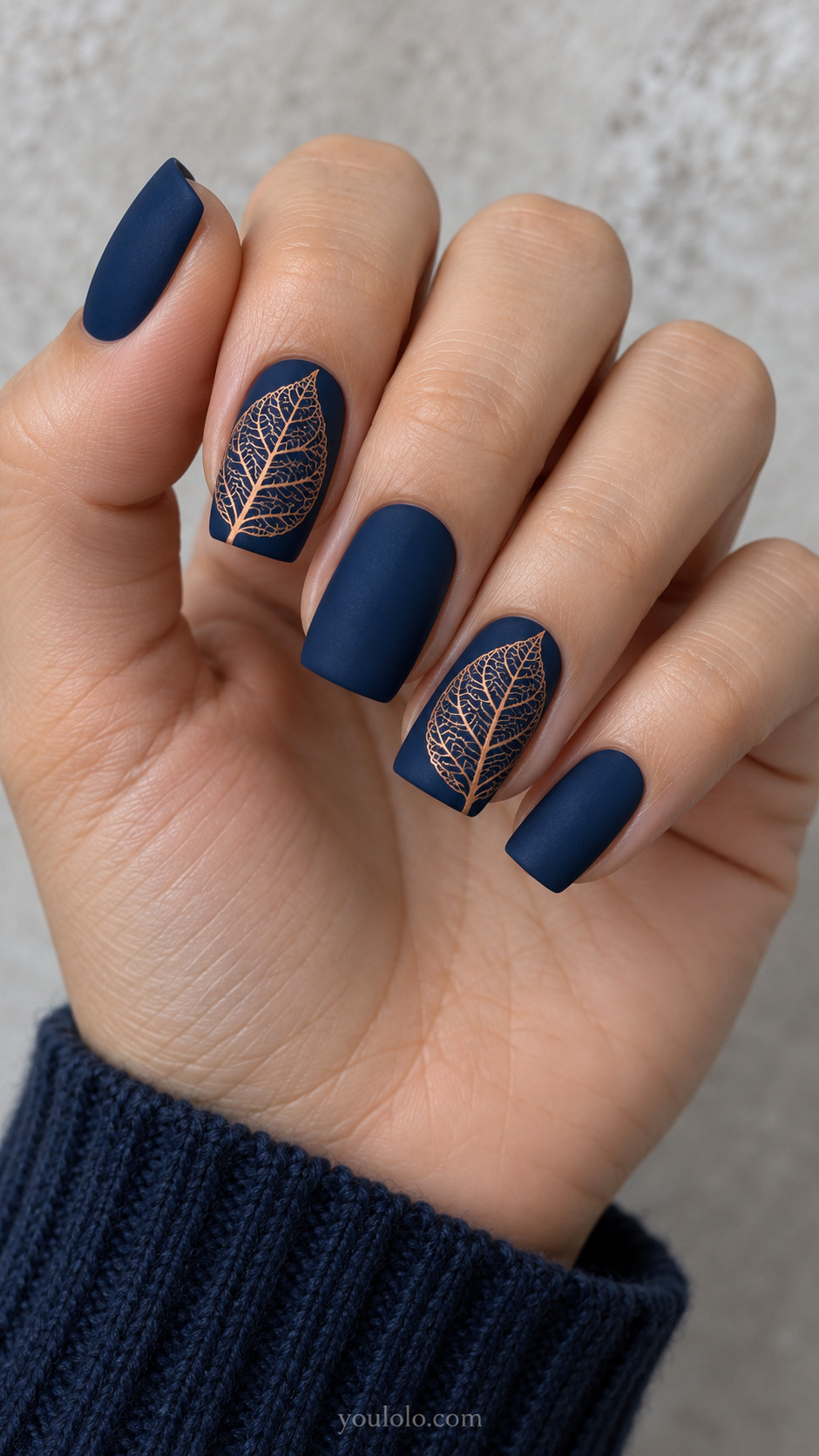
A skeleton leaf shows its structure rather than a solid block of color. Copper lines against matte navy make that delicate network visible, especially on a square nail with enough width. Use painted metallic detail rather than thick raised decoration. Two accents are plenty; the dark plain nails make the intricate lines feel cleaner and more expensive.
Salon brief: Flat copper skeleton leaves on two matte navy nails.
11. Diagonal Rowan Leaf Trail
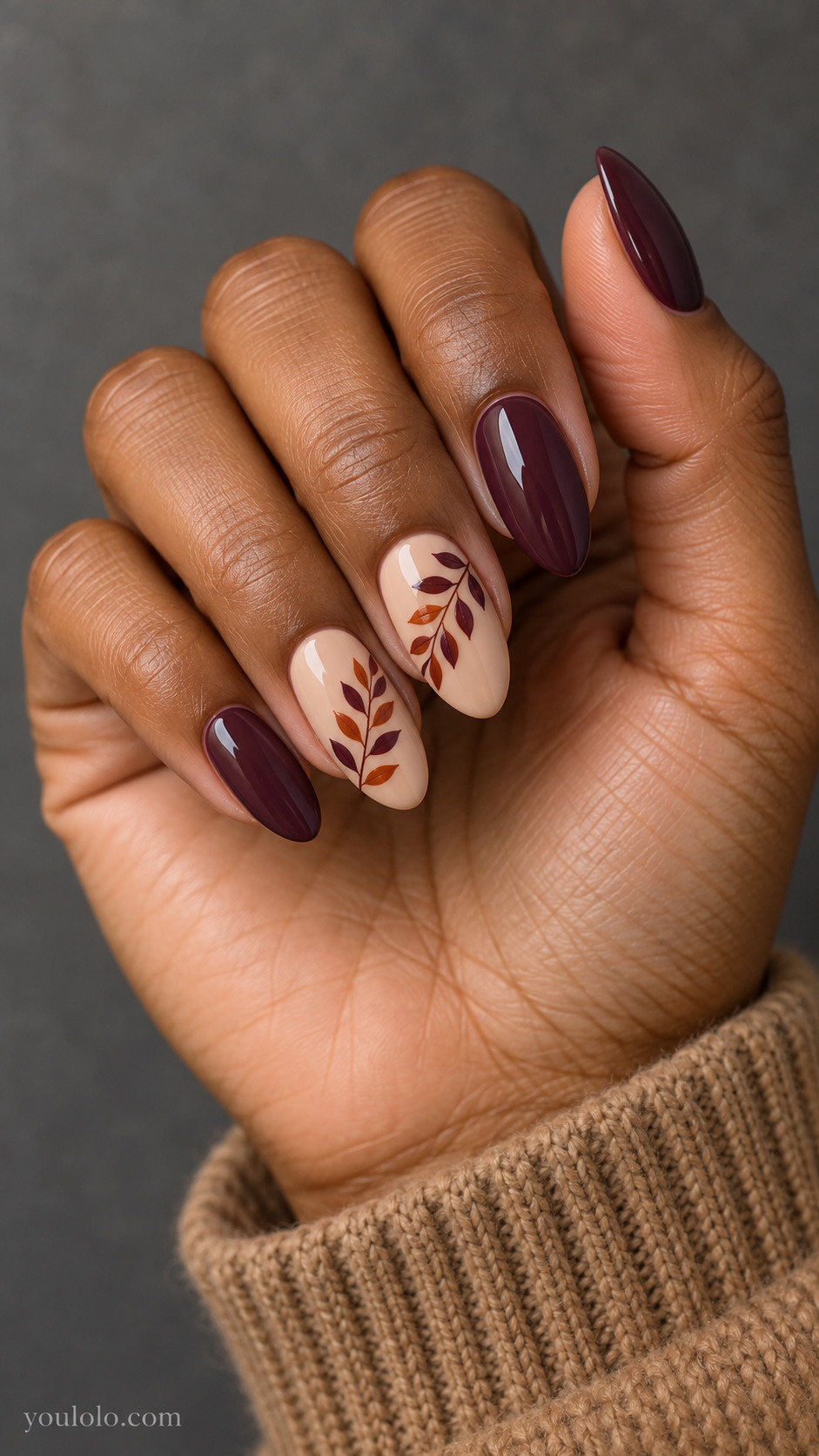
The rowan branch has a different rhythm from a single large leaf. Its paired leaflets form a slim diagonal trail, with orange and plum repeating along the stem. Setting that trail on two creamy nails lets the shape stay readable. Solid plum on the remaining fingers gives the manicure a clear anchor instead of five competing illustrations.
Salon brief: Two diagonal rowan trails, cream base, plum companion nails.
12. Sage and Ochre Leaf Patchwork
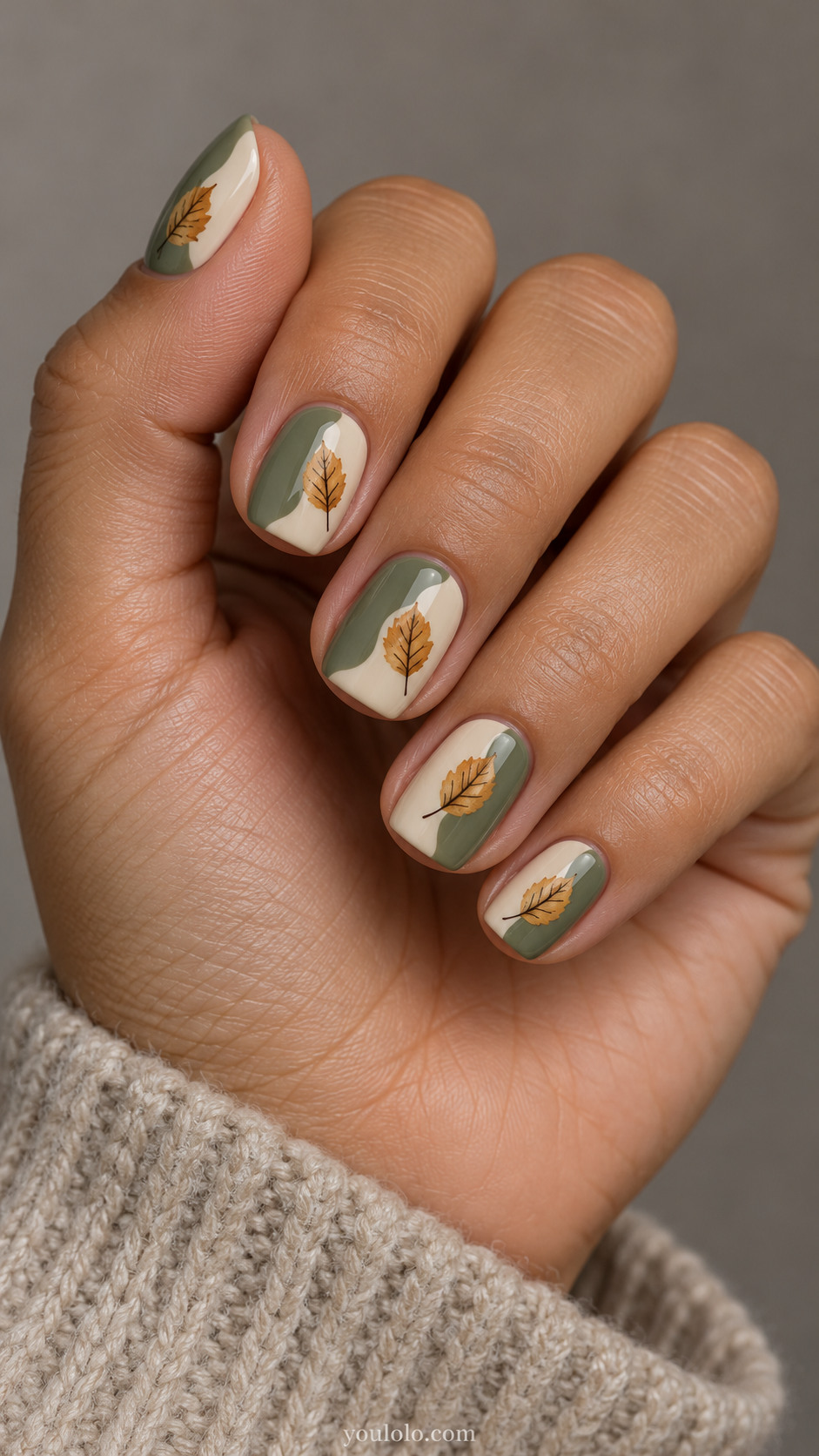
Color blocking gives this set its structure before the leaf is added. Sage and ivory meet at an irregular line, and one little ochre beech leaf bridges the join. The rounded leaf shape softens the geometric background. Keep the blocks broad and the leaf small; that scale difference is what makes the patchwork look considered on short nails.
Salon brief: Broad sage and ivory blocks with one tiny ochre leaf each.
13. Fallen Leaves Along the Tips
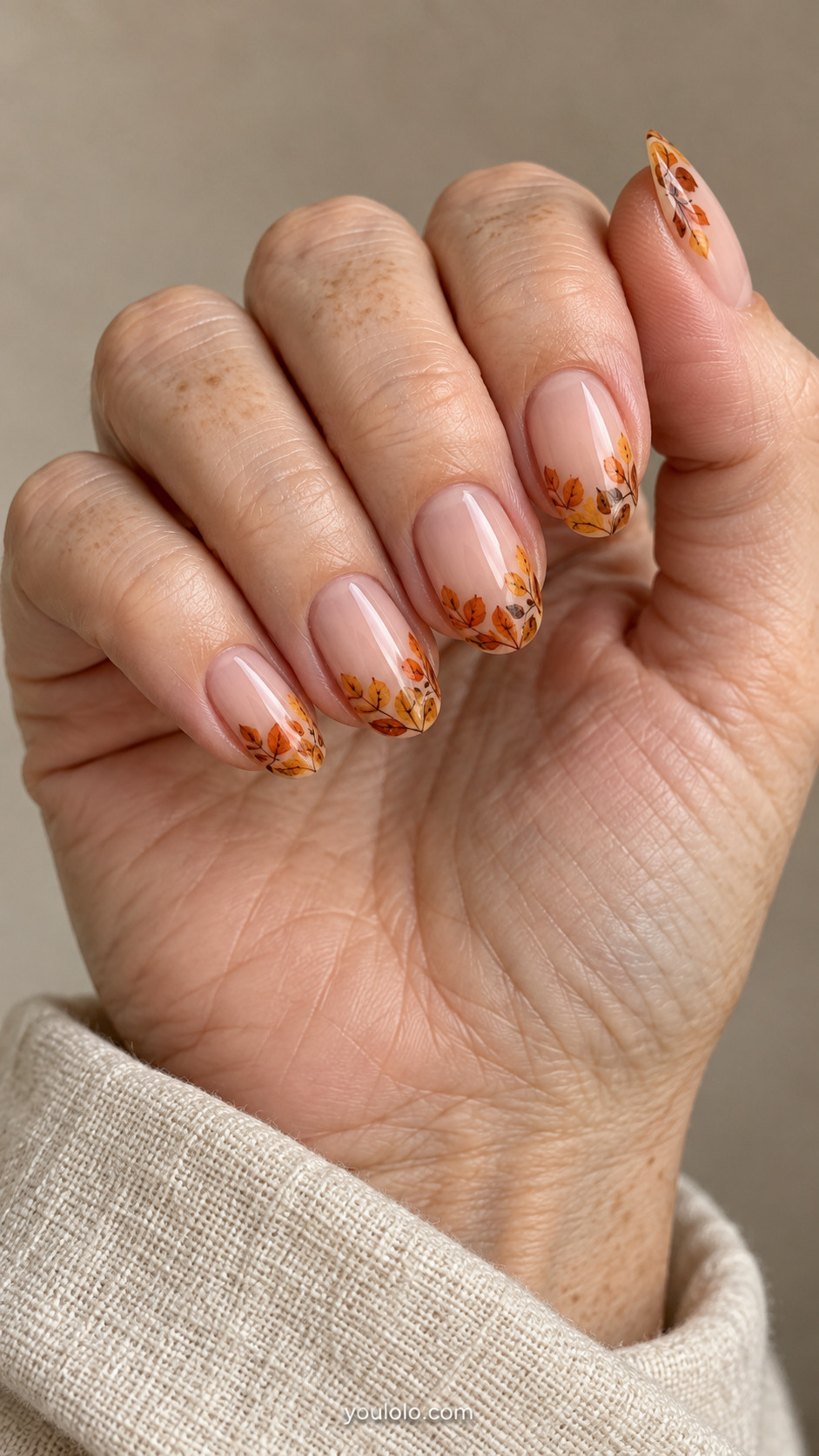
Instead of a solid French tip, this border is built from little fallen leaves. Warm amber and brown shapes overlap lightly at the free edge, leaving the rest of the nail open. It is a useful option when you want seasonal detail without covering the whole nail. Keep the border uneven, but not so deep that the transparent base disappears.
Salon brief: A narrow scattered-leaf border at each free edge.
14. Black Ink Beech Print

Black botanical linework gives dusty rose a sharper mood. Beech leaves have a simple enough outline for a short nail, but their fine serrated edges add interest close up. Two printed accents keep the look easy to wear with darker clothes. Ask for thin interior lines so the veins support the leaf shape rather than filling it in.
Salon brief: Fine black beech leaf sprigs on two dusty rose accent nails.
15. Amber Jelly Leaf Layers
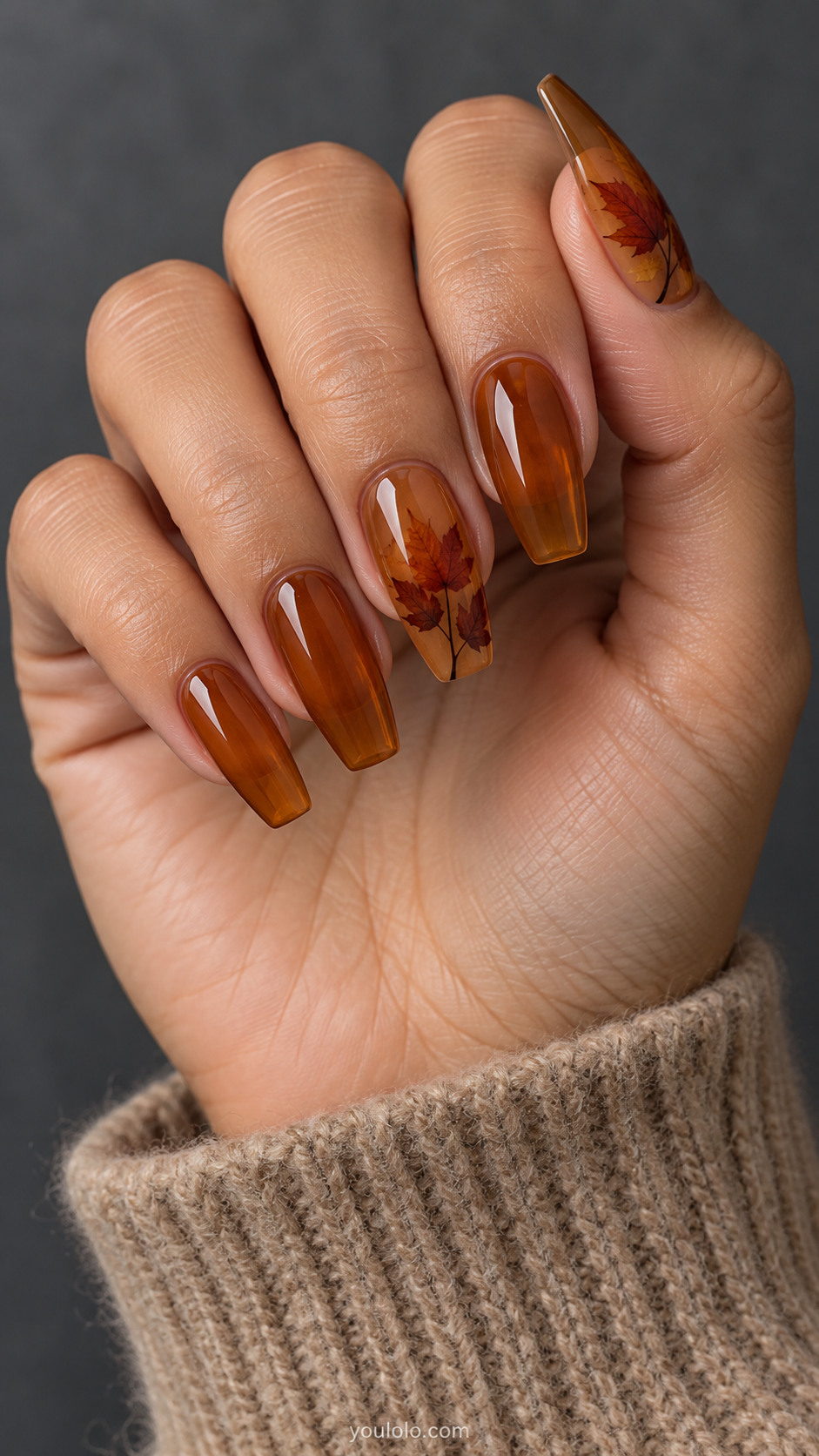
Translucent leaf artwork creates depth without bulky decoration. Russet maple shapes sit inside an amber jelly effect, with fine dark stems keeping their outlines clear. Save the artwork for the thumb and middle nail rather than covering every finger. The plain jelly nails matter just as much: they let the light come through and stop the set from looking heavy.
Salon brief: Russet maple leaf artwork on amber jelly thumb and middle accents.
16. Tiny Leaves and Fine Pinstripes
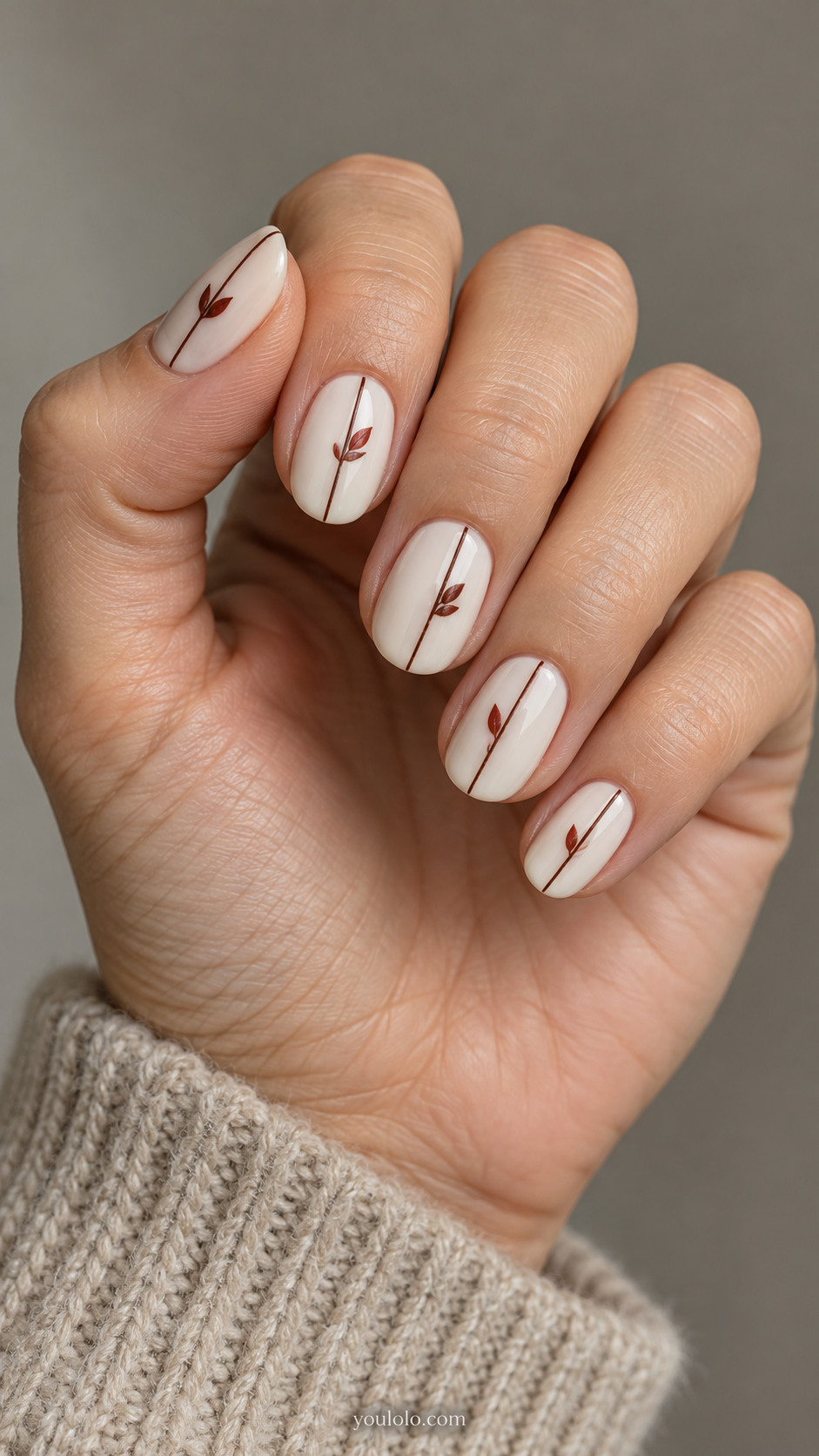
One pinstripe gives the tiny leaves a place to sit. Moving the leaf accents slightly higher or lower from finger to finger makes the pattern feel less rigid, while chocolate and brick red keep it grounded. This suits short oval nails particularly well because the design uses length rather than width. Avoid extra dots or foil; the clean spacing is the point.
Salon brief: Chocolate pinstripes with tiny brick leaf accents.
Graphic autumn leaves and unexpected color pairings
17. Two-Tone Maple Silhouettes
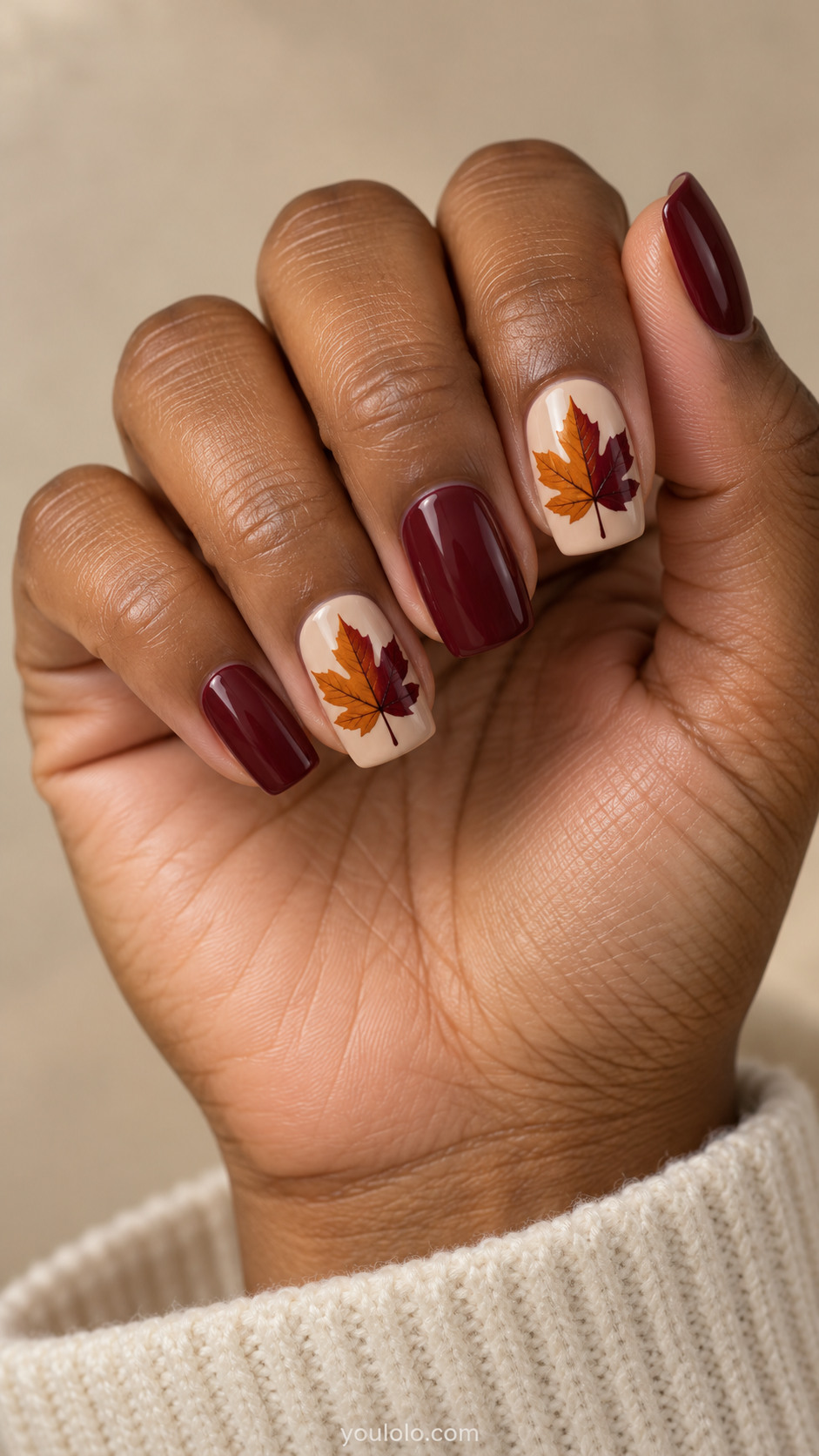
Splitting the maple itself into two colors gives a familiar motif a stronger graphic identity. Orange and burgundy meet at the central vein, with no extra outlines needed. A beige accent base makes the split easy to see. Keep the silhouette large enough for its points to stay sharp, and let the solid burgundy nails do the balancing.
Salon brief: Large split orange-and-burgundy maples on two beige accents.
18. Ginkgo Fans on Black French
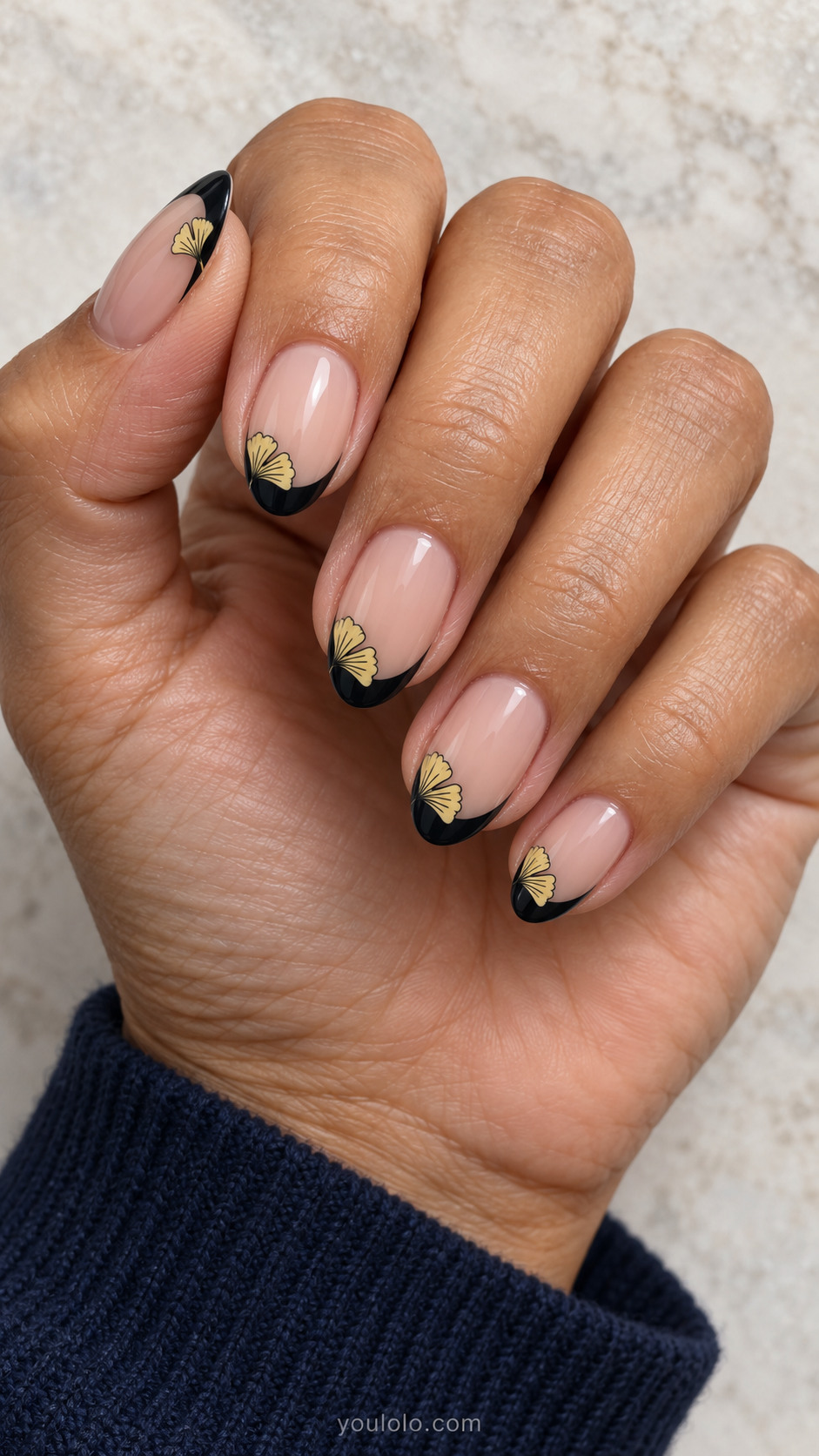
A pale ginkgo fan softens the edge of a black French tip. The fan sits slightly to one side, so the manicure keeps its clean outline instead of becoming a uniform floral border. Use pale yellow paint rather than foil for a quieter finish. The almond shape helps the little fan and narrow tip share the space without feeling cramped.
Salon brief: Fine black tips, one pale yellow ginkgo fan at the side.
19. Tonal Leaf Relief Illusion
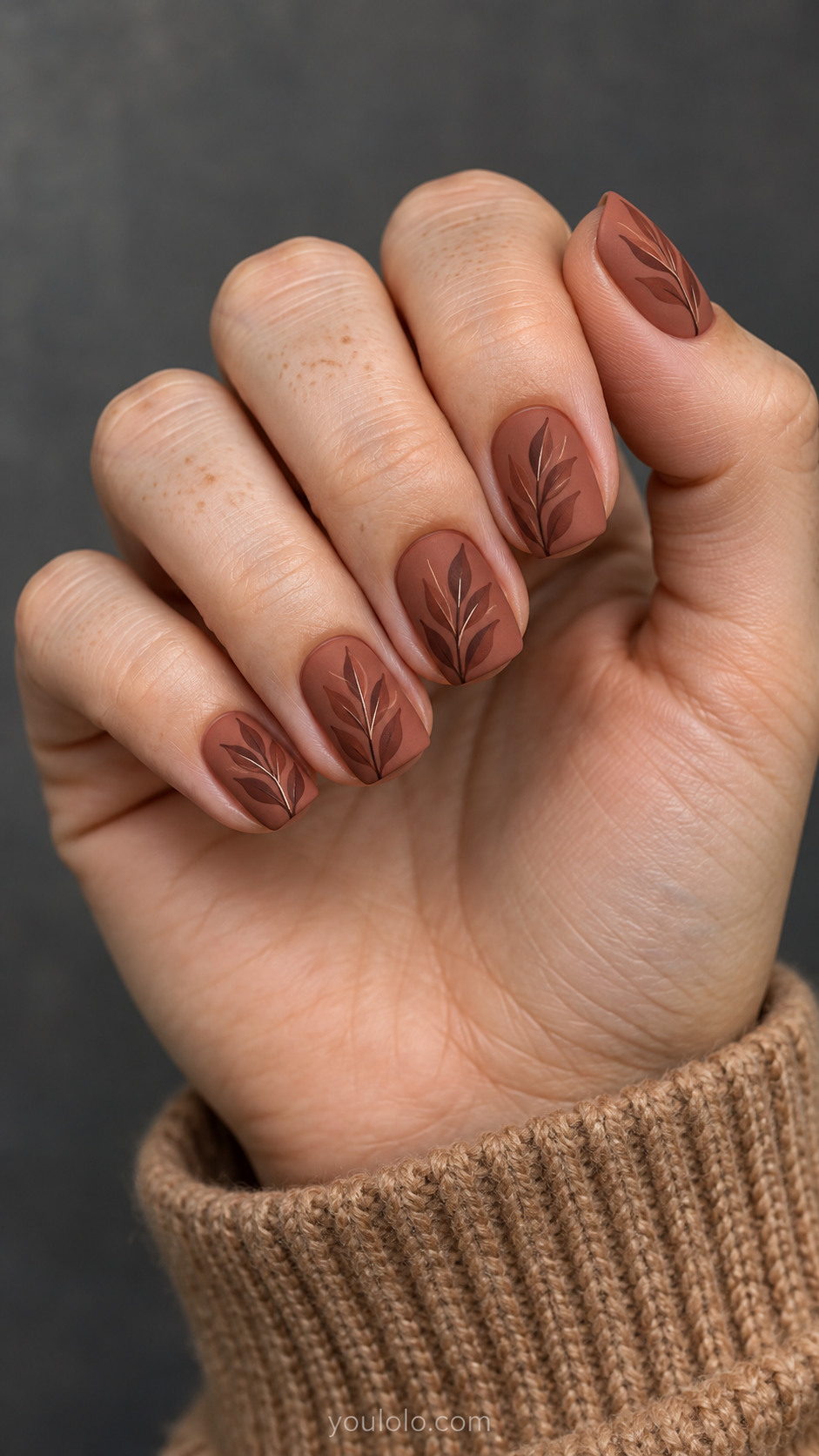
This design suggests carved detail while staying completely flat. Darker leaf sprigs and fine lighter stems give matte terracotta a little depth without bulky gel decoration. It works best when the contrast is subtle enough to feel tonal but visible enough to show the outline. Short squoval nails keep the overall effect calm and wearable.
Salon brief: Flat tonal terracotta leaf sprigs with fine lighter stems.
20. Olive Leaves in Cream Frames
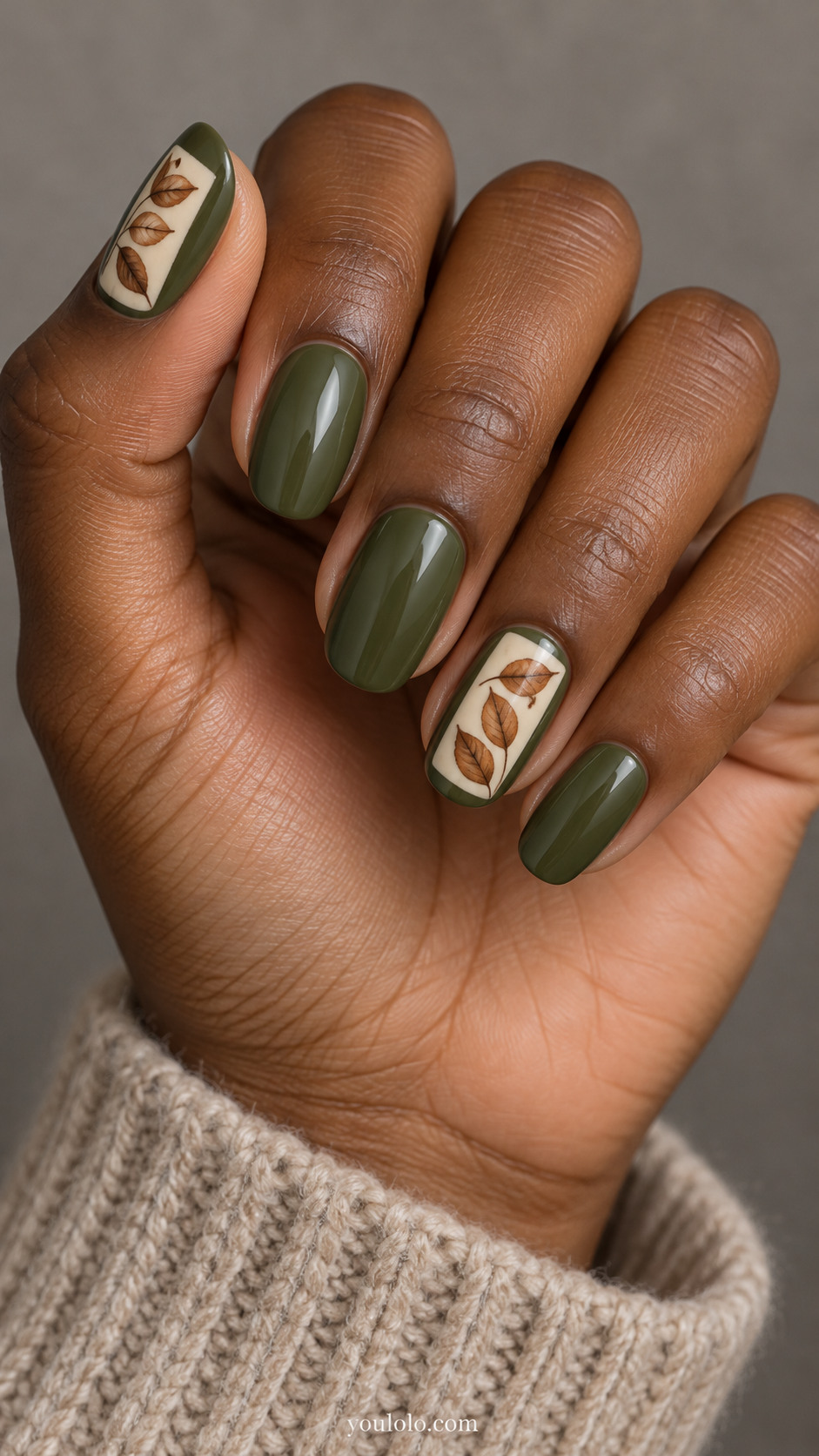
A small cream frame turns the leaves into a miniature illustration. Three brown beech shapes sit inside each accent panel, with enough space around them to preserve the framed effect. Olive keeps the set tied to autumn without relying on orange. Rounded tips are a nice counterpoint to the straight panel edges and keep the composition from looking too severe.
Salon brief: Two cream inset panels with three brown leaves in each.
21. Plum Leaves and Silver Lines
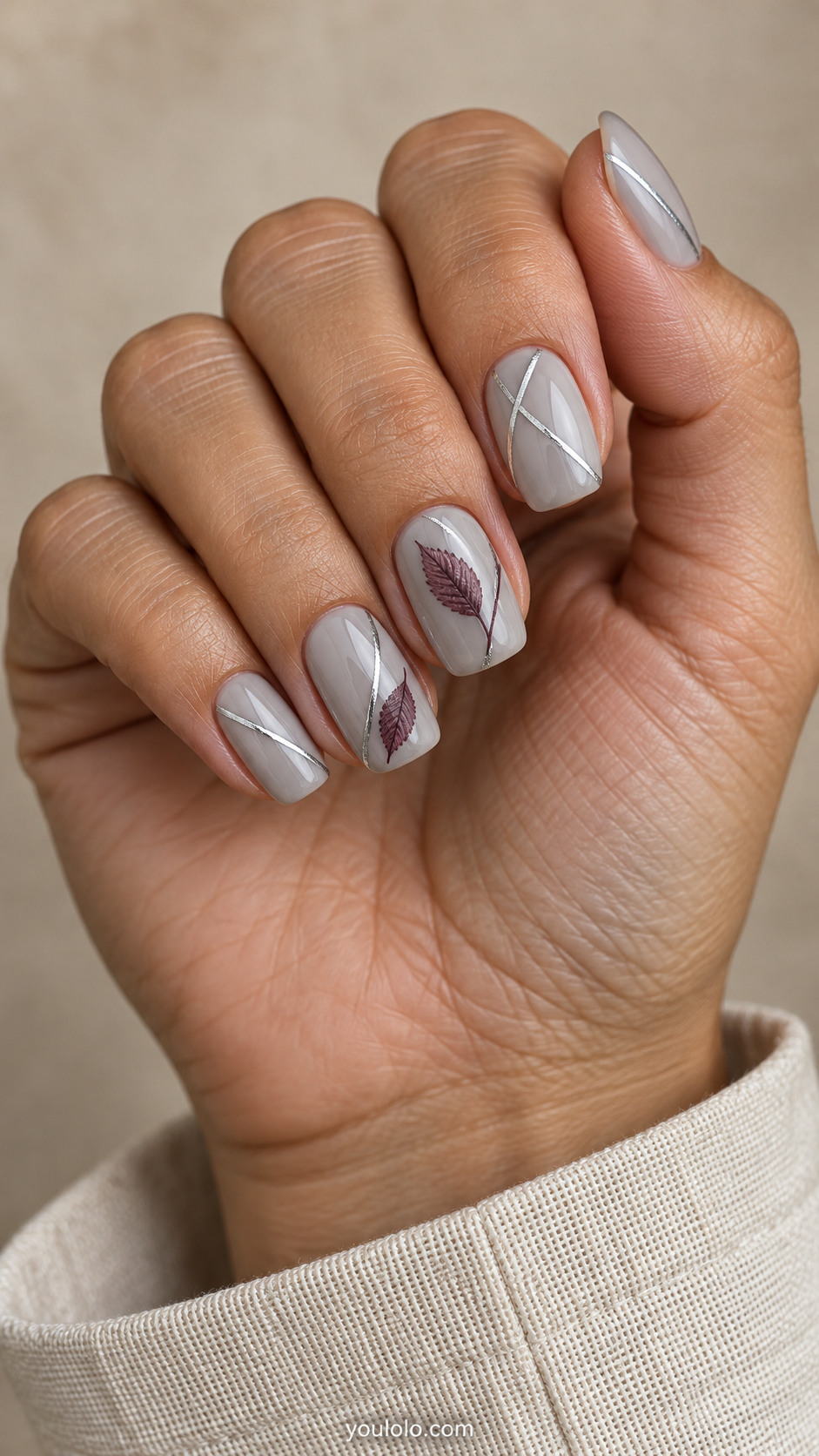
Plum leaves give this gray manicure a cool-weather palette, while a slim silver line adds a little reflected light. Keep the metallic mark narrow enough that it does not compete with the leaf edges. Alternating illustrated and plain striped nails makes the set feel intentional. This is a good choice if warm orange and gold are not your usual colors.
Salon brief: Milky gray, fine silver diagonals, small plum elm leaves.
22. Maple Leaf Micro Dots
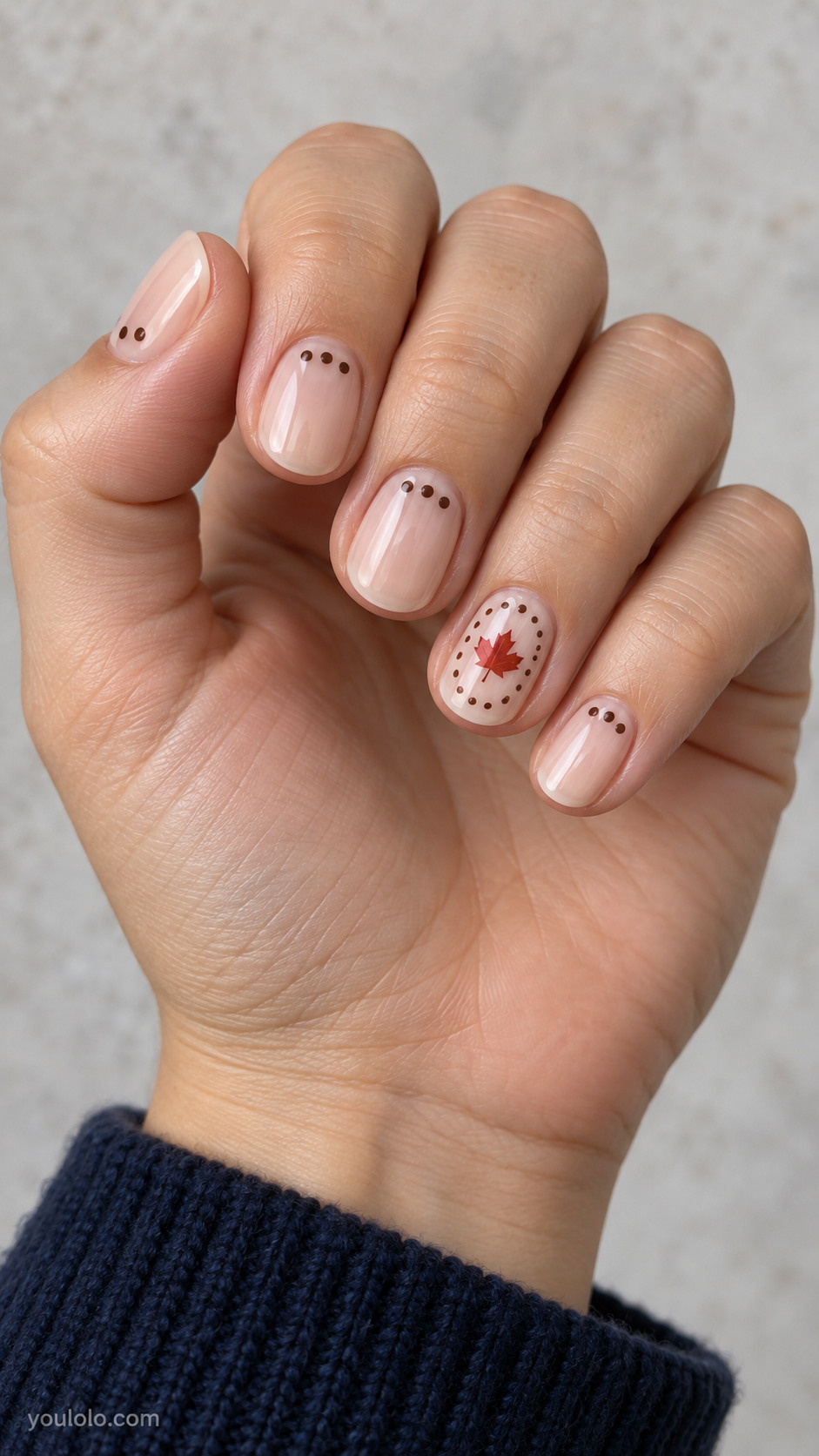
The dotted frame makes one miniature maple feel special without adding another large motif. A sparse oval of chocolate dots surrounds the red leaf, with just a few dots repeated on the other nails. The sheer base keeps the detail light. Make sure the maple still has distinct points; if the nail is very small, simplify the dotted frame first.
Salon brief: One red maple inside sparse chocolate dots, sheer base.
23. Leaf-Shaped French Smile
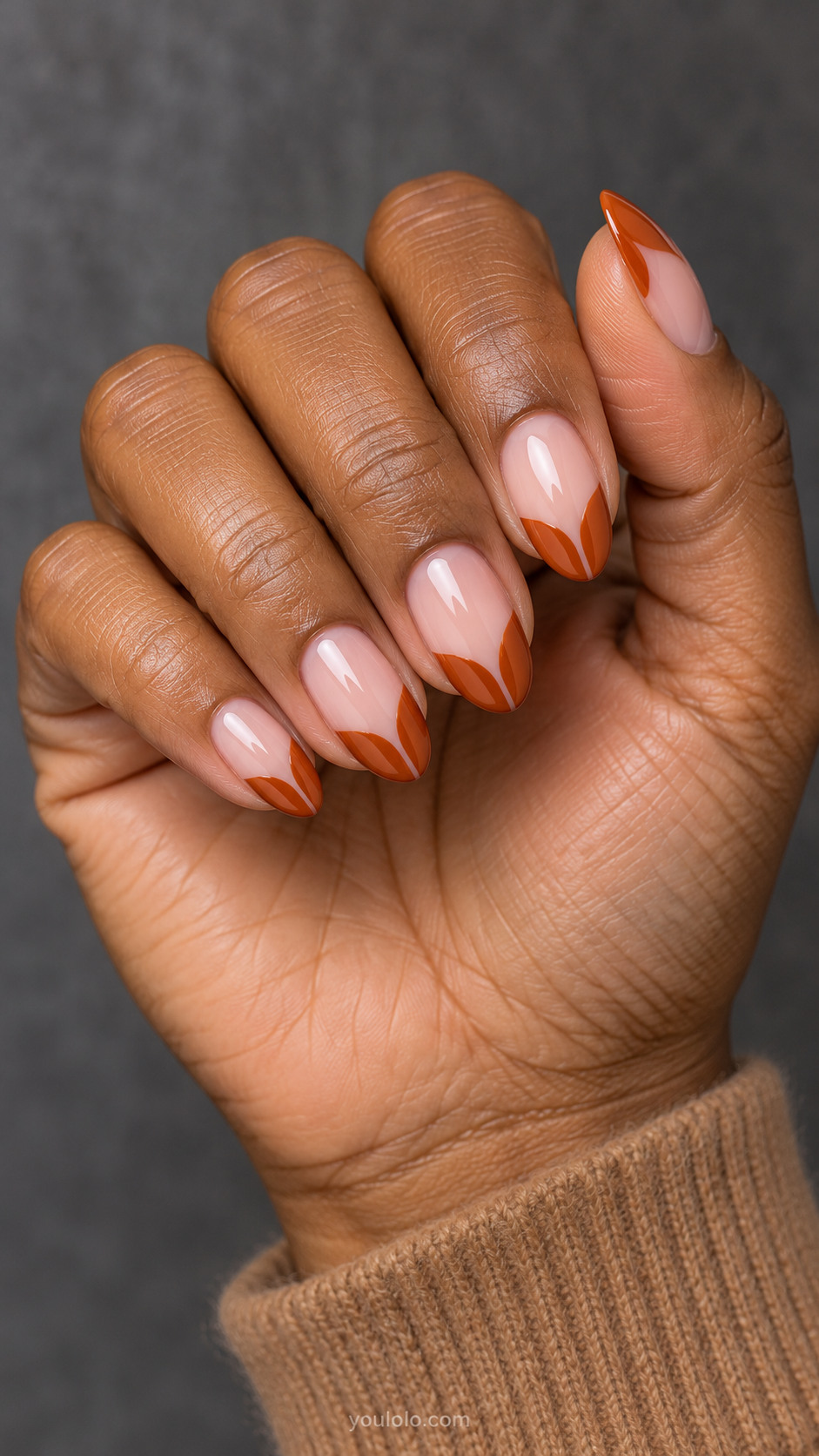
Here, the leaf becomes the tip itself. Two pointed lobes form a stylized inner edge, with a slim clear slit suggesting the central vein. It is more graphic than a painted leaf and easier to appreciate from a distance. Keep the orange area shallow enough to preserve the natural pink base, especially if the oval nails are not very long.
Salon brief: Burnt orange tips shaped like paired leaf lobes.
24. Autumn Herbarium Squares
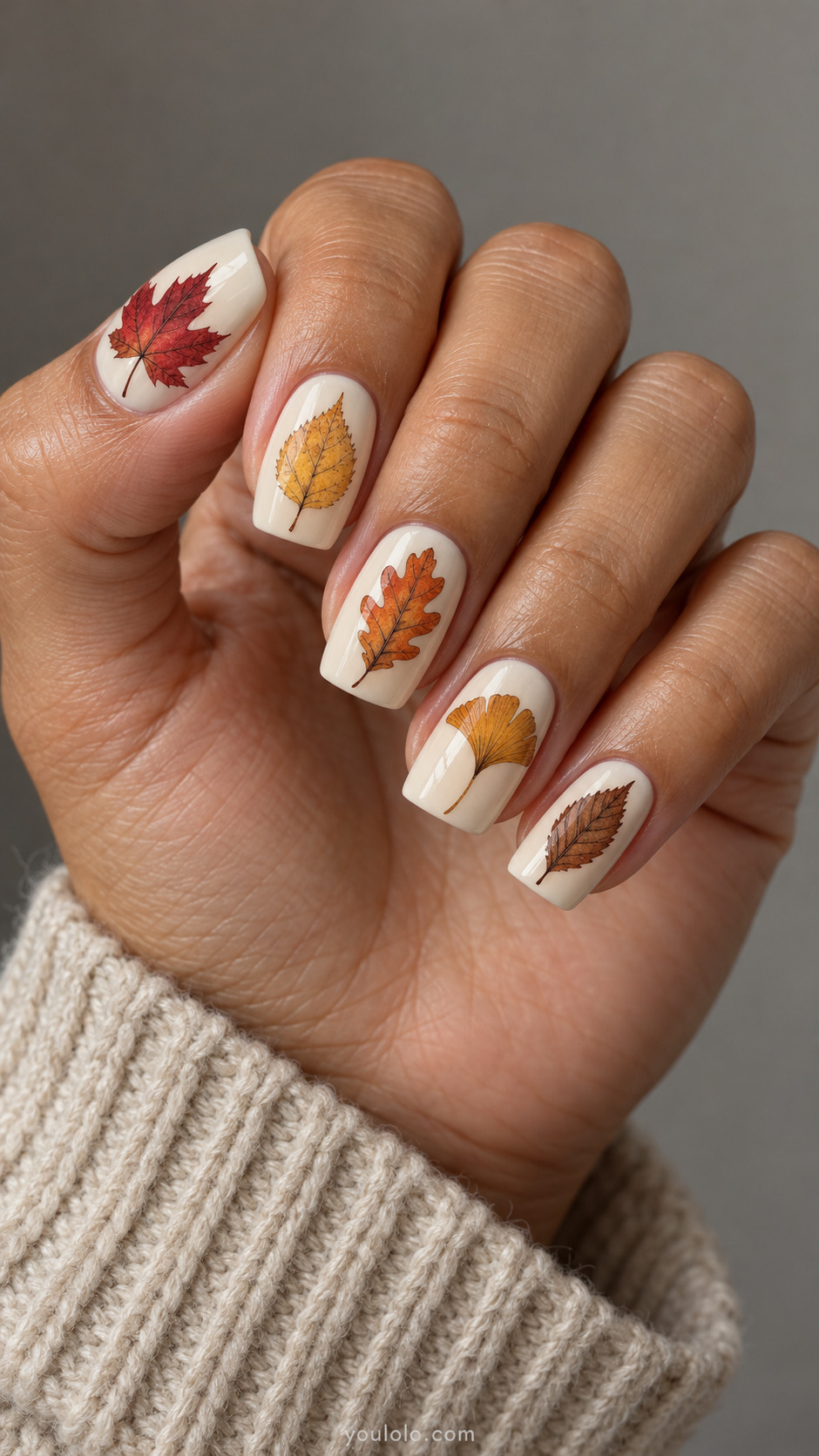
A different leaf on each finger creates the feel of a miniature herbarium. The shared cream base and consistent scale keep the five shapes connected, even though their outlines vary. This is the set to choose if recognizable leaves matter more than sparkle. Ask your artist to keep the silhouettes clear and leave out lettering or extra decorative clutter.
Salon brief: Five different leaf species on cream; no text.
Statement leaf arrangements worth saving
25. Teal Leaves on Cinnamon
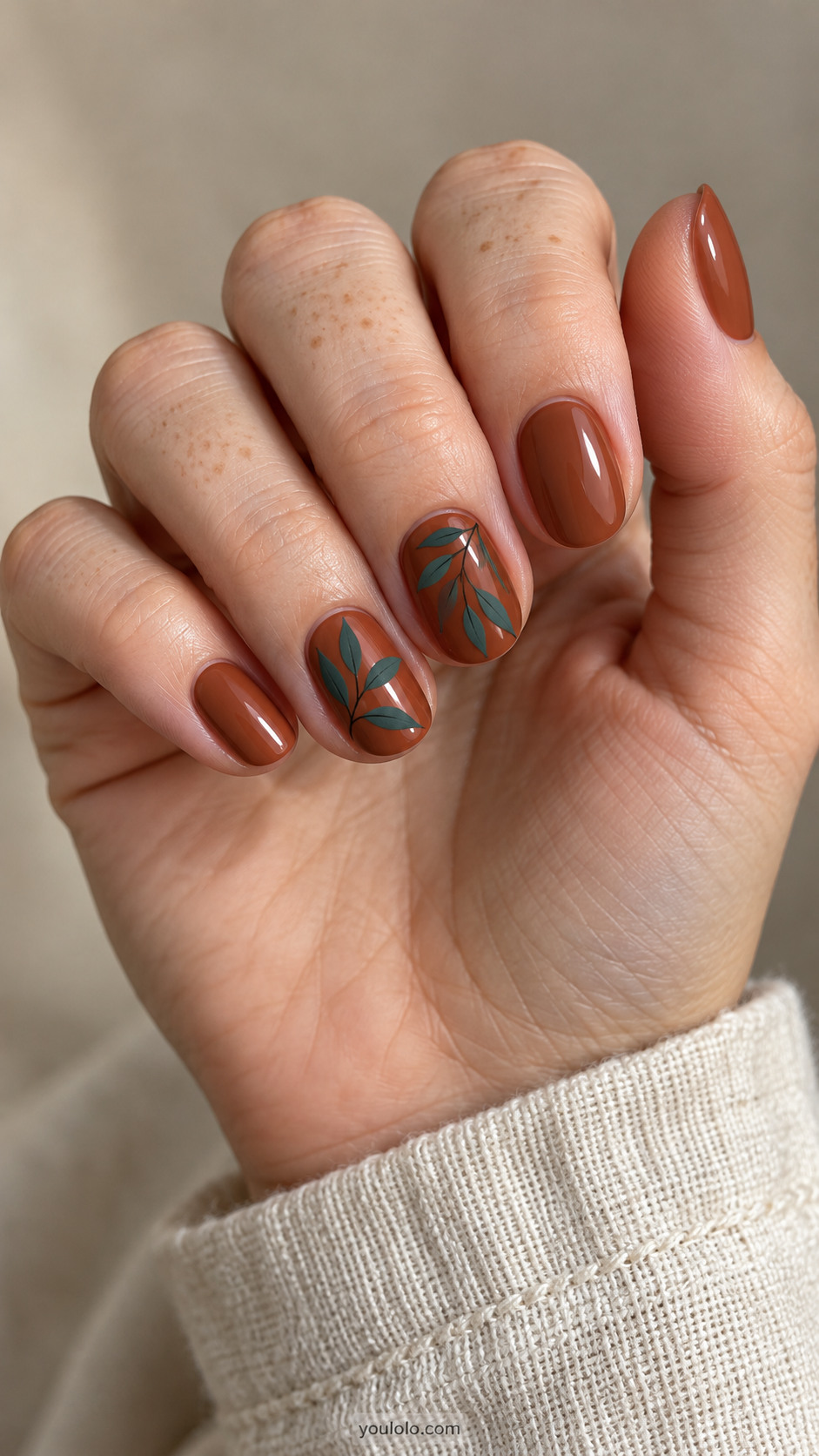
Dusty teal is an unexpected partner for cinnamon, but the muted tones make them easy to wear together. Narrow willow leaves form loose sprigs on two nails, creating movement without covering the whole nail. Keep the leaves slim and the stems light. The plain cinnamon nails hold the palette together and make the cool accents stand out.
Salon brief: Dusty teal willow sprigs on two cinnamon nails.
26. Half-Leaf Edge Study
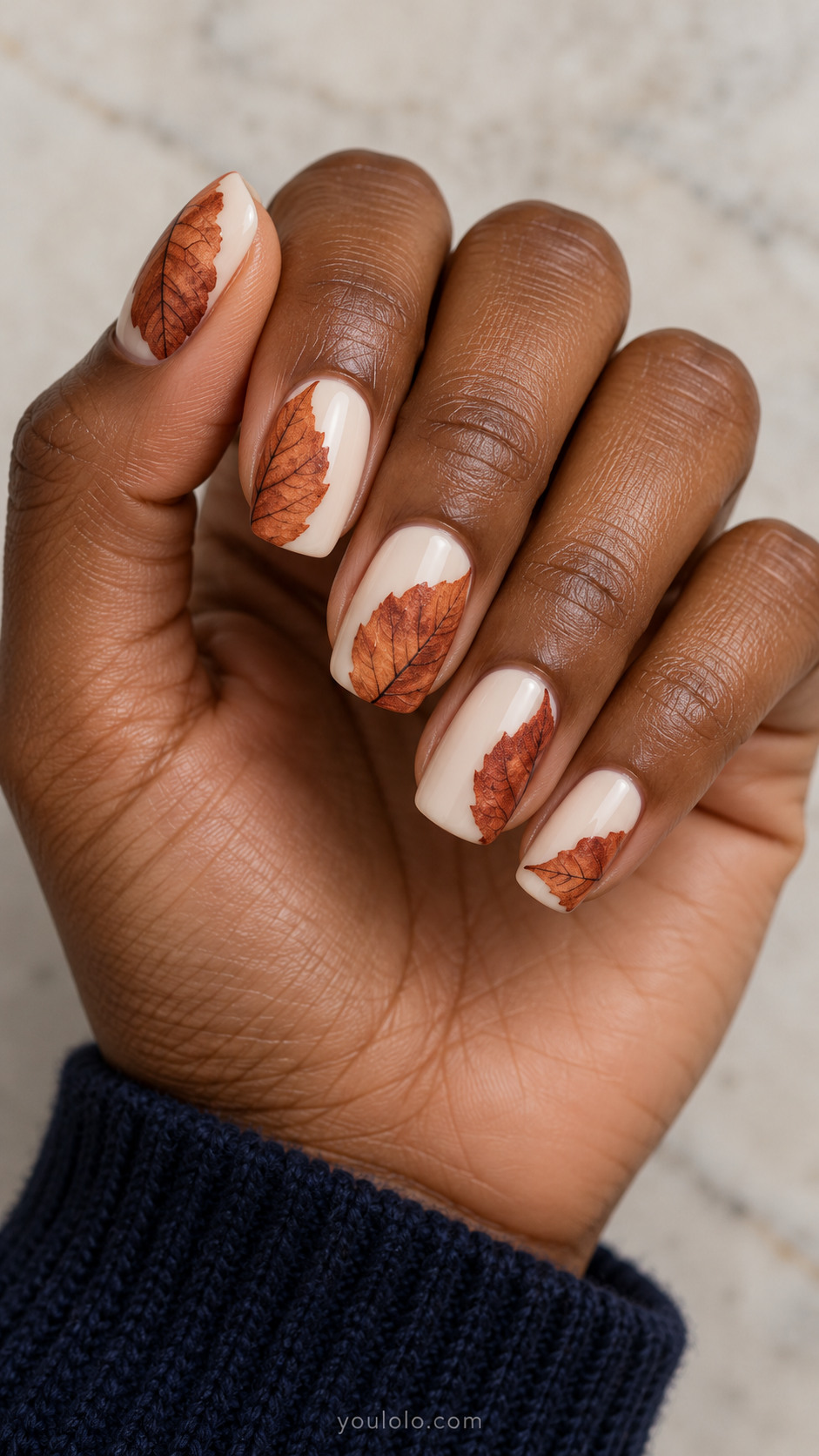
Cropping a leaf at the side gives the design a close-up, editorial feeling. Only half the beech shape is visible, so its veins and serrated edge become the focus. Moving the crop between left and right edges keeps the set varied. An ivory base is useful here because it lets the rust color stay rich without needing metallic accents.
Salon brief: Large rust half-leaves entering from alternating side edges.
27. Muted Leaf Checker Accents
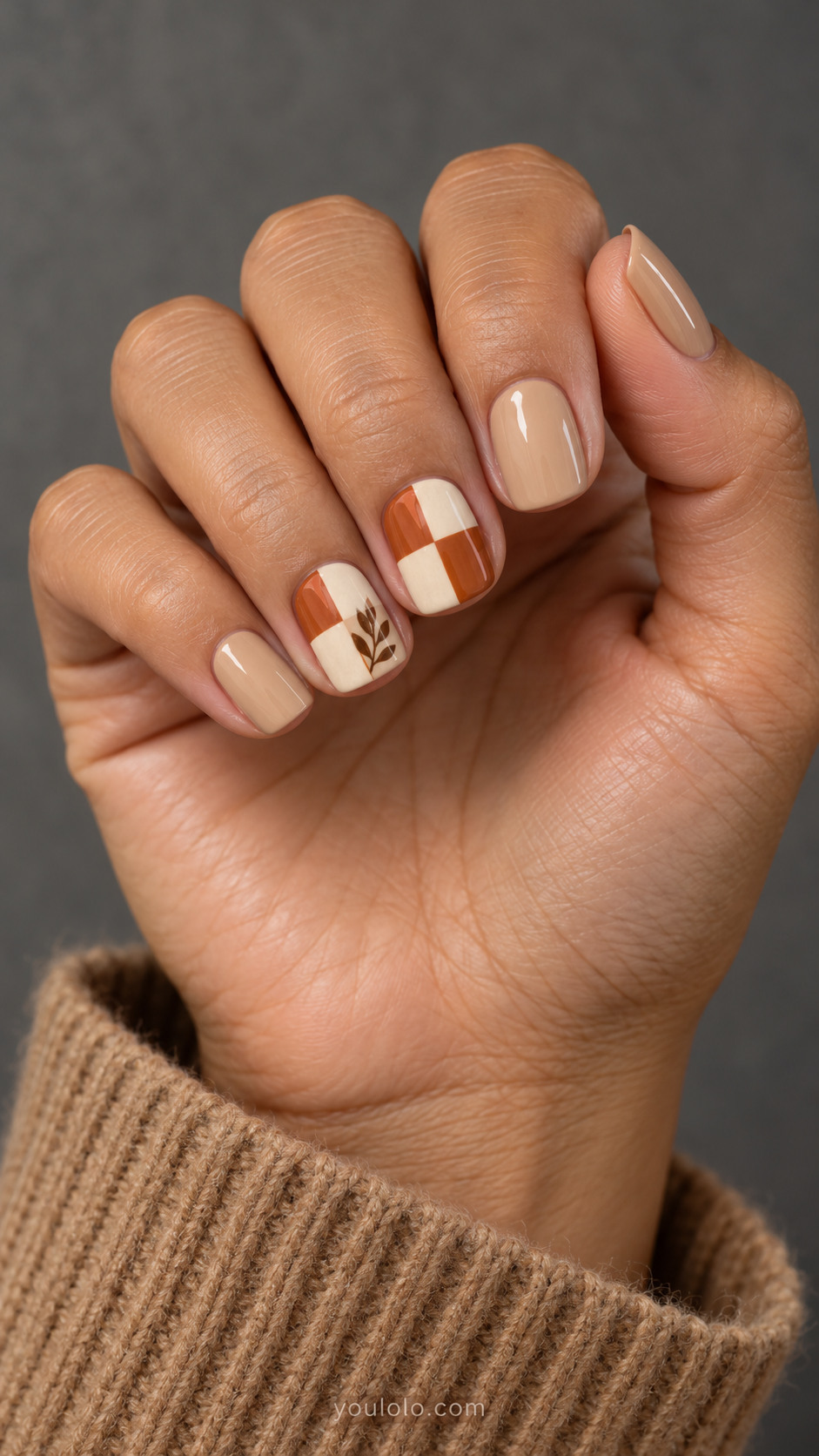
A broad checker accent supplies the pattern, while a small leaf sprig makes it seasonal. Keeping the sprig mostly within one ivory area prevents the two ideas from fighting for attention. Dusty orange is softer than a bright pumpkin shade, and plain beige fingers give the eye somewhere to rest. This layout works particularly well with short square edges.
Salon brief: Two broad orange-and-ivory checkers; one with a brown leaf sprig.
28. Evening Leaf Crescent
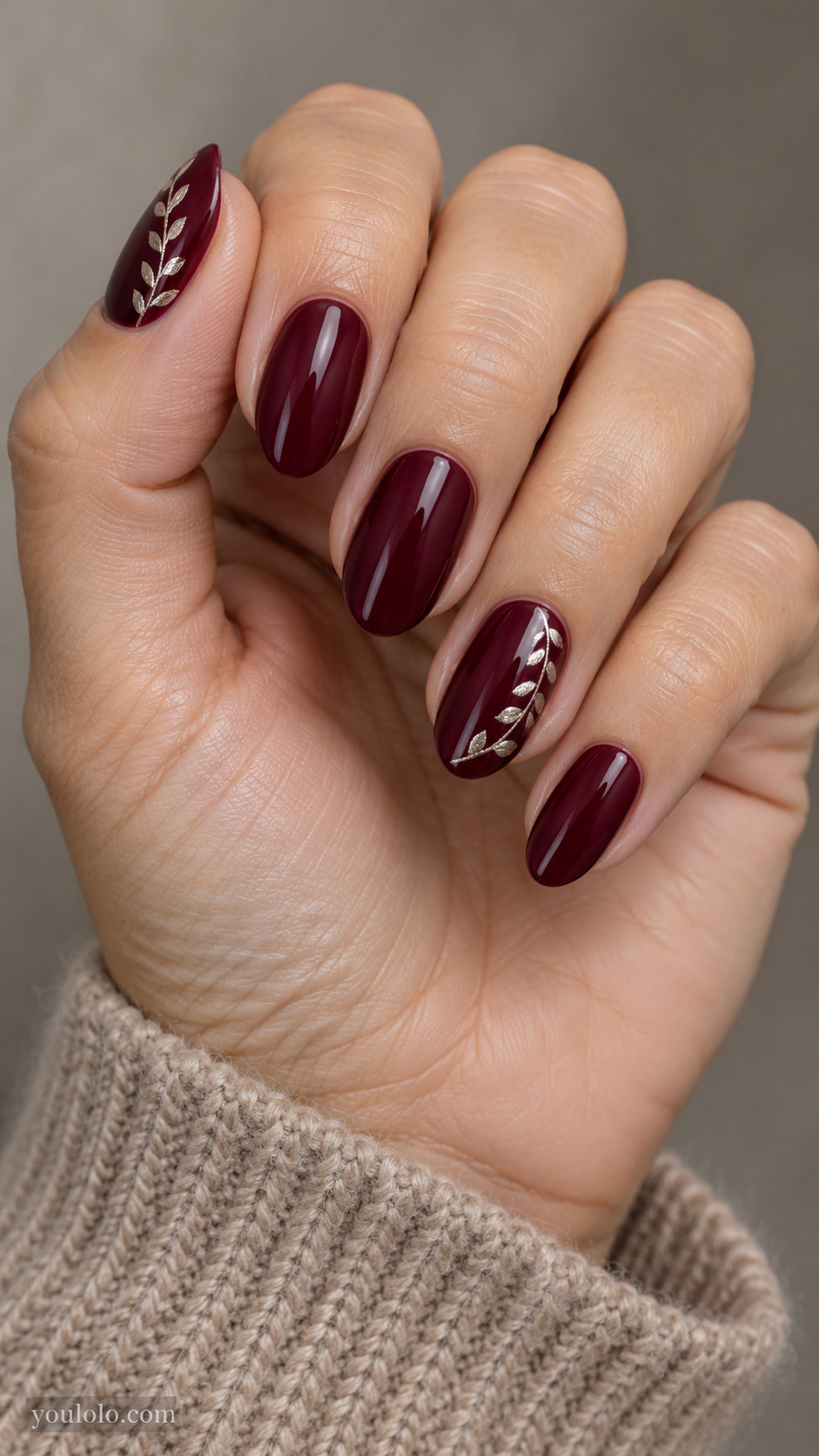
A crescent of tiny silver leaves gives deep wine nails a dressier finish. The curve hugs one side rather than tracing the whole nail, which makes the accent feel lighter. Keep the individual leaves flat and separated so they read as a botanical pattern instead of a thick metallic stripe. Two accents are enough for an evening-focused set.
Salon brief: Antique silver leaf crescents on wine thumb and ring nails.
29. Windblown Leaves on Taupe
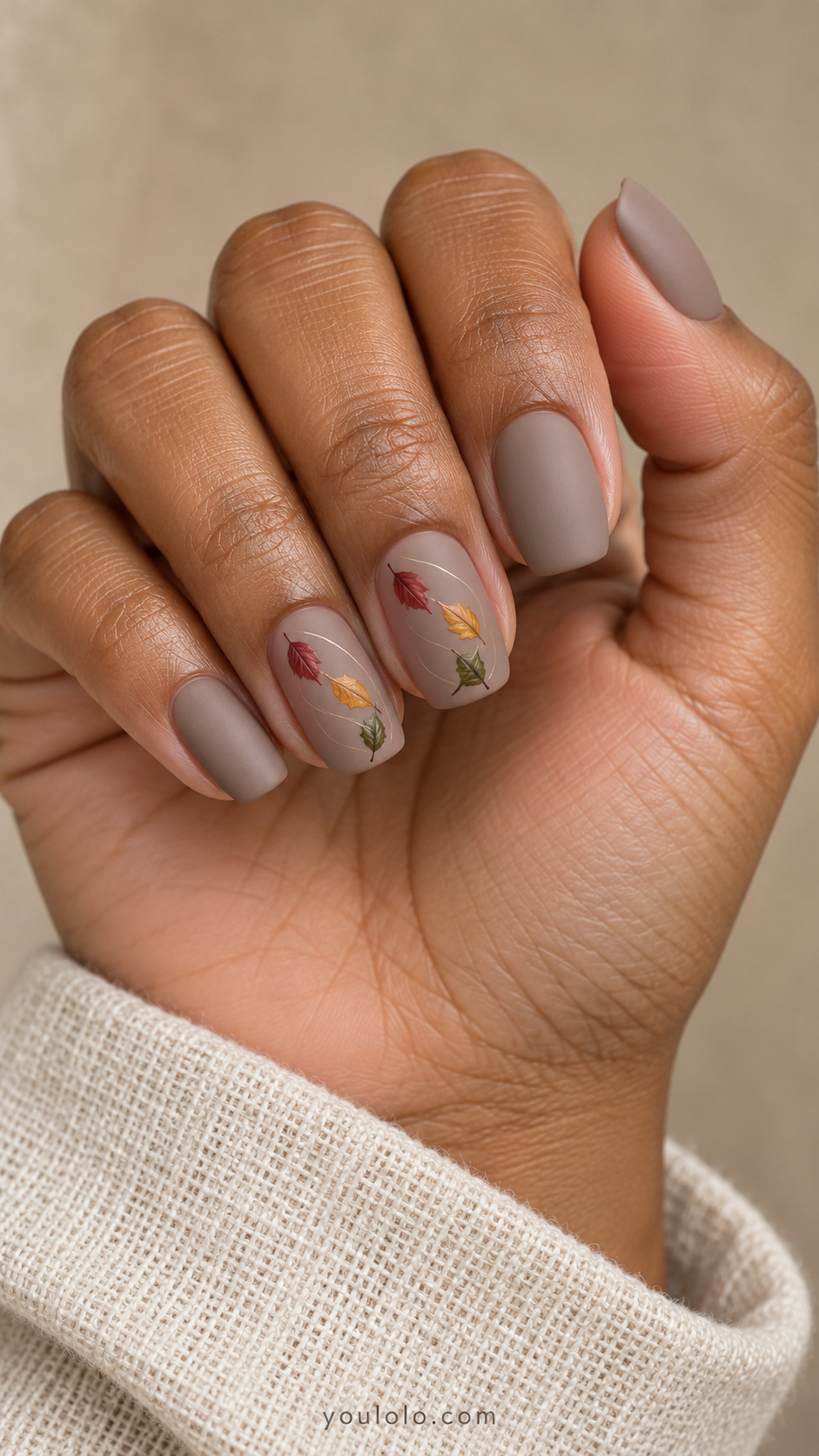
A fine curved line gives the falling leaves a sense of direction. Red, amber and olive shapes tumble across two taupe nails, each tilted a little differently. Keep that line delicate and the leaves separated, or the movement will disappear into a tangle. The matte background supports the illustration, while the plain fingers keep the final look balanced.
Salon brief: Three tumbling leaves and one fine wind curve on two accents.
How to choose fall leaf nail designs for your nail length
On short nails, a single leaf, a corner crop or a narrow trail leaves enough background visible. Medium nails offer more room for a detailed vein pattern or a framed accent. Long extensions can carry layered compositions, but they still benefit from plain companion nails.
Choose the leaf before the color
Maple leaves bring sharp points, ginkgo leaves create a soft fan, and oak leaves have rounded lobes. A beech or elm outline is useful for fine linework, while willow leaves suit narrow spaces. Pick the silhouette you actually like before choosing the polish palette.
Make the salon brief specific
Show your chosen design and agree on shape, length, accent fingers and finish. Ask whether the leaf detail will be painted, stamped or applied as a decal; each method can give a different line quality. If the sample art looks too dense for your nail size, reduce the number of leaves before shrinking every detail.
Fall leaves nail art: questions before your appointment
Can fall leaf nail art work on very short nails?
Yes. Choose one small silhouette or a leaf cropped at the edge. A sheer or light base helps the outline stay visible, and one accent nail can be enough for the whole set.
Do autumn leaf nails have to be orange and brown?
No. Dusty blue, plum, gray, olive and muted pink can all support a seasonal leaf design. Repeating one color across the accent and plain nails helps an unusual palette feel connected.
Are leaf decals or hand-painted leaves better?
Decals can give consistent detail, while painting allows an artist to adapt each leaf to your nail. Choose according to the look, appointment time and the artist’s preferred technique. Fine painted leaves and good-quality decals can both look polished when the edges are finished neatly.
Should every nail have a leaf?
Only if you want an all-over print. One or two accents often make detailed leaves easier to appreciate. Repeating a base color, a narrow line or a tiny dot on the other nails can connect the set without repeating the whole drawing.
How do I keep a leaf design from looking crowded?
Choose one main motif and leave visible background around it. Avoid combining large leaves, glitter, gems and several unrelated patterns on every finger. If you love a detailed accent, balance it with quieter companion nails.
For another autumn direction, compare botanical fall almond nails. Save your favorite leaf arrangement before your appointment so the shape and placement are easy to discuss.