
The Best Fluffy Pancakes recipe you will fall in love with. Full of tips and tricks to help you make the best pancakes.


Burgundy and tortoiseshell nails bring together two very different surfaces: a solid, deep red and a layered amber pattern. The burgundy gives the manicure a strong block of color, while the tortoiseshell adds movement through irregular darker patches.
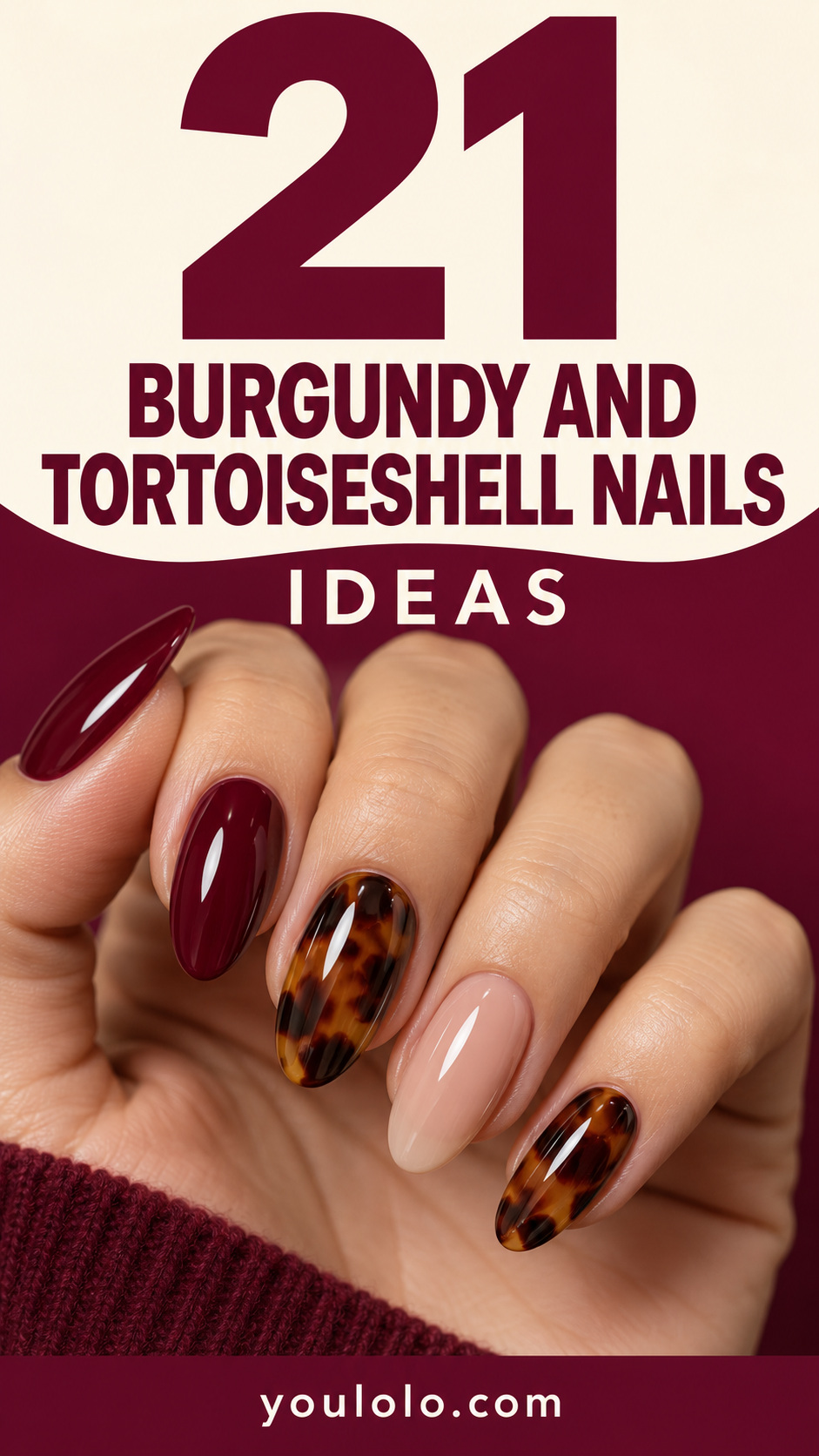
You do not need elaborate artwork on every finger. One patterned nail can be enough, especially when the amber stays visible and the red has a clear wine tone. Nude or sheer areas offer a third option when you want to lighten the overall effect.
Tortoiseshell nails: tortoiseshell is different from leopard print
In nail art, tortoiseshell usually refers to a mottled amber-and-brown effect with irregular, overlapping-looking patches. Leopard designs more often use recognizable spots or rosette-like markings. Both can include brown and black, but the colors alone do not make them the same pattern.
For this manicure, ask for a translucent-looking amber base with uneven dark patches. A pattern made only from evenly spaced black dots will read differently. A reference image is more useful than relying on a label that a seller may use loosely.
1. Burgundy with one amber accent
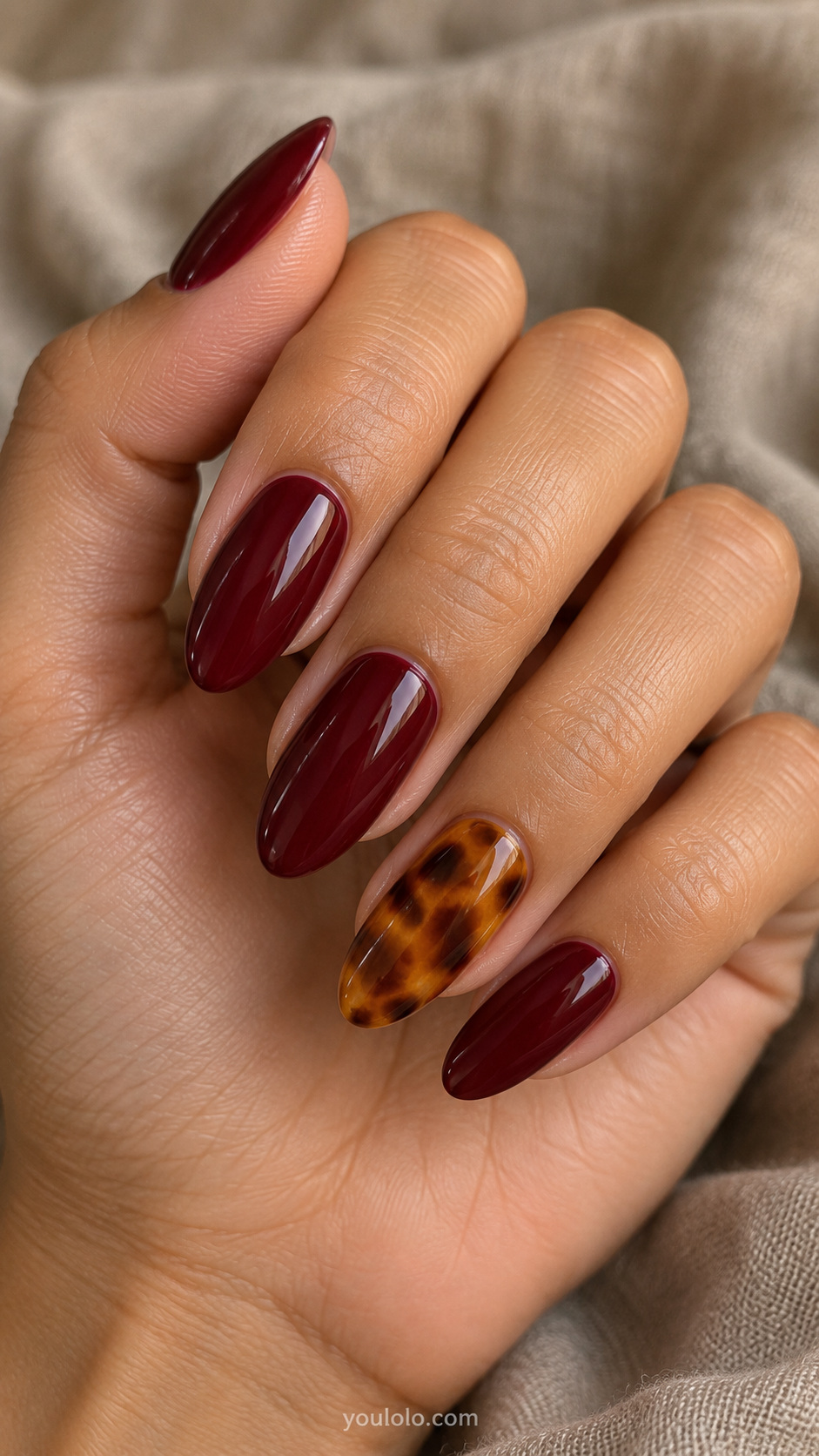
Keep four nails solid burgundy and reserve the ring nail for tortoiseshell. Choose an amber background light enough to stand apart from the red. This arrangement is a good starting point if you want the pattern to feel deliberate without turning the manicure into a full mixed-design set.
2. Alternating wine and tortoiseshell

Alternate the two finishes across the hand for a stronger contrast. Let the dark patches vary in shape and placement so the patterned nails do not look stamped from an identical template. Use the same burgundy on every solid nail to keep the overall palette consistent.
3. Tortoiseshell French tips with burgundy nails

Combine two full burgundy nails with three sheer-base nails carrying amber-patterned tips. Give the tips enough depth for the mottling to remain visible. Extremely thin tips may compress the design into a brown line, especially when viewed from a distance.
4. Burgundy French tips and one full tortoiseshell nail
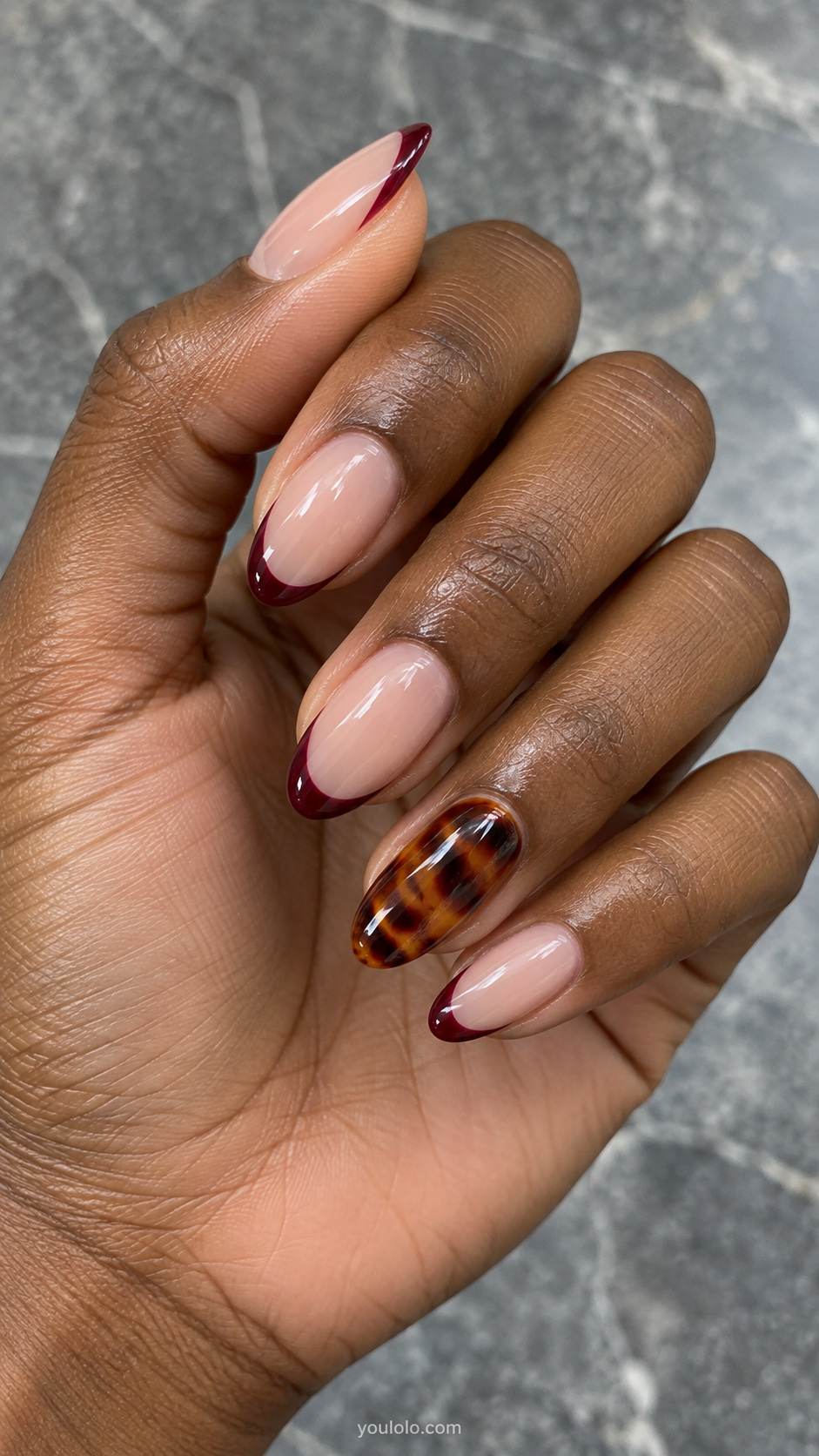
Reverse the emphasis: use narrow wine-colored French tips on most nails and a full amber accent on one. This leaves more of the natural-looking base visible. Match the curve of the French line to the nail shape rather than making every tip unusually deep or pointed.
5. Wine, amber, and sheer nude

Arrange two burgundy nails, two tortoiseshell nails, and one sheer nude nail. The unpatterned nude creates breathing room between the richer colors. Choose a nude you like against your own hand; it does not have to be pale beige to serve as a quiet part of the design.
6. Burgundy with a narrow amber side panel

Place a slim tortoiseshell panel along one side of an otherwise burgundy accent nail. The off-center detail gives the set a graphic shape without covering the whole nail in pattern. Keep the panel wide enough to show both amber and darker patches clearly.
7. A fine gold border between wine and amber
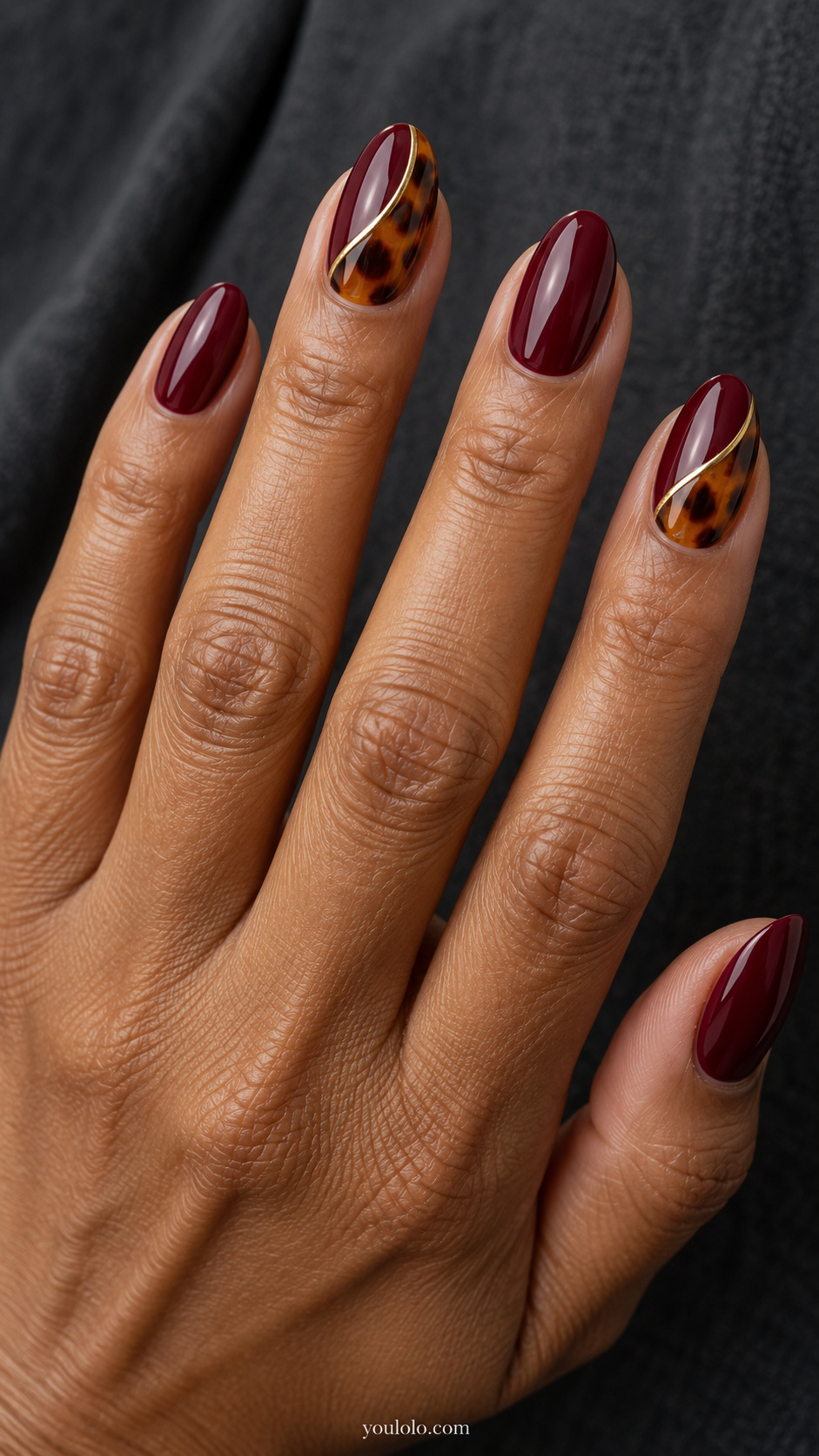
On one or two nails, separate a burgundy section from a tortoiseshell section with a thin gold line. Keep the line subordinate to the two main finishes. A thick metallic border can become the dominant feature and make the amber pattern feel like background decoration.
8. Short oval burgundy with small tortoiseshell accents

Choose short oval nails and use the amber pattern on one full nail or a broad tip. Avoid forcing several tiny patterned sections into a small area. This version retains the wine-and-amber palette while changing the silhouette from a longer almond to a compact rounded shape.
9. Burgundy half moons with amber tips
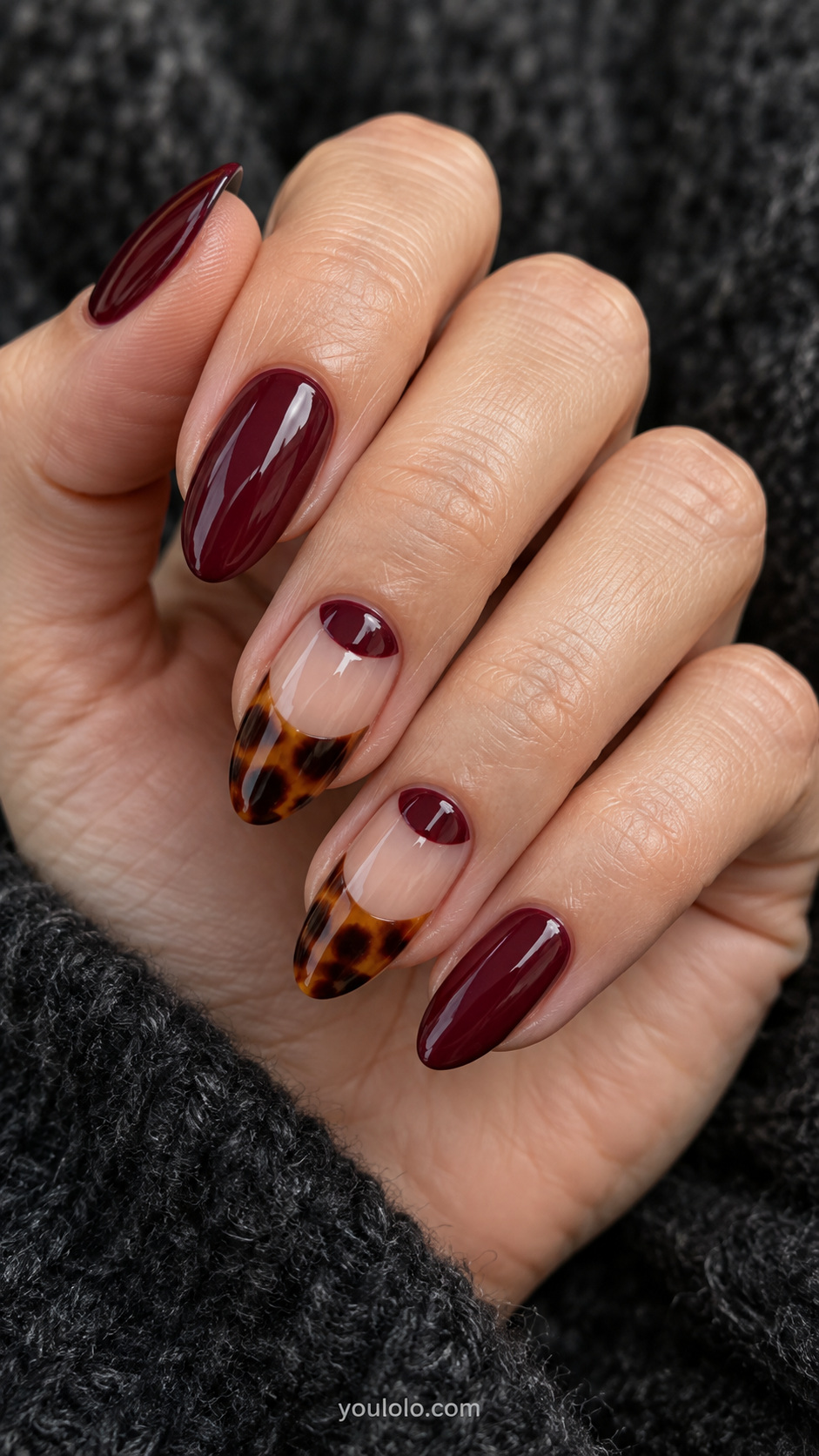
Leave a sheer middle section between a small burgundy half moon near the cuticle and a broad tortoiseshell tip. Repeat the layout on two nails, with solid wine polish elsewhere. The open middle keeps the two strong finishes separate and makes the curved shapes easier to recognize.
10. Matte wine with glossy tortoiseshell

Choose matte burgundy for four nails and a glossy amber accent for one. The difference in reflection becomes part of the design even when the colors are similar in depth. Ask to see the burgundy with its final matte finish, since the appearance can differ from a glossy swatch.
11. Burgundy waves beside amber windows
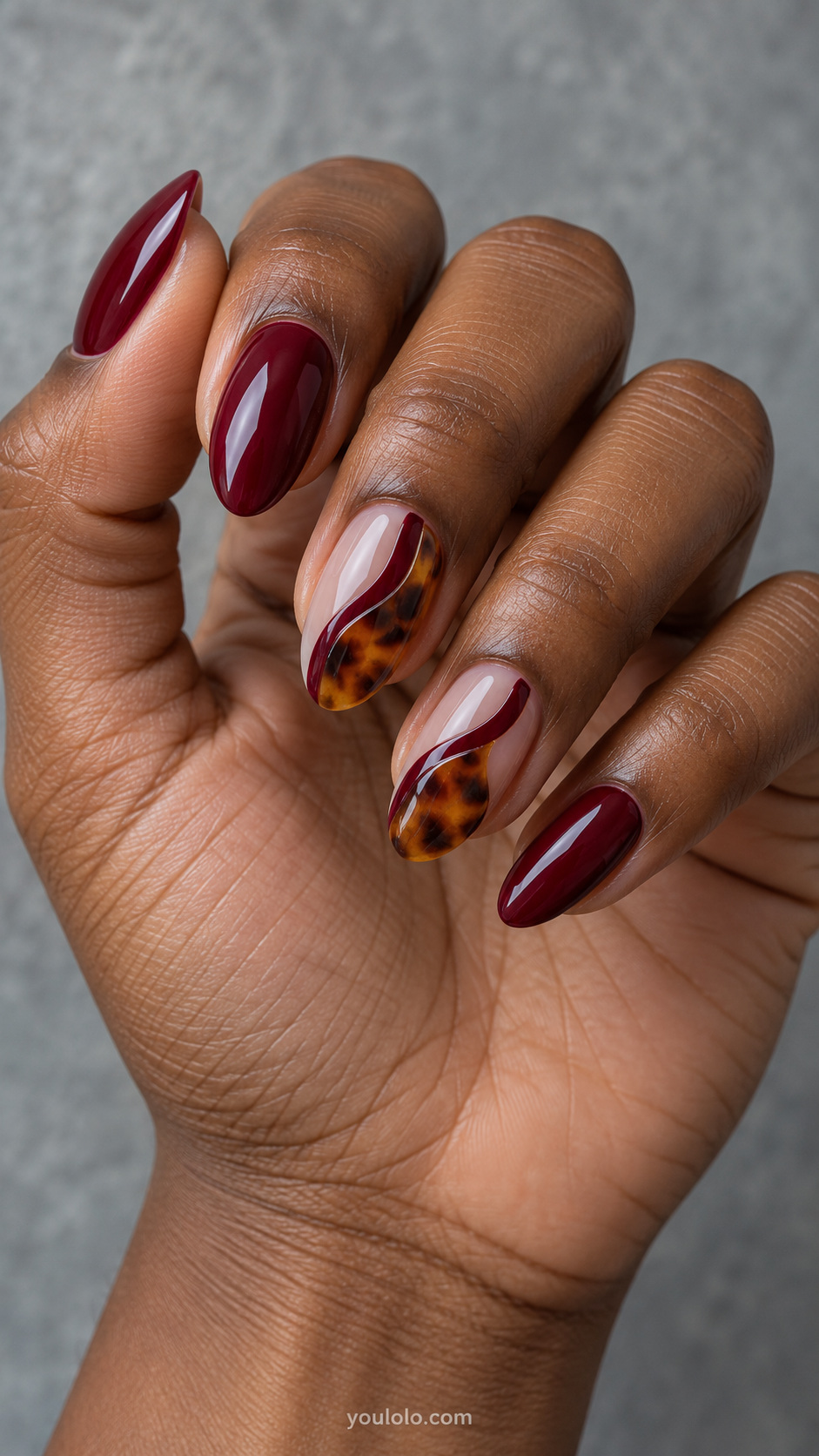
Use a curving burgundy ribbon to divide a sheer accent nail from a small tortoiseshell section. Keep the ribbon smooth and the amber window broad enough to show mottling. Solid wine nails around it allow this flowing shape to stand apart from a conventional French design.
12. Wine and amber checkerboard accent
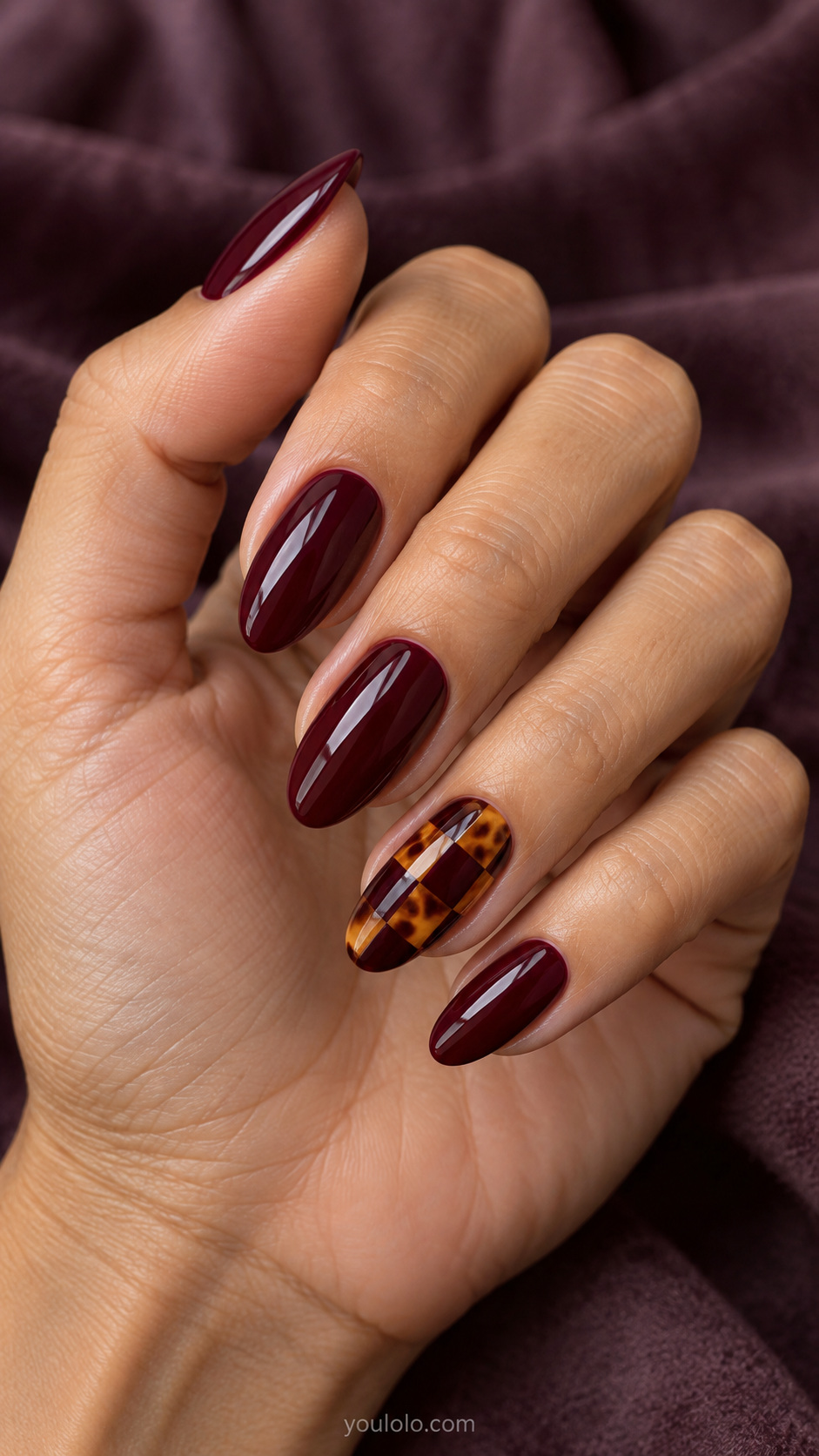
Create a large-scale checkerboard on one nail, alternating solid burgundy squares with amber-patterned squares. Limit the grid to a few readable blocks and keep the rest of the set burgundy. Tiny squares would make the tortoiseshell detail difficult to distinguish, especially on shorter nails.
13. A tortoiseshell frame around a burgundy center
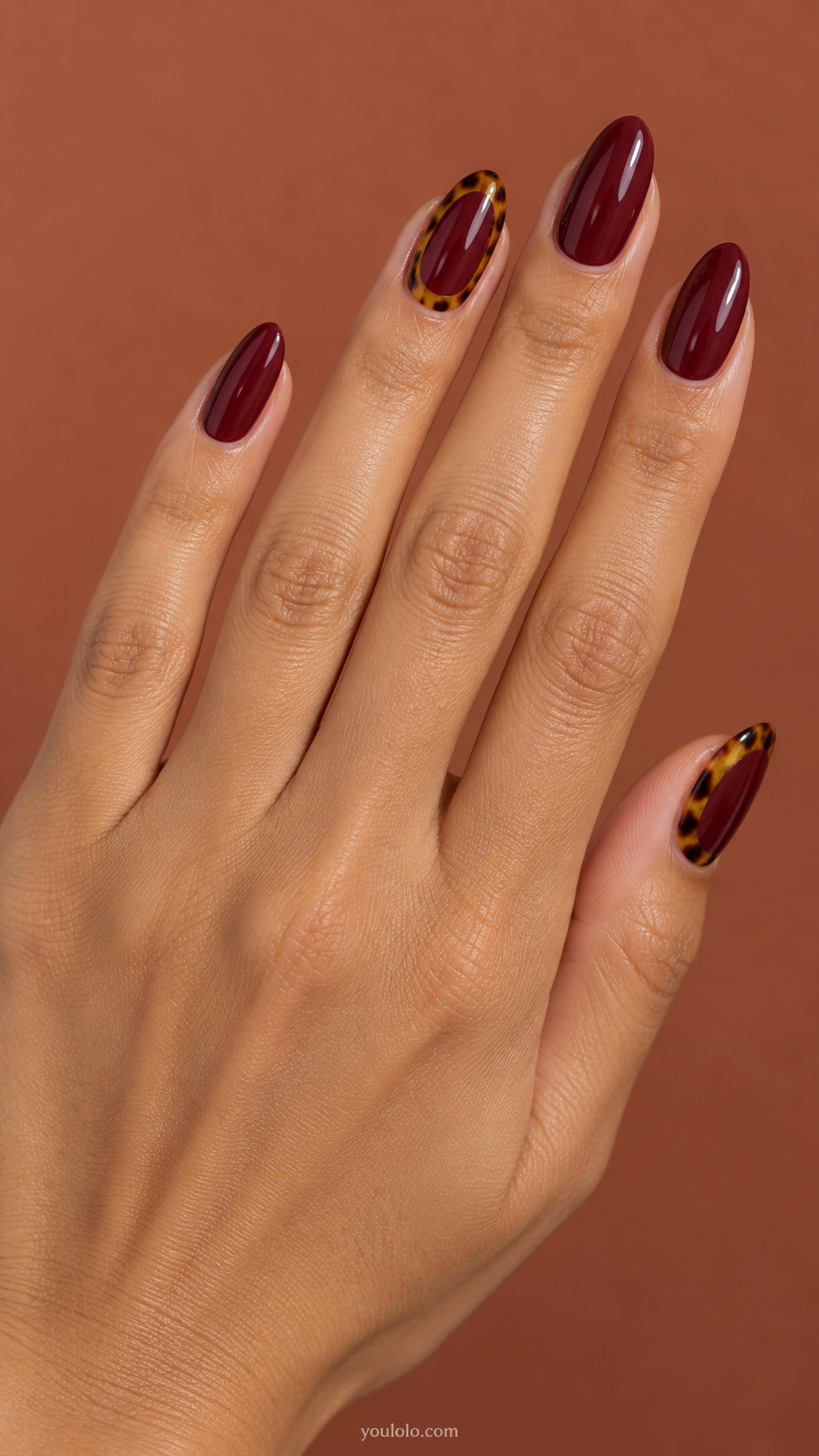
Surround a wine-colored center panel with a narrow amber-patterned border on one accent nail. Leave enough width in the border for a few uneven dark patches. This framed layout puts the two finishes on the same nail while making their boundaries deliberately clear.
14. Amber nails with burgundy outlined tips
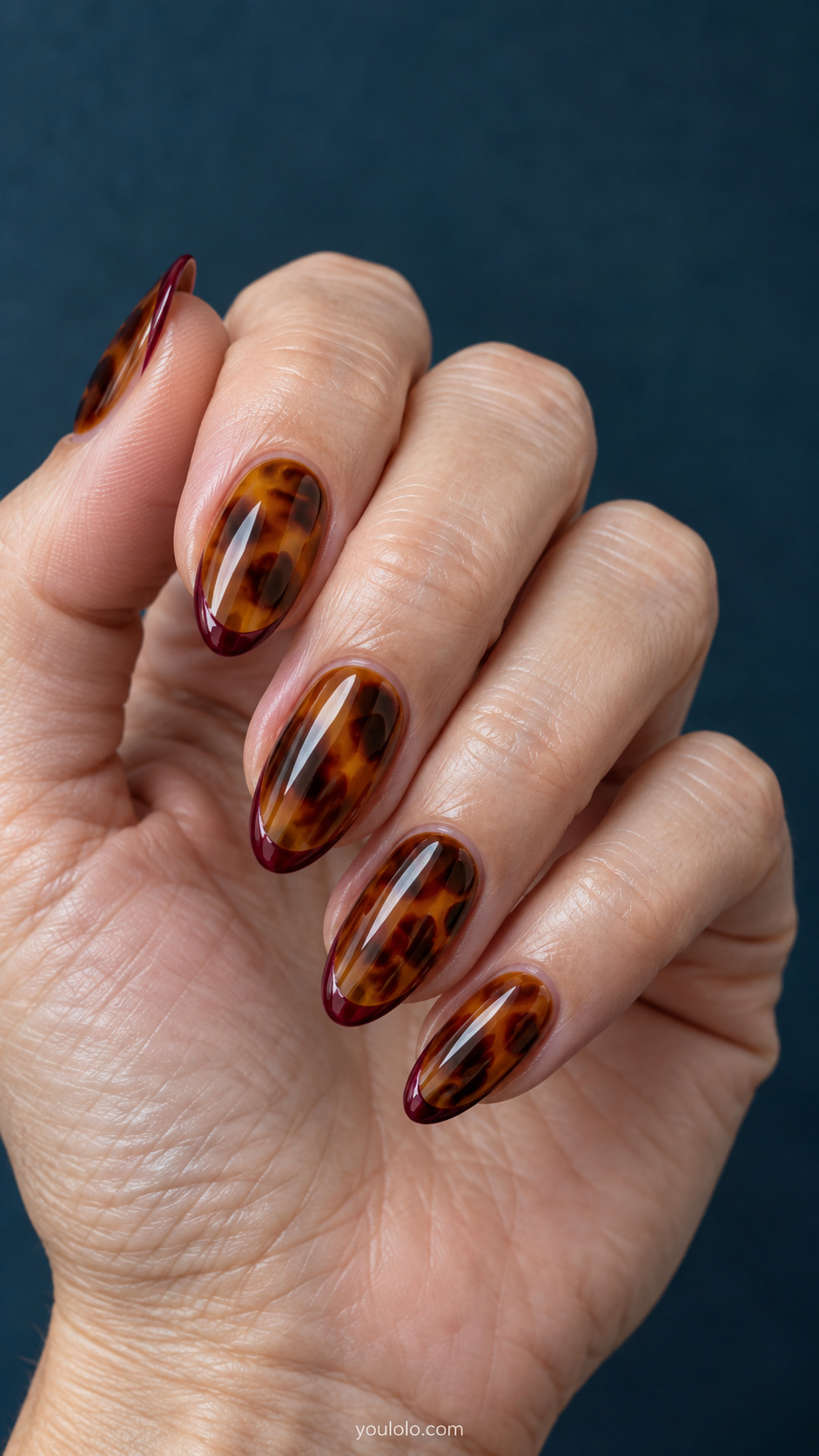
Use full tortoiseshell nails and draw a narrow burgundy French outline along the free edges. The line should remain distinct from the darkest patches in the pattern. Choose a wine color with enough red in it that the outline does not disappear into the brown background.
15. Burgundy with tiny amber hearts
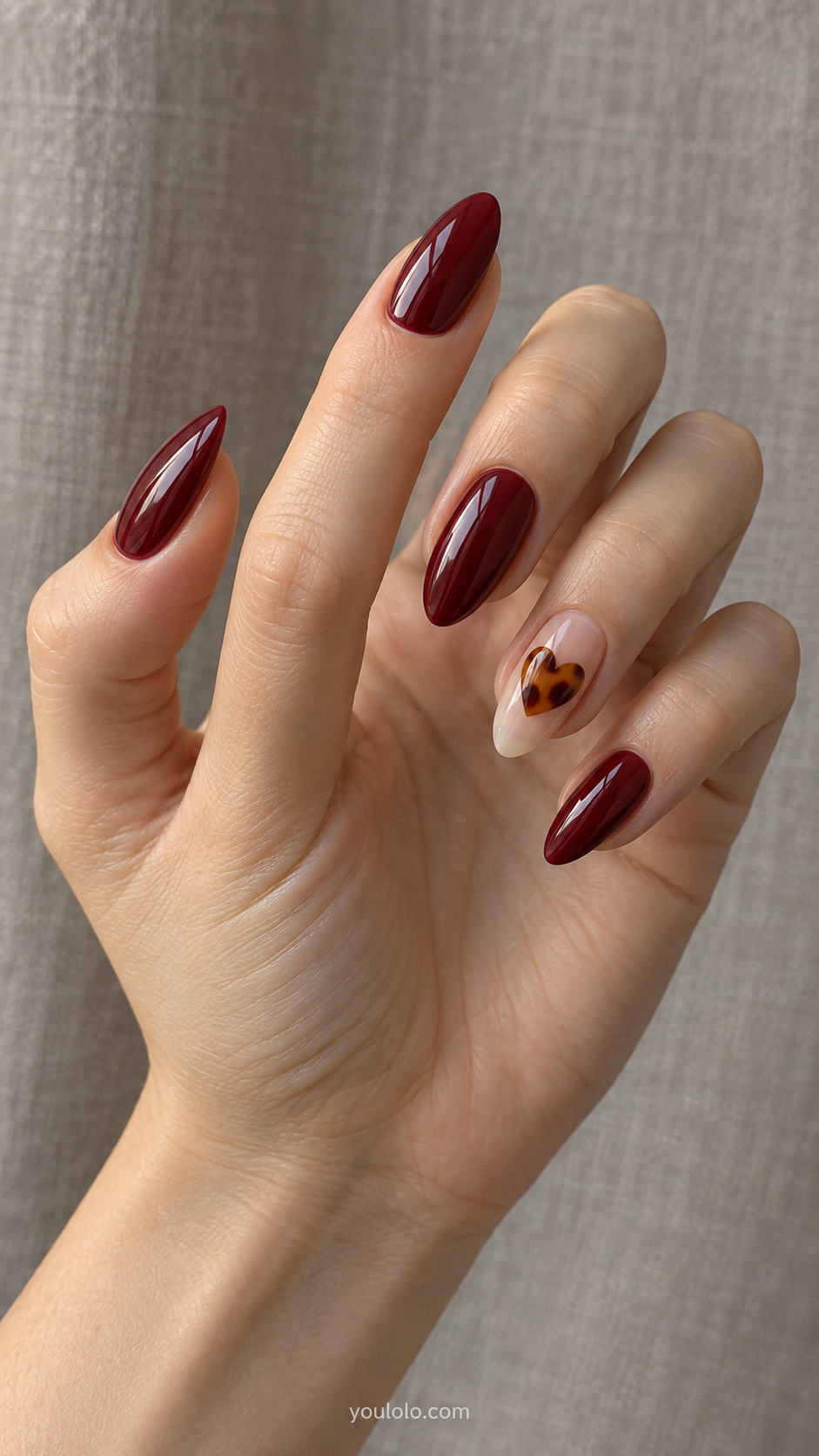
Place a small tortoiseshell heart on a sheer accent nail and surround it with solid burgundy nails. Make the heart large enough to show more than one dark patch; otherwise it may read as an ordinary brown heart. Keep the rest of the accent surface clear.
16. Copper flecks over a wine-and-amber set
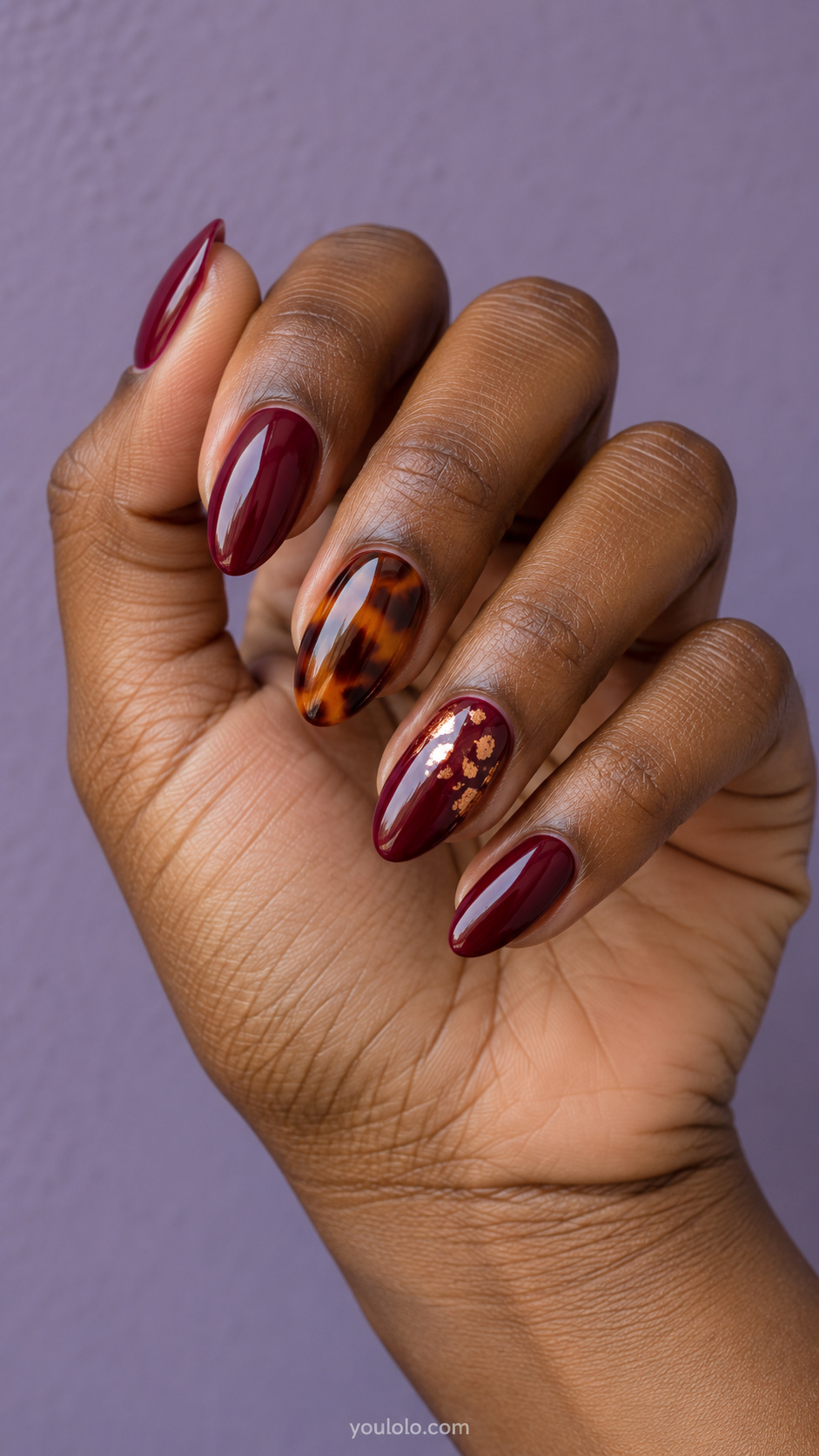
Add a few restrained copper-colored foil flecks to one burgundy nail, with one tortoiseshell accent beside it. Leave the other wine nails plain. The metallic pieces should be small and irregular, creating a light-catching detail without covering the solid red or competing with the amber pattern.
17. Diagonal wine and tortoiseshell split
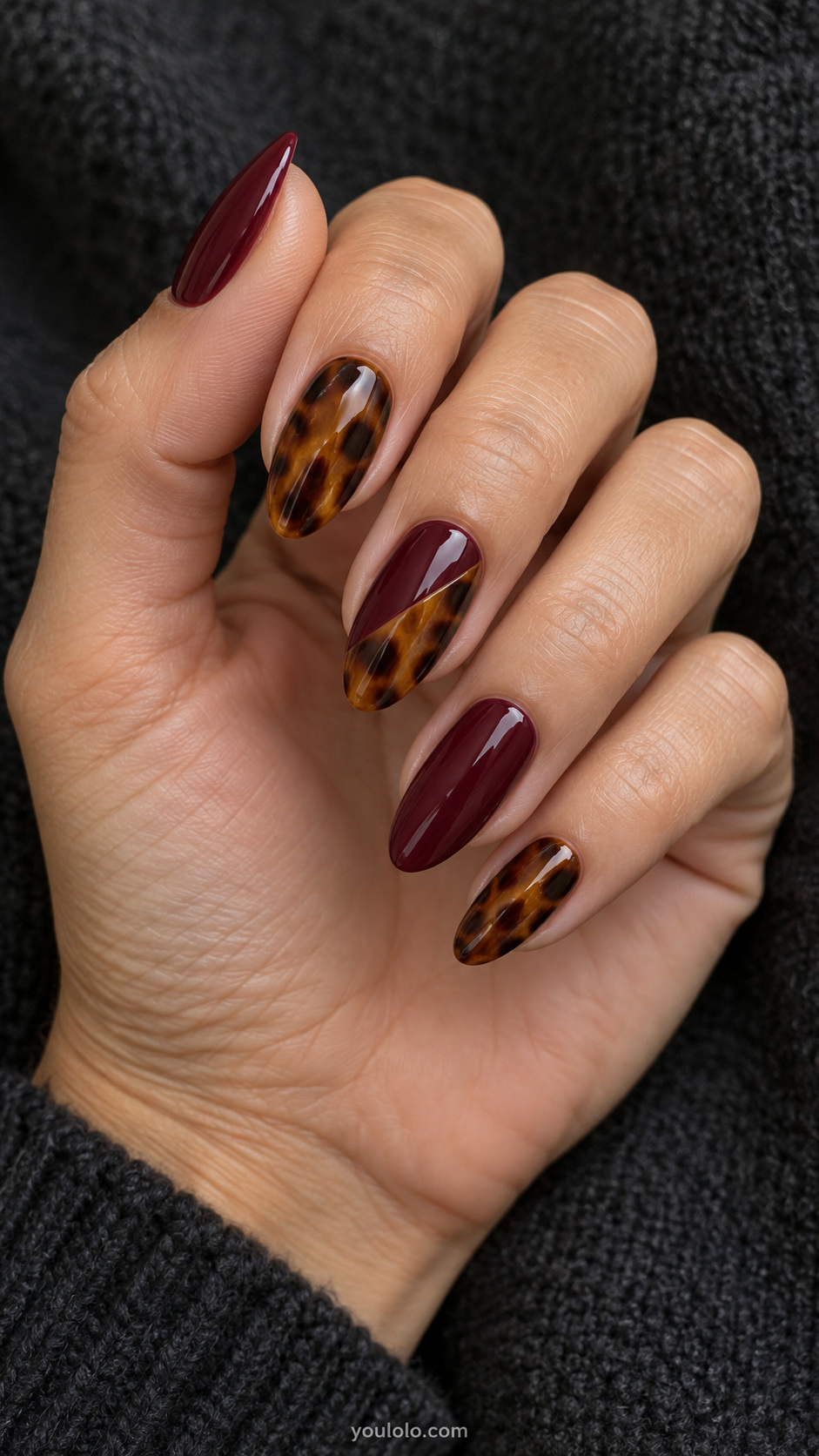
Divide an accent nail diagonally into solid burgundy and tortoiseshell halves. Use a clean painted boundary with no metallic line, then repeat the two colors separately on the remaining nails. The diagonal is the main feature, so avoid adding dots or another border around it.
18. Burgundy croc lines with an amber accent

Give one wine nail a subtle darker burgundy crocodile-inspired line pattern, then add one separate tortoiseshell nail. Keep the other nails solid. The croc design should be recognizable as a grid of uneven enclosed shapes, not random cracks, and the amber accent should remain a different pattern.
19. Burgundy with a thin amber cuticle cuff
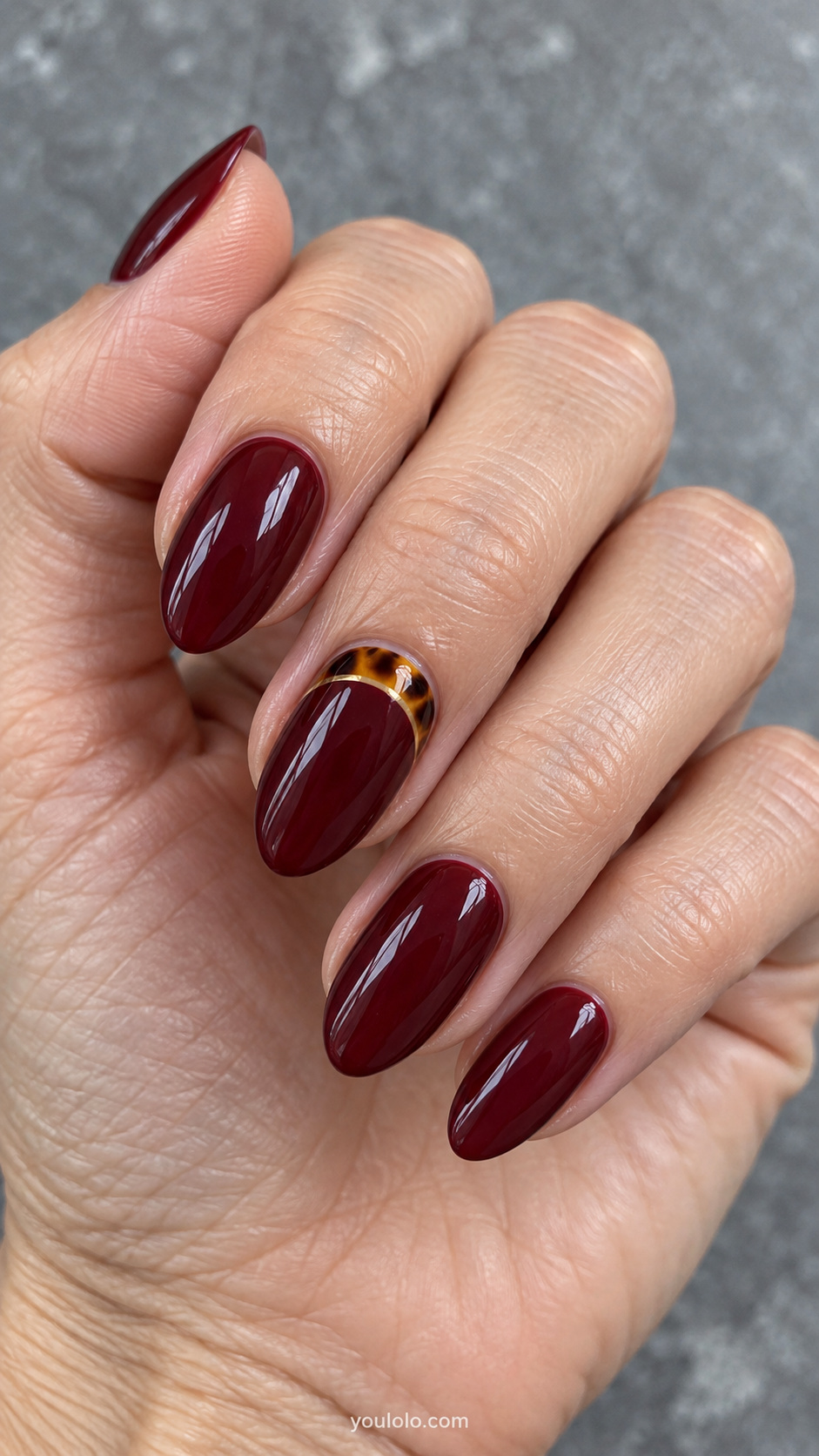
Curve a narrow tortoiseshell band around the base of one burgundy nail, leaving a clear margin from the skin. The band needs to be broad enough for visible amber mottling. Pair it with plain wine nails so the unusual placement remains the focus.
20. Sheer nails with burgundy dots and amber tips

Use a sheer nude base with broad tortoiseshell tips on two nails, then place one small burgundy dot below each tip. Keep the other nails solid wine. This is a sparse dot accent rather than an all-over polka-dot manicure, so the amber tips should lead visually.
21. Wine velvet shimmer with a tortoiseshell accent

Pair a softly luminous wine-colored shimmer finish with one glossy amber accent. Keep the shimmer fine and the tortoiseshell free of glitter so the surfaces remain distinct. Ask your artist for a sample of the light effect rather than assuming every product called velvet looks identical.
How to keep the colors distinct
Very dark burgundy can look nearly black in low light. If you want the red to remain obvious, compare it with the darkest brown in the tortoiseshell pattern before committing. A slightly brighter wine shade may give the two finishes more separation.
The amber should also have visible lighter areas. When the dark patches cover almost all of the background, the design loses its layered appearance and can read as a flat brown manicure.
A clear appointment brief
“I would like a glossy burgundy manicure with amber tortoiseshell accents. Please keep the amber visible between irregular dark patches. I prefer medium almond nails, with two patterned nails and one sheer nude nail on each hand.”
Specify your preferred arrangement if you want the hands to match. If you like a looser composition, ask for the same color balance with different accent positions.
Choosing tortoiseshell nails with the right burgundy balance
Tortoiseshell nails look quite different when amber is a small accent instead of the dominant finish. Begin with design 1 if you want mostly burgundy. Compare it with design 2 for a more even split. Design 14 gives the amber pattern most of the surface and uses burgundy as an outline.
Think about the lightest color in the pattern. Honey amber creates a brighter contrast against wine red; a darker caramel background gives a quieter result. The important detail is visible space between the dark patches. If everything becomes equally dark, the mottled effect is harder to see.
Keep the two patterns readable
For short tortoiseshell nails, a full accent nail is often a clearer reference than a narrow patterned border. Longer nails give the framing and diagonal designs more room. The motif can be adapted, but it does not have to contain the same number of patches at every length.
When combining burgundy with tortoiseshell nails, decide which finish should catch the eye first. A matte wine surface beside a glossy amber accent emphasizes texture. A shimmer finish beside the pattern introduces another detail, so it benefits from a simpler arrangement elsewhere.
Choose one extra accent
The copper flecks in design 16 and the gold boundary in design 7 are different ways to add a metallic detail. Choose one approach if you want the set to remain restrained. A heart-shaped amber accent is another option when you want the pattern in a small, recognizable shape.
Bring an image of the tortoiseshell nails you like and point out the patch size, amber tone, and amount of burgundy. Asking for those three details is clearer than requesting a general animal-print manicure. This collection uses mottled amber patterns rather than treating leopard spots and tortoiseshell as the same thing.
For French layouts, Essie’s French-tip guide is a useful reference for the tip boundary. The amber artwork inside that boundary is a separate design choice to discuss with your artist.
For another cream-and-brown pattern, compare our brown dotted manicure ideas. Round dots give a more regular rhythm than tortoiseshell nails, so they work well on separate accents when you want to combine the two.
Tortoiseshell nails: frequently asked questions
Is this only an autumn manicure?
No. The deep red and amber palette has an autumn mood, but there is no need to reserve it for a particular season.
Must tortoiseshell nails be long?
No. A full accent nail provides room for the pattern on shorter shapes. The size of the patches should suit the available surface.
Should every patch be identical?
No. Uneven shapes and areas of visible amber are part of this look. Consistent colors matter more than perfectly repeated marks.



[…] you would rather make amber mottling the main feature, compare our burgundy and tortoiseshell designs. Keep brown polka dot nails as the main pattern when you want clear repeated circles instead of […]
[…] another direction, explore our burgundy and tortoiseshell manicure ideas and compare the amount of pattern before choosing your next […]